
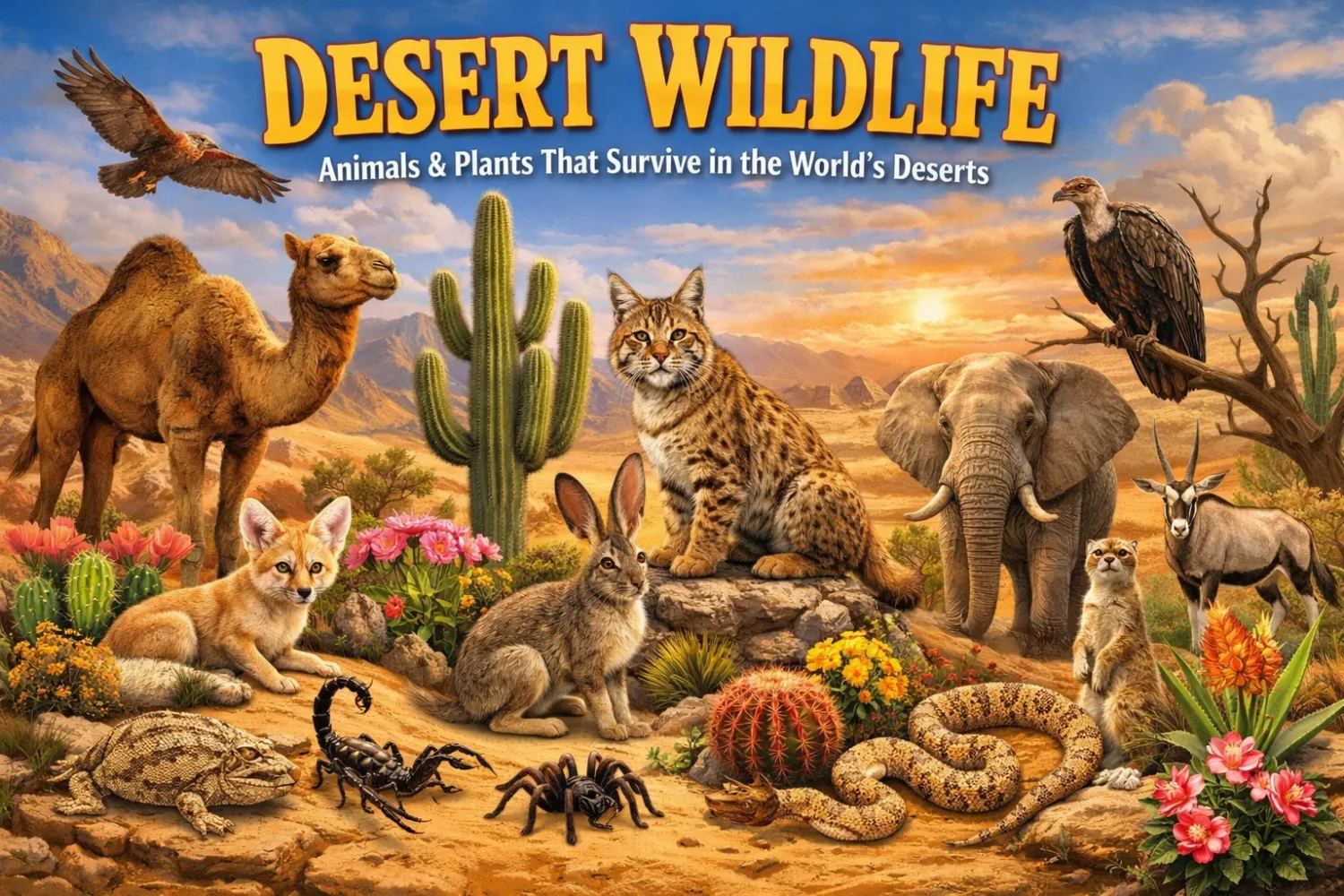
Desert Wildlife: Animals & Plants That Survive in the World’s Deserts
A desert looks quiet only if you read it from a distance. Move closer and the pattern changes. Under a shrub, a rodent has built a cool burrow. On a foggy coast, beetles lift their backs into the wind. In a dry wash, roots wait below the surface for a brief pulse of rain. Across the driest ground on Earth, life does not merely hang on. It works with timing, structure, storage, and restraint.
That is the real story of desert wildlife. Deserts are not empty margins of the planet. They are living systems shaped by low rainfall, sharp temperature swings, strong evaporation, salty soils, fog belts, cold winters, sparse cover, and sudden short-lived booms of food. Some places fit the popular image of towering sand dunes. Others do not. The Antarctic Desert is ice-covered. The Gobi is often stony, cold, and wind-cut. The Atacama can be cool by day along the coast because ocean-driven fog holds the heat down. Read that again and the old idea falls apart: a desert is defined more by lack of available moisture than by heat or sand.
Many geographers use 250 millimetres of mean annual precipitation as a practical upper line for a true desert, though dry regions exist along a wider aridity range. Drylands as a whole cover about 41% of Earth’s land surface and support around 2 billion people, which tells you something important right away: desert and dryland ecology is not niche knowledge. It shapes a large part of the planet. And inside those dry systems, plants and animals have built some of the most exact survival tactics anywhere on land.
A useful way to read desert life: do not ask only, “How does this animal survive?” Ask also, “What water source does it use, what time of day does it move, what plant holds the food web together, and what tiny shelter lets it avoid heat or cold?” Desert ecology makes more sense that way.
Why Desert Wildlife Is More Diverse Than Many People Expect
The first surprise is scale. The Sahara spans about 8.6 million square kilometres and remains the largest hot desert on Earth. The Arabian Desert covers roughly 2.3 million square kilometres. The Gobi spreads across Mongolia and northern China, and the Antarctic Desert, at about 14.2 million square kilometres, is larger than every hot desert on the planet. Each one contains not one habitat but many: dunes, gravel plains, playas, wadis, volcanic slopes, saline basins, rocky escarpments, fog-fed coasts, ephemeral rivers, and oasis belts.
The second surprise is that biodiversity in deserts often concentrates in microhabitats. A dry valley bottom may seem bare, while a few metres away a shrub island holds insects, seeds, shade, cooler soil, and bird activity. A fog belt in the Namib can support species that barely use rainfall at all. A Sonoran wash can look quiet from above and still carry roots, reptiles, bats, owls, rodents, and biocrust organisms through the year. In deserts, life clusters where moisture, shelter, and timing line up. Sparse does not mean simple.
| Desert Setting | Main Environmental Pressure | Typical Moisture Source | Common Survival Pattern |
|---|---|---|---|
| Hot Subtropical Desert | Intense daytime heat and evaporation | Rare rain, groundwater, short seasonal pulses | Nocturnal activity, burrows, water-saving kidneys, succulence |
| Cold Desert | Low moisture plus winter cold | Light rain, snow, seasonal melt | Insulation, seasonal movement, dormant seeds, low-growing shrubs |
| Coastal Fog Desert | Almost no rain, salty air, wind | Fog, dew, limited runoff | Fog harvesting, shallow surface uptake, reduced leaves |
| Polar Desert | Cold, wind, frozen water, very low liquid moisture | Snow, meltwater, marine nutrient input | Marine-based food webs, mosses and lichens in ice-free patches |
So yes, deserts support fewer tall trees and fewer continuously wet habitats than humid regions. Yet what they lack in density, they make up for in specialization. Desert wildlife is full of species that have narrowed their needs with astonishing precision. A cactus flower opens at night because a bat is active then. A lizard moves at dawn because the thermal window is narrow. A seed stays dormant because germinating in the wrong week means death. In dry country, mistiming is costly.
What Makes Survival Hard in a Desert
Water Shortage Is Only the Beginning
Water is the main limit, but desert life is not challenged by dryness alone. What matters is available moisture after evaporation, runoff, salt stress, and heat have done their work. A place can receive some rain and still function as a hard desert environment if the water vanishes fast, falls at the wrong time, or never reaches roots. That is why a rainfall number by itself never tells the full story.
Many desert plants and animals respond not to averages but to pulses. A thunderstorm may wake dormant annuals, trigger insect emergence, and start a short breeding window for rodents and birds. Then the flush ends. Quickly sometimes. In other places, especially fog deserts, moisture arrives not in storms but in tiny repeated inputs. That changes everything. Fog can be enough to keep lichens active, feed beetles, and support highly local plant communities while the same region receives almost no conventional rainfall.
Temperature Swings Are Brutal
In the Sonoran Desert, summer air temperatures often pass 40°C and may reach 48°C. In the Sahara, daytime heat can reach around 50°C. The Gobi flips the script: it is a cold desert, with frost, snow, and very sharp seasonal contrast. In Antarctica, interior summer rarely rises above -20°C and winter falls far below -60°C. Hot or cold, deserts punish exposed tissue and reward any species that can hide, insulate, or shift its schedule.
Soils, Salt, and Wind Matter More Than They Seem
Desert soils are often poor in organic matter, patchy in fertility, and sometimes strongly saline. Wind strips loose particles, exposes roots, reshapes dunes, and dries surface layers after light rain. Plants cope by reducing leaf area, storing water, tapping groundwater, or growing only during brief safe windows. Animals cope by using plants, shade, burrows, body posture, pale coloration, and careful water budgeting. Hard lives these are, but empty ones they are not.
A desert animal is usually solving four problems at once: water balance, body temperature, food timing, and shelter. A desert plant is solving the same four in botanical form.
How Desert Animals Survive
They Move When the Desert Lets Them
The plainest desert adaptation is also one of the best: do not be active at the worst time. Many rodents, foxes, snakes, geckos, and insects are nocturnal. Others become active at dawn and dusk, when sand and rock still hold manageable temperatures. This is why a midday desert can look lifeless and a sunset desert can feel busy within minutes. The habitat has not changed much. The schedule has.
Some species go farther and pause their lives almost entirely during harsh periods. Desert snails and some amphibians may enter estivation, a dormant state during hot dry conditions. Many reptiles retreat to cracks, rodent burrows, or shaded rock faces. Small mammals often shift from exposed foraging to brief, fast movements between cover. Under shrubs, cooler it is. Under the ground, cooler still.
They Save Water Better Than Most Mammals Can
Desert rodents are famous for water economy. Kangaroo rats can survive on dry seeds because metabolism and highly efficient kidneys let them reclaim water and produce very concentrated waste. The spinifex hopping mouse of Australia shows the same logic in a different lineage: it can survive without drinking during dry periods, and its kidneys reclaim so much water that its urine is exceptionally concentrated. Tiny body. Very exact plumbing.
Larger mammals also rely on body design. Camels lose water slowly, sweat less than many mammals under comparable heat, protect the eyes and nostrils from sand, and use fat stored in the hump as an energy reserve rather than storing water there. That old myth still shows up, but the hump is a fat depot, not a canteen. Dromedaries can lose up to about 30% of body weight without collapse, and a thirsty animal may drink around 30 gallons in 13 minutes when water becomes available again.
They Dump Heat Into Air, Sand, and Shade
Desert foxes, hares, and some rodents use large ears as heat exchangers. Lizards raise the body off hot ground, shift between sun and shade, or change posture to reduce solar exposure. The desert tortoise is a classic case. It is not built to endure peak surface heat in the open; it survives by digging burrows. Those burrows buffer heat, cold, and dryness. A good burrow is a shelter, a temperature regulator, and a long-term survival tool all at once.
They Use the Desert Surface Like a Map
On dunes, movement matters. The sidewinder’s sideways locomotion reduces contact with hot sand. Darkling beetles in the Namib climb dune crests to meet fog head-on. The thorny devil of Australia uses tiny channels between scales to move moisture toward the mouth by capillary action when dew or wet sand is available. It looks odd, and useful it is.
| Animal Adaptation | What It Does | Good Examples |
|---|---|---|
| Nocturnal Activity | Avoids daytime heat and lowers water loss | Kangaroo rats, foxes, many geckos, desert beetles |
| Burrowing | Buffers temperature and keeps humidity higher underground | Desert tortoise, bilby, hopping mice, jerboas |
| Efficient Kidneys | Produces concentrated urine and reduces water loss | Rodents, camels, many arid-zone mammals |
| Large Heat-Dumping Surfaces | Releases heat into moving air | Fennec fox, jackrabbit, some desert rodents |
| Fog or Dew Use | Uses non-rain moisture | Namib beetles, thorny devil, fog-zone invertebrates |
| Rapid Breeding After Rain | Matches reproduction to sudden food pulses | Annual insects, rodents, amphibians in ephemeral pools |
How Desert Plants Survive
They Reduce the Cost of Having Leaves
A leaf is a food factory, but in a desert it can also be a leak. Many plants solve this by shrinking the leaf, dropping it during drought, coating it with wax, curling it, or replacing leafy photosynthesis with green stems. Creosote bush, one of the most drought-tolerant perennial plants in North America, uses tiny leaves to limit water loss and can survive on as little as 3 inches of annual rainfall once established. In the Gobi and other Asian deserts, shrubs such as saxaul, tamarisk, and saltwort cope with dryness, salt, and wind by keeping foliage sparse and tissues hardy.
They Store Water or Reach It Fast
Succulents store moisture in stems, pads, or leaves. The saguaro is the most famous North American example. Its pleated trunk expands after rain and contracts during dry spells, like an accordion made of water storage tissue. Yet not every desert plant stores big reserves. Some do the reverse: they build shallow, wide roots that absorb water the moment rain hits the surface. Saguaros use this tactic too. Others become phreatophytes, sending roots toward groundwater. Mesquite, some desert trees, and many riparian plants use that strategy where subsurface water is reliable.
They Shift Photosynthesis Into the Night
Many desert succulents use CAM photosynthesis—Crassulacean Acid Metabolism. The trick is elegant. Instead of opening stomata in hot daytime air, these plants open them at night, when temperatures are lower and water loss is reduced. Carbon dioxide is stored and then used during the day while stomata stay mostly closed. Cacti and agaves are classic CAM plants. It is one of the clearest plant examples of desert timing.
They Wait Better Than Most Plants Can
Many desert annuals survive the dry season not as a stem or root but as a seed bank. Seeds remain dormant until temperature, soil moisture, and timing line up. This is why a bare plain can explode with flowers after a rare storm. The Atacama’s famous blooms, the Sonoran annual carpets after winter rains, and many cold-desert flushes in Central Asia all depend on this logic. The plant is not gone. It is waiting.
They Use Fog, Salt, and Shade
In the Namib and Atacama, some plant communities rely heavily on fog. Welwitschia mirabilis can use both sea fog and deep groundwater, and some plants in Peru and Chile’s fog oases depend almost entirely on moisture from marine fog. Elsewhere, halophytes handle salty soils, and seedlings establish under “nurse plants” that soften sun and frost. Young saguaros commonly start life below palo verde, ironwood, or mesquite. Shade first, height later.
A desert plant does not simply “need less water.” It may store it, dodge its loss, harvest it from fog, delay growth until it arrives, or reach it deep below the surface. Often more than one of those at once.
Plants and Animals Depend on Each Other More Than Most Readers Notice
Desert pages often split flora and fauna into separate lists. Real deserts do not work that way. Plants build the schedule and structure of animal life. A shrub patch changes wind speed, humidity, and seed availability. A cactus flower times nectar for a pollinator. A tree casts a narrow strip of afternoon shade that can decide whether a reptile, rodent, or seedling lives through the day.
The Sonoran Desert offers the clearest example. Saguaro flowers open in a way that suits nocturnal pollinators, and lesser long-nosed bats are the primary pollinators of saguaro and organ pipe cactus. Later, the fruits feed birds and mammals, while seeds are spread through droppings and discarded pulp. Mature saguaros also become nesting towers. Woodpeckers excavate cavities; after that, owls, sparrows, martins, and other birds may use the chambers. One plant, many roles.
In the Sahara and Arabian deserts, thorny shrubs and acacias feed browsing gazelles and camels while also offering shelter from sun and wind. In the Gobi, sparse shrubs and halophytes may look unimpressive from a distance, yet they anchor grazing routes and determine where small mammals can forage safely. In the Namib, fog-fed plants and even lichen-rich surfaces extend the food base for invertebrates, which then support reptiles, birds, and small mammals. Even in Antarctica, where terrestrial plant life is tiny by desert standards, mosses, lichens, algae, microbial mats, and marine primary production drive the food system.
Pollination
Night-blooming cacti and agaves support bats and other nectar feeders. Pollinators return the favor by moving pollen across scattered desert plants.
Seed Dispersal
Fruit-eating birds and mammals spread cactus and shrub seeds into protected microsites where germination chances improve.
Nurse Plant Effects
Shrubs and trees cool the soil, reduce radiation, trap litter, and create safer seedling sites for younger plants.
Habitat Architecture
Large plants become platforms, cavities, shade islands, nesting points, and movement markers across otherwise open ground.
Microhabitats: The Small Places That Keep Desert Life Alive
One of the most overlooked truths in desert ecology is that survival happens in small spaces. The broad landscape may be arid, but a north-facing crack, dune toe, ephemeral wash, biocrust patch, gravel hummock, or fog-facing slope can support very different conditions from the surface around it. That is why two parts of the same desert can feel biologically worlds apart.
Burrows are perhaps the clearest example. For tortoises, bilbies, hopping mice, jerboas, and snakes, the burrow is not just a shelter but a climate-controlled chamber. The spinifex hopping mouse shelters in deep, humid burrows about a metre underground. That extra humidity cuts water loss. The tortoise uses burrows for both summer heat and winter cold. A desert animal without a burrow is often a desert animal with a very narrow safe window above ground.
Washes and wadis are another major refuge. These channels may run only after rare rain, yet their deeper sediments hold moisture longer than surrounding flats. Trees and shrubs are more likely to root there, which then attracts insects, birds, bats, reptiles, and browsers. Desert life often follows drainage lines, even when the stream itself is dry most of the year.
Biological soil crusts, often called biocrusts or cryptobiotic crusts, are just as important. They are living surface communities of cyanobacteria, fungi, lichens, mosses, algae, and bacteria. In drylands they help stabilize soil, hold nutrients, and influence water movement. They look modest. They are not. A biocrust can be the thin living skin that keeps a bare-looking patch from blowing or washing away.
Then there are fog belts, especially in the Namib and along parts of the Atacama coast. These are not broad green zones in the rainforest sense. They are narrow, often quiet strips where repeated fog changes the moisture budget enough to support plants, invertebrates, reptiles, and birds that could not persist on rainfall alone. This is one of the strongest content gaps in many desert articles: they discuss rain and ignore fog, even though in some coastal deserts fog is the real moisture engine.
Wildlife and Plants of the Sahara Desert
The Sahara Desert is the largest hot desert on Earth, covering about 8.6 million square kilometres across North Africa. Its daytime heat can reach around 50°C, but the popular image of endless dunes tells only part of the story. The Sahara also includes regs of gravel, hammadas of exposed rock, mountains, depressions, and oasis systems. Wildlife follows that variety closely.
Sahara Animals
Among the best-known Saharan mammals are the fennec fox, dorcas gazelle, and the desert-adapted addax. Small mammals such as jerboas and gerbils use nocturnal schedules and quick digging behavior to escape heat and predators. Reptiles, scorpions, and beetles fill the warmer and drier niches where mammals would pay a high water cost. Birds use oases, cliff zones, and migration corridors, and in some places desert-adapted larks and sandgrouse link open plains to scattered water sources.
The fennec fox shows the usual Saharan logic in a compact form: large ears shed heat, pale fur reflects radiation, and night activity cuts water loss. Gazelles deal with another challenge—long distances between quality forage patches. Their survival depends on movement, plant moisture, and the ability to use sparse browse efficiently rather than waiting for open water.
Sahara Plants
Saharan plant life is patchy but not absent. Acacias, tamarisks, scattered grasses, and seasonal annuals appear where soil, runoff, or shallow groundwater allow it. In oases, date palms become ecological anchors, creating shade and lowering surface stress for smaller plants. Many Sahara articles focus on mammals and skip the plant side, yet that misses the point. Desert herbivores are reading moisture through vegetation. So are people, for that matter.
Some Saharan plants avoid the hottest open ground by clustering in wadis and depressions, where runoff briefly improves soil moisture. Others stay small, thorny, or seasonally dormant. Their leaves may be tiny, waxy, or temporary. Their roots may be shallow and opportunistic or deeper and more stable. A thin green line in the Sahara is not decorative. It is a map of hidden water.
Wildlife and Plants of the Gobi Desert
The Gobi Desert breaks the warm-sand stereotype. It is a cold desert, spread across Mongolia and northern China, with frost, snow, rocky plains, salt flats, dry basins, and only limited dune country in some sectors. In the Trans-Altai Gobi, annual precipitation can fall below 100 millimetres. Much of the landscape is nearly waterless at the surface, though some groundwater persists below.
Gobi Animals
The Gobi supports animals adapted to both dryness and cold. The standout mammal is the wild Bactrian camel, a rare desert grazer built for long travel, sparse forage, and strong seasonal contrast. The wider Gobi region also supports khulan, goitered gazelles, jerboas, reptiles, raptors, and mountain-edge predators. Unlike hot lowland deserts, the Gobi demands insulation and drought tolerance together. That double pressure shapes everything from fur density to seasonal movement.
Small mammals and birds in the Gobi often exploit the boundary between desert and steppe. That edge matters. More precipitation can mean a slightly richer food base, and slight changes matter a lot in dry country. Rodents use burrows to escape both summer heat and winter cold. Reptiles remain part of the system, but their activity patterns are narrower than in hotter deserts.
Gobi Plants
Vegetation is sparse in much of the Gobi, yet riverbeds and moister depressions can support tamarisk, salt-tolerant annuals, and the iconic saxaul. Saxaul is one of the most important desert plants in Central Asia because it stabilizes sandy soils, slows wind erosion, and supports animal life where tree cover is otherwise minimal. In drier reaches, plants stay low, tough, and scattered. In slightly less severe zones, the landscape grades toward steppe with a broader plant cover.
If the Sahara teaches the lesson of heat, the Gobi teaches the lesson of compound stress: low water, cold winters, strong winds, and sparse forage. That is why Gobi survival looks less flashy and more disciplined. Lean plants. Mobile herbivores. A hard climate, written into every body plan.
Wildlife and Plants of the Arabian Desert
The Arabian Desert, the largest desert in Asia, covers roughly 2.3 million square kilometres across most of the Arabian Peninsula. It includes great sand seas such as the Rub’ al Khali, gravel plains, rocky plateaus, and seasonal drainage networks. The air can be punishingly dry, and vegetation often appears absent until the eye adjusts. Then shrubs, grasses, and scattered trees begin to resolve.
Arabian Desert Animals
The animal most closely tied to this desert in the public mind is the dromedary camel, and for good reason. Its thick footpads, sand-closing nostrils, tough browsing lips, and excellent water economy fit the peninsula’s dry open terrain. Yet the Arabian Desert is not a camel-only stage. Arabian oryx, sand gazelles, foxes, jerboas, reptiles, and desert birds all form part of the wider wildlife picture.
The oryx is especially telling because it depends on both movement and sparse vegetation structure. It uses open landscapes but still needs access to enough browse, grass, or herbs during favorable periods. Deserts favor mobility, but mobility without plant patches does not work for long. That balance shapes ungulate ecology across the Arabian Peninsula.
Arabian Desert Plants
Plant cover in the Arabian Desert is sparse, though not random. Acacias, salt-tolerant shrubs, ephemeral herbs after rain, and hardy grasses in better years form the base of local food webs. In some parts of Arabia, ghaf and related trees become shade islands that hold birds, insects, and browsing pressure around them. Around oases and managed water points, date palms and associated vegetation create a very different microclimate from open dunes.
A good way to read Arabian desert vegetation is to look for pattern, not density. Plant life follows runoff routes, calcareous patches, hardpan breaks, slight elevation shifts, and any place where moisture lingers a little longer than expected.
Wildlife and Plants of the Atacama Desert
The Atacama Desert of northern Chile is one of the driest regions on Earth and the driest nonpolar desert. Along the coast, the Peru (Humboldt) Current helps create a thermal inversion that produces fog and low cloud but little rain. Coastal summer temperatures are often modest for the latitude—around 18–19°C in some cities—so the Atacama is not simply a furnace. It is a dry system built by ocean currents, topography, and atmospheric stability.
Atacama Animals
Animal life in the Atacama tends to cluster in salt flats, fog-fed zones, coastal lomas, river oases, and higher Andean margins. Lizards, insects, foxes, rodents, and birds use these patchy resources in different ways. In the wider desert region, flamingos appear at saline wetlands, guanacos use better grazing pockets, and smaller animals track cover and moisture with precision. The pattern is fragmented, and that fragmentation is normal here.
Atacama Plants
The Atacama’s plant story is one of the best examples of dormancy plus fog. Much of the coast supports lomas, fog oases that appear as islands of vegetation within an otherwise hyper-arid belt. Satellite and field research has shown these fog oases are far more extensive than once thought, with over 17,000 square kilometres of productive area mapped and more than four times as many fog-oasis areas identified as older records suggested.
These fog oases hold many endemic plants and support a living edge that rainfall numbers alone fail to explain. Then there is the famous desierto florido, the desert bloom. Dormant seeds wait in the soil for unusually timed rain, germinate in a short rush, flower, set seed, and disappear again. It looks miraculous to visitors. Ecologically, it is a well-tuned gamble.
This is another place where standard desert articles often miss the real engine. They speak of drought, but not enough about fog ecology. In the Atacama, fog is not a side note. It is one of the quiet architects of life.
Wildlife and Plants of the Namib Desert
The Namib Desert is one of the world’s oldest deserts and one of the clearest examples of a fog desert. Much of the coastal belt is almost rainless, but the cold Benguela Current chills the air and produces frequent fog. In parts of the Namib Sand Sea, fog is the main source of moisture, and many endemic animals get water from it. Along the coast, temperatures are often only about 10–16°C, far lower than many people expect from a desert.
Namib Animals
The Namib’s best-known survival story belongs to the darkling beetles. Fog can reach up to about 100 kilometres inland, and fog events in inland parts of the Namib occur on roughly 30 days per year. Some beetles exploit that moisture by climbing dune ridges and taking a head-down fog-basking posture so droplets run toward the mouth. Studies found that the behavior itself matters more than fancy shell texture. Position first. Surface details second.
Beyond beetles, the Namib supports gemsbok, springbok, ostrich, jackal, lizards, geckos, snakes, and an array of arthropods built for sand, heat, and scattered forage. Larger mammals often rely on ephemeral rivers, dune-edge vegetation, and cool movement windows. Smaller animals use sand temperature gradients, burrows, and body posture to avoid lethal exposure.
Namib Plants
No desert plant captures public attention quite like Welwitschia mirabilis. It grows in the northern Namib, can survive for hundreds of years, and some individuals are thought to be over 2,000 years old. It absorbs moisture from fog and can also access deeper groundwater. With only two continuously growing leaves over its lifetime, it looks almost unreal, yet it is perfectly logical in ecological terms: long-lived, low-growing, water-wise, and built for a place where consistent rainfall is not something to expect.
The Namib also supports lichen fields, succulents, ephemeral river vegetation, and specialized dune plants. Infrequent rain still matters, but in many sectors the moisture book is balanced by fog, not by storms. That alone makes the Namib one of the most instructive deserts on Earth.
Wildlife and Plants of the Sonoran Desert
The Sonoran Desert is often described as the most species-rich desert in North America, and the numbers help explain why. It supports at least 60 mammal species, more than 350 bird species, around 100 reptiles, about 30 native fish, and more than 2,000 plant species. Rain falls in two main seasons—winter rains and summer monsoon storms—and that bimodal precipitation creates a wider calendar of food and flowering than many other deserts enjoy.
Sonoran Animals
This is the desert of javelinas, Gila monsters, desert tortoises, kangaroo rats, roadrunners, owls, hawks, tarantulas, and a long list of bats. Large-scale diversity here comes from relief and habitat variety. The Sonoran includes flats, rocky slopes, riparian strips, cactus forests, thornscrub, and sky-island connections to cooler uplands. One slope can be stark and hot; the next wash can hold birds, shade, and better forage. That variety stacks species into the same desert rather than spreading them far apart.
Sonoran Plants
The plant lineup is iconic: saguaro, barrel cactus, organ pipe cactus, cholla, prickly pear, ocotillo, agaves, palo verde, ironwood, mesquite, and creosote bush. Young saguaros usually begin beneath nurse trees such as palo verde, ironwood, or mesquite. Those shrubs and trees protect seedlings from blazing summer sun and winter frost. Later, a saguaro may outlive the nurse that once sheltered it. That is desert plant succession in miniature.
Saguaros grow slowly—only a few inches in their first decade. Branches often appear at about 60 to 75 years, adults may weigh 2 tons or more, and average life span is roughly 150 to 175 years, with some living beyond 200 years. Their pleats expand to accomodate water after rain, then contract in drought. Their flowers feed pollinators. Their trunks hold nest cavities. Their fruits feed birds and mammals. Few desert plants do more ecological work.
The Sonoran also shows how rain timing shapes biodiversity. Winter rain can trigger annual wildflower displays; summer storms feed warm-season growth and insect pulses. Bats then pollinate night-blooming cacti and agaves, seed-eaters respond to fruit and annual seed crops, and predators follow. In this desert, seasonality is layered, not simple.
Wildlife and Plants of the Mojave Desert
The Mojave Desert is the hottest desert in North America and home to some of the continent’s most recognizable arid-land species. In Mojave National Preserve alone, there are about 50 mammal species, more than 200 bird species, 36 reptiles, and smaller numbers of amphibians and fish. The Mojave is often described through heat, yet like all deserts it is really a story of terrain, shelter, rainfall timing, and plant structure.
Mojave Animals
The desert tortoise is the emblematic Mojave reptile. It balances sun and shade rather than trying to brute-force the climate. Burrows protect it during peak summer heat and winter cold. Other Mojave animals include the sidewinder, kit fox, black-tailed jackrabbit, bighorn sheep on rocky ranges, and many birds that use desert shrubs, Joshua trees, or ephemeral water pockets.
Desert predators in the Mojave often rely on timing as much as speed. The fox hunts at cooler hours. Snakes pick their thermal windows. Birds use elevated perches from Joshua trees and other vegetation to scan open ground. The desert looks open, but lines of visibility, patches of cover, and shade geometry matter every hour.
Mojave Plants
The plant most tied to the Mojave is the Joshua tree, along with creosote bush, Mojave yucca, blackbrush, and numerous annuals that respond to favorable rains. Joshua trees use a shallow radial root network to capture brief pulses of moisture. Creosote bush, by contrast, is a master of persistence and can survive on extremely low rainfall once established. Its small leaves limit water loss, and its presence shapes insect communities and open-shrub spacing across huge areas.
Mojave plant communities may seem sparse from a highway view, but that reading is shallow. Look at the spacing and you see competition, water capture zones, seed shadow patterns, and nurse effects. Look after rain and another layer appears. Fast annuals rise, pollinators track them, and rodents respond to seed production. The whole system works in pulses.
Wildlife and Plants of the Australian Deserts
Australia’s deserts are not one single block but a broad arid interior made up of regions such as the Simpson, Great Victoria, Great Sandy, Tanami, and Gibson deserts. Together they support a desert fauna unlike any other, shaped by marsupial biology, old nutrient-poor soils, spinifex landscapes, and long cycles of boom and bust after rain.
Australian Desert Animals
The thorny devil, greater bilby, and spinifex hopping mouse are three of the clearest examples of Australian arid adaptation. Thorny devils eat ants almost exclusively and can use tiny skin channels to move water toward the mouth from dew or damp surfaces. Bilbies are nocturnal burrowers with low metabolic rates and low water turnover, well suited to arid country. Spinifex hopping mice hide in deep burrows, emerge at night, and can survive dry periods without free water.
Add in red kangaroos, reptiles, desert birds, and invertebrates, and you get a fauna built around movement and refuge. In Australia’s deserts, burrows are used not only for shade but for humidity buffering after long dry spells and fire events. Small mammals often disappear from view for much of the day, then re-enter the system in short bursts.
Australian Desert Plants
Spinifex grasses, saltbush, and mulga define large parts of Australian desert vegetation. Spinifex in particular creates habitat architecture. Its hummock form offers shelter, nest space, hunting cover, and seed resources. When people say desert plants are sparse, they often overlook how much structure a clump-forming grass can add to the landscape.
Australian desert ecology also teaches a useful lesson about irregular abundance. Rain years may bring sudden growth, breeding surges, and wider movement. Dry years strip the system back. Neither is abnormal. Pulse ecology is the norm.
Wildlife and Plants of the Antarctic Desert
The Antarctic Desert is the largest desert on Earth, covering about 14.2 million square kilometres. It is also the coldest. Interior snowfall may amount to only centimetres per year, which is why so much of Antarctica qualifies as desert despite all that ice. On land, less than 1% of the continent is ice-free, leaving very little room for terrestrial vegetation.
Antarctic Animals
Most Antarctic animal life is marine-based. Penguins, seals, seabirds, fish, krill, squid, and whales dominate the broader ecosystem because the Southern Ocean, not the land surface, provides the food base. Krill supports much of the visible food web. On land, by contrast, animal life is tiny and sparse. In the McMurdo Dry Valleys, the largest common animals are often nematodes, while microbial communities fill soils, streams, and meltwater features.
Antarctic Plants
Terrestrial plant life in Antarctica consists mainly of mosses, lichens, and liverworts in ice-free sites. These plants endure months of darkness, wind, freezing temperatures, and very short growing windows. In dry valleys and other exposed areas, microbial mats and algae become major biological players. This is desert ecology stripped to essentials: little liquid water, short active phases, and life concentrated in the rare places where energy and moisture line up.
Antarctica matters in any serious pillar page on desert wildlife because it breaks lazy definitions. A desert is not “a hot sandy place.” It is a place where water is scarce in biologically usable form. Antarctica fits that exactly.
Camel Facts and the Logic of Desert Survival
Camels deserve their own section because they are often reduced to trivia. The real biology is better than the trivia. Camels do not store water in their humps. The humps store fat, which serves as an energy reserve. During scarcity, fat metabolism contributes usable water and fuel, but the hump itself is not a water tank. That distinction matters because it shows how desert adaptation often works: indirect, efficient, and multi-purpose.
The dromedary is the one-humped camel of the Arabian and Saharan regions, while the Bactrian camel has two humps and is linked with colder, more seasonal deserts and steppes of Central Asia. Both are built for dry, open landscapes, but they solve climate differently. The dromedary handles hotter conditions with remarkable heat tolerance and water economy. The Bactrian camel also carries insulation for winter cold.
Several traits make camels such effective desert mammals:
- Rare sweating compared with many other mammals under similar heat loads.
- High tolerance for dehydration, with dromedaries able to lose up to about 30% of body mass before severe collapse.
- Rapid rehydration, including drinking around 30 gallons in roughly 13 minutes when water is available.
- Closable nostrils and long eyelashes that limit sand entry.
- Broad footpads that spread body weight on soft ground.
- Tough lips that allow browsing on thorny shrubs many other grazers avoid.
Camel survival is also behavioral. They move according to forage and water, adjust pace to heat, and make use of plant moisture in seasons when free water is scarce. In winter, even desert plants may hold enough moisture for a camel to go weeks without drinking. That detail links the camel back to the wider theme of this page: animal survival is plant-mediated. Even the most famous desert mammal is reading water through vegetation.
The wild Bactrian camel adds another layer. It lives in one of the toughest dry landscapes on Earth, where forage is sparse, winters are severe, and water sources are widely scattered. That species is a reminder that “camel” is not a single adaptation package. It is a family of related strategies tuned to different desert climates.
Desert Plants That Shape Whole Ecosystems
Some desert plants do more than survive. They organize animal life around them. These are the structural species—the plants that build shelter, food, breeding sites, pollination routes, and shade mosaics. If you want to understand desert wildlife, start with these.
| Plant | Main Desert Region | Survival Trait | Wildlife Value |
|---|---|---|---|
| Saguaro | Sonoran | Water storage, pleated stem, shallow radial roots | Nectar, fruit, nesting cavities, perch sites |
| Creosote Bush | Mojave, Sonoran, Chihuahuan | Small leaves, drought tolerance, long persistence | Insect host, shade, seed-zone structure |
| Mesquite | North American Deserts | Deep rooting, nitrogen fixation, drought tolerance | Shade, pods, nesting cover, nurse plant effects |
| Welwitschia | Namib | Fog use, deep-root support, very long lifespan | Food and shelter value in sparse systems |
| Saxaul | Gobi and Central Asian Deserts | Wind resistance, low leaf area, arid-soil tolerance | Sand stabilization, forage support, habitat structure |
| Spinifex | Australian Deserts | Clumped growth, arid-soil persistence | Cover for mammals, reptiles, birds, insects |
| Date Palm | Oases in Sahara and Arabia | Deep-root use where water is available | Shade, food, cooler understory habitat |
The saguaro is a vertical city. Mesquite is a nurse and a food source. Creosote is a long-haul drought specialist. Welwitschia is a fog-and-time expert. Saxaul is a sand stabilizer. Spinifex is habitat architecture disguised as grass. That is why desert plant coverage cannot be treated as an afterthought in a wildlife article. Without these plants, the animal page is half-written.
Food Webs, Seasonality, and Pulse Ecology
Deserts run on pulses. A rainfall event, fog period, brief snowmelt, or flowering window can reshape the food web for days or weeks. Annual plants germinate. Insects rise fast. Rodents breed or expand foraging. Reptiles respond to prey. Raptors and foxes track the movement. Then the pulse fades and the system tightens again.
This stop-start rhythm is easy to miss if you only look at yearly averages. In the Sonoran Desert, two rainy seasons create two different biological opportunities. In the Atacama, rare rain plus fog can wake entire plant communities. In Australian deserts, boom-and-bust small mammal cycles often follow rainfall. In the Gobi, seasonal windows are narrower because cold limits activity as much as drought does. In Antarctica, short melt seasons switch biological systems on, then off again.
Pulse ecology also explains why many desert animals are opportunists rather than specialists in one single food item all year. Rodents may shift from seeds to green shoots or insects. Foxes shift with prey. Birds time breeding to insect abundance. Plants, too, behave in pulses. They leaf out, flower, or fruit when moisture and temperature align, not when a calendar says they should.
A desert, then, is not a low-productivity system in a flat, constant sense. It is a system where productivity is brief, localized, and timing-sensitive. Miss the pulse and the place looks empty. Catch it right and the desert reads completely differently.
Why Cold Deserts and Fog Deserts Belong in Any Serious Desert Wildlife Page
Many articles about desert animals and plants still lean too hard on hot dunes, reptiles, and cacti. That makes the topic feel narrower than it is. Two of the most valuable corrections are simple:
- Cold deserts are true deserts. The Gobi and Antarctica show that low biologically available moisture, not heat, is the core condition.
- Fog deserts have their own moisture logic. The Atacama and Namib prove that regular non-rain moisture can shape whole ecosystems.
This matters because wildlife strategies change with desert type. A hot-dry reptile schedule does not fully explain a Gobi mammal with winter cold stress. A rain-only plant model does not explain a Namib beetle or an Atacama lomas community. Put more simply: there is no single desert survival formula.
The best way to read desert wildlife across the planet is to compare how moisture arrives, how fast it disappears, and what shelter exists between active periods. Once you do that, very different deserts begin to make sense side by side.
Pressure Points for Desert Wildlife and Plant Communities
Desert species are built for harsh conditions, but that does not make them unbreakable. Systems tuned to narrow water windows can be sensitive to altered fire patterns, groundwater loss, heavy soil disturbance, habitat fragmentation, and shifts in fog or rainfall timing. When those changes hit, the first damage often appears in the small supports: seedling recruitment, pollinator timing, biocrust cover, burrow stability, or access to scattered water and forage.
In the Mojave, slow-growing plants such as Joshua trees depend on long timelines. In the Sonoran, bats, agaves, and columnar cacti are linked through flowering schedules. In fog deserts, even small changes in moisture delivery can shift which patches remain productive. In Antarctica, where little land is ice-free, tiny areas of moss and lichen matter out of all proportion to their size.
Desert resilience is real. Many species recover after drought or wait for better years through dormancy, seed banks, or low activity. Still, resilience has limits. A desert can absorb a dry year. Repeated losses of shelter, soil stability, water access, or plant recruitment are harder to absorb. Quiet systems often look stable right up until a threshold is crossed.