
Antarctica looks empty from a map, yet its animal life is anything but empty. This continent covers 13,661,000 km², holds about 90% of Earth’s fresh water in ice, and still counts as the largest desert on Earth because moisture is so low. Average snowfall across the continent is often described as roughly 150 mm of rain equivalent a year, and less than 1% of the land is ice-free. That sounds like a place with little room for wildlife. On land, that is mostly true. In the sea around it, the story changes fast.
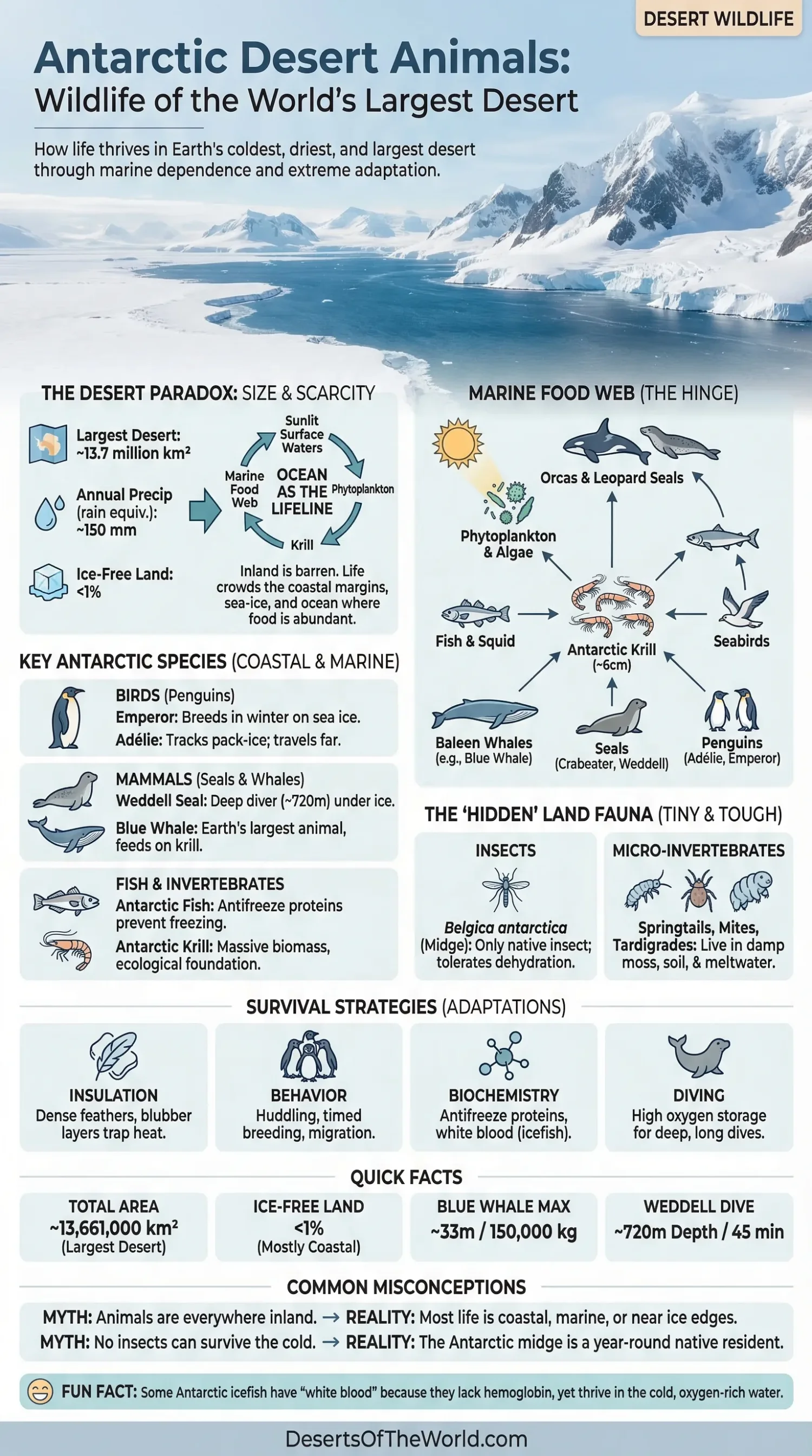
| Feature | Data | Why It Matters for Animals |
|---|---|---|
| Antarctica’s Size | 13,661,000 km² | It is the largest desert, so wildlife patterns are shaped by scale, distance, and isolation. |
| Moisture | About 150 mm rain equivalent annually in broad continent-wide summaries | Dry air and low snowfall make inland habitats harsh for large land animals. |
| Ice-Free Land | Less than 1% | Almost all breeding, nesting, and land-based activity gets squeezed into tiny patches. |
| Breeding Birds | Over 100 million birds breed around rocky coasts and offshore islands each spring | Most Antarctic wildlife is coastal or marine, not inland. |
| Adult Antarctic Krill | About 6 cm long and over 1 gram | Small body, huge ecological role. Krill feeds penguins, seals, fish, squid, and whales. |
| Weddell Seal Diving | Up to 720 m deep and up to 45 minutes underwater | Shows how far Antarctic mammals have adapted to ice-covered seas. |
| Blue Whale Size | Up to 110 ft (about 33 m) and roughly 150,000 kg | The Southern Ocean supports the planet’s largest animal because food in the water is dense. |
Why the World’s Largest Desert Still Supports So Much Wildlife
The surrounding ocean provides most of the food. Inland Antarctica is a cold, dry plateau with very little exposed ground, very little liquid water, and almost no room for large land fauna. The coast and the Southern Ocean are different. Sunlit surface waters produce phytoplankton, phytoplankton feeds krill, and krill supports one of the best-known marine food webs on the planet. So when people think about Antarctic desert animals, they are really thinking about animals tied to sea ice, pack ice, fast ice, ice-free shorelines, and nearby ocean water.
Antarctica is a desert, but its coastal and marine zones support dense concentrations of wildlife. Its wildlife crowds the margins: the sea-ice edge, coastal rock, polynyas, offshore islands, and productive waters where prey gathers. Far inland, almost nothing large lives year-round. Along the coast, life suddenly stacks up in colonies, haul-outs, feeding swarms, and migration routes.
Where Antarctic Animals Actually Live
Most of the familiar species live in one of four habitat bands. Location matters as much as species in Antarctica, because a penguin on fast ice, a seal in pack ice, and a springtail in damp moss are all solving very different survival problems.
- Fast Ice and Coastal Ice: Emperor penguins breed here. Weddell seals also stay close to stable ice and breathing access points.
- Pack Ice Zone: Adélie penguins, crabeater seals, leopard seals, and many feeding seabirds use this shifting belt of ice and open water.
- Southern Ocean Waters: Krill, squid, Antarctic fish, baleen whales, and orcas dominate this zone.
- Ice-Free Ground and Damp Microhabitats: Tiny land invertebrates such as springtails, mites, nematodes, rotifers, tardigrades, and the Antarctic midge survive here.
So the real map of Antarctic wildlife is not “ice everywhere, animals everywhere.” It is patchy. Tight. Seasonal. Sometimes surprisingly crowded in very small places.
Animals That Define Antarctic Wildlife
Emperor Penguin
The emperor penguin is the animal most closely linked with the Antarctic continent itself. It breeds farther south than any other penguin, and colonies can range from a few hundred pairs to more than 20,000 pairs. Unlike other penguins, emperors breed during the Antarctic winter. The male balances a single egg on his feet and shelters it under a fold of skin while the female returns to sea to feed.
This is not just a famous breeding story; it is a survival system built for a desert coast. No nesting material. No mild spring. No easy food nearby. The egg stays off the ice, the adults huddle to reduce heat loss, and timing must match the return of sea ice and the short window when chicks can grow before conditions shift again. Fast ice is not background scenery for emperors; it is breeding ground.
On 9 April 2026, the IUCN Red List changed the emperor penguin (Aptenodytes forsteri) from Near Threatened to Endangered. The assessment identifies human-driven climate change and the resulting loss and early break-up of sea ice as the main threat. Emperor penguins need stable fast ice for breeding, chick development, and moulting. If that ice disappears before chicks are ready to enter the water, breeding failure can affect entire colonies.
IUCN modelling indicates that the global emperor penguin population could decline by more than half over the coming generations, with projections pointing to roughly a 50% reduction by the 2080s if sea-ice conditions continue to deteriorate. Satellite-based estimates also indicate a decline of around 10% between 2009 and 2018, equivalent to more than 20,000 adult birds.
Adélie Penguin
Adélie penguins are smaller, quicker on land, and strongly tied to the pack-ice system. They breed on land in summer and then spend much of the colder season at sea among ice floes. Tracking work has shown they can travel more than 1,200 km from breeding sites. That range tells you something important about Antarctic animals: many of them do not stay close to one colony or beach for long. They move with food, ice conditions, and season.
Adélies also show the difference between continental Antarctica and the broader Antarctic region. They are true Antarctic birds. Gentoo, chinstrap, king, and macaroni penguins are also associated with the broader Antarctic region, but many of these species belong more strongly to the Antarctic Peninsula fringes or the sub-Antarctic islands than to the deep continental interior.
Crabeater Seal
The crabeater seal has one of the oddest names in polar zoology because it does not live on crabs. It feeds mainly on Antarctic krill. Its teeth are specially shaped with comb-like projections that let the animal pull in seawater and strain out prey. In practical terms, it is a living filter built for a krill-rich ocean.
This seal matters because it shows how Antarctic abundance works. A species can be common not because the land is productive, but because the surrounding ocean produces massive food pulses. Where krill is dense, crabeater seals do well. In that sense, the seal is less a coastal mammal than a moving extension of the Southern Ocean food web.
Weddell Seal
Weddell seals are among the southernmost-living mammals on Earth. They can remain underwater for up to 45 minutes and dive to about 720 m. These diving abilities show how strongly the continent’s most successful large animals depend on marine habitats.
Weddells feed on fish, squid, octopus, and prawns. Their body design, oxygen storage, and diving behavior let them exploit prey under sea ice where many other predators cannot work as efficiently. Calm-looking on the surface, deep-working below it, they are one of the best examples of Antarctic marine adaptation.
Leopard Seal
Leopard seals sit higher in the food web. They are sleek, fast in water, and flexible in diet. Some focus more on penguins near breeding colonies, others take young seals or switch prey by season and place. That flexibility makes them one of the clearest upper-level hunters in Antarctic seas.
They also remind us that Antarctica is not only a krill story. Krill supports much of the system, yes, but the web branches upward into fish-eaters, squid-eaters, filter-feeders, scavengers, and top marine predators. Antarctic wildlife is simple compared with tropical systems, not simple in an absolute sense.
Baleen Whales and Orcas
The Antarctic region hosts 4 species of toothed whales and 6 species of baleen whales in Australian Antarctic Program summaries. Baleen whales such as humpbacks and blue whales come south to exploit dense feeding grounds. Blue whales can reach about 33 m and around 150,000 kg, which makes them the largest animals known on Earth.
That scale is only possible because Antarctic waters can pack extraordinary food into a short season. Baleen whales filter small prey from seawater, above all krill. Orcas, by contrast, are toothed whales and operate as versatile hunters. Same ocean, very different feeding mechanics. The same food web supports several specialized feeding strategies.
Antarctic Krill
No animal explains this desert better than Antarctic krill. Adults are only about 6 cm long and weigh a little over 1 gram, yet they support penguins, fish, squid, seabirds, seals, and whales. Krill feed on algae linked to sunlit waters and sea-ice systems, and they form the base of much of the marine web.
Krill is easy to overlook beside penguins and whales, but its small size does not reflect its ecological role. Krill is the hinge species of Antarctic wildlife. Remove the swarms and the larger animals thin out fast.
Antarctic Fish
Antarctic fish are less famous than penguins, but some of the sharpest cold-weather adaptations appear here. Antarctic toothfish can grow to about 2 m, weigh around 100 kg, live up to 45 years, and occupy depths from 100 m to 3,000 m. They carry antifreeze proteins in their tissues and blood, which lets them function in water colder than the normal freezing point of body tissue.
Icefish add another twist. Some are known as white-blooded fishes because they lack hemoglobin in their blood cells. Their blood looks colorless, and they still manage to move oxygen through the body in a cold, oxygen-rich ocean. These fish are closely adapted to the cold, oxygen-rich waters around Antarctica.
Antarctica’s Small Land Animals
The continent’s true land animals are tiny. There are no naturally occurring terrestrial mammals, reptiles, or amphibians on the Antarctic continent. That fact alone changes how the region should be described. If someone imagines herds, burrows, or desert reptiles, they are imagining the wrong desert.
The most species-rich animal group on land is terrestrial invertebrates. Australian Antarctic Program material highlights nematodes, tardigrades, rotifers, springtails, and mites as common Antarctic land animals. On maritime Antarctic and sub-Antarctic islands, mites and springtails can reach several thousand individuals per square meter. Tiny animals, dense populations, narrow wet habitats.
Belgica Antarctica: The Insect That Makes Antarctica Feel Alive
Belgica antarctica, the Antarctic midge, is the only insect native to Antarctica. Adult males are only about 3 mm long, and larvae measure roughly 2–7 mm. Yet this small, flightless midge is one of the largest animals that stays on land year-round on the continent. It spends a two-year larval period in harsh conditions and can survive the loss of about 70% of its body water.
Its survival depends on extreme tolerance rather than large body size. A midge, not a mammal, carries one of the most impressive survival stories on the continent.
Springtails, Mites, Tardigrades, and Nematodes
Springtails and mites are the small engineers of Antarctic ground ecosystems. Some springtails on the continent are only 1–2 mm long and use natural antifreeze-like chemistry to keep functioning in cold habitats. Tardigrades and rotifers survive in thin films of water around moss, algae, and damp soil. Nematodes dominate some of the driest inland soils where larger life simply cannot operate.
These animals are easy to miss, yet they represent the dominant form of animal life on Antarctic desert ground far more often than penguins or seals.
How Antarctic Animals Survive Cold, Wind, and Dry Conditions
Antarctic adaptation works at several levels at once. Body shape matters. Behavior matters. Timing matters. Microhabitat matters. A seal solves the desert with blubber and diving. A penguin solves it with feathers, huddling, and precise breeding timing. A midge solves it with dehydration tolerance and a two-year larval cycle.
- Insulation: Penguins, seals, and whales rely on dense feather structure, waterproofing, and fat layers.
- Behavior: Emperor penguins huddle, many seabirds breed in brief summer bursts, and seals time feeding around ice conditions.
- Biochemistry: Antarctic fish use antifreeze proteins; some invertebrates tolerate freezing or major water loss.
- Diving Ability: Marine mammals avoid surface cold and reach prey hidden under or below sea ice.
- Small Size and Shelter Use: Land invertebrates exploit moss beds, damp soil, rock cracks, and meltwater edges.
Even within one region, animals do not all use the same strategy. Each response is closely matched to a narrow habitat, food source, and seasonal cycle.
The Marine Food Web That Holds Everything Together
Phytoplankton to krill to predators is the cleanest way to picture Antarctic feeding relationships. Phytoplankton uses sunlight. Krill consumes algae and plant-like plankton. Fish, squid, penguins, flying seabirds, and some seals feed on krill. Whales filter krill from seawater. Leopard seals and orcas move farther up the chain by taking larger prey.
The web is often described as relatively simple compared with tropical seas, but “simple” here does not mean weak or empty. It means many species depend on a smaller set of strong links. Sea ice matters because it shapes feeding grounds, shelter, breeding access, and algae growth tied to the lower part of the web. When sea-ice patterns shift, animals do not all respond in the same way, but many feel it.
Antarctic Animals vs Sub-Antarctic Animals
This distinction matters for biological and geographic accuracy. Not every animal shown in “Antarctica wildlife” galleries is a true continental species. The Antarctic Peninsula, nearby archipelagos, and sub-Antarctic islands support far more breeding and resting sites than the inland continent. Gentoo penguins, king penguins, many albatrosses, elephant seals, and a wider set of insects and plants often belong more strongly to these fringe zones than to the frozen interior.
True continental wildlife is narrower. Emperor penguins, Adélie penguins, Weddell seals, snow petrels, springtails, mites, nematodes, and the Antarctic midge tell a more exact story of the desert itself. Broader Antarctic-region wildlife includes many more penguins, seabirds, seals, whales, and island invertebrates. Both are worth knowing. They are not the same thing.
What Makes Antarctic Desert Animals Different From Hot Desert Animals
Hot deserts usually force animals to deal with heat, water loss, and daytime exposure. Antarctic desert animals deal with cold, wind, dryness, and seasonal darkness. The parallel is the water problem. Dryness still rules. The difference is that here water is locked as ice for much of the year, and the biggest food supply sits offshore rather than on land.
That is why Antarctica has no camel-like land fauna, no reptile guild, no rodent community, no large browsing mammals. Instead, it has penguin colonies on rocky coast, seals on ice, krill in swarms, whales in feeding zones, and tiny invertebrates in wet moss or thin soil films. Same desert logic, different temperature.
Why This Wildlife Matters for Understanding Antarctica
Animals reveal the shape of the continent better than a climate graph does. Where the animals gather tells you where Antarctica becomes usable: sea-ice edges, open-water leads, rocky nesting ground, damp moss patches, shallow shelves, and food-rich seas. Follow the wildlife and the “empty white continent” suddenly becomes a mosaic of habitats.
Antarctica is the planet’s largest desert, yet most of its animal abundance is concentrated along the coast and in the surrounding ocean. Penguins are the most visible representatives, krill supports much of the marine food web, and tiny invertebrates form the main year-round animal communities on land.
Sources
- Australian Antarctic Program – Antarctic Geography and Geology (continent size, fresh water, dryness, elevation, winds, temperature)
- British Antarctic Survey – Antarctic Factsheet and Geographical Statistics (desert conditions and precipitation summary)
- British Antarctic Survey – Antarctic Wildlife (true Antarctic penguins, marine focus, lack of terrestrial vertebrates, springtails, food web context)
- Australian Antarctic Program – Emperor Penguin (colony size, distribution, winter breeding behavior)
- Australian Antarctic Program – Emperor Penguin Breeding Cycle (egg care, seasonal timing, sea-ice breeding)
- IUCN – Emperor Penguin and Antarctic Fur Seal Now Endangered (9 April 2026 Red List change, sea-ice loss, population projections, and Antarctic seal status changes)
- IUCN Red List – Emperor Penguin 2026 Assessment (Endangered A3bc, population trend and climate-related sea-ice projections)
- Australian Antarctic Program – Antarctic Food Web (phytoplankton, krill, predator links, krill size)
- Australian Antarctic Program – Antarctic Fish (icefish, toothfish, antifreeze proteins, body size, depth range)
- Australian Antarctic Program – Weddell Seal (diet, diving depth, underwater time)
- Australian Antarctic Program – Land Invertebrates (species-rich land fauna, densities, moisture dependence)
- NOAA Fisheries – Studying and Conserving Antarctic Ecosystems (krill as the base of the Southern Ocean food web)
- NOAA Fisheries – Blue Whale (body size and species profile)
- Miami University – Belgica Antarctica Research Summary (Antarctic midge size, dehydration tolerance, life cycle notes)