
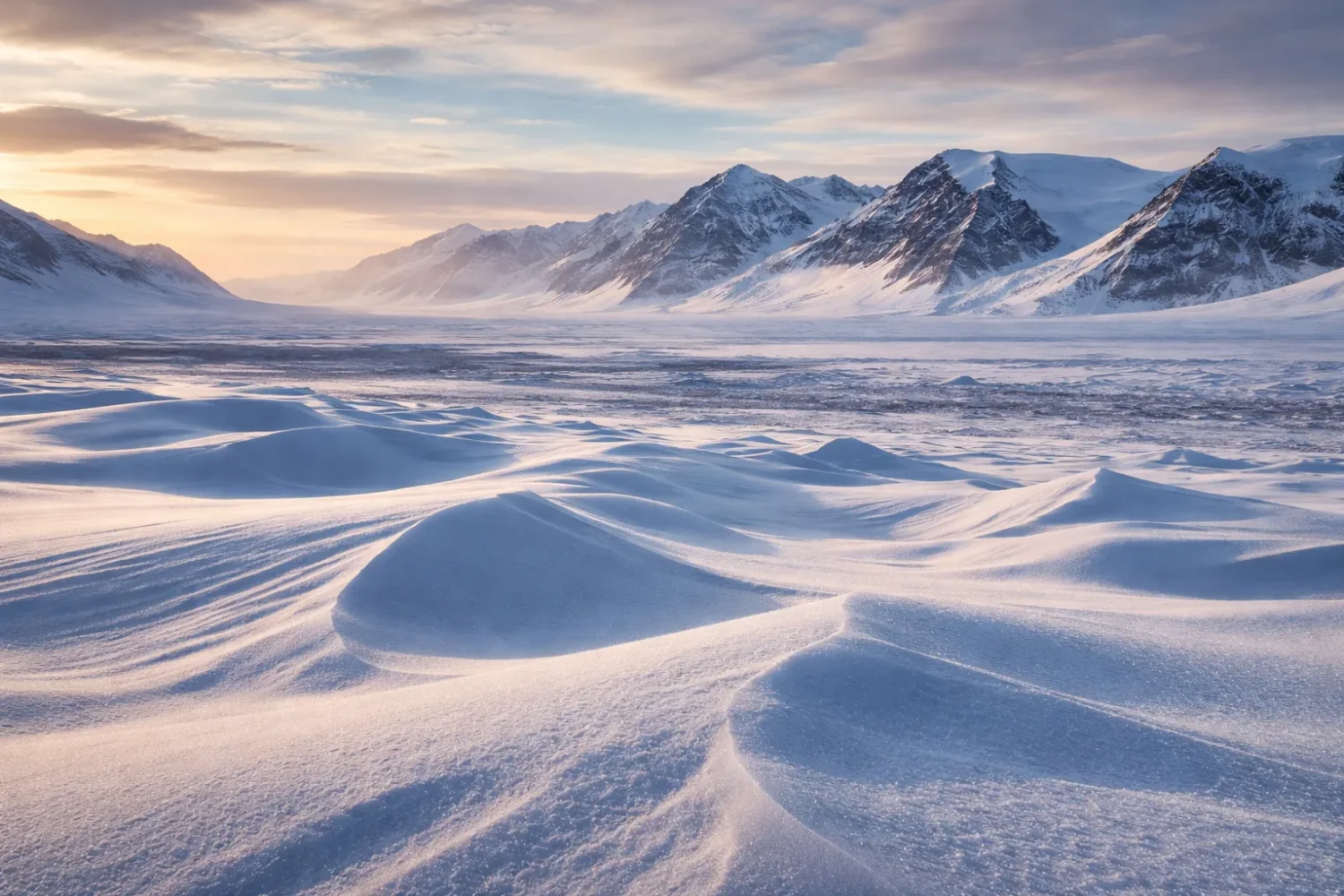
Among the world’s deserts, Arctic deserts confuse people more than almost any other type. They are cold deserts, not hot ones. They can hold snowfields, glaciers, sea ice, frost-shattered rock, gravel plains, patterned ground, and bare ridges in the same landscape. They look wet from a distance, yet by desert standards they are often very dry. That contrast is the first thing to understand.
Russian Arctic
Location & Continent Continent: Europe & Asia (Eurasia) Country: Russian Federation Region: Russian Arctic Desert & High Arctic...
Read More →Greenland (Polar Desert)
Location & Continent Continent: North America Country: Greenland (Kalaallit Nunaat) – an autonomous territory within the Kingdom of...
Read More →North American Arctic
Location & Continent Continent: North America – the northern polar fringe of the continent, entirely above or near...
Read More →Arctic Desert (Polar Desert)
Location & Continent Continent: Mostly Europe & Asia (Eurasian Arctic), with related polar desert zones in North America...
Read More →4 inventions in Arctic
In plain terms, an Arctic desert is a polar landscape where precipitation stays very low, the ground remains controlled by permafrost, the growing season is very short, and plant cover ranges from sparse to patchy rather than forming a continuous green mat. In the coldest High Arctic pockets, the surface can stay so harsh that only a small share of the ground supports herbs, mosses, or lichens. Everything else is stone, gravel, frost-broken rubble, snow patches, or ice.
This pillar page focuses on the main Arctic polar desert belt and the four connected regions that help make sense of it: the broader Arctic Desert, the North American Arctic, Greenland as a polar desert landscape, and the Russian Arctic. Together, these regions show how a desert can be shaped by cold, dryness, wind, sea ice, permafrost, and light rather than by heat.
One idea matters more than any other: in polar deserts, dryness is measured by precipitation, not by how much snow you can see in a photo. A place can be snow-covered for long periods and still qualify as a desert if the total water input stays low.
What Makes An Arctic Desert A Desert
People often hear the word desert and picture dunes, blazing heat, and cloudless skies. That picture fits some deserts. It does not fit all of them. A desert is defined first by low precipitation. In the Arctic, many polar desert landscapes receive 250 millimeters of precipitation per year or less, and the driest northern pockets can drop to around 45 to 50 millimeters annually in water equivalent. That is desert territory by any climate definition.
The catch is that low evaporation changes how the land feels. In hot deserts, scarce rainfall disappears fast into dry air and hot ground. In the Arctic, evaporation is weak, the ground is frozen at depth, and meltwater can linger near the surface during the short thaw season. So a place can be both desert-dry in annual precipitation and surface-moist for a short summer window. Odd? Yes. Very real, too.
That is why the Arctic desert should not be described as a frozen copy of the Sahara. The polar version works by different rules. Moisture arrives mostly as snow, blowing snow, frost, light snow grains, and in some places fog. Water stays locked in ice for much of the year. The result is a landscape where biological activity runs on a tiny seasonal timer. Only for a few weeks does the surface really wake up.
Why Snow Does Not Cancel Desert Status
Snow cover can make a place look rich in water, but appearance misleads here. Fresh snow is fluffy and light. Cold air does not hold much moisture. So even repeated snowfall events may add up to a small yearly water total when converted into liquid equivalent. A coastal storm can whiten the land quickly, then months later the annual moisture total still remains low by global standards.
That helps explain one of the most common mistakes in Arctic writing: calling the land “not really a desert” because there is snow on the ground. Better to say this instead: the Arctic desert stores much of its small water supply in frozen form. That is the cleaner, more accurate way to put it.
What “Polar Desert” Means On The Ground
In the field, a polar desert usually looks like a land of contrasts. One ridge may be almost bare, scraped by wind and freeze-thaw action. A shallow hollow a few meters away may hold finer sediment, late-lying snow, and a narrow strip of plants. Small differences in elevation matter a lot. In fact, a height change of just a few tens of centimeters can alter snow cover, soil warmth, moisture, and root space.
This microtopography is one of the big things that many short articles skip. Yet it explains why Arctic desert landscapes never read as a simple empty white sheet when you look closely. They are patchy, mosaic-like, and controlled by very local ground conditions.
| Physical Benchmark | Typical Arctic Desert Pattern | Why It Matters |
|---|---|---|
| Annual Precipitation | Often 250 mm or less; driest northern polar deserts can fall near 45–50 mm | Confirms desert status despite cold and snow cover |
| Warmest Month | Usually below 10°C; in the most severe polar deserts, mean July can stay below 2°C | Limits plant growth, soil thaw, and species richness |
| Ground Cover | In the harshest High Arctic polar desert zones, only about 5% of the surface may support herb-cryptogam cover | Shows how open and sparsely vegetated true polar desert can be |
| Active Layer | Often around 30–40 cm in severe polar desert settings | Roots, microbes, drainage, and thaw all stay restricted to a shallow layer |
| Dominant Surface Traits | Gravel, frost-shattered stone, polygons, stone nets, snow patches, bare ridges | These landforms tell you frost action is doing much of the surface work |
Where Arctic Desert Regions Are Found
The Arctic desert belt is not one neat block. It is a circumpolar set of High Arctic landscapes spread across islands, northern coasts, plateaus, fjord margins, and interior ice-free tracts. Some of its clearest expressions appear in the Canadian Arctic Archipelago, northern Greenland, and the island groups of the Russian High Arctic. The farther north and drier the setting, the more likely you are to move from tundra toward polar semi-desert and then into full polar desert.
In practice, Arctic desert country tends to cluster in places where several controls come together: very cold summers, limited moisture supply, long snow cover, wind exposure, shallow thaw, and soils with little organic matter. You do not need all of these in the same strength everywhere, but the more they pile up, the barer the land becomes.
Think of the Arctic as a gradient, not a switch. Southward or in milder coastal zones you get more continuous tundra. Move into colder High Arctic islands, exposed uplands, and very dry interiors, and the vegetation thins, shrubs fade out, and polar desert conditions take over.
The Broad Arctic Desert Belt
The broadest sense of Arctic desert includes the driest High Arctic terrain across northern Eurasia, Greenland, and North America. This belt is tied to the lands and islands closest to the central Arctic Ocean, where summer warmth stays weak and moisture sources are often far away or seasonally blocked by sea ice. On maps, the pattern may look broken. On the ground, it feels connected by shared traits: cold, aridity, exposed ground, shallow thaw, sparse life, and long dormancy.
A lot of summaries stop there. That misses something important. The Arctic desert belt is not uniform at all. The Canadian High Arctic tends to show wide gravel plains, polar barrens, and extensive ice-influenced island terrain. Northern Greenland adds large ice-free sectors near one of the world’s biggest ice sheets. The Russian Arctic brings long island chains, severe maritime cold, and huge east-west spread across Eurasia. Same desert family, different regional expression.
The North American Arctic Desert Pattern
Much of the classic terrestrial polar desert in North America lies in the Canadian Arctic Archipelago, especially the far northern islands. Here, summer warmth is so limited that woody plants can disappear entirely from the coldest zones. Bare mineral ground, frost-sorted surfaces, snowbeds, sparse herbs, and cryptogams become the main story.
The North American Arctic is also useful for understanding how temperature controls plant diversity. In the coldest herb zones of the High Arctic, local floras can be very small. Once summer warmth rises even a little, species counts climb. That is why mean July temperature is such a strong ecological signal in this part of the world. Few variables explain the desert-tundra boundary as clearly.
Greenland’s Polar Desert Pattern
Greenland is often imagined as one continuous ice mass, and the ice sheet is indeed dominant. Still, the island’s ice-free margins and northern sectors matter greatly for polar desert geography. Northern Greenland, especially in places such as Peary Land, shows some of the clearest High Arctic desert scenery on Earth: rocky ground, sparse plant cover, long frost seasons, and an environment shaped by cold more than by rainfall.
Greenland also shows a steep north-south ecological gradient. The south can support shrubier, milder, and more biologically busy landscapes. Farther north, that livelier Arctic look fades and gives way to much more open polar desert terrain. This shift makes Greenland one of the best natural classrooms for understanding how temperature and moisture rearrange Arctic landscapes.
The Russian Arctic Desert Pattern
The Russian Arctic stretches across an immense span of longitude and includes islands where polar desert and semi-desert conditions are a defining part of the landscape. Franz Josef Land, parts of Novaya Zemlya, Severnaya Zemlya, and other northern island groups help form the Eurasian side of the Arctic desert belt.
The regional scale matters here. Because the Russian Arctic reaches across about nine time zones, it mixes different moisture pathways, sea-ice settings, and landforms. Yet the High Arctic islands pull the same ecological pattern into view: thin soils, shallow thaw, frost-driven geomorphology, sparse vegetation, and a very short window for growth.
| Region | Desert Expression | Typical Landscape Feel | What Stands Out |
|---|---|---|---|
| Arctic Desert | Umbrella term for the driest High Arctic desert belt | Bare ground, gravel, snow patches, polar barrens | Best viewed as a circumpolar biome rather than a single country-level unit |
| North American Arctic | Strong terrestrial polar desert across northern Canadian islands | Plateaus, gravel plains, sparse herbs, patterned ground | Excellent example of how summer warmth controls species richness |
| Greenland | High Arctic polar desert in northern and ice-free sectors | Rocky coasts, fjords, polar barrens, ice-sheet margins | Sharp ecological gradient from sub-Arctic south to desert north |
| Russian Arctic | Island-heavy Eurasian polar desert and semi-desert | Archipelagos, glaciated terrain, severe cold, sparse cover | Huge east-west spread across Eurasia with strong High Arctic island character |
Climate In Arctic Deserts
To understand Arctic desert climate, forget the idea that cold air automatically means heavy snow. It often means the opposite. Cold air holds little water vapor. Moisture sources can be distant. Sea ice can limit direct evaporation from the ocean. The outcome is a climate where the sky may stay white, the land may stay frozen, and the annual water total can still remain desert-low.
Low Precipitation, High Cold
Large parts of the Arctic are dry, but the driest terrestrial and ocean-adjacent sectors fall within the polar desert threshold of 250 millimeters or less per year. Some Atlantic-facing Arctic margins receive far more, especially where open water and storm tracks feed snowfall or rain. That is why not every Arctic landscape is a desert. The desert core sits where cold meets distance from moisture and weak summer thaw.
In the strictest High Arctic polar desert settings, mean July temperature can remain below 2°C. That is a brutally small heat budget for any ecosystem. Flowers may bloom close to the ground. Mosses and lichens may activate when meltwater appears. Yet the season is short, and the pause between useful growing days can be long. Small it is, but that summer pulse decides almost everything.
Long Winters And A Short, Intense Summer Window
The annual rhythm of an Arctic desert is lopsided. Winter dominates the calendar. Summer arrives late, runs fast, and leaves quickly. Light changes amplify the effect: polar night removes solar input for a long stretch, while summer brings very long daylight. That does not create warmth in the way many people assume, because low sun angle, snow cover, ice, and cold air still limit energy gain.
Yet when thaw begins, activity can become sudden. Snowmelt releases water into the shallow active layer. Microbes wake up. Plants push tiny shoots upward. Birds arrive and nest in a compressed seasonal rush. The whole system behaves like a very tight schedule. Miss that window and the year is mostly gone.
Wind, Exposure, And Surface Harshness
Arctic deserts are not only cold and dry. They are often wind-shaped. Wind strips snow off ridges, piles it into hollows, abrades loose surfaces, and adds another layer of stress to plants already growing near their thermal limit. A ridge with thin snow may thaw earlier but lose moisture faster. A depression with deeper snow may stay insulated longer, thaw later, and support different plant cover. This is why nearby ground patches can look so unlike each other.
Exposure also explains why some slopes become nearly plantless while sheltered sites support a surprising scatter of life. Rarely does a polar desert look empty at close range. Step down from a wind-scoured crest into a protected niche and the land can change in a few meters.
Why Moisture Can Sit Near The Surface
This is one of the most useful ideas for readers who want more than a simple overview. In many Arctic desert settings, permafrost traps water near the surface. Since the ground below the active layer stays frozen, meltwater and summer moisture cannot percolate deeply. The result can be shallow wet patches, ephemeral ponds, and saturated fine sediments even in an area that receives very little precipitation each year.
So yes, a polar desert can have muddy spots. It can even have wetlands on a small scale. That is not a contradiction. It is a consequence of frozen subsurface storage, weak evaporation, and short seasonal thaw.
What Makes The Climate So Dry
- Cold air holds little moisture
- Sea ice can reduce open-water evaporation
- Storm tracks do not feed all Arctic sectors equally
- Interior High Arctic areas sit far from strong moisture sources
Why The Surface Can Still Look Moist
- Permafrost blocks deep drainage
- Evaporation stays weak
- Snowmelt supplies short bursts of water
- Microtopography traps moisture in small hollows
Permafrost, Active Layer, And The Shape Of The Land
If hot deserts are often read through dunes and wadis, Arctic deserts are read through permafrost, freeze-thaw cycles, and patterned ground. The land is not just sitting under cold air. It is being physically rearranged by frost.
Permafrost Is The Hidden Foundation
Permafrost is ground that stays frozen for at least two consecutive years, though in the High Arctic it usually persists for far longer and can extend to great depth. In much of the Arctic desert belt, permafrost is continuous. That means the frozen ground beneath the thin seasonal thaw is widespread rather than patchy.
This frozen foundation shapes drainage, soil chemistry, plant rooting, slope stability, and even the look of the surface. A desert without deep drainage behaves differently from one where water can sink away. That is why the Arctic desert often feels like a place where the surface is thin, delicate, and temporary, while the real control sits just below it in frozen ground.
The Active Layer: Thin, Seasonal, And Ecologically Huge
The active layer is the upper ground layer that thaws in summer and refreezes in winter. In severe polar desert settings, its depth often sits around 30 to 40 centimeters, though local variation can be large. In warmer or drier tundra settings it may deepen more, and in wet, insulated ground it may stay shallower.
That thin layer is where nearly all summer biological work happens. Roots use it. Soil microbes operate in it. Meltwater moves through it. Nutrients cycle inside it. If you imagine the whole living surface of the Arctic desert as a book, the active layer is only a few pages thick. Everything below is frozen shut.
When the active layer deepens, the whole system shifts. Drainage may improve in some places. Surface subsidence may start in others. Fine balance there is, and sometimes a very shrot thaw-season change can push the ground into a new pattern.
Patterned Ground, Stone Nets, And Polygons
Some of the most distinctive Arctic desert landforms come from repeated freeze-thaw sorting. As water freezes and expands, stones move. Fine sediment shifts. Frost heave lifts and rearranges material. Over time, the surface organizes itself into polygons, circles, stripes, stone nets, and frost-sorted patches.
These features are not decorative details. They are ecological boundaries. The rim of a polygon may be drier and better drained than its center. Coarse gravel patches heat and cool differently from fine silts. Roots can exploit one micro-site and fail in the next. This is why the Arctic desert often contains many small habitats in a space that looks monotonous from far away.
In the harshest High Arctic settings, soils are often skeletal, stony, and low in organic matter. Chemical weathering stays weak because low heat slows it down. Physical weathering does much of the labor instead. Rocks crack, surfaces sort, edges sharpen. A cold desert writes its geology in frost.
Why Topography Matters So Much
A modest ridge can lose snow to wind and expose plants early. A shallow hollow can collect snow, thaw later, hold moisture longer, and shelter more species. A south-facing slope may develop a deeper active layer than a nearby boggy depression. In some Arctic studies, topographic differences of only a few centimeters help decide which plants survive.
That is a major content gap in many general articles. They talk about “the Arctic desert climate” as if the land were uniform. It is not. Microrelief reamins one of the best keys to reading Arctic desert ecology.
Thermokarst And Surface Change
When ground ice thaws, the surface can settle or collapse. This process helps create thermokarst landforms such as thaw slumps, uneven hollows, and altered drainage routes. In wetter tundra these changes may create ponding. In some drier sites they may increase drainage and expose more mineral ground.
Arctic desert regions do not all respond in the same way. That matters. In one place deeper thaw can mean more available moisture at the surface. In another, it can mean the opposite because the land drains more freely. Same warming direction, different local result.
| Ground Process | What It Does | Visible Result |
|---|---|---|
| Freeze-Thaw Sorting | Moves fine sediment and stones into repeated patterns | Stone circles, stone nets, stripes, sorted polygons |
| Seasonal Thaw | Opens the active layer for roots, microbes, and water movement | Short-lived biological burst in summer |
| Permafrost Control | Blocks deep drainage and limits root depth | Shallow wet patches, perched moisture, shallow soils |
| Ground-Ice Thaw | Can destabilize the surface and alter hydrology | Subsidence, thaw slumps, uneven terrain |
Soils And Water In Polar Desert Regions
Arctic desert soils are usually thin, coarse, young-looking, and poor in organic matter. Still, “poor” here does not mean lifeless. It means life is concentrated into narrow windows and tiny spaces: a crack in rock, the lee side of a stone, a silty frost boil, a seep below a snow patch.
Thin Soils, Sparse Organic Matter
In the coldest polar desert settings, the soil profile may lack a well-developed organic layer. Organic material accumulates only in pockets under sparse plants or in protected crevices. This matters because organic-rich soils usually hold more water, insulate the ground, and support more microbial activity. Without much of that organic cushion, the land stays more exposed and more dependent on fine-scale shelter.
In warmer Arctic tundra to the south, organic layers become deeper and more continuous. That is one of the practical differences between polar desert and tundra: not just more plants, but a different soil-body altogether.
Moisture Is Patchy, Not Absent
Polar deserts are dry in annual climate totals, yet during the growth season the soil surface can be moist, especially where snowmelt collects. The driest ridges, frost-sorted gravels, and wind-scoured uplands stay barren longer. Lower microsites can hold films of water, brief saturation, or even shallow ponds. That patchiness lets plants survive where they otherwise should not.
This is why botanical fieldwork in polar deserts can feel almost paradoxical. You walk through bare gravel for minutes, then kneel by a seep or snowbed edge and find a small but busy community of mosses, lichens, or flowering plants. In a hot desert, water can be the exception. In an Arctic desert, usable thawed water is the exception.
Snowbeds And Meltwater Niches
Areas where snow lingers longer into summer create their own microhabitats. These snowbed communities benefit from meltwater and from a degree of protection under winter snowpack. Once thaw arrives, the growing season is shorter there, but moisture is better. Some Arctic desert plants exploit exactly that trade-off.
Nearby ridges may tell the opposite story: less snow, more exposure, earlier thaw, and stronger drying winds. The land reads like a patchwork of seasonal bargains.
Plant Life In Arctic Deserts
The vegetation of Arctic deserts is not lush, yet it is far from absent. It is small-scale, low to the ground, and highly specialized. Most plants survive by hugging the surface, using snow as insulation, exploiting sheltered cracks, and making the most of brief thaw. Their strategy is not speed alone. It is endurance.
What Grows In A Polar Desert
The dominant plant elements in Arctic desert vegetation are often mosses, lichens, tiny herbs, and in slightly less severe settings some grasses or sedges. True woody plants disappear from the most severe polar desert zones. Where summer warmth improves a bit, dwarf shrubs begin to enter the picture. That threshold is ecologically important because it marks a move away from full desert barrens toward tundra.
In the far north, vegetation may cover only a small fraction of the surface. In the hardest polar desert zones, about 5% ground cover is a realistic benchmark. That means most of the eye sees stone, frost-sorted sediment, snow remnants, and bare mineral patches, while most of the ecological action happens in scattered, low-profile communities.
Common Plant Types And Growth Forms
- Lichens that tolerate long dormancy and revive when moisture appears
- Mosses in moist pockets, seep zones, and snowmelt margins
- Cushion plants that reduce wind exposure and hold a slightly warmer microclimate
- Tiny forbs and herbs such as saxifrages and poppy-type flowers in suitable microsites
- Scattered grasses or sedges in less severe or more moist ground
Cushion growth is especially clever. By forming dense rounded mounds, these plants create a more stable microenvironment around their tissues. Wind speeds drop at the surface, heat is retained a bit better, and the plant protects itself from abrasion. Elegant solution, really.
Why Mean July Temperature Matters So Much
In Arctic vegetation studies, summer warmth often predicts plant richness better than annual precipitation does. In the Canadian High Arctic, mean July temperature has been shown to explain most of the variation in vascular plant species counts. The coldest herb zones may support only 1 to 35 species, while slightly warmer zones can rise to 35–60, then 60–100, and in still warmer prostrate shrub zones exceed 100 species.
That is a striking pattern because it shows how close many Arctic desert landscapes sit to biological thresholds. Add a little summer warmth and species richness can climb. Remove a little and the vegetation thins quickly.
Low Height Is A Survival Strategy
Tall growth is usually a bad bargain in a polar desert. Wind exposure rises. Heat loss rises. Snow abrasion becomes harsher. So most Arctic desert plants stay low, compact, and close to the warmer boundary layer near the ground. Some flower fast during the brief thaw. Some store resources for years. Some wait through long dormant periods and only grow when a narrow mix of light, moisture, and temperature lines up.
There is no wasted movement here. Every millimeter of height, every extra leaf, every day of activity costs energy.
Biological Soil Crusts And Tiny Life Systems
One topic that deserves more attention in Arctic desert writing is biological soil crust. On certain exposed surfaces, communities of cyanobacteria, fungi, algae, lichens, and mosses can stabilize fine sediments and add biological function to ground that looks almost bare. These crust-like systems are subtle, easy to miss, and ecologically useful.
In many desert discussions, people focus only on flowering plants. In polar deserts, that misses a huge part of the story. Cryptogams — mosses, lichens, algae, and related low-profile organisms — often do a large share of the living work.
Animal Life In Arctic Desert Landscapes
Arctic deserts support fewer terrestrial species than richer tundra zones, yet the idea that they are “empty” is wrong. Animal life persists through mobility, insulation, timing, food flexibility, and marine links. Some species live year-round on land. Others depend on seasonal productivity. Many are tied to nearby sea ice, coasts, or polynyas rather than to the sparse plant layer alone.
Why Large Herbivores Are Limited
The sparse vegetation of a true polar desert limits how many large grazing animals the land can support. Compared with lower Arctic tundra, plant biomass is small, patchy, and slow to rebuild. That means fully terrestrial food webs stay thin. Where muskoxen, hares, or reindeer-like grazers occur near the desert edge, they often use more productive patches, sheltered valleys, or neighboring tundra rather than the barest ground alone.
This is one reason Arctic desert ecosystems often rely heavily on marine subsidy. In coastal High Arctic zones, birds, foxes, and larger predators may depend on the ocean, shorelines, or sea-ice systems more than on land plants. You cannot understand Arctic desert animals by looking only at the land surface. The sea-land connection is built in.
Mammals Associated With Arctic Desert Regions
- Arctic fox in coastal and inland High Arctic settings
- Polar bear in regions where sea ice and marine feeding grounds remain central
- Arctic hare in some rocky and sparsely vegetated northern landscapes
- Muskox in suitable High Arctic terrain, especially where forage is enough
- Small rodents only in places where vegetation and snow conditions allow them
The Arctic fox is a good example of desert-region adaptability. It can move widely, use marine food, scavenge, cache food, and breed quickly when conditions allow. Its compact body and thick insulating fur suit a place where energy conservation is not optional.
Bird Life: Seasonal, Fast, And Highly Timed
Birds can make Arctic desert regions feel much more alive in summer than the vegetation suggests. Seabirds gather near cliffs and productive coasts. Shorebirds and migratory species use the brief thaw for breeding. Snow-free gravel, meltwater edges, and open patches become nesting or feeding sites. Timing is everything. A late melt or ice event can shift the whole seasonal rhythm.
In some Arctic ecological work, the number of bird species correlates closely with summer warmth. That fits what the plants show: a small rise in mean July temperature often broadens the biological menu.
Marine Links Are Part Of The Story
If you stand in a coastal Arctic desert, the land may look almost barren while nearby marine waters support seals, seabirds, fish, and the predators that follow them. This is why coastal polar desert often functions differently from inland polar desert. The land itself offers little food, but the surrounding sea can transform the local ecological picture.
In Greenland and the Russian Arctic especially, those coast-ocean links matter a lot. Fjords, ice margins, leads, and polynyas can turn otherwise austere land into a seasonal wildlife corridor.
Four Core Arctic Desert Regions
A pillar page works best when it separates the shared biome from the local expression. The four regions below belong to the same cold-desert family, yet each has its own surface character, moisture pattern, and ecological personality.
Arctic Desert As The Umbrella Region
The broad Arctic Desert is best understood as the High Arctic polar desert biome in its widest sense. It spans the coldest and driest Arctic islands and adjacent high-latitude land areas where shrubs fade out, vascular plant diversity drops, and frost-driven landforms dominate. It is not one seamless sand-like tract. It is a belt of related landscapes tied together by climate and ground process.
Its strongest features are easy to list and hard to mistake: annual precipitation often below 250 mm, a very short growing season, shallow active layer, widespread permafrost, sparse vegetation, and abundant frost-sorted ground. In the most severe subzones, woody plants are absent and only a small share of the surface carries herb-cryptogam communities.
This umbrella category matters because it helps connect places that are often described separately — northern Greenland, far northern Canada, and the Russian High Arctic islands — even though they share the same basic desert logic.
North American Arctic
The North American Arctic gives some of the clearest textbook examples of terrestrial polar desert, especially across the northern Canadian Archipelago. Here, the transition from tundra to polar barren can be sharp. Bare gravel and rock dominate exposed ground, and local plant communities cluster where moisture, fine sediment, and shelter align.
One of the region’s strongest scientific lessons is the tight connection between mean July temperature and species richness. When the warmest month stays extremely cold, local floras remain tiny. As summer warmth rises even modestly, species counts can increase fast. That makes the North American Arctic one of the best regions for understanding threshold ecology in polar deserts.
Large islands such as Ellesmere, Devon, and Axel Heiberg, along with the Queen Elizabeth group more broadly, help define the North American side of the High Arctic desert belt. Glaciation, wind exposure, snow redistribution, and shallow thaw all help shape the land.
Greenland As A Polar Desert
Greenland’s desert identity sits in its ice-free margins and High Arctic north, not in a simple “all ice means no desert” way. The island is dominated by ice, but the land that remains exposed — especially in northern Greenland — includes some of the most severe and fascinating polar desert landscapes in the Arctic.
Peary Land stands out as Greenland’s largest ice-free northern region and one of the world’s clearest examples of High Arctic desert terrain. Here, the surface shows the classic combination of bare ground, limited plant cover, freeze-thaw landforms, and long biological dormancy. The farther south you go in Greenland, the more the desert tone softens and a richer Arctic vegetation mosaic appears.
Greenland also reminds us that ice-free land does not mean mild land. A rocky coastal strip beside an ice sheet or a fjord can still function as a severe cold desert if summer warmth stays low and moisture input remains modest.
Russian Arctic
The Russian Arctic carries the Eurasian side of the Arctic desert belt across a huge geographic span. It includes islands and coasts where polar desert and semi-desert terrain occupy the northern edge of Eurasia. Franz Josef Land, parts of Novaya Zemlya, Severnaya Zemlya, and related archipelagos bring together glaciation, maritime cold, long winters, sparse plant cover, and strong frost action.
Because the Russian Arctic extends across about nine time zones, it is not a single climatic block. Still, its far northern island groups keep returning to the same High Arctic desert formula: shallow thaw, stony ground, thin soils, little organic build-up, and plant life restricted to sheltered or moist microsites.
The Russian Arctic is also useful for understanding scale. In a smaller desert, you can read the land valley by valley. In the Russian Arctic, you read it archipelago by archipelago. Vastness itself becomes part of the geography.
How Arctic Deserts Differ From Arctic Tundra
The line between polar desert and tundra is one of the most important distinctions in Arctic geography. They belong to the same cold world, but they are not the same landscape.
| Feature | Arctic Desert | Arctic Tundra |
|---|---|---|
| Vegetation Cover | Sparse, patchy, often very low cover | More continuous plant cover |
| Woody Plants | Absent in the coldest true polar desert zones | Low shrubs often present in many tundra zones |
| Soils | Thin, coarse, little organic matter | More developed organic layers in many places |
| Species Richness | Low, tightly limited by summer warmth | Higher than in true polar desert |
| Surface Appearance | Large areas of bare rock, gravel, frost-sorted ground | More plant carpet, wetlands, sedges, dwarf shrubs |
The easiest field clue is visual. If the land is mainly bare mineral surface with plants restricted to scattered pockets, you are likely in polar desert or polar semi-desert. If the vegetation forms a more continuous mat with sedges, dwarf shrubs, and moss-rich ground, you are moving into tundra.
Another clue is the soil. Tundra tends to build more organic material. Arctic desert usually does not. That difference feeds back into insulation, thaw depth, microbial activity, and plant productivity.
Seasonality In Arctic Desert Regions
Arctic desert landscapes are ruled by the calendar more than many other deserts. Light, thaw, snow cover, and wind all follow a strong annual rhythm. Reading that rhythm makes the whole biome easier to understand.
Winter
Winter is long, cold, dark, and strongly controlled by snow redistribution and wind. Biological activity drops to a minimum. Sea ice, snowpack, and frozen ground dominate the scene. The land appears still, yet physical processes continue: blowing snow, frost cracking, and cold-season surface adjustment all keep working.
Spring
Spring does not arrive evenly. Wind-scoured ridges may expose early. Snow-filled hollows can stay buried much longer. This mismatch helps create the patchwork ecology of the Arctic desert. Some sites begin to thaw while others remain winter-locked only meters away.
Summer
Summer is brief but dense with action. The active layer opens. Meltwater flows. Mosses and lichens hydrate. Tiny flowers bloom low against the ground. Birds breed on a compressed schedule. In the harshest places the change may last only weeks. Fast, then gone.
Autumn
Autumn can feel abrupt. Surface thaw ends, the active layer refreezes, plant activity shuts down, and the land returns to a long cold pause. In a warm desert, autumn often feels like relief. In an Arctic desert, it feels like the system closing itself.
Why Arctic Deserts Matter Scientifically
Arctic deserts matter not because they are crowded with species or human settlement, but because they are sensitive boundary landscapes. They sit near the edge of what land-based life can tolerate and near the edge of what climate can sustain as true polar desert.
Natural Laboratories For Climate And Life Limits
Few places show the boundary between life and near-barrenness as clearly as the High Arctic desert. Small changes in summer warmth, snow cover, or active-layer depth can shift species composition, ground stability, and moisture pathways. That makes Arctic deserts useful for studying climate thresholds, permafrost behavior, and low-productivity ecosystems.
Carbon And Frozen Ground
The wider terrestrial Arctic stores vast carbon reserves in soils and permafrost, on the order of 1.4 to 1.6 trillion tonnes of carbon across the northern permafrost region. True polar deserts are not the richest carbon landscapes in that wider Arctic system — peatier tundra and wetlands often hold more — yet Arctic desert ground still matters because thaw, drainage change, and microbial reactivation can alter local carbon balance.
In other words, even sparse land can play an outsized scientific role when it sits on frozen ground that is changing.
Arctic Warming And Desert Boundaries
Modern observations show the Arctic warming much faster than the global average — close to four times faster since 1979 in one widely cited observational analysis. That matters for deserts because summer warmth helps determine where the line between polar desert and tundra sits. If the Arctic warms, some areas now classed as polar desert may support denser vegetation in the future.
Older Arctic vegetation modeling has long suggested a future contraction of polar desert area and a poleward push of tundra. The exact local outcomes will differ. Still, the broad direction is easy to follow: more warmth usually means less severe desert character where moisture and soil allow plants to respond.
How Arctic Desert Regions Are Changing
Change in the Arctic desert does not always look dramatic at first glance. It may appear as a slightly deeper active layer, a wetter hollow, a drier ridge, more shrub entry at a biome edge, or altered timing of snowmelt. The point is not that every site changes the same way. The point is that small physical shifts matter a lot in a biome this tightly constrained.
Longer Thaw Seasons In Some Areas
Deeper or longer thaw can expand the biologically active zone, alter drainage, and change where water sits during summer. In some places that can support more vegetation. In others it can dry the surface and expose more mineral ground. Arctic desert response depends heavily on ground ice content, topography, and moisture routing.
Precipitation Is Rising In Parts Of The Arctic
Recent Arctic monitoring shows that precipitation has been rising across the broader Arctic, especially in winter. That does not instantly erase polar deserts. Some of the driest High Arctic areas remain dry enough to stay within cold-desert character. Yet rising precipitation can alter snow cover, insulation, runoff timing, and the length of seasonal wetness.
Vegetation Change Is Uneven
The phrase “Arctic greening” gets used a lot, sometimes too loosely. In desert-edge landscapes, more warmth can allow denser cover or more species. In very severe cores, plant response can stay small because temperature, soil development, and moisture availability still limit growth. A greener Arctic is not automatically a greener polar desert core.
That is worth stressing because broad Arctic trends can blur local desert reality. The north does not change as one uniform surface. It changes by region, by slope, by sediment type, by snow regime, sometimes by a single sheltered depression.
Questions People Often Ask About Arctic Deserts
Is The Arctic Really A Desert?
Parts of it are. Not all Arctic landscapes qualify as desert, but many High Arctic regions do because annual precipitation is low enough to meet desert criteria. In the coldest sectors, that dryness combines with shallow thaw, sparse vegetation, and continuous permafrost to produce true polar desert conditions.
How Can A Place With Snow Be A Desert?
Desert status depends on how much precipitation falls over a year, not on whether the ground looks snowy. Cold air holds little moisture, so snow can accumulate in visually striking ways without adding much liquid-equivalent water to the annual budget.
What Is The Difference Between Polar Desert And Tundra?
Polar desert is barer, colder in summer, poorer in organic soil, and lower in plant cover. Tundra supports more continuous vegetation, often includes dwarf shrubs, and usually has a better-developed organic surface layer.
Are There Sand Dunes In Arctic Deserts?
Some Arctic regions do have dune fields or sandy surfaces, but sand is not the defining feature of Arctic deserts. The more typical image is frost-shattered rock, gravel plains, patterned ground, snowbeds, and sparse plant patches. Arctic desert is a climate-and-ecology category first, not a “must have sand” landform category.
What Plants Survive In Arctic Desert Regions?
Mostly lichens, mosses, tiny herbs, cushion plants, and a few grasses or sedges in suitable microsites. The coldest true polar desert zones lack woody plants. Farther toward tundra margins, low shrubs begin to appear.
Do Animals Live In Arctic Deserts Year-Round?
Yes, some do. Arctic foxes and a few other hardy species can persist year-round, especially where marine food helps support them. Many birds are seasonal visitors. Some larger mammals use the desert edge or move between richer and poorer habitats rather than living only on the barer ground.
Which Region Shows The Clearest Arctic Desert Landscapes?
The High Arctic islands of northern Canada, northern Greenland, and the Russian High Arctic archipelagos all show classic Arctic desert traits. Each region gives a slightly different version of the same biome.
Is Greenland Entirely A Polar Desert?
No. Greenland contains a strong polar desert component, especially in the High Arctic north and ice-free severe landscapes, but the island as a whole includes a much broader range of Arctic and sub-Arctic environments.
Reading Arctic Deserts As Part Of The World’s Desert System
On a global desert site, Arctic deserts deserve a place beside the Sahara, Namib, Gobi, Atacama, and Antarctic desert regions not because they look alike, but because they solve the same climatic problem in a different way: too little available moisture. The Arctic answer is cold, permafrost, and compressed biological time.
A hot desert spreads heat across bare stone and sand. An Arctic desert stores cold in frozen ground and lets only a thin seasonal layer thaw. A hot desert often hides its life in roots, stems, and nighttime behavior. An Arctic desert hides much of its life in timing, microtopography, cryptogams, shallow soils, and protected meltwater niches. Different look. Same desert logic.
That is why Arctic deserts should never be treated as a side note under tundra alone. They are their own desert expression, with their own climate metrics, landforms, ecological thresholds, and regional identities.
Arctic Desert Regions Covered On This Site
The wider Arctic desert story makes the most sense when read region by region. The umbrella biome explains the rules. The North American, Greenlandic, and Russian examples show how those rules play out on real ground — on islands, along fjords, beside ice sheets, across archipelagos, and over frost-shaped plains.
- Arctic Desert explains the full High Arctic cold-desert biome
- North American Arctic shows the Canadian High Arctic desert pattern especially well
- Greenland reveals how ice-free northern land can still function as true polar desert
- Russian Arctic shows the Eurasian archipelago version of the same desert system