
Camels are built for dry country. Not by one trick, and not by a magical hump full of water, but by a whole set of body systems working together. Their blood, kidneys, nose, coat, feet, and feeding habits all help them stay active in places where heat, wind, and limited water shape daily life.
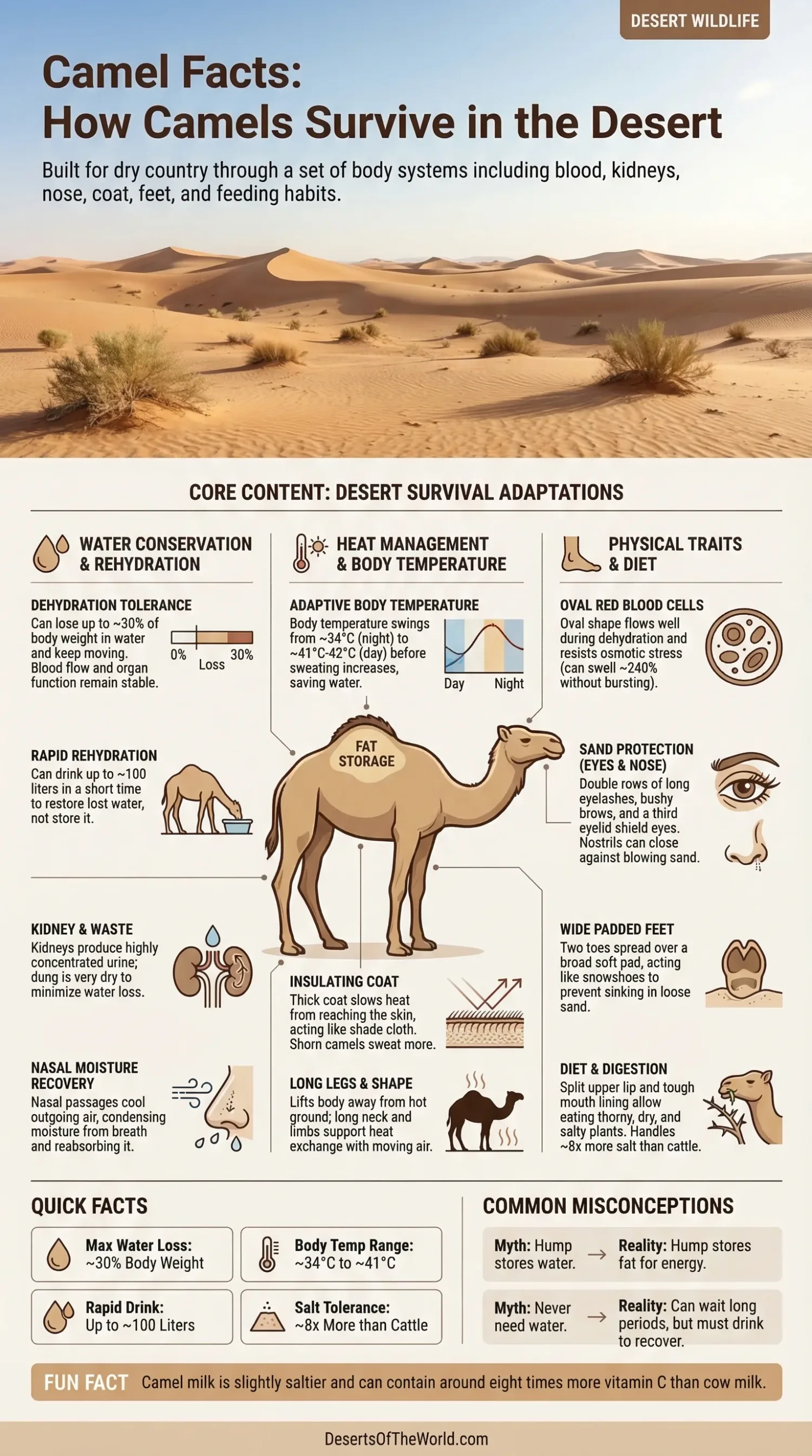
That is why camels remain tied so closely to the great desert belts of Africa and Asia. They are not only symbols of arid land. They are working desert mammals with a very practical design.
| Desert Trait | What It Means In Plain English | Why It Helps |
|---|---|---|
| Hump Fat Storage | The hump stores fat, not water | Provides energy and keeps much of the rest of the body less insulated by fat |
| Dehydration Tolerance | A camel can lose up to about 30% of its body weight as water | Lets it keep moving when water is scarce |
| Adaptive Body Temperature | Body temperature can swing from about 34°C to 41°C, and sometimes near 42°C before sweating rises | Reduces the need to waste water through sweat |
| Oval Red Blood Cells | Red blood cells are oval, not round like in most mammals | Helps blood keep flowing during dehydration and rapid rehydration |
| Nasal Moisture Recovery | The nose can recapture water from exhaled air | Cuts respiratory water loss |
| Wide Padded Feet | Two toes spread over a broad soft pad | Helps the animal walk on sand without sinking |
What Kind Of Camel Lives In The Desert?
When people say camel, they usually mean one of two Old World species in the genus Camelus. The dromedary has one hump and dominates the hot deserts of North Africa, the Arabian Peninsula, and nearby dry lands. The Bactrian camel has two humps and is better known from the cold deserts and dry steppes of Central Asia.
About 90% of the world’s camels are dromedaries, so the one-humped camel is the animal most readers picture when they think of the Sahara or Arabian deserts. Still, the two-humped Bactrian matters just as much for understanding camel biology, because it shows that camel survival is not only about heat. It is also about handling big temperature swings, sparse grazing, and long dry spells.
Bactrian camels make that point well. They can live through a range from about -29°C to 49°C. So, yes, camel adaptation belongs to the desert story, but not only to the hot-sand version of it.
Do Camels Store Water In Their Humps?
No. The hump stores fat. This is one of the most repeated camel myths, and it misses the clever part. A hump works like a fuel depot, not a water tank. When grazing is poor, the camel draws on that stored fat for energy.
The hump also helps with heat management. By keeping much of the body fat gathered in one place, the camel avoids having a thick fat layer spread all under the skin. That makes it easier for the rest of the body to release heat. In a hot desert, that matters a lot.
When food is short, the hump can shrink and sag. Thats normal. It means the camel is using stored reserves.
How Camels Save Water Better Than Most Mammals
The best-known camel fact is still the most useful one: camels can go a long time without drinking. In very hot conditions, a camel may drink only every eight to ten days. In milder conditions with green forage, the interval can stretch much longer.
That ability starts with dehydration tolerance. A camel can lose up to about 30% of its body weight in water, a level that would be dangerous or fatal for many other large mammals. This is not because the animal is ignoring biology. It is because camel biology is built to keep blood flow and organ function working under dry stress.
Then comes rapid rehydration. After a dry stretch, a camel can drink up to about 100 liters in a short time. It does not store that water away for later in a secret tank. It simply restores what the body has lost.
Kidneys, Intestines, And Very Little Waste
The camel’s kidneys are a major reason for this water-saving ability. They produce highly concentrated urine, so less water leaves the body. Camel dung is also famously dry. In many desert communities it has even been used as fuel once dried.
There is a technical side to this too. The renal pelvis of the camel kidney has an elaborate layout with 20–24 recesses around the medulla. That structure supports intense urea recycling and strong water reabsorption. Put simply: the kidney is built to squeeze water back into the body instead of throwing it away.
The small intestine helps as well. It reabsorbs extra water, which is one reason camel feces come out so dry. Desert survival is not a single organ story. It is a whole-body economy.
The Nose Works Like A Water Saver
A camel also loses less water every time it breathes. Its nasal passages cool outgoing air and help condense moisture from the breath. That moisture is then reabsorbed rather than lost to the desert air.
This is one of the least talked-about camel adaptations, yet it is one of the smartest. The nose is not just for smelling and breathing. In desert conditions, it also acts like a moisture recovery unit.
How Camels Deal With Desert Heat
Many mammals fight heat by sweating hard and keeping body temperature narrow and steady. Camels do not rush into that. They allow a wider daily swing in body temperature, which helps them save water.
A camel’s body temperature can move from about 34°C in the cooler part of the day to around 41°C, and sometimes close to 42°C before sweating increases. Water-stressed camels can show a daily temperature spread of more than 6°C. This process is often called adaptive heterothermy.
That shift matters because sweating costs water. By letting body temperature rise during the day and drop again at night, the camel stores some heat instead of dumping it out through evaporation right away. Short sentence, big effect.
Why A Desert Animal Has A Thick Coat
At first glance, the camel’s coat looks wrong for hot weather. It is not. The coat insulates. It slows the rate at which outside heat reaches the skin, much the way shade cloth slows the sun. Shorn camels actually sweat more, which tells you the coat is part of the cooling system, not a mistake.
The long legs help too, lifting the body away from hot ground. Even the body shape matters: a long neck, long limbs, and a raised trunk all support heat exchange with moving air.
Blood: One Of The Camel’s Best Desert Tools
Among the most striking camel facts is the shape of its red blood cells. In most mammals, red blood cells are round and biconcave. In camels, they are oval. That sounds like a tiny detail. It is not.
Oval red blood cells keep flowing well even when the animal is dehydrated. They are also very resistant to osmotic stress. Studies report that camel red blood cells can swell to about 240% of their original volume without bursting. That helps explain how a camel can drink a huge amount after dehydration and still keep its circulation stable.
This is one of the clearest examples of desert physiology. The camel’s blood is not just “tough.” It is shaped for dry-country extremes.
Eyes, Nostrils, Feet, And Pads Built For Sand
Desert life is not only about thirst. It is also about wind-blown grit, hot ground, and long travel over soft surfaces. Camels handle those problems with a set of visible structural traits.
Eyes And Nostrils
Camels have double rows of long eyelashes, bushy brows, and a thin nictitating membrane, often called a third eyelid. These features help shield the eyes from dust while still allowing the animal to see.
Their nostrils can close against blowing sand. That sounds simple, but in a wind-driven desert it is a real mechanical advantage.
Feet And Calloused Pads
Camel feet are broad, soft, and padded rather than hoof-like in the way many people expect. Each foot has two toes and a thick sole pad that spreads under weight. This wide base acts a bit like a snowshoe, lowering pressure on loose sand so the animal sinks less.
Camels also carry heat-resistant calloused pads on the feet, knees, elbows, chest, and sternum. These pads let them kneel or lie on hot ground with less strain. They even lack a typical stifle fold, which helps air keep moving under the body while resting.
| Body Part | Desert Job | What That Looks Like In Real Life |
|---|---|---|
| Eyes | Dust protection | Long lashes, brows, and a third eyelid reduce sand irritation |
| Nostrils | Sand control and moisture saving | Nostrils can close and the nose recovers water from exhaled air |
| Feet | Travel over loose surfaces | Wide two-toed pads spread body weight on sand |
| Chest And Leg Pads | Resting on hot ground | Calloused areas protect the body while kneeling or lying down |
| Coat | Heat buffering | Insulates against harsh sun and helps slow heat gain |
What Camels Eat In Dry Landscapes
Camels are not delicate eaters. Their split upper lip helps them browse close to the ground and pick through rough vegetation. Each half can move on its own, which gives fine control while feeding.
They eat thorny plants, dry grasses, shrubs, and even salty plants that many other grazing animals avoid. Their lips are tough and flexible, and the mouth is lined with firm papillae that help guide coarse, prickly food inward without much damage.
Camel salt tolerance is striking too. Research reviews note that camels can handle far more salt than sheep and cattle, with some estimates placing it at about eight times more without showing the same blood pressure problems. In desert plant communities where halophytic, salt-loving plants are common, that is a real feeding advantage.
They also ruminate, though not in exactly the same way as true four-chambered ruminants such as cattle. Camels are often described as pseudoruminants. For a desert browser, that digestive setup works well with poor, fibrous forage.
Why Camels Matter So Much In Desert Regions
The camel is not only a survivor. It is also a desert livelihood animal. A working camel can carry roughly 90 kilograms and still cover around 32 kilometers in a day. In places where heat, distance, and soft ground make transport hard, that kind of endurance still matters.
Camels also provide milk, hair, leather, and transport. FAO notes that the global camel population now stands at more than 41 million head, and its 2021 count recorded 39 million, with 87% in Africa and almost 13% in Asia. That distribution mirrors the geography of arid and semi-arid land.
Camel milk is another part of the picture. It is slightly saltier than cow milk and, on average, can contain around eight times more vitamin C than cow milk. In dry regions where fresh fruit and vegetables are not always easy to get, that matters in everyday life.
Common Myths About Camel Survival
- Myth: Camels store water in their humps.
Reality: The hump stores fat. - Myth: Camels never need water.
Reality: They need water, but they can wait far longer than most mammals and recover fast when they drink. - Myth: Camels belong only to hot deserts.
Reality: Bactrian camels are built for cold deserts and harsh continental climates too. - Myth: Long eyelashes are just a visual trait.
Reality: They are part of a full sand-defense system that also includes brows, nostril control, and a third eyelid.
Sources
- FAO – International Year Of Camelids 2024 (global camel numbers, regional distribution, and the role of camelids in dry lands)
- FAO – Camels (global population estimate, camel milk production, and vitamin C note)
- San Diego Zoo Wildlife Alliance – Camel (species traits, hump function, feet, lips, and temperature range)
- Natural History Museum – How Do Camels Survive In Deserts? (water loss, nasal moisture recovery, pads, feet, and feeding on thorny plants)
- National Library Of Medicine / PMC – From Desert To Medicine: A Review Of Camel Genomics And Therapeutic Products (oval red blood cells, osmotic tolerance, urine concentration, and desert physiology)
- Frontiers In Veterinary Science – Camel Proteins And Enzymes: A Growing Resource For Functional Evolution And Environmental Adaptation (body temperature range, sweating threshold, and water balance)
- Heliyon / ScienceDirect – Anatomical Features In The Kidney Involved In Water Conservation Through Urine Concentration In Dromedaries (renal pelvis structure, medullary layout, and urine concentration)
- Duke University Trinity College – By Studying Extreme Environments, Knut Schmidt-Nielsen Reoriented Biology (camel heat storage and nasal turbinate moisture recovery)