
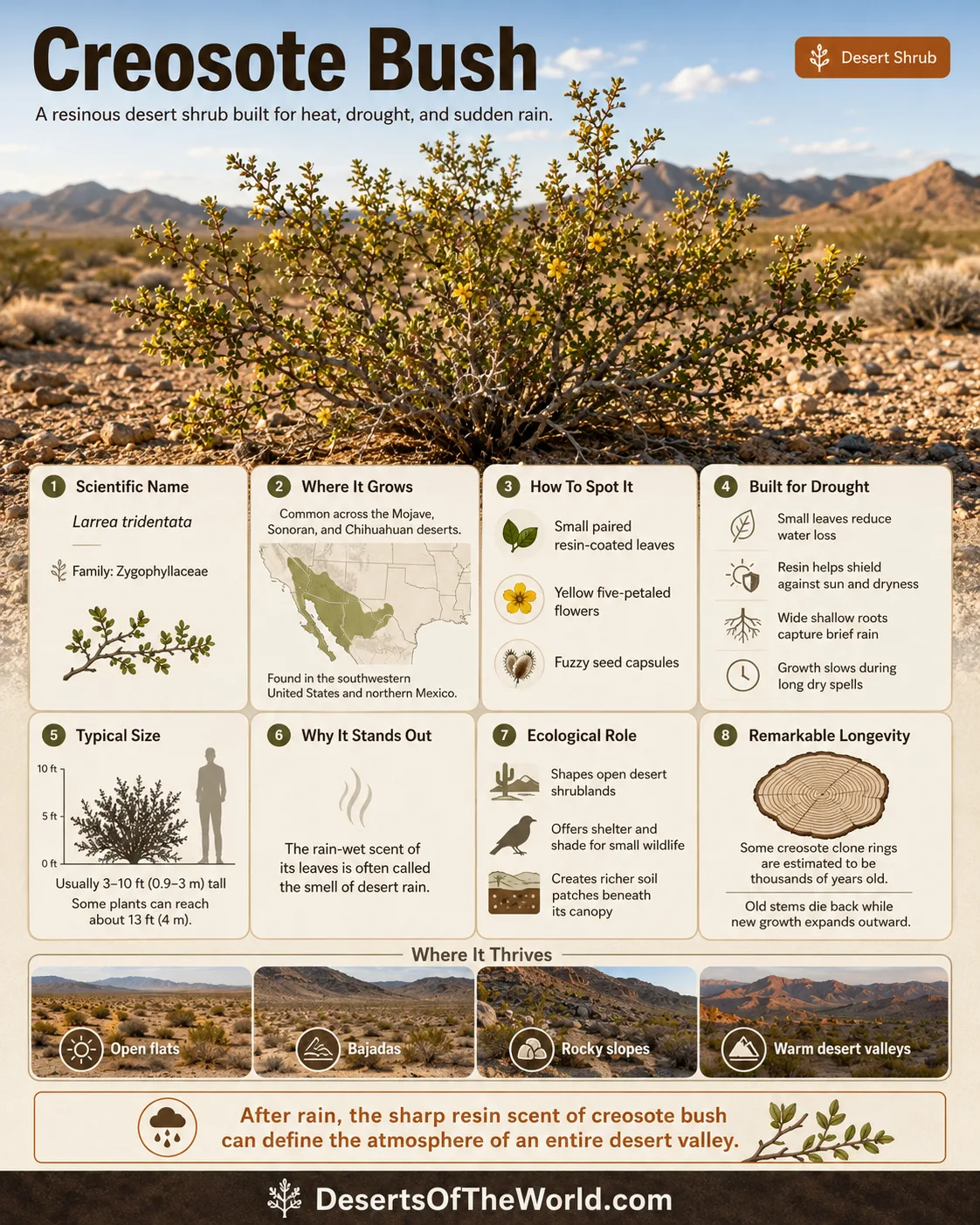
Creosote bush (Larrea tridentata) is a resinous evergreen shrub of the Mojave, Sonoran, and Chihuahuan deserts. It looks modest from a distance: low green branches, small paired leaves, yellow flowers, and pale fuzzy seed balls. Up close, it tells a larger desert story. This plant handles heat, thin soil, long dry spells, strong sunlight, and sudden rain pulses with a set of survival traits that make it one of the most recognizable shrubs in warm North American deserts.
The name “creosote bush” comes from the sharp, rain-wet scent released by its resin-coated leaves. In many desert valleys, that smell is simply the smell of rain. The plant is also called greasewood, chaparral, and in Spanish, gobernadora. It is not a cactus, not a tree, and not a plant that depends on deep shade. It is a desert shrub built for open flats, bajadas, rocky slopes, and sunlit valleys where water arrives briefly and leaves quickly.
Main Details for Creosote Bush
| Feature | Details |
|---|---|
| Scientific Name | Larrea tridentata |
| Plant Family | Zygophyllaceae, the caltrop family |
| Common Names | Creosote bush, creosotebush, greasewood, chaparral, gobernadora |
| Native Range | Southwestern United States and northern Mexico |
| Main Desert Regions | Mojave Desert, Sonoran Desert, Chihuahuan Desert, Baja Peninsula desert areas |
| Growth Form | Evergreen desert shrub with many upward and outward branches |
| Typical Height | About 3–10 ft (0.9–3 m), with some plants reaching around 13 ft (4 m) |
| Leaves | Small, paired, glossy, resinous leaflets |
| Flowers | Yellow, usually five-petaled, often most visible after seasonal rain |
| Fruit | Small rounded capsule covered with pale to rusty hairs |
| Desert Role | Dominant shrub in many warm desert scrub communities |
Where Creosote Bush Grows
Creosote bush grows across a broad warm-desert belt of southwestern North America. Its range extends through southern California, southern Nevada, southwestern Utah, Arizona, New Mexico, western Texas, and large parts of northern Mexico. It is especially tied to the Mojave, Sonoran, and Chihuahuan deserts, where it may form open shrublands that stretch across valley floors and low slopes.
Its habitat is not random. Creosote bush prefers places where winter cold does not last too long, where soil drains well, and where rain is scarce but not absent. It appears on:
- Alluvial fans and bajadas below desert mountains
- Gravelly flats and desert pavements
- Open valleys between mountain ranges
- Rocky slopes with shallow soil pockets
- Low desert plains with sparse shrub cover
In the Mojave Desert, creosote bush often grows with white bursage (Ambrosia dumosa). In the Sonoran Desert, it may share the ground with triangle-leaf bursage, palo verde, ocotillo, brittlebush, cholla, and cactus species. In the Chihuahuan Desert, it often appears with tarbush, mesquite, yucca, prickly pear, and desert grasses. Same shrub, different neighbors.
Creosote Bush Across the Mojave, Sonoran, and Chihuahuan Deserts
| Desert Region | Creosote Bush Setting | Common Plant Neighbors |
|---|---|---|
| Mojave Desert | Broad valley floors, gravel plains, bajadas, and low-elevation shrublands | White bursage, Joshua tree, desert holly, cholla, brittlebush |
| Sonoran Desert | Warm flats, lower slopes, desert washes, and open scrub near cactus-rich terrain | Triangle-leaf bursage, palo verde, ocotillo, saguaro, jojoba |
| Chihuahuan Desert | Dry basins, shrublands, grassland edges, and calcareous desert soils | Tarbush, mesquite, yucca, agave, prickly pear, desert grasses |
The plant changes subtly across these regions. Botanists have documented different chromosome counts in regional forms: 78 in the Mojave form, 52 in the Sonoran form, and 26 in the Chihuahuan form. That detail helps explain why creosote bush can feel like the same plant everywhere while still being finely tuned to local desert conditions.
How To Identify Creosote Bush
Creosote bush is easier to identify once you know the leaf pattern. The leaves are small, glossy, and usually divided into two joined leaflets. They sit opposite each other along slender stems. The surface often feels slightly sticky because the plant coats its leaves with resin.
Several traits stand out in the field:
- Leaves: tiny paired leaflets, green to yellow-green, shiny, and aromatic after moisture
- Flowers: yellow with five rounded petals
- Fruit: small fuzzy balls, often pale white or rusty in tone
- Shape: open vase-like shrub, often wider near the top than near the base
- Scent: strong resin smell after rain, humidity, or crushed leaves
A dry plant may look sparse, almost tired. After rain, it can brighten quickly. New leaves appear, yellow flowers open, and the resin smell rises from the branches. No drama needed; the change is plain to see.
Why the Leaves Smell After Rain
The scent comes from resinous compounds on the leaves. These compounds help the plant reduce water loss, reflect some sunlight, and protect tender tissues from harsh desert exposure. When humidity rises, the odor becomes more noticeable. Rain touches the leaf surface, and the smell spreads through the air.
This is why many people link creosote bush with “desert rain.” The plant does not create the rain, of course. It marks it. In a landscape where moisture can vanish in hours, that scent becomes part of the desert’s seasonal rhythm.
How Creosote Bush Survives Dry Desert Conditions
Creosote bush survives by spending water carefully. It does not race through the desert year. It waits, slows, sheds stress, and grows when conditions allow. That rhythm fits warm deserts where rain may arrive as scattered winter showers, summer monsoon pulses, or both.
The shrub’s drought survival comes from several traits working together:
- Small leaves reduce the surface area exposed to drying air.
- Resinous coatings help protect leaves from intense sunlight and water loss.
- Flexible growth lets the plant pause during dry spells and respond after rain.
- A wide root system gathers water from shallow soil after short storms.
- Older branches can die back while living parts continue from the crown.
The plant is evergreen, but that does not mean it grows evenly all year. In hard drought, leaves may become sparse and the plant may look nearly dormant. When rain returns, fresh growth can appear along the outer branches. Quietly, it resets.
Roots Built for Short Rain Pulses
Creosote bush is often described as drought-tolerant, but its root system is more practical than heroic. It commonly has a shallow taproot with lateral roots spreading through the upper soil. Those lateral roots can gather moisture from brief rains before it sinks too deep or evaporates.
In many desert soils, hard layers such as caliche can limit deep root growth. Creosote bush works with that reality. It uses the soil zone where quick moisture becomes available, then slows down when the pulse ends.
Why Creosote Bushes Often Look Evenly Spaced
Across many desert flats, creosote bushes appear spaced in a loose pattern, with bare ground between shrubs. That spacing has several causes. Roots compete for shallow moisture. Leaf litter changes the soil near the plant. Shade patterns, wind, runoff, soil crusts, and small animal activity also shape the space around each shrub.
People sometimes say “nothing grows under creosote bush.” That is too simple. Annual flowers, grasses, and small seedlings may appear near or under shrubs when rainfall and soil conditions line up. The open ground around creosote is better read as a water-and-soil pattern, not as an empty zone with one cause.
Flowers, Seeds, and Slow Establishment
Creosote bush flowers are small but easy to notice against gray-green desert scrub. The flowers are yellow and usually have five petals. Blooming often follows seasonal moisture, with spring flowers common in many areas and additional flowering possible after summer rains.
The seed capsules are fuzzy and rounded. Their hairs help the fruits move across the ground, especially in open flats where wind can push them along the surface. The seeds do not float like light plumes. They tumble.
Seedling survival is the hard part. Young creosote plants face heat, hungry animals, unstable soil, and long gaps between useful rains. Many seeds never become adult shrubs. This is one reason old creosote stands can look steady for a long time: adult plants persist, while successful replacement by seedlings may happen only in favorable years or protected microsites.
Long Life and Creosote Clone Rings
Creosote bush can live far longer than its size suggests. Individual stems may age, die back, and split from the original crown. Over time, a plant can form a ring of genetically related stems around the place where the original seedling once grew. The center may die, while the outer ring continues outward.
This clonal growth pattern has made creosote bush famous among long-lived desert plants. Some clone rings are estimated to be thousands of years old. The best-known example is often called King Clone, a creosote ring from the Mojave Desert near Lucerne Valley, California. Its age has been estimated at roughly 11,700 years in published discussions of creosote longevity, though age estimates for old clones depend on methods, growth rates, and site history.
The useful point is simple: creosote bush does not need fast growth to succeed. In harsh desert terrain, patience works.
Ecological Role in Desert Shrublands
Creosote bush helps define many warm desert scrub communities. It gives structure to open flats where tall trees are scarce and cactus cover may be patchy. Its branches provide perch sites, shade pockets, and shelter for desert insects, spiders, reptiles, and small mammals.
The shrub also affects the soil around it. Wind-blown dust, leaf litter, and organic debris can collect beneath the canopy. These “islands” under shrubs often differ from the open spaces between plants. The pattern matters because desert soils are not uniform. A few inches can change moisture, shade, temperature, and seed survival.
Wildlife Connections
Creosote bush is part of a small food-and-shelter web. Bees and other insects visit the yellow flowers. Gall midges may form round growths on stems or leaves. Small animals use the shrub’s shade during hot parts of the day. Birds may perch on the upper branches in open desert flats where taller vegetation is limited.
The plant is not a lush buffet. Desert life rarely works that way. Its value comes from persistence: it is present when many softer plants have dried away.
Creosote Bush Scrub as a Desert Plant Community
“Creosote bush scrub” describes desert vegetation where creosote bush is a main shrub, often mixed with bursage, tarbush, cactus, yucca, or desert grasses. This plant community is common across lower, warmer desert elevations.
The look of creosote scrub can change from place to place:
- On gravel plains, plants may sit far apart with wide bare spaces between them.
- Near washes, shrubs may grow taller and denser because water moves through the soil after storms.
- On rocky slopes, creosote may share space with agave, yucca, cactus, and small woody shrubs.
- In valley basins, creosote and bursage can create broad, open shrublands with low plant cover.
Creosote bush is one of the defining shrubs of North America’s warm deserts. It is not a rare botanical footnote. It can shape the look and structure of entire desert valleys.
Plants That May Be Confused With Creosote Bush
Creosote bush can be confused with other small desert shrubs, especially outside bloom season. Leaf shape, scent, and fruit texture usually separate it from lookalikes.
| Plant | How It Differs From Creosote Bush |
|---|---|
| White Bursage (Ambrosia dumosa) | Usually lower and grayer, with softer-looking leaves and no strong resin smell like creosote after rain. |
| Triangle-Leaf Bursage (Ambrosia deltoidea) | Has more triangular leaves and a compact form; common near creosote in the Sonoran Desert. |
| Brittlebush (Encelia farinosa) | Has pale, fuzzy, silvery leaves and daisy-like yellow flower heads on taller stalks. |
| Tarbush (Flourensia cernua) | Often associated with Chihuahuan Desert shrublands; leaves and flower heads differ from creosote’s paired leaflets and five-petaled flowers. |
The Name “Creosote” and What It Really Means
The common name can confuse readers because “creosote” also refers to tar-like industrial substances. Creosote bush is a plant. Its name comes from the odor of its resinous leaves, especially after rain or humidity. The plant is not the same thing as treated wood creosote or coal-tar creosote.
The older common name “chaparral” can also confuse people, because chaparral is a vegetation type in California and other Mediterranean-climate regions. In plant references, “chaparral” may refer to creosote bush in a traditional or herbal context, but the shrub itself is Larrea tridentata.
Traditional Use, Modern Caution, and Desert Respect
Creosote bush has a long record of traditional use in parts of its native range. Historical and ethnobotanical references mention leaves, resin, and plant material used in different ways by communities familiar with desert plants.
Creosote bush should be understood first as a native desert plant, not as a home remedy. Internal use of creosote bush products has been linked with health concerns in medical literature, so it should not be used for treatment without qualified medical guidance. In its natural habitat, the shrub is part of the structure and ecology of warm desert scrub.
What Creosote Bush Teaches About Desert Survival
Creosote bush is tough because it is careful. It does not rely on one trick. It uses small leaves, resin, slow growth, flexible dormancy, shallow water capture, cloning, and a long life span. Each trait helps a little. Together, they let the shrub hold ground in places where water is brief and heat is routine.
That is the real lesson of creosote bush. Desert survival is not always about storing huge amounts of water or growing sharp spines. Sometimes it is about restraint: lose less, wait longer, grow when the moment is right.
Sources
- USDA Forest Service Fire Effects Information System: Larrea tridentata (taxonomy, range, habitat, roots, reproduction, longevity, and desert plant communities)
- USDA PLANTS Database: Larrea tridentata (official plant profile and classification)
- National Park Service, Joshua Tree National Park: Creosote Bush (Mojave Desert context, scent after rain, chromosome forms, growth habit, and clone rings)
- National Park Service, Organ Pipe Cactus National Monument: Trees and Shrubs (Sonoran Desert identification notes, height, flowers, fruit, and plant community context)
- Oregon State University Landscape Plants: Larrea tridentata (botanical description, leaf size, flower form, fruit, and growth habit)
- Bureau of Land Management: Mojave Desert Native Plants, Larrea tridentata (distribution, habitat, plant associations, ecology, seed supply, nursery practice, and restoration notes)