
A desert stranding is not a test of toughness. It is a test of calm decisions. Heat, distance, dry air, poor signal, and confusing terrain can turn a small delay into a serious emergency. The safest pattern is simple: stop early, reduce heat exposure, protect your water, make yourself visible, and call for help as soon as possible.
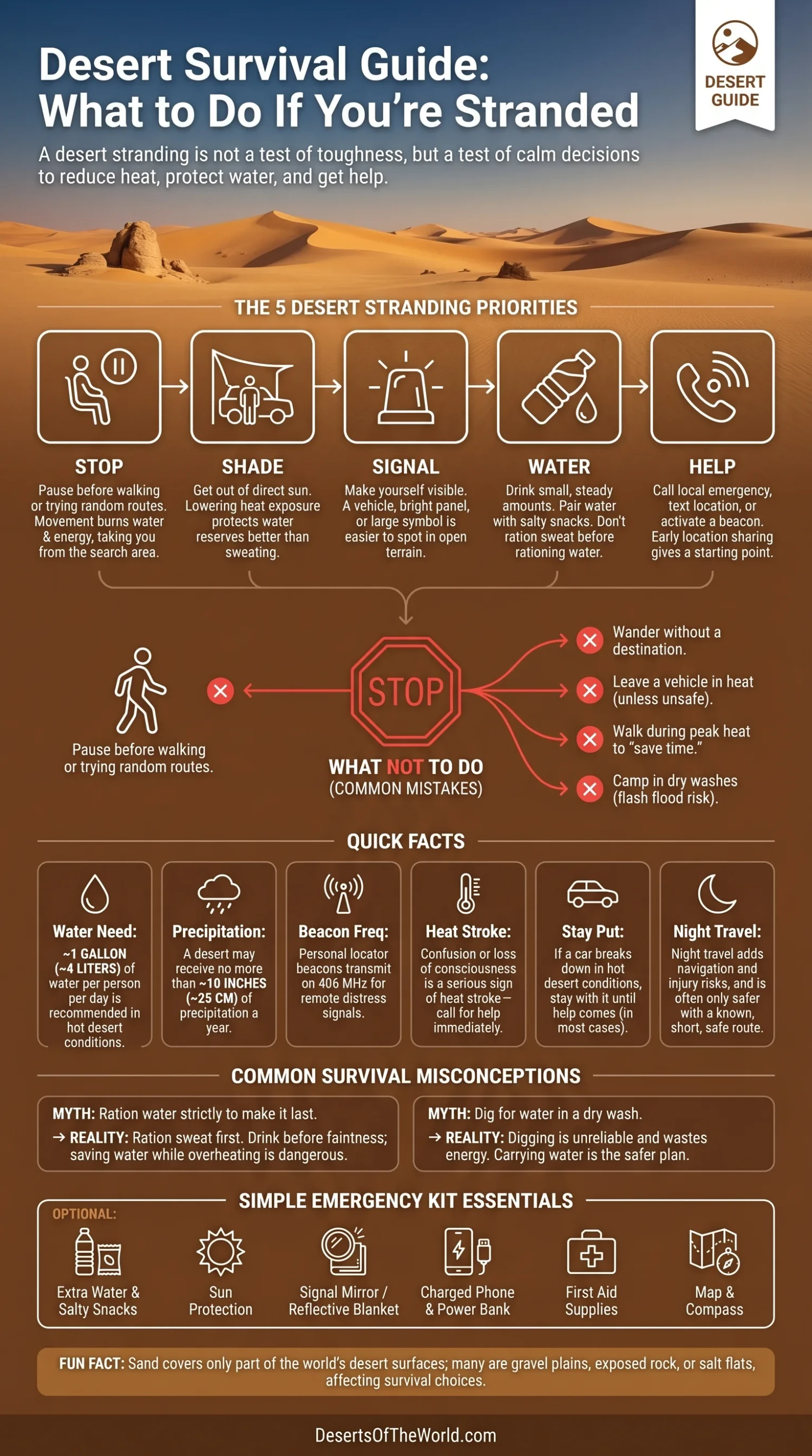
Desert Survival Guide: What to Do if You’re Stranded
Deserts are dry landscapes, but they are not all the same. Some are dune fields. Many are rocky plains, salt flats, gravel basins, dry washes, badlands, or high cold deserts. The common problem is water loss. A desert may receive no more than about 10 inches / 25 centimeters of precipitation a year, and evaporation often removes moisture faster than rain can replace it.
That dryness changes survival thinking. Sweat can vanish before a person notices how much water is leaving the body. Shade may be thin. Distances look shorter than they are. Phone service may disappear. A stranded person who walks without a clear plan can become harder to find than the vehicle, trailhead, or last known point they left behind.
| Priority | What It Means | Why It Matters in Desert Terrain |
|---|---|---|
| Stop | Pause before walking farther or trying random routes. | Movement burns water and energy, and it can take you away from the area rescuers may search first. |
| Shade | Get out of direct sun or create shade with a vehicle, tarp, clothing, pack, or natural cover. | Lowering heat exposure protects water reserves better than forcing the body to sweat. |
| Signal | Make yourself visible from the ground and air using bright material, mirrors, lights, or large ground markings. | Open desert has long sightlines, but a person is small. A vehicle, bright panel, or large symbol is easier to spot. |
| Water | Drink small, steady amounts and pair water with food or salty snacks when available. | Desert heat can drain fluids quickly, but water alone without salts can also cause problems during long heat exposure. |
| Help | Call the local emergency number, text location details, or activate an emergency beacon if you have one. | Early location sharing gives search teams a starting point while you still have battery and mental clarity. |
What Makes a Desert Stranding Different
A desert does not always announce danger loudly. The ground may look flat and open, yet it can hide soft sand, sharp rock, dry channels, steep washes, salt crusts, and heat-trapping basins. Even on mild days, the air can be so dry that thirst comes late.
Three desert traits matter most in a stranding:
- Low humidity: Sweat evaporates fast, so clothing may not feel soaked even when the body is losing water.
- Wide temperature swings: Hot deserts can cool sharply after sunset. High deserts and cold deserts may become chilly or freezing at night.
- Open but confusing terrain: Dunes, gravel flats, washes, and mirages can make distance and direction hard to judge.
Not all deserts are sand seas. The U.S. Geological Survey notes that sand covers only part of the world’s desert surfaces; many arid lands are gravel plains, exposed rock, desert soils, alluvial fans, playas, or oasis zones. This matters because survival choices change with the ground under your feet. A stuck vehicle in sand, a lost hiker on white dunes, and a driver stopped on a remote gravel road all need slightly different actions.
The First 10 Minutes: Stop, Cool Down, and Make Yourself Findable
The first minutes shape the rest of the emergency. Panic pushes people into the hottest part of the day, away from shade, and away from their last known location. Stillness helps. Breathe, check injuries, look at your supplies, and decide what can be done without wasting sweat.
Do These First
- Move out of direct sun if shade is nearby.
- Call the local emergency number while the phone still has power.
- Send a text with your location, route, vehicle description, number of people, water supply, and visible landmarks.
- Turn on battery-saving mode after sending messages.
- Mark your location with bright clothing, a reflective item, or a large ground signal.
- Check everyone for dizziness, confusion, headache, nausea, cramps, or unusual tiredness.
If you have a GPS coordinate, copy it exactly. If not, describe the last known road, trailhead, junction, mile marker, wash, ridge, ruin, visitor center, campground, or named landform. A rough but honest location is better than silence.
Use the Stop–Think–Observe–Plan Method
A simple field method works well here:
- Stop: Sit down in shade or create shade.
- Think: Avoid sudden decisions based on fear.
- Observe: Count water, food, battery, clothing, tools, daylight, and weather signs.
- Plan: Choose one safe action at a time.
In a desert, the plan should usually favor staying findable over roaming. A person moving across open ground is like a bead on a huge table. A vehicle, trailhead, or marked spot is a much larger target.
If You Are Stranded With a Vehicle
A vehicle is usually the best survival tool you have. It gives shade, visibility, a possible radio or phone charging source, reflective surfaces, shelter from wind, and a fixed point for rescuers. National Park Service desert safety pages often give the same core advice: if the car breaks down in hot desert conditions, stay with it until help comes, unless the location itself is unsafe.
Stay With the Vehicle in Most Cases
Staying with the vehicle makes sense when:
- You told someone your route or destination.
- You are on or near a known road, track, trailhead, or parking area.
- You do not know exactly where reliable help is.
- The heat is strong or water is limited.
- Someone is injured, dizzy, confused, or weak.
Leaving the vehicle may only make sense when the vehicle is in immediate danger, such as a wash during rising water, a slope with rockfall risk, or a location where staying put is clearly unsafe. Even then, move to the nearest safer high or shaded place and keep the vehicle visible if possible.
Make the Vehicle Look Like a Help Signal
- Raise the hood if it can be done safely.
- Place a bright cloth, reflective blanket, or light-colored shirt on the roof or antenna.
- Use a mirror, phone screen, metal surface, or emergency mirror to flash sunlight toward roads, aircraft, or distant people.
- At night, use hazard lights in short, planned periods to save the battery.
- Place a large ground marker near the vehicle using rocks, branches, packs, or contrasting material.
Do not sit inside a closed vehicle in extreme heat. Use the vehicle for shade, but manage airflow. Shade from the side of the vehicle, a tarp, or a door can be safer than sitting in a heat-filled cabin.
If the Vehicle Is Stuck in Sand or Mud
Do not keep spinning the tires. That can dig the vehicle deeper. Use smooth, gentle movement if you know the correct recovery method and can do it without overheating yourself. If recovery is not easy, stop. A stranded but visible vehicle is better than an overheated person beside a deeper rut.
Simple, low-risk steps may include clearing loose sand from around tires, placing a floor mat or flat material for traction, and reducing unnecessary load. But only work in cool periods and only for short bursts. Sweat is the hidden cost.
If You Are Stranded on Foot
A hiker, photographer, cyclist, or visitor away from a vehicle has fewer margins. The safest move is often to stop near a visible place and make that place easy to search. In dune fields, for example, rangers advise lost visitors to stop, sit high on a dune, and signal rather than wander.
Choose a Waiting Spot Carefully
A good waiting spot is:
- Visible from above or from nearby high ground.
- Close to your last known route.
- Out of dry washes, flood channels, and narrow canyon bottoms.
- Near shade or materials that can create shade.
- Safe from loose rock, unstable ledges, and cliff edges.
If you are on a marked trail, stay on or near it. If you leave a trail to reach shade, mark the trail edge clearly with a visible object so searchers can notice your direction.
Leave Clear Clues if You Must Move
Sometimes movement becomes necessary: no shade, unsafe ground, incoming storm water, or a known shelter very close by. If you move, leave clues.
- Write the time and direction of travel on paper, bark-free wood, smooth stone, or in the sand.
- Place arrows using rocks or sticks.
- Move during cooler hours, not under full midday sun.
- Keep the route simple. Do not zigzag through washes, dunes, and side canyons.
- Stop often and reassess.
Walking at random is one of the worst desert decisions. Walking with a clear reason, short distance, and visible markers is different.
Water: Drink Carefully, but Do Not Save It Too Long
Many desert parks recommend at least 1 gallon / 4 liters of water per person per day in hot conditions. Some recommend more for hikers and cyclists. Death Valley and Mojave guidance both point to the same idea: desert heat demands more water than many visitors expect.
There is a common survival mistake: saving water so strictly that the body overheats and weakens while water remains in the bottle. A better rule is to ration sweat before rationing water. Shade, rest, loose clothing, and stillness reduce water loss. Then drink small amounts at steady intervals.
Water Decisions That Help
- Drink before you become confused, faint, or severely weak.
- Take small sips often instead of waiting until thirst becomes strong.
- Eat salty snacks or normal food if available, especially during long heat exposure.
- Keep water bottles shaded, not on hot metal or direct rock.
- If half your water is gone during a planned walk, turn back unless rescue or shade changes the situation.
Do Not Trust Unverified Desert Water
Maps may show springs, tanks, wells, or seasonal water. In deserts, those sources may be dry, contaminated, restricted, or used by wildlife. Do not stake your safety on a water mark on a map. If you find water and must use it, filter or treat it when you can. Clear water can still carry biological risk.
Water Myths to Avoid
- Do not drink untreated unknown water unless the alternative is worse and no treatment option exists.
- Do not depend on cactus water. Many plants are hard to identify, protected, unsafe, or not useful as a water source.
- Do not drink seawater or very salty water in coastal desert settings.
- Do not eat unfamiliar plants to “get moisture.” Misidentification can make the situation worse.
Shelter and Shade: Lower Body Heat Before Moving
Shade is not comfort. In desert survival, shade is water protection. Every minute out of full sun reduces the body’s cooling load. That means less sweating and clearer thinking.
Use What You Already Have
- A vehicle door, open hatch, tarp, emergency blanket, sleeping pad, poncho, jacket, or pack can create shade.
- Light, loose clothing protects skin better than removing too much clothing in full sun.
- A hat, long sleeves, sunglasses, and neck covering help reduce solar exposure.
- Sit on a pack, pad, folded clothing, or wood instead of hot ground.
Under full sun, rock, sand, and vehicle surfaces can become very hot. The ground can heat the body from below while the sun heats it from above. A small air gap under the body helps.
Cold Nights Still Matter
Deserts can cool quickly after sunset, especially in high basins, plateaus, and winter conditions. Keep one dry layer for night. If you sweated during the day, change or loosen damp clothing before temperatures fall. Use the vehicle, a windbreak, or natural shelter to reduce exposure to cold wind.
Signaling for Rescue in Open Desert Terrain
Desert landscapes can help rescuers because open ground offers long views. The problem is scale. A person lying in the shade may be almost invisible from a road or aircraft. Make your location look unnatural, bright, and deliberate.
Day Signals
- Use a mirror, phone screen, foil, metal bottle, or reflective blanket to flash sunlight.
- Lay out bright clothing, a tarp, or a contrasting panel on open ground.
- Create a large X or SOS with rocks, branches, backpacks, or marks in sand.
- Stand near the signal when aircraft, vehicles, or people are visible, then return to shade.
- Use slow arm waves with both arms when someone can see you.
Night Signals
- Use a flashlight, headlamp, phone light, strobe, or vehicle lights in repeated patterns.
- Save battery by signaling at intervals rather than leaving every light on all night.
- Keep one light source reserved for emergency use.
Fire is not a first-choice signal in many desert areas. Dry vegetation, wind, park rules, and wildfire risk make it unsafe in many locations. Use light, reflection, and ground markings first.
Phones, Texts, and Beacons
Cell service can be weak or absent. A text may send when a voice call will not. Try a short emergency text with location details, then conserve battery. If you carry a satellite messenger or a registered personal locator beacon, use it according to its instructions when the situation is urgent.
Personal locator beacons are designed for remote emergencies and transmit on 406 MHz. Some models include GNSS/GPS location in the distress signal, and activated units are built to operate for a minimum emergency period. They are preparation tools, not decorations at the bottom of a pack.
Heat Illness: Warning Signs That Need Fast Action
Heat illness can move from mild to severe quickly in a desert. The Centers for Disease Control and Prevention describes heat stroke as the most serious heat-related illness; body temperature can rise rapidly, and confusion or loss of consciousness can appear. Treat altered thinking in heat as an emergency.
| Condition | Possible Signs | Immediate Action |
|---|---|---|
| Heat Cramps | Muscle pains or spasms, often in legs, arms, or abdomen. | Stop activity, rest in shade, sip water, and eat salty food if available. |
| Heat Exhaustion | Heavy sweating, weakness, headache, nausea, dizziness, cool clammy skin, fast weak pulse, or faintness. | Move to shade, loosen clothing, cool the head and neck, sip water, and seek medical help if symptoms worsen or last longer than about an hour. |
| Heat Stroke | Confusion, disorientation, slurred speech, loss of consciousness, seizure, very high body temperature, or hot skin with or without sweating. | Call emergency services immediately. Cool the person fast with shade, wet cloths, water on clothing, airflow, and cooling around the head, neck, armpits, and groin while waiting for help. |
Cool First, Then Solve Other Problems
A person with heat illness may not make good decisions. Do not ask them to “push through.” Move them out of sun, reduce clothing layers, wet fabric if water can be spared, fan air across damp cloth, and keep someone with them.
If the person is confused, fainting, unable to drink safely, or getting worse, treat the situation as urgent. Heat stroke is not solved by rest alone.
Navigation: When Moving Is Safer and When It Is Not
The safest navigation choice depends on what is known, not what is hoped. Desert distances deceive the eye. A road that looks close may be many miles away across rough ground. A ridge that looks easy may hide cliffs, drainages, and soft sand.
Stay Put When
- Your route and return time were shared with someone.
- You are near a vehicle, trail, road, or last known location.
- You lack enough water for the walk.
- The day is hot and shade is available where you are.
- You do not know the exact distance to help.
- Someone is injured or showing heat illness signs.
Move Only When
- The current spot is unsafe because of flooding, rockfall, exposure, or other immediate hazard.
- You can see a safe shelter or road very close by.
- You have enough water, daylight, and strength for the distance.
- You can leave clear markers behind.
- You move during cooler hours and stop before heat builds again.
Navigation tools help, but they can fail. GPS maps can send drivers onto rough or outdated tracks. Phone batteries drain. Paper maps, a compass, route notes, and visible landmarks still matter in remote desert travel.
Desert Weather Risks Beyond Heat
Heat gets the attention, but deserts have other hazards. Some arrive fast.
Flash Floods in Dry Washes
A dry wash is not a campsite. Rain can fall miles away and send water down a canyon or channel with little warning. Avoid narrow canyons, drainage bottoms, and low crossings when storms are possible. Never try to cross moving floodwater in a vehicle or on foot.
Lightning in Open Terrain
Open desert ridges, isolated trees, metal fences, and high points can be dangerous during thunderstorms. The National Weather Service is clear: there is no safe place outside when thunderstorms are in the area. A substantial building or enclosed hard-topped vehicle is safer than open ground.
Dust, Wind, and Low Visibility
Wind can hide tracks, bury footprints, irritate eyes, and reduce visibility. Cover your nose and mouth with cloth during blowing dust, protect your eyes, and avoid walking in dust conditions unless moving away from immediate danger.
Cold, Even in a Desert
Cold deserts and high deserts can bring freezing nights. Hypothermia risk rises when a tired person is sweaty, dehydrated, and exposed to wind. Keep insulation dry. Block wind. Use the vehicle, pack, pad, or natural shelter to reduce contact with cold ground.
What Not to Do When Stranded in the Desert
Some mistakes appear in desert stories again and again. They are easy to understand. Fear makes distance look smaller. Thirst makes poor water choices tempting. A visible road on the horizon feels like a promise. It may not be.
- Do not wander without a clear destination. Random movement makes search harder.
- Do not leave a vehicle in heat unless staying is unsafe. A vehicle is easier to spot than a person.
- Do not wait too long to call for help. Battery, daylight, and judgment can fade.
- Do not walk during peak heat to “save time.” It often costs more water than it saves.
- Do not depend only on phone GPS. Carry a map, route notes, and a backup power source before travel.
- Do not camp in dry washes. They can flood even when the sky above looks clear.
- Do not remove all sun protection. Bare skin can heat and burn fast.
- Do not ignore confusion. In heat, confusion is a serious warning sign.
Simple Desert Emergency Kit Before a Trip
Preparedness is part of desert survival because the desert gives little back once supplies run out. A small kit can change the outcome of a breakdown, wrong turn, or delayed return.
| Item | Why It Helps |
|---|---|
| Extra Water | Plan for at least 1 gallon / 4 liters per person per day in hot desert conditions, with more for exertion or delays. |
| Salty Food or Electrolytes | Helps replace salts lost through sweat during long heat exposure. |
| Sun Protection | Wide-brimmed hat, sunglasses, sunscreen, and long sleeves reduce direct solar stress. |
| Map and Compass | Useful when GPS, phone maps, or vehicle navigation fail. |
| Charged Phone and Power Bank | Supports emergency calls, texts, coordinates, and light signaling. |
| Signal Mirror or Reflective Blanket | Creates visible flashes or a bright ground marker in open terrain. |
| Flashlight or Headlamp | Helps with night signaling and safe movement after dark. |
| First Aid Supplies | Supports basic care for blisters, cuts, heat stress, and minor injuries. |
| Tarp, Emergency Blanket, or Poncho | Creates shade by day and wind protection at night. |
| Vehicle Recovery Basics | Spare tire, tire inflator, pressure gauge, shovel, and traction boards can help on remote dirt roads. |
| Personal Locator Beacon or Satellite Messenger | Can send an emergency signal when cell service is unavailable. |
Desert Survival Questions
Should You Stay With Your Car if Stranded in the Desert?
In most hot desert breakdowns, yes. A vehicle gives shade, visibility, signaling options, and a fixed search point. Leave only if the vehicle is in an unsafe place, such as a flood channel, or if you know a safe destination is very close and conditions allow careful movement.
How Much Water Do You Need in a Desert Emergency?
Many desert parks recommend at least 1 gallon / 4 liters per person per day in hot conditions. Hikers, cyclists, and people doing physical work may need more. Water need changes with heat, wind, body size, health, clothing, and exertion.
Is It Better to Travel at Night?
Night travel can reduce heat stress, but it adds navigation and injury risks. It may be safer only when the route is known, the distance is short, the ground is safe, and you have light, water, and a clear reason to move. Otherwise, staying findable is usually safer.
Can You Find Water by Digging in a Dry Wash?
Sometimes water exists below the surface in certain desert settings, but digging is not reliable and can waste energy. Many mapped springs and washes are seasonal, dry, polluted, or too far away. Carrying water remains the safer plan.
What Is the Biggest Mistake People Make When Stranded?
The biggest mistake is often leaving a known point and walking without a clear, safe plan. Heat, distance, and panic can turn a short-looking walk into a much harder situation. Stop, shade, signal, and call for help first.
What Should You Do if Someone Shows Heat Stroke Signs?
Call emergency services immediately. Move the person to shade, remove excess clothing, cool them quickly with wet cloths or water on clothing, and focus cooling around the head, neck, armpits, and groin. Stay with them until help arrives.
Sources
- National Park Service – Death Valley National Park Safety (desert heat, water needs, heat illness signs, and vehicle safety)
- National Park Service – Mojave National Preserve Safety (off-pavement desert travel, water amounts, route sharing, and supplies)
- National Park Service – White Sands Hiking Safety Tips (lost hiker actions, signaling, phone use, and staying visible)
- CDC / NIOSH – Heat-Related Illnesses (heat exhaustion, heat stroke symptoms, and first aid)
- Ready.gov – Extreme Heat (heat warnings, vulnerable groups, and emergency heat response)
- National Weather Service – Lightning Safety Overview (safe shelter and thunderstorm risk outdoors)
- NOAA SARSAT – 406 MHz Emergency Distress Beacons (personal locator beacons and emergency signal basics)
- U.S. Geological Survey – What Is a Desert? (desert definition, arid land, and desert surface types)