
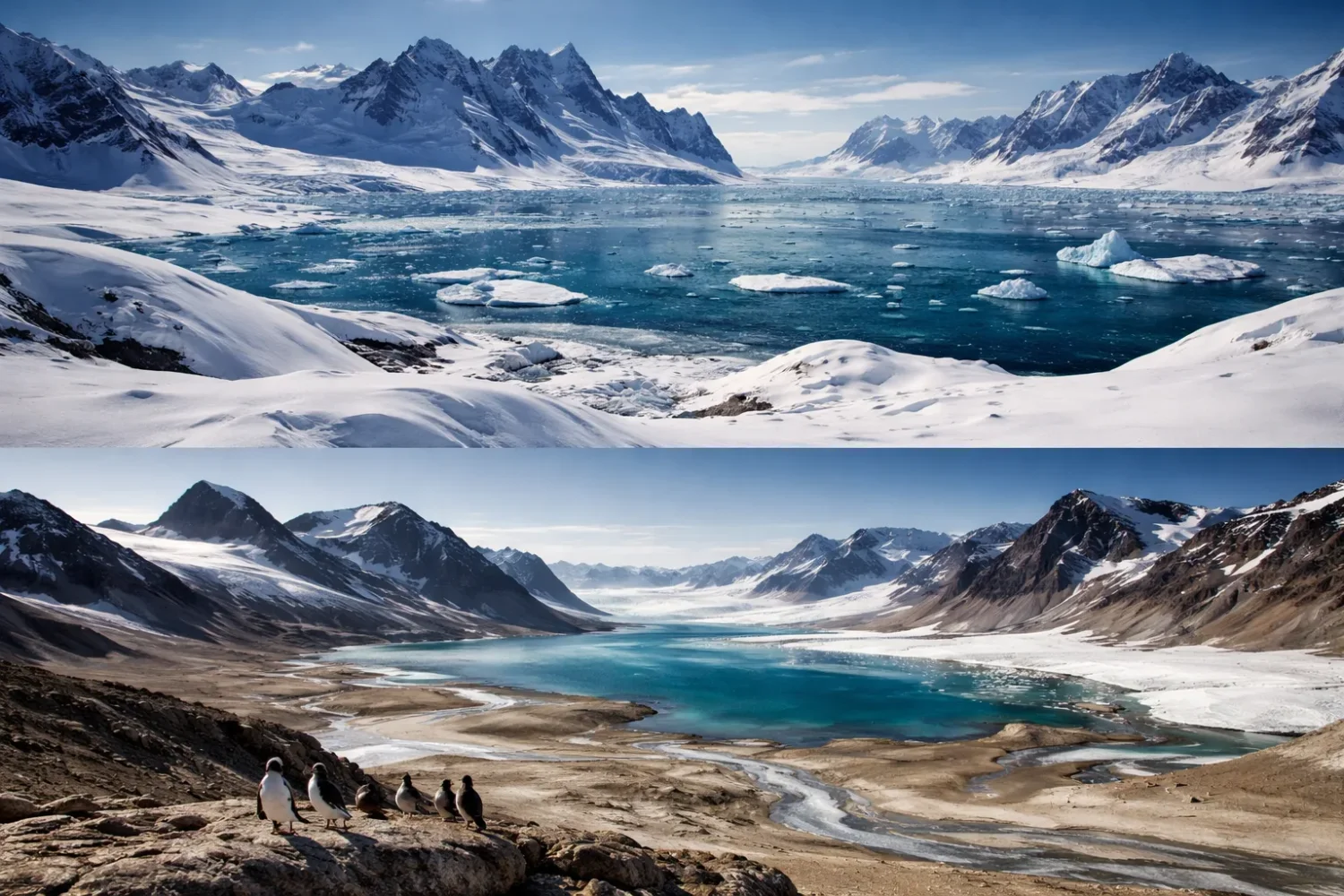
A polar desert rarely matches the image most people carry in their heads. There are no sunburned dunes rolling for days, no cactus silhouettes, no baked red plains. Instead, these places run on cold, dryness, wind, salt, ice, and bare mineral ground. Some parts stay hidden under ice sheets. Other parts stand open as gravel terraces, shattered bedrock, frost-cracked soil, dry valley floors, and wind-scoured ridges. Quiet landscapes, often. Empty-looking too. Yet the ecology, geology, and climate of a polar desert are anything but simple.
Russian Arctic
Location & Continent Continent: Europe & Asia (Eurasia) Country: Russian Federation Region: Russian Arctic Desert & High Arctic...
Read More →Greenland (Polar Desert)
Location & Continent Continent: North America Country: Greenland (Kalaallit Nunaat) – an autonomous territory within the Kingdom of...
Read More →North American Arctic
Location & Continent Continent: North America – the northern polar fringe of the continent, entirely above or near...
Read More →Arctic Desert (Polar Desert)
Location & Continent Continent: Mostly Europe & Asia (Eurasian Arctic), with related polar desert zones in North America...
Read More →Meyer Desert
Meyer Desert – Location & Continent Continent: Antarctica Region: Ross Dependency, Transantarctic Mountains (northern Dominion Range) Nearby features:...
Read More →McMurdo Dry Valleys
Location & Continent Continent: Antarctica Region: Victoria Land, along the coast of the Ross Sea and McMurdo Sound...
Read More →Antarctic Desert (Polar Desert)
Photos of the Antarctic Desert Location & Continent Continent: Antarctica – a vast polar desert wrapped around the...
Read More →7 inventions in Polar Deserts
Desert means dry more than it means hot. That one idea clears up most confusion at once. The Arctic and Antarctica hold vast amounts of frozen water, but living systems there still struggle with liquid water shortage. Snowfall stays low, evaporation is limited but so is thaw, and much of the year the available moisture remains locked as snow, ice, permafrost, or saline ground ice. The result is a biome shaped less by heat and more by moisture poverty.
Seen from space, polar deserts look white or steel gray. Seen on the ground, they show more texture: patterned ground, frost polygons, stone stripes, ventifacted pebbles, salt crusts, nunataks, blue-ice patches, dry stream channels, and low plant communities pressed flat by wind. Some surfaces appear almost lifeless. Look closer and you find lichens clinging to rock, microbes living inside stone, moss beside seasonal meltwater, and small animals surviving on a timing so narrow it feels almost impossible. Briefly the landscape softens. Then winter closes the door again.
Polar Desert Regions Covered on This Page
This subject works best when it stays tied to real places, not just textbook labels. The seven regions below anchor the discussion and show how broad the polar desert idea really is, from the ice-capped north to the dry valleys and fossil-bearing outcrops of Antarctica.
| Region | Main Setting | Why It Matters |
|---|---|---|
| Arctic Desert | High-latitude Arctic belts across islands, coasts, and ice-dominated terrain | The broad northern model of a cold desert, where low precipitation, permafrost, and sparse plant cover define the biome. |
| North American Arctic | Canadian High Arctic and nearby polar fringe | Shows how the driest parts of the Canadian Arctic Archipelago behave as true polar desert rather than classic tundra. |
| Greenland | North America, with a huge ice sheet and dry far-northern margins | Useful for separating wet southern coastal zones from the dry northern Arctic-desert landscapes many readers overlook. |
| Russian Arctic | Eurasian High Arctic islands and glacier-heavy archipelagos | One of the clearest examples of icy, stony, wind-shaped desert terrain in the northern hemisphere. |
| Antarctic Desert | Continent-wide south polar desert | The largest desert on Earth and the clearest proof that ice cover does not cancel desert status. |
| McMurdo Dry Valleys | Ice-free valleys in Victoria Land, Antarctica | A rare place where Antarctic desert processes stand exposed: katabatic winds, saline lakes, dry soils, and rock-based microbial life. |
| Meyer Desert | Ice-free area in the Dominion Range, Antarctica | Small in area, huge in scientific value, especially for what its sediments and fossils reveal about older Antarctic environments. |
What Counts as a Polar Desert
A polar desert is a cold desert biome found at very high latitudes. The broad desert rule used in many climate discussions sets the upper limit at about 250 millimetres of annual precipitation or less. Some ecological studies use an even tighter description for true polar-desert soils: annual precipitation under roughly 150 millimetres and a warmest-month mean below 10°C. The exact number shifts a little from source to source. The pattern does not. These places stay dry enough, cold enough, and biologically lean enough to form a desert system.
The word desert confuses readers because snowfall can still occur often in cold air. Yet snowfall amount and water availability are not the same thing. In very cold air, snow may be fluffy and moisture-poor. Wind can move it long distances. Sublimation can remove it without any liquid phase at all. On many polar surfaces, a thin white cover suggests abundance, but the living ground beneath remains thirsty. Dryness hides in plain sight.
Temperature matters too, but not in the way hot-desert definitions teach us to think. In the polar desert biome, the warm season is short, low-angle sunlight limits energy, and soils thaw only shallowly where they thaw at all. That shallow seasonal thaw is called the active layer. Beneath it lies permafrost, frozen ground that may persist for years, centuries, or far longer. Once you understand that stack of conditions—low precipitation, low evaporation, shallow thaw, frozen storage, fierce wind, scarce liquid water—the desert label starts to feel exact rather than strange.
There is also a vegetation test, even if nobody states it that way out loud. True polar desert terrain supports very limited plant cover. Tall shrubs do not set the tone. Dense tundra meadows do not set the tone either. What you usually see instead is a thin scatter of lichens, moss patches in sheltered wet spots, dark microbial films, cushion plants, tiny forbs, or plain bare ground with only occassional life signals. In the harshest sectors, exposed mineral surfaces dominate so strongly that the land reads almost sterile until you get down on a knee and inspect the stone itself.
A Simple Working Definition
A polar desert is a cold, high-latitude biome where annual precipitation stays very low, the warm season remains weak, liquid water is limited for much of the year, plant cover is sparse, and the ground is shaped by frost, wind, ice, and mineral weathering more than by dense vegetation.
That definition also helps separate polar desert from tundra. The two sit close together on maps and often grade into one another. Tundra usually carries more continuous plant cover, more organic material near the surface, and a slightly less severe moisture-energy bottleneck during summer. Polar desert pushes farther toward barrenness. The transition can be subtle. In some Arctic islands, one slope looks desert-like while a nearby wet hollow feels fully tundra. Sharp borders are rare. Environmental gradients run the show.
Why Ice and Snow Do Not Cancel Desert Status
The fastest way to understand polar deserts is to drop the sand-based idea of desert altogether. A desert is not defined by what covers the ground. It is defined by how little moisture arrives and how little of that moisture becomes biologically useful. Ice sheets and snowfields can sit on top of a desert climate. Antarctica proves this better than anywhere else. Its interior receives so little precipitation that the continent qualifies as a desert even while it holds most of the planet’s surface fresh water in frozen form.
Think of it this way: frozen water is storage, not daily supply. Plants, microbes, soil animals, and weathering processes need moisture that can move, seep, melt, refreeze, or remain thinly liquid around grains and pores. In the Arctic and Antarctic interior, much of the water budget stays locked up. What looks wet from a planetary view can act dry at the scale of soil, root, lichen crust, or microbial mat.
Another point matters. In many polar desert settings, the air is too cold to hold much water vapour in the first place. That limits cloud moisture and keeps total precipitation low. On the Antarctic plateau this effect becomes extreme. The air may feel still and empty, and in a physical sense it nearly is—thin in moisture, stingy with snow, reluctant to release meltwater. White surface, desert climate. There is no contradiction there.
Arctic and Antarctic: Two Polar Desert Systems, Not One
Readers often group the north and south poles into a single mental picture. That blur hides a lot. The Arctic is mostly an ocean surrounded by continents. Antarctica is a continent surrounded by ocean. That one structural difference changes climate, surface processes, ecology, and even the look of the desert itself.
In the Arctic, sea ice, open-water leads, storm tracks, island chains, and nearby continental landmasses create a mosaic. Polar desert appears in pieces—on the driest High Arctic islands, in glacier-fringed coasts, on polar barrens, and across rocky sectors where vegetation stays thin. Moisture patterns vary a lot from one side of the Arctic to the other. The Atlantic-facing north is often wetter. Interior High Arctic sectors and parts of the Canadian Archipelago are much drier. So the northern polar desert is a patchwork.
Antarctica behaves differently. Much of the continent forms one massive cold-dry system, with a high ice-covered interior and a narrow fringe of coastal and ice-free ground. The Antarctic version is more unified, more continental, and in many places more severe. Only a tiny share of Antarctica is free of snow and ice—roughly 0.4% by commonly cited Antarctic research figures—yet that small fraction carries outsized scientific value because it exposes the actual desert surface: rock, gravel, salts, patterned ground, lakes, dry streams, moss beds, and ancient sediments.
| Feature | Arctic Polar Desert | Antarctic Polar Desert |
|---|---|---|
| Basic Setting | An ocean-centred north with islands, archipelagos, and continental margins | A continental south pole wrapped in a vast ice sheet |
| Spatial Pattern | Broken into sectors and regional belts | Broad continent-wide desert system with rare ice-free windows |
| Vegetation | Sparse but often more varied than in Antarctica, especially in sheltered Arctic sites | Far more limited on land; strongest biological activity appears near coasts or summer melt zones |
| Typical Surfaces | Permafrost plains, bare rock, frost-shattered slopes, polar barrens, icy coasts | Ice sheet, blue ice, nunataks, dry valleys, gravel plains, saline ponds, exposed bedrock |
| Moisture Control | Sea-ice cover, storm tracks, distance from open water, local topography | Extreme continental cold, low vapour content, katabatic winds, elevation, interior isolation |
| Reader Mistake | Calling all High Arctic terrain “tundra” | Assuming ice cover means it cannot be a desert |
The Arctic also supports a wider terrestrial species mix in many places because it connects to northern continental ecosystems. That does not make the Arctic desert mild. It simply means there are more transition zones. Antarctica, by contrast, isolates life with brutal efficiency. Inland land life there remains sparse, highly specialized, and often microscopic. Animals people associate with the Antarctic—penguins, seals, seabirds—depend mainly on the surrounding sea rather than on the inland desert floor. That distinction matters a lot.
So when someone says “polar desert,” it helps to ask a second question right away: north or south? The answer changes almost everything—surface form, moisture path, species pattern, and the way the desert reveals itself to the eye.
How Polar Deserts Form
No single cause creates a polar desert. Several controls pile on top of one another. Low temperatures reduce the atmosphere’s ability to hold moisture. Distance from open water limits supply. High pressure can suppress cloud formation. Mountains can block snow-bearing air. Wind strips and redistributes snow. Frozen ground traps water beneath the surface. Strong reflection from snow and ice keeps energy low. Put those pieces together and a cold desert takes shape.
Low Atmospheric Moisture
Cold air simply cannot carry the same amount of water vapour as warm air. That is the first gate. Over the Antarctic interior, the air stays so cold and dry that annual precipitation can sink to only about 50 millimetres water equivalent on the inland plateau, while the continent as a whole averages roughly 150 millimetres. In the Arctic, many areas are wetter than that, but the driest High Arctic sectors still qualify as desert by the same moisture logic. Some parts receive amounts comparable to hot deserts, even when snow falls more often than rain ever would.
This dryness reshapes more than the sky. It affects soil development, salt movement, microbial metabolism, frost cracking, and the time window in which plants can stay physiologically active. Moisture is not just a number on a graph. It is the gatekeeper for almost every other process in the system.
Snow Does Not Always Stay Where It Falls
Wind is a geomorphic force in all deserts, and in polar deserts it can dominate the surface story. Snow that lands lightly may not stay put. It can drift into hollows, pack into lee slopes, blow off exposed ridges, or sublimate away. That means precipitation maps and ground reality do not always match at small scale. One patch may build a snowbank that feeds meltwater for weeks. Ten metres away, a ridge remains bare, dry, and biologically starved.
In Antarctica, katabatic winds matter especially. These are gravity-driven downslope winds formed as cold, dense air spills from higher ice surfaces toward lower ground. In ice-free valleys and leeward zones, they can scour snow, dry the air, and keep valley floors astonishingly bare. Their effect is physical and immediate. Snow vanishes. Humidity drops. Surfaces harden. Desert character sharpens.
Elevation and Continentality
The Antarctic plateau sits high, cold, and far from easy oceanic moisture delivery. Elevation chills the air further, while continental distance reduces what little vapour might have arrived. This makes the south polar desert especially severe. In the Arctic, continentality works in a different way. High Arctic islands and interior coastal sectors may lie far from strong moisture sources during long frozen seasons, especially when nearby ocean surfaces stay sealed under sea ice. Less open water, less vapour feed. The dryness tightens.
That is why the Arctic can flip from wetter subarctic shores to true polar desert over a broad but uneven northward gradient. The biome does not appear because of latitude alone. It appears where the full moisture-energy balance tips far enough toward scarcity.
Permafrost Locks Water in Place
Even where snow or meltwater exists, the ground may not behave like open soil. Permafrost blocks deep infiltration. Water stays near the surface, refreezes, ponds briefly, or runs off in a thin seasonal pulse. In some places this helps life by keeping moisture close to roots and microbes. In others it does the opposite by limiting drainage, concentrating salts, and shortening the usable season. A cold desert is full of these small contradictions.
Freeze-thaw cycles, ground-ice lenses, and shallow active layers also build the familiar patterned ground of polar deserts: polygons, circles, stripes, sorted stone borders, and frost-boil surfaces. These are not decorative curiosities. They are physical records of energy flow, moisture movement, and the slow sorting action of frozen soil.
Salt, Sublimation, and the Drying of the Surface
On exposed Antarctic ground, salts can accumulate because liquid water moves so rarely and evaporation or sublimation removes moisture faster than the system can flush minerals away. That produces salty soils, brines, and in a few local basins water bodies that remain liquid below the normal freezing point. In the McMurdo sector, this helps explain the region’s famous saline lakes and ponds. In the Arctic, salt effects also appear in coastal or mineral-rich settings, though usually with more tundra influence around them.
Sublimation deserves extra attention. In ordinary conversation, people think water turns to vapour after it becomes liquid. In cold deserts, snow and ice can skip that liquid step and pass straight to vapour. That process quietly removes surface moisture without any visible melt season at all. Snow disappears. The ground does not get wetter. That is classic desert behaviour, just in a frozen register.
Main Controls Behind a Polar Desert
- Very low atmospheric moisture capacity in cold air
- Limited precipitation input
- Snow redistribution by strong wind
- Sublimation that removes snow and ice without melt
- Permafrost that restricts deep water movement
- Short thaw season and weak solar energy at the surface
- Mountain barriers, local rain-shadow effects, and ice-sheet topography
Landforms, Soils, and Surface Patterns
Many readers expect dunes whenever the word desert appears. Polar deserts do have sand in some places, but the more typical look is rock, gravel, frost-broken rubble, hard snow, and bare mineral crust. The ground often feels skeletal. Organic matter is thin. Soil horizons are weak or patchy. Stones sit sorted into rings and polygons as if arranged by hand. They were not. Frost did it.
Patterned Ground
Patterned ground is one of the signature visuals of a polar desert. Repeated freeze-thaw, ground-ice growth, and differential movement sort coarse and fine particles into recognizable shapes. You may see stone circles, stripes on slopes, polygon borders, and irregular frost boils. These patterns tell you the soil is active even when the landscape looks inert. The desert surface moves slowly, season after season.
In the High Arctic, patterned ground often shares space with sparse vegetation. In Antarctica’s driest ice-free areas, the pattern may appear on almost completely barren soil. That difference matters. Similar geometry, different ecological setting.
Fellfields and Polar Barrens
A fellfield is a windswept, stony surface with little plant cover and shallow or absent soil development. The term fits many Arctic and Antarctic desert landscapes well. On these surfaces, fine material blows away or settles into pockets, while coarse fragments remain exposed. Plants, when present, hug the ground. Lichens, moss crusts, and tiny vascular species occupy the more stable micro-sites. Elsewhere, just stone and frost.
The phrase polar barrens captures the same visual reality from another angle. It is not a perfect synonym for every cold-desert surface, but it helps describe those near-empty zones where plant cover stays so low that the land reads almost raw.
Permafrost Soils and the Active Layer
Most polar desert soils are controlled by permafrost. Only the upper skin thaws seasonally, and even that thaw may be shallow. Soil chemistry can become unusual under these conditions. Salts accumulate. Organic turnover slows. Nitrogen and carbon cycling depend heavily on brief summer pulses. A few sunny weeks can decide the entire annual activity budget of the ground biota.
These soils are not dead, though they may look it. They host microbial communities, nematodes in some Antarctic valleys, fungi, algae, cyanobacteria, and tiny invertebrates in Arctic sectors. The life is often patchy, moisture-sensitive, and microscale. Stand upright and the terrain looks empty. Kneel down and the system becomes crowded with survival strategies.
Blue Ice, Nunataks, and Ice-Free Windows
In Antarctica, the ice itself can form desert-like surfaces. Blue-ice areas develop where wind and ablation remove surface snow faster than new snow can bury it, exposing dense glacial ice. Nunataks—mountain peaks or ridges projecting above the ice sheet—create rocky islands in a frozen sea. Around these exposures, life, weathering, and sediment storage play out in highly restricted pockets. Tiny habitats, big scientific use.
Those ice-free pockets matter because they preserve the actual ground of Antarctica. Without them, the continent’s desert nature would remain harder to see beneath the white cover. With them, the desert becomes visible: gravel sheets, bedrock, salts, till, sand lenses, and wind-polished clasts.
Dry Valleys, Closed Basins, and Saline Waters
The most famous Antarctic examples are the dry valleys, where mountains block incoming ice and downslope winds strip away snow. Valley floors can remain largely exposed, with ephemeral streams, closed-basin lakes, and extremely saline ponds. Some waters hold such high salt content that they stay liquid below normal freezing temperatures. The chemistry can look almost alien. It is still Earth, just working near one of its physical limits.
These valley systems help readers understand an important point: a polar desert is not only a snow-and-ice story. It is also a story of sediment, salt, wind erosion, and short-lived surface water. The same landform vocabulary used in hot deserts—playa-like basins, desert pavement, alluvial traces, ventifacts—can appear in cold-desert form as well, though the processes and timing differ.
Life in a Cold-Dry Biome
Wildlife photography can give the wrong impression of polar deserts. Yes, the polar regions support iconic animals. Yet many of those animals live mainly from the sea, not from the inland desert surface itself. Penguins, seals, and seabirds in Antarctica rely on marine food webs. Polar bears in the Arctic depend heavily on sea ice and coastal systems. If the question is what lives on the land of the desert itself?, the answer becomes smaller, thinner, and more subtle.
Plants That Stay Low and Slow
In Arctic polar deserts, plant cover often takes the form of dwarf herbs, saxifrages, cushion plants, mosses, lichens, sedges in wetter pockets, and low willow forms in less severe zones. Growth stays close to the ground, where air can be slightly warmer and wind stress weaker. Height becomes a liability. Low profile becomes an asset.
Antarctica is far harsher on land plants. Much of the interior supports none at all. In ice-free and relatively mild coastal sectors, you may find moss beds, lichens, microbial mats, and algae in wet microsites. The overall lesson is clear: as dryness and cold intensify together, plant architecture simplifies, cover declines, and the living layer contracts into cracks, seeps, stream margins, and rock faces.
Microbial Life Does the Quiet Work
If any group truly defines the land biology of a polar desert, it is microbes. Cyanobacteria, algae, fungi, bacteria, and microbial consortia exploit the rare places where water appears long enough to matter. In Antarctic dry valleys, microbial mats flourish in and around summer melt channels and lake margins. Endolithic communities live inside porous rock, where tiny cavities buffer dryness and radiation. Hypolithic communities occupy the undersides of translucent stones, especially quartz, where a faint protected light environment can still support photosynthesis.
That hidden ecology is easy to miss. It is also central. Microbial systems drive much of the biogeochemistry of exposed polar-desert ground: carbon turnover, nutrient transformation, pigment production, mineral interaction, and the early stages of biological colonization.
Small Animals, Narrow Windows
The biggest land animals do not define the biome. Tiny ones do. Arctic polar deserts may support mites, springtails, simple soil fauna, and birds or mammals moving through seasonally. In Antarctic ice-free ground, some valleys host nematodes, tardigrades, rotifers, and microscopic invertebrates that survive long frozen periods and react quickly to fleeting wetness. Life there is often governed by a single blunt rule: active when liquid water appears, dormant when it vanishes.
Food webs stay short. Organic matter is limited. Physical stress is high. A thin band of meltwater or a sheltered stone cavity can decide whether a site supports life at all. In that sense, microhabitat matters more than the wider map in many polar deserts.
Coastal Richness Can Hide Inland Poverty
This is one of the most useful corrections a reader can make. A coastline full of seals or seabirds does not mean the nearby inland is biologically rich. The marine edge and the terrestrial desert interior can sit side by side while functioning as almost separate worlds. Nutrient spillover from colonies can enrich soils locally. Meltwater can green up a small patch. Step away from those bonuses and the old polar-desert logic returns fast: low moisture, low biomass, low cover.
Arctic Polar Desert Regions
The northern half of the polar desert biome is not one uninterrupted sheet. It is a ring of sectors scattered across the High Arctic. Some lie in North America, some in Greenland, some in Eurasia. Each expresses the biome a little differently, depending on sea-ice conditions, island topography, storm paths, exposure, and the degree to which tundra pushes in from milder ground nearby.
Arctic Desert
The broad northern Arctic desert is best understood as a high-latitude belt of very dry, cold terrain rather than as one seamless surface. It appears on island groups, coastal plains, uplands, and glaciated sectors where plant cover stays thin and the summer thaw remains shallow. In many scientific and educational summaries, the driest parts of the Canadian Arctic Archipelago and the central Arctic Ocean margin fall cleanly into this category because annual precipitation stays at or below the desert range.
What gives the Arctic version its own identity is mosaic structure. One stretch may show glacier tongues, exposed till, patterned ground, and frost-shattered ridges. Another may have wet sedge pockets and bird-cliff nutrients that make it look less barren for a short season. The biome does not lose its desert status because of those local soft spots. It simply reminds us that moisture distribution in the Arctic is uneven and strongly local.
Surface processes in the northern polar desert include frost sorting, needle-ice action, solifluction in thawed layers, wind polishing of exposed clasts, nivation around snow patches, and limited chemical weathering. Plant communities tend to stay prostrate and open. Soil organic matter is usually low. Bare mineral ground remains visually dominant over large areas. Often the landscape looks less like a garden under stress and more like geology left almost unsoftened by biology.
That broad Arctic model also helps explain why readers should not treat all northern cold lands as tundra by default. Tundra can be lush by polar standards. The Arctic desert is another step beyond, where the balance tips further toward exposed ground, sparse vegetation, and short moisture pulses.
North American Arctic
The North American Arctic contains some of the clearest polar-desert terrain in the northern hemisphere, especially across the High Arctic islands of Canada. NOAA summaries describe much of the Canadian Arctic Archipelago and the central Arctic Ocean sector as polar desert because annual precipitation often stays at or below 250 millimetres. In the driest island groups, totals can fall even lower.
This matters because readers often imagine the Canadian Arctic as one continuous tundra field. It is not. Northern Ellesmere, Axel Heiberg, Devon, and neighboring High Arctic lands include extensive terrain where the desert signal is stronger: sparse cover, frost-shattered rock, barren plateaus, polar oases in only a few favored pockets, and broad periglacial surfaces with little organic softness. Even when snow lies across the land for much of the year, the moisture story remains dry.
Topography sharpens the contrast. Some valleys and sheltered basins trap snow and summer melt, creating richer patches that support moss, sedge, and more visible plant cover. Nearby ridges may remain stark, gravelly, and almost plant-free. So the North American Arctic is a lesson in microclimate as much as latitude. Small differences in snow accumulation, wind exposure, or slope aspect can draw the line between a desert-like surface and a short-lived tundra patch.
The geology of the High Arctic adds another layer. Ice caps, raised marine sediments, frost-active soils, patterned ground, and dry mineral surfaces mix together in a landscape that feels broad, hard, and stripped back. There is beauty in that restraint. More than that, there is clarity: if a reader wants to understand how a desert can exist under persistent cold, the High Arctic of North America makes the case in plain physical terms.
Greenland
Greenland is often discussed as though the whole island shares one climate face. It does not. The south and southeast receive far more precipitation, while the far north becomes remarkably dry. In broad geographic summaries, annual precipitation drops from more than 1,900 millimetres in the south to about 50 millimetres in parts of the north. That northern dryness is why large areas of the island can be classed as Arctic desert.
The huge Greenland Ice Sheet shapes everything around it. It chills nearby air, feeds downslope winds, controls meltwater pathways, and confines ice-free ground to coastal margins, nunatak-like highs, and exposed northern sectors. This means Greenland’s polar-desert zones are not simply “cold places.” They are ice-sheet-conditioned landscapes where moisture availability, snow persistence, and exposed mineral ground vary sharply over short distances.
What many readers miss is that Greenland holds both tundra and true desert-like Arctic terrain. In the southwest and in milder coastal belts, vegetation can be much fuller. Move far north and the desert character strengthens: bare gravel flats, frost patterns, sparse lichens, low herbs, and an overall impression of open mineral terrain with plant life reduced to thin punctuation marks. The land feels spacious and pared down.
The island also helps explain an important polar-desert rule: ice cover and desert climate can coexist. Greenland is not Antarctica, and its climate is less extreme than the Antarctic interior, but it still shows how a frozen landscape can operate under strong aridity limits. It is a bridge example—easier for many readers to picture than Antarctica, yet governed by some of the same cold-dry principles.
Russian Arctic
The Russian Arctic stretches across a massive Eurasian sector and includes island groups where the polar desert signal becomes especially strong. Educational overviews describe these northern islands as terrain of tundra, semi-desert, and true desert conditions, while Russian Arctic National Park materials note that Franz Josef Land sits squarely in the Arctic-desert climatic zone. In that archipelago, about 85% of the territory is glacier-covered, which says a lot about how cold, icy, and moisture-limited the setting is.
Yet the region is not a flat white blank. It contains bare rock, glacier margins, coastal cliffs, snowfields, frost-active soils, and islands with very limited but real plant cover. On Franz Josef Land, for example, mosses and lichens dominate the visible flora, while only a small number of vascular plants manage to establish themselves during the short summer. That balance—heavy ice cover plus sparse land vegetation—fits the classic polar desert profile.
Other northern Russian islands and archipelagos show related conditions: glacier dominance, frost-shattered debris, low plant stature, strong wind exposure, and life concentrated near coasts, bird cliffs, or moisture-trapping niches. The Russian Arctic is especially useful because it reminds readers that a polar desert does not need to be entirely barren to deserve the term. It only needs to be dry enough, cold enough, and biologically open enough for desert controls to dominate the ground system.
There is also a visual lesson here. Eurasian Arctic desert terrain often looks more broken and archipelagic than the continental south polar picture. Ice, sea, rock, and weather sit close together. That gives the northern desert a fractured geometry. Antarctica feels larger and cleaner in outline. The Russian High Arctic feels more segmented, more coastal, more interrupted—still a desert, just built from different pieces.
Antarctic Polar Desert Regions
If the Arctic teaches readers how varied a polar desert can be, Antarctica teaches the opposite lesson: how broad, severe, and physically pure a cold desert system can become when a continent sits isolated around the South Pole. The Antarctic story works at two scales at once. One scale is continental and enormous. The other is local and surprisingly detailed, showing itself in ice-free valleys, exposed ridges, fossils, saline ponds, and gravel plains.
Antarctic Desert
The Antarctic Desert is the largest desert on Earth, covering roughly 14 million square kilometres when described at the scale of the continent. It is also the clearest proof that a desert does not need sand, heat, or dune fields to deserve the name. Antarctic research summaries commonly place the continent’s average annual snowfall or rainfall equivalent near 150 millimetres, while the inland plateau may receive only about 50 millimetres water equivalent each year.
That level of dryness sits at the heart of the biome. The interior atmosphere contains very little water vapour, the temperatures remain intensely low, and the ice sheet stores rather than freely releases moisture. Much of the continent is buried beneath thick ice, but only a small fraction of Antarctica is actually ice-free at the surface. Those exposed areas matter because they show what the land underneath looks like: bedrock, till, gravel, patterned ground, salt-rich soils, and occasional melt-fed habitats.
The Antarctic Desert also differs from the north because inland terrestrial biology is so limited. On land, the marine edge matters enormously. Along coasts and in better-watered ice-free patches, mosses, lichens, and microbial mats can build small but vivid ecosystems. Move inland and the continent becomes more severe, with land life thinning out fast. The visual drama of Antarctica often comes from ice cliffs, shelves, and mountains. The desert logic comes from precipitation poverty, frozen storage, and surface dryness.
There is another reason this desert matters. Antarctica’s ice sheet holds about 90% of the world’s surface fresh water. That makes the continent globally important well beyond the desert label. Still, from a ground-climate viewpoint, it remains unmistakably a desert—coldest, driest, and in many places starkly mineral once the snow and ice pull back enough to expose the land.
McMurdo Dry Valleys
The McMurdo Dry Valleys are the most famous exposed Antarctic desert landscape for good reason. Covering about 4,500 square kilometres, they form the largest relatively ice-free area in Antarctica. Here, the white mask slips. Instead of endless snow, you find open valley floors, glaciers ending against dry ground, perennially ice-covered lakes, seasonal meltwater streams, saline ponds, ventifacted clasts, and soils that can be so dry and salty they resemble extraterrestrial terrain.
The main driver is wind, especially strong downslope katabatic winds that scour away snowfall and lower humidity. Mountains also block the flow of inland ice into some valley spaces. Together these controls create a rare Antarctic setting where exposed ground can persist for long periods. Snow does fall, but much of it does not last on the valley floors. It blows away, sublimates, or remains too slight to build lasting cover.
What makes the Dry Valleys so compelling is not only their appearance but their process mix. They show the Antarctic desert as a living physical laboratory: freeze-thaw sorting, salt concentration, ephemeral hydrology, microbial mats along melt channels, endolithic communities inside rock, and lakes whose chemistry records past climate and water balance. Some local waters are highly saline. Some soils contain soluble salts accumulated over very long dry intervals. The land feels old in a way that is hard to describe until you see how little organic softening has taken place.
The valleys also correct another common mistake: the idea that Antarctica is one flat frozen sheet. It is not. The McMurdo Dry Valleys reveal a desert of relief and contrast—glacier tongues beside gravel plains, meltwater threads beside hard permafrost, dark rock beside reflective ice. Scientific interest runs high here because the region preserves exposed cold-desert processes with unusual clarity, and because its soils and hydrology help scientists think about life at environmental margins.
In visual terms, this is probably the closest thing on Earth to a textbook “cold desert stripped bare.” No wonder the area appears so often in polar science. It shows the Antarctic desert not as an abstraction, but as land.
Meyer Desert
The Meyer Desert is much smaller than the Dry Valleys—about 130 square kilometres, or roughly 50 square miles—but its scientific weight is far greater than its map footprint suggests. Located at the northern end of the Dominion Range near the meeting of the Beardmore and Mill glaciers, it is an ice-free Antarctic area where exposed sediments and landforms preserve an unusual record of older environmental conditions.
This is where the Meyer Desert Formation becomes so important. Fossil-bearing deposits from this area have yielded plant remains and even freshwater mollusc evidence, showing that Antarctica once supported much milder terrestrial environments than the present cold desert would ever hint at. That makes the site a rare bridge between the modern polar desert surface and the deeper paleoclimate story of the continent.
On the ground today, the landscape remains stark: wind-exposed, gravelly, cold, and largely barren. In plain physical terms it still fits the Antarctic desert pattern—ice-free rock and sediment inside a continent dominated by frozen dryness. What makes it special is the time dimension. The exposed strata show that the current desert is not the only Antarctic face that has ever existed. The land once supported tundra-like communities during warmer intervals of the Neogene, before the modern ice-dominant regime tightened its grip.
That combination of present-day austerity and deep-time biological evidence gives the Meyer Desert unusual value in any broad discussion of polar deserts. It reminds readers that a desert landscape is not only a snapshot of current climate. It can also be a storehouse of older climates, older ecosystems, and older ice-sheet behaviour written into sediment and fossil assemblages.
Numbers That Help Put the Biome in Focus
Numbers alone never explain a polar desert, but a few well-chosen figures make the scale easier to grasp. The table below keeps to broad, widely used climate and geography ranges rather than pretending every site behaves the same way every year.
| Measure | Typical Figure | Why It Matters |
|---|---|---|
| Broad desert cutoff | About 250 mm annual precipitation or less | Useful upper boundary for calling a cold region a desert. |
| Stricter ecological polar-desert description | Often below 150 mm and warmest month below 10°C | Helps separate the harsher polar-desert end from wetter tundra. |
| Antarctic continent average precipitation equivalent | Roughly 150 mm per year | Shows why a frozen continent still qualifies as a desert. |
| Interior Antarctic plateau | About 50 mm water equivalent per year | One of the driest large areas on Earth. |
| Antarctica ice-free surface | About 0.4% | Most Antarctic desert terrain is hidden beneath snow and ice. |
| Antarctic Desert area | Roughly 14 million km² | Makes it the planet’s largest desert. |
| McMurdo Dry Valleys area | About 4,500 km² | Largest relatively ice-free Antarctic region. |
| Meyer Desert area | About 130 km² | Small surface area, very high paleoclimate value. |
| North Greenland annual precipitation in driest far north | About 50 mm | Shows that parts of Greenland are true Arctic desert. |
| Canadian Arctic Archipelago and central Arctic Ocean | Many sectors at or below 250 mm | Explains why the High Arctic cannot be treated as tundra everywhere. |
Useful Terms in Polar Desert Science
A few technical terms show up again and again in serious writing about polar deserts. Knowing them makes the landscape easier to read.
| Term | Plain Meaning | Why It Shows Up in Polar Deserts |
|---|---|---|
| Permafrost | Ground that stays frozen for at least two consecutive years | Controls soil water, root depth, drainage, and frost-driven surface movement. |
| Active Layer | The thin top layer that thaws in summer and refreezes later | Most biological and hydrological activity happens here. |
| Katabatic Wind | Cold, dense air flowing downslope under gravity | Very important in Antarctica for stripping snow and drying valleys. |
| Sublimation | Ice or snow turning directly into vapour | Removes moisture without creating liquid water at the ground. |
| Patterned Ground | Stone circles, polygons, stripes, and frost-sorted shapes | Classic sign of repeated freeze-thaw and soil sorting. |
| Fellfield | Windswept stony terrain with very sparse plant cover | Common visual form of Arctic and Antarctic desert ground. |
| Nunatak | A rock peak or ridge sticking above an ice sheet or glacier | Creates rare exposed habitats in Antarctica and glacierized Arctic sectors. |
| Cryoturbation | Soil disturbance caused by freezing and thawing | Helps build patterned ground and mix shallow soil layers. |
| Endolithic Life | Microbial life living inside rock | A smart way to survive radiation, wind, and dryness in exposed deserts. |
| Hypolithic Life | Microbial communities living beneath stones | Uses the stone as a tiny shelter with moderated moisture and light. |
| Brine | Very salty liquid water | Can remain liquid below normal freezing temperature in some Antarctic settings. |
| Polar Oasis | A relatively moist, biologically richer patch within a harsher polar desert matrix | Explains why some valleys or coastal spots look greener than nearby barrens. |
What Readers Often Miss About Polar Deserts
The first missed point is simple: desert does not mean sand. Most polar-desert surfaces are rock, gravel, till, ice, or salt-rich soil. Sand may occur locally, but it does not define the biome. Moisture does.
The second missed point is that tundra and polar desert are not identical. They overlap, grade into one another, and sometimes occupy neighboring slopes, but tundra usually carries more continuous plant cover and more surface organic influence. Polar desert pushes the land farther toward exposed mineral ground and harsher moisture limits.
The third missed point is scale. Wildlife images, bright summer photos, or a single coastal landing can make a region look richer than it is. A penguin colony says a lot about the sea nearby. It says much less about the inland Antarctic desert floor. The same goes for seabird cliffs or walrus coasts in the Arctic. The marine edge is often biologically busy. The inland desert may still be sparse, dry, and severe.
The fourth missed point is time. A polar desert does not only tell a climate story happening now. In places like the Meyer Desert, it preserves evidence of climates that no longer exist there. In the Dry Valleys, lake sediments, salts, and exposed soils record long dry intervals and subtle environmental shifts. These are not just bleak landscapes. They are archives.
The fifth missed point is aesthetic. Many people think these landscapes are empty because they do not advertise life loudly. But quiet ecosystems are still ecosystems. A lichen crust on rock, a microbial mat in a meltwater channel, a single moss patch beside a polar seep, a cryptic community beneath a quartz pebble—those are not background details. In land terms, they are often the main biological story.
Why These Regions Matter Far Beyond the Poles
Polar deserts matter because they sit at the meeting point of climate, ice, geology, and life under stress. The Arctic is warming far faster than the global average in long observational records, and that affects snow-rain balance, permafrost, vegetation cover, and the stability of cold-desert surfaces. In parts of the far north, wetter seasons and warmer summers are already changing the line between tundra and desert-like terrain.
Antarctica matters because its ice sheet is not just a polar feature. It is part of the global water and sea-level system. Yet the ice-free Antarctic desert also matters on its own terms. Those rare exposed surfaces hold nearly all of the continent’s land-based plant life, much of its terrestrial microbial diversity, and some of its best direct evidence for how the environment behaves when cold and dryness combine at full strength.
There is also a planetary-science angle. The driest Antarctic valleys and the harshest Arctic barrens help researchers test ideas about life at environmental limits, mineral weathering in cold conditions, salt-controlled hydrology, and the persistence of microbes where liquid water appears only briefly. The value here is not hype. It is practical. Extreme places show where the boundary of habitability may sit.
Then there is the geological value. A warm, wet mountain valley writes one kind of history. A polar desert writes another. Because biological disturbance stays low and chemical weathering is limited, old surfaces, salts, fossils, sediment layers, and patterned ground can persist in ways that would be harder to preserve in milder climates. These landscapes hold long memory.
And finally, there is the plain descriptive truth. Polar deserts widen our idea of what a desert can be. Not a furnace, but a freezer. Not abundance of sun, but shortage of liquid water. Not dunes by default, but gravel, till, patterned soil, blue ice, and wind-bared stone. Once that clicks, the biome stops feeling like an exception. It starts to look like one of Earth’s clearest climate forms—stripped down, exact, and unforgettable.