
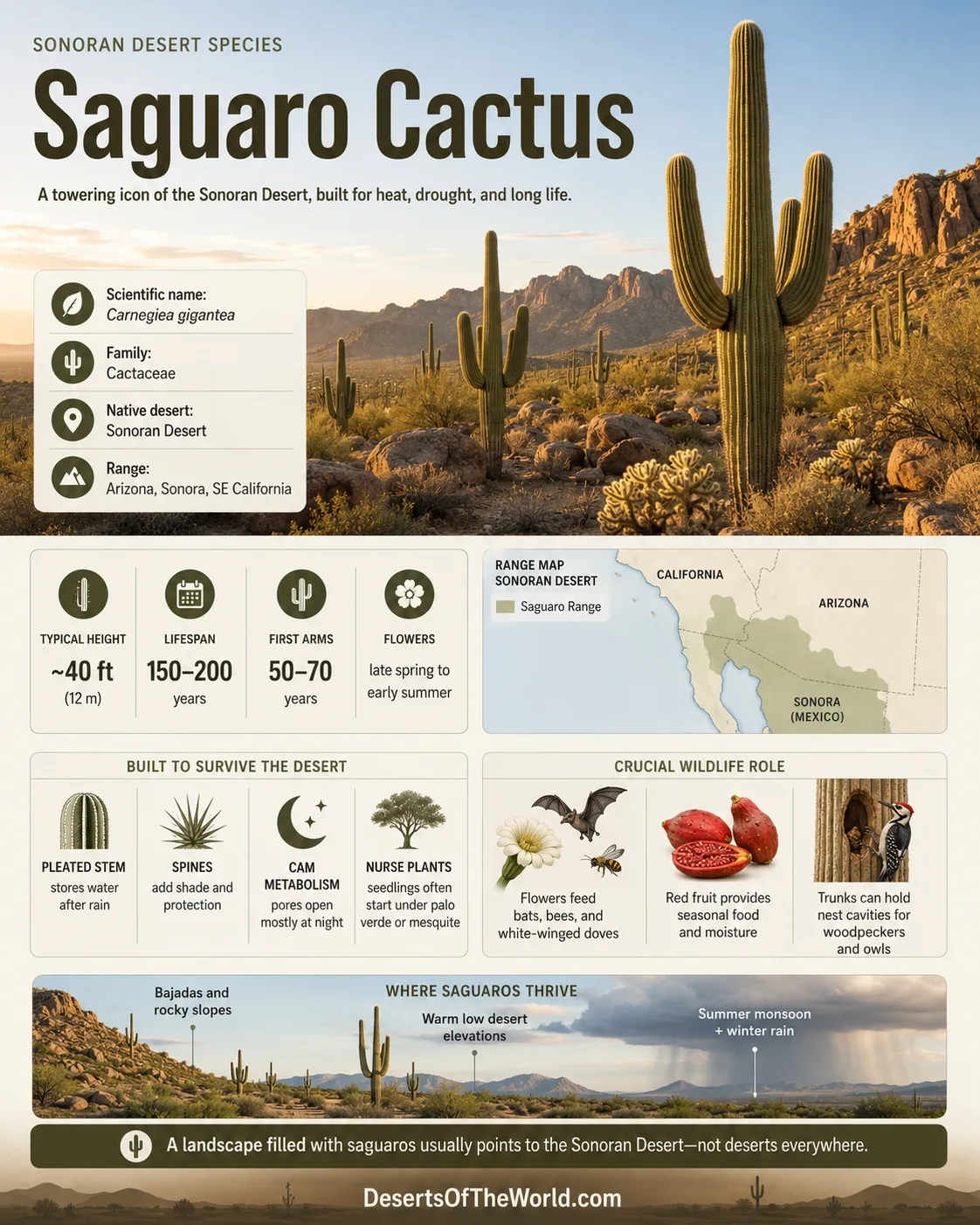
The saguaro cactus (Carnegiea gigantea) is the tall, branching cactus most closely linked with the Sonoran Desert. It is not a general “desert cactus” found across every hot dry region. Its natural home is much narrower: parts of Arizona, a small area of southeastern California, and Sonora in northwestern Mexico. That limited range is part of what makes the saguaro so closely tied to one desert, one climate rhythm, and one living landscape.
A mature saguaro looks simple from far away: a green column, upright arms, and deep vertical ribs. Up close, it is a slow-growing desert plant shaped by summer rains, winter cold limits, pollinating bats and birds, nurse trees, rocky slopes, and long dry seasons. In the Sonoran Desert, it provides shelter, food, shade, nesting space, and a clear marker of the climate conditions this cactus needs.
Saguaro Cactus Profile
| Common Name | Saguaro cactus, giant saguaro |
|---|---|
| Scientific Name | Carnegiea gigantea |
| Plant Family | Cactaceae |
| Native Desert | Sonoran Desert |
| Natural Range | Southern and central Arizona, small parts of southeastern California, and Sonora, Mexico |
| Typical Mature Height | Often around 40 feet in favorable habitat; some grow taller |
| Maximum Reported Height | Records note exceptional saguaros far taller than average, including a reported 78-foot specimen |
| Flowering Season | Mostly late spring into early summer |
| Flower Color | White to creamy white, usually near the tops of stems and arms |
| Main Pollinators | Lesser long-nosed bats, Mexican long-tongued bats, white-winged doves, bees, and other desert visitors |
| Fruit Season | Late spring to early summer, often ripening around June into early July |
| Typical Habitat | Desert uplands, bajadas, slopes, gravelly soils, and warm Sonoran Desert valleys below cold elevation zones |
Why the Saguaro Belongs to the Sonoran Desert
The saguaro grows naturally in the Sonoran Desert, not in the Sahara, the Mojave as a whole, the Atacama, or every sandy-looking dryland. Its range follows a careful balance of heat, seasonal rainfall, and winter temperature. Too cold, and young saguaros may fail. Too dry for too long, and seedlings struggle. Too high in elevation, frost becomes a regular problem.
The Sonoran Desert is different from many deserts because it can receive rain in two seasonal pulses: winter storms and summer monsoon rains. Saguaros are especially tied to this pattern. Summer rain can arrive fast and hard, filling washes, soaking gravelly slopes, and giving desert plants a short window of relief. The saguaro stores part of that water in its expandable stem for use during dry periods.
Natural Range and Desert Boundaries
Most saguaros grow in Arizona and Sonora, Mexico. In the United States, they are most strongly associated with southern Arizona, especially around Tucson and the broad desert basins nearby. A smaller number occur in southeastern California, including areas near the Whipple Mountains and Imperial County.
Range maps matter here because the saguaro is often used in films, drawings, and logos as a generic desert symbol. In real desert ecology, it is much more specific. A scene filled with saguaros points to the Sonoran Desert or a planted landscape, not to deserts everywhere.
Elevation, Frost, and Winter Cold
Saguaros are limited not only by dryness, but also by cold. They are generally found from low desert elevations up to roughly 4,000 feet, though local conditions can shift that line. A south-facing slope may stay warmer than a nearby valley bottom. A rocky hillside may drain cold air better than a flat basin. Small differences matter.
Freezing temperatures can damage saguaro tissue. This is one reason the cactus does not simply spread through every nearby desert. Heat alone is not enough. The plant needs a warm desert that also offers the right rain pattern and avoids repeated hard freezes.
How the Saguaro Survives Heat and Drought
A saguaro survives through a combination of water storage, reduced water loss, slow growth, shallow spreading roots, CAM photosynthesis, and careful use of seasonal rainfall. These traits allow a large cactus to remain active through long dry periods without depending on frequent rain.
Pleated Stem and Water Storage
The tall green trunk is not a solid wooden stem like a tree trunk. It is a succulent column with expandable pleats. After rain, the outer skin can swell as internal tissue stores water. During dry periods, the plant slowly uses that stored moisture and the pleats tighten again.
Inside the saguaro, a woody rib structure supports the heavy body. Mature plants can become extremely heavy after rain because so much of their mass is stored water. The vertical ribs allow expansion without tearing the outer surface.
Spines, Shade, and Surface Protection
Saguaro spines are more than defense. They cast small shadows on the cactus surface, reduce direct sun exposure, and help protect living tissue from some browsing animals. The green stem handles photosynthesis, so its surface must remain functional.
Leaves would lose too much water in this climate. The saguaro reduces that problem by carrying out photosynthesis in its green stem instead. With no broad leaves, it limits exposed leaf surface while maintaining a slow growth pattern suited to dry conditions.
Night Gas Exchange and Desert Timing
Like many cacti, saguaros use a water-saving photosynthetic pattern known as CAM metabolism. In simple terms, the plant opens tiny pores mostly at night, when temperatures are cooler and water loss is lower. It stores carbon compounds and uses them during the day while keeping those pores more closed.
This timing reduces water loss during the hottest part of the day and allows the saguaro to maintain photosynthesis under dry Sonoran Desert conditions.
Growth, Arms, and Long Life
Saguaros grow slowly, especially during their early years. A seedling may remain very small for a long time, hidden under a shrub or tree. Large branching saguaros seen from a road are often many decades old, sometimes well over a century.
A Very Slow Beginning
Young saguaros face heat, drought, insects, browsing animals, and exposure. Many seeds never become seedlings, and many seedlings never become mature plants. Survivors often begin life beneath a nurse plant such as palo verde, mesquite, or ironwood. That nurse plant provides partial shade, reduces temperature extremes, and can improve the seedling’s chance of surviving its first dry years.
For years, the cactus may remain small beneath its sheltering plant. As it grows, it can eventually rise above that cover and compete more strongly for water and space. The nurse plant may later decline or die while the saguaro continues into maturity.
When Saguaros Grow Arms
The arms of a saguaro add growing tips, and those tips can produce additional flowers and fruit. More arms can therefore provide more reproductive surface.
Many saguaros grow their first arms around 50 to 70 years of age, depending on location and growing conditions. In some places, it may take closer to 100 years. Some saguaros never grow arms at all. A tall, single-column saguaro can still be a mature plant.
Age and Size Are Not Exact Twins
A short saguaro is not always young, and a tall saguaro is not necessarily the same age as another cactus of similar height. Soil, slope, rainfall, competition, temperature, and early seedling conditions all affect growth. A plant on a favorable bajada may grow faster than one in a harsher pocket of desert.
Broad patterns still help. A small seedling may take years to become noticeable. A many-armed giant is usually old. The largest saguaros can live roughly 150 to 200 years in suitable conditions.
Flowers, Fruit, and Pollination
Saguaro flowers appear near the tops of the main stem and arms. They are usually white or creamy white with yellow centers, and they open during the cooler night hours. By the following day, many begin to close. This short bloom window links the cactus to night-flying bats, daytime birds, bees, and other visitors.
Night Blooming in Late Spring
Flowering often begins in late April or May and can continue into June, depending on local conditions. Instead of opening every flower at once, a saguaro may produce flowers over a period of weeks. Several flowers may open on a single night, followed by others on later nights.
The placement near the top of the cactus makes flowers easy for flying pollinators to reach. On tall saguaros, flowering crowns provide nectar and pollen above much of the surrounding vegetation.
Bats, Doves, Bees, and Shared Work
At night, nectar-feeding bats such as the lesser long-nosed bat and Mexican long-tongued bat visit saguaro flowers. As they feed, pollen can cling to their heads and bodies, then move to the next flower. During the day, white-winged doves, bees, and other insects visit flowers that remain open.
This overlap spreads pollination across both night and daytime hours. Several animal groups can therefore contribute to fruit set during the relatively short flowering season.
Red Fruit and Seed Dispersal
After pollination, saguaro fruit ripens into a red, fleshy food source. Each fruit can contain many small black seeds. Birds, bats, mammals, and other desert animals feed on the fruit and help move seeds across the landscape.
The fruit also provides moisture during a hot part of the year. Its water-rich pulp and sugars make it a seasonal food source for several Sonoran Desert animals when surface water may be limited.
The Saguaro as Wildlife Habitat
A mature saguaro is a vertical habitat. It offers flowers, fruit, shade, perches, nesting cavities, and structural height in a desert where tall plants are not common everywhere. Many animals use these resources throughout the year.
Woodpecker Cavities and Desert Homes
Gila woodpeckers and gilded flickers can excavate nesting cavities in saguaros. The cactus responds by forming a hardened lining around the wound, often called a saguaro boot. Once the original bird leaves, other animals may use the cavity later.
Elf owls, small birds, and other cavity-nesting species can benefit from these ready-made spaces. One mature saguaro can therefore provide nesting sites across several breeding seasons.
Food for Birds, Bats, Mammals, and Insects
Flowers provide nectar and pollen. Fruit feeds birds, bats, insects, and mammals. Seeds may be eaten, carried, buried, or dropped in new locations, linking the cactus to seed dispersal and food webs across the surrounding habitat.
White-winged doves are especially linked to saguaro flowering and fruiting season. Bats also connect the cactus to broader night-time pollination routes across the Sonoran Desert and nearby drylands.
Nurse Plants and Young Saguaros
The familiar image of a giant saguaro standing alone leaves out an important part of its early life. Young saguaros often begin beneath other desert plants. These nurse plants create cooler and more protected microsites.
Shade During the First Years
A seedling under open sun may dry out before it can build enough stored water. Beneath a palo verde, mesquite, or ironwood, conditions are less severe. The soil may stay slightly cooler, and the seedling can avoid the strongest midday solar exposure.
In open desert habitat, even partial shade can reduce surface temperature and water stress during the most vulnerable stages of seedling growth.
Bajadas, Slopes, and Gravelly Soil
Saguaros often grow well on desert uplands and bajadas, the gently sloping aprons of sediment below mountains. These areas can offer good drainage and enough runoff after storms. Coarse, gravelly soils help reduce waterlogging, which cacti do not tolerate well.
Rocky slopes may also buffer some saguaros from drought stress by shaping runoff, shade, and soil moisture at small scales. A hillside can contain several microhabitats within a short distance.
Plants Commonly Found Near Saguaros
Saguaros share the Sonoran Desert with plants that also handle heat, drought, and seasonal rain. These neighbors help define the structure and ecology of saguaro habitat.
| Plant | Connection to Saguaro Habitat |
|---|---|
| Palo Verde | Often acts as a nurse plant for young saguaros and adds seasonal shade. |
| Mesquite | Can shelter seedlings and supports pollinators through flowers and pods. |
| Ironwood | Creates shade and protected microhabitats in parts of the Sonoran Desert. |
| Creosote Bush | Common desert shrub in warm valleys and flats, often part of surrounding desert scrub. |
| Ocotillo | Shares desert slopes and bajadas with saguaros in suitable Sonoran Desert areas. |
| Cholla and Prickly Pear | Other cacti that occupy nearby dryland plant communities. |
Saguaro National Park and Protected Habitat
Saguaro National Park near Tucson, Arizona, protects large areas of saguaro habitat in two separate districts: the Tucson Mountain District to the west and the Rincon Mountain District to the east. The park is named for the cactus, but it protects far more than one plant. Desert scrub, foothill slopes, washes, mountains, animals, pollinators, and long-running ecological research all meet there.
Other public lands in southern Arizona also preserve saguaro habitat, including Organ Pipe Cactus National Monument. These protected desert areas help keep large stands of saguaros connected to the animals and plant communities they depend on.
Why People Say “Cactus Forest”
In some parts of the Tucson area, saguaros grow densely enough for the term cactus forest to be useful. It does not mean a forest in the usual leafy sense. It describes a landscape where tall cacti create strong vertical structure across slopes and valleys.
That structure provides elevated perches, nesting cavities, shade, flowers, fruit, and physical habitat that smaller desert plants cannot provide in the same way.
Respectful Viewing and Plant Protection
Saguaros are protected native plants in Arizona, and moving or removing them is controlled by official rules. For ordinary visitors, the practical approach is to enjoy them where they grow, stay on marked routes where required, and leave living plants and fallen cactus material in place unless clear permission applies.
A fallen saguaro continues to affect its surroundings as its tissues break down, shelter small organisms, and return material to the soil.
Common Misunderstandings About Saguaro Cacti
Saguaros Do Not Grow in Every Desert
The saguaro is often drawn as a symbol for “the desert,” but its real range is much smaller. A desert in Nevada, North Africa, Australia, or Chile will not naturally have saguaros. This cactus is a Sonoran Desert plant.
Not Every Mature Saguaro Has Arms
Arms are common on older saguaros, but they are not guaranteed. Some mature plants remain single columns. Others grow many arms. Shape depends on age, growth conditions, damage history, genetics, and local site conditions.
Saguaros Are Not Fast-Growing Landscape Plants
A saguaro grows slowly by human gardening standards. Its early life is especially slow, and a large branching plant represents many decades of growth. Mature saguaros in natural habitat cannot be replaced quickly.
Saguaro Recruitment and the Altar Valley Restoration Pilot
Long-lived saguaros can remain prominent on a landscape even when relatively few young plants are joining the population. University of Arizona researchers report that saguaro recruitment has declined since the early 1990s, with prolonged drought, higher temperatures, and habitat loss making it harder for seedlings to survive long enough to replace older plants.
In early 2026, researchers from the University of Arizona School of Natural Resources and the Environment began a restoration pilot on Bureau of Land Management and Pima County lands in southern Arizona’s Altar Valley. During the first planting season, the team transplanted approximately 600 young saguaros. About 50 were salvaged five- to six-foot plants from power-line rights-of-way, while most of the remaining plants were one- to two-foot nursery-grown saguaros donated for the project.
Testing Better Conditions for Young Saguaros
The pilot uses several methods intended to improve establishment after transplanting. Smaller saguaros are being placed beneath nurse trees, while other treatments include shade cloth, hand-watering, mulch, and protective metal mesh. These measures address some of the same problems naturally established seedlings face: intense sun, limited moisture, temperature swings, browsing, and trampling.
The project is designed for multi-year monitoring rather than a short-term planting count. Researchers plan to follow survival and establishment over several years and use the results to improve future saguaro transplantation methods. The work is part of a broader Altar Valley restoration effort that also includes native grass seeding, erosion-control structures, and nest boxes for native birds.
Why New Generations Matter
A stand of tall saguaros can look healthy even when few young plants are surviving. Researchers therefore track recruitment, meaning the establishment and survival of new plants, as well as mortality among older saguaros. A population with many mature plants but few seedlings or young columns can change slowly over decades.
For such a long-lived cactus, restoration results also take time to judge. Survival during the first few seasons is useful information, but the wider question is whether young saguaros can remain established long enough to become part of the next generation of mature plants.
Cultural Presence in the Sonoran Desert
The saguaro has long been part of life in the northern Sonoran Desert. Its fruit, flowering season, and form are woven into regional knowledge, especially among Indigenous communities with deep ties to the desert. The Tohono O’odham have a continuing relationship with saguaro fruit harvest traditions in parts of the plant’s range.
This cultural presence should be handled with care and plain respect. The saguaro is a living desert plant connected to food, seasons, place, and ecological knowledge.
How to Recognize a Saguaro
A saguaro can be recognized by its tall upright stem, vertical pleats, columnar shape, and arms that usually curve upward when present. Mature plants may tower over nearby shrubs and smaller cacti.
- Shape: tall, tree-like cactus with one main trunk and, often, upward arms.
- Surface: green, pleated, and ribbed, with rows of spines along the ribs.
- Flowers: white blooms near the top of stems and arms in late spring.
- Fruit: red fruit near the crown after flowering.
- Habitat clue: natural stands point strongly to the Sonoran Desert.
Saguaro vs Other Columnar Cacti
Several columnar cacti grow in the Sonoran Desert region, and some can confuse casual observers. Organ pipe cactus usually grows as many stems from the base rather than one main trunk with raised arms. Cardon cactus, found mainly farther south in Mexico, can be larger and belongs to a different genus. Young saguaros, before arms appear, can also look like simple green columns.
| Feature | Saguaro Cactus | Organ Pipe Cactus |
|---|---|---|
| Growth Form | Usually one main trunk, often with arms higher up | Many stems commonly rise from the base |
| Main U.S. Association | Southern Arizona, especially Sonoran Desert uplands | Organ Pipe Cactus National Monument and nearby warm desert areas |
| Flower Timing | Late spring into early summer | Often late spring to early summer, with strong night-blooming pattern |
| General Look | Iconic tall column with raised arms when mature | Clustered vertical stems, more pipe-like from the ground |
Why the Saguaro Matters in Desert Ecology
The saguaro matters because it connects many parts of the Sonoran Desert at once. It stores water after rain, produces nectar for pollinators, fruits during a hot season, gives nesting space to birds, and creates structure in open desert. It also marks a climate zone where winter cold, summer rain, elevation, and soil meet in the right balance.
The saguaro reflects several seasonal processes in the Sonoran Desert. Flowering marks the late-spring period, fruit provides a short-lived early-summer food source for birds and bats, and successful seedlings often establish beneath nurse plants where shade improves early survival.
Sources
- National Park Service — Saguaro, Saguaro National Park (range, climate limits, and Sonoran Desert habitat)
- National Park Service — Saguaro Cactus Growth (growth rate, elevation limits, and natural environment)
- National Park Service — Saguaro Cactus, Organ Pipe Cactus National Monument (height, water storage, flowering, and seed production)
- U.S. Forest Service — Saguaro, Plant of the Week (flowers, pollinators, fruiting season, and lifespan)
- U.S. Forest Service Fire Effects Information System — Carnegiea gigantea (habitat, elevation, reproduction, and ecology)
- U.S. Geological Survey — The Iconic Giant Saguaro Cactus in the Sonoran Desert (rocky slope habitat and drought research context)
- University of Arizona Cooperative Extension — Arizona Native Plant Law (protected native plant rules and removal permissions)
- Arizona-Sonora Desert Museum — Saguaro Cactus Fact Sheet (habitat, range, water, and temperature notes)
- University of Arizona College of Agriculture, Life & Environmental Sciences — A Giant Undertaking: Transplanting Thousands of Saguaros to Help Restore Ecosystems in the Altar Valley (2026 pilot planting of approximately 600 young saguaros, recruitment decline, nurse trees, shade, watering, mulch, protection, and long-term monitoring)