
Climate change is not simply making deserts “more desert.” That sounds neat, but it misses what is really happening. In many dry regions, heat is rising, evaporation demand is climbing, rainfall is becoming harder to predict, and the sharpest stress often appears along desert margins rather than in the empty core of a dune field. Some places dry out year after year. Others swing between long dry spells and short, violent downpours. Both patterns can damage desert systems.
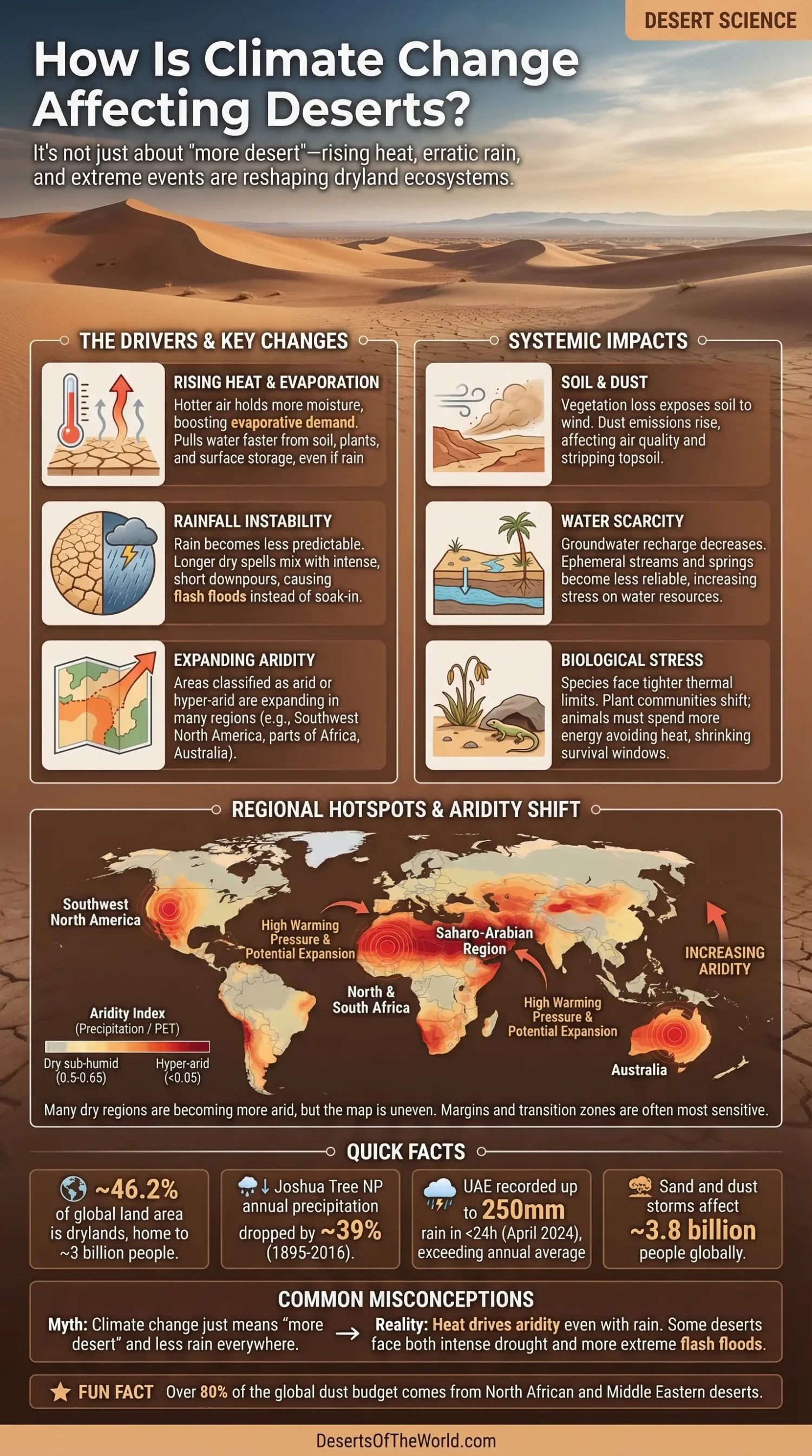
That matters because drylands already cover a very large share of Earth’s land surface and support hundreds of millions of livelihoods tied to grazing, farming, groundwater, wadis, oases, and seasonal vegetation. The current shift is not only about scenery. It changes soil moisture, surface water, dust movement, plant cover, and the thermal limits of desert wildlife.
| Climate Signal | What Is Changing in Deserts | Why It Matters |
|---|---|---|
| Higher Air Temperature | Hotter air raises potential evapotranspiration, dries soils faster, and lengthens heat stress periods | Plants lose water faster, streams shrink sooner, and animals spend more energy avoiding heat |
| Rainfall Instability | Rain comes less reliably in many dry regions, with longer gaps between events | Seed germination, grazing cycles, and groundwater recharge become less dependable |
| Heavier Short Rain Events | Some deserts now receive rare but intense storms | Flash floods, erosion, and infrastructure damage can rise even where annual rainfall stays low |
| More Bare Ground | Vegetation loss leaves soil exposed to wind and water erosion | Dust emissions rise, topsoil thins, and local air quality worsens |
| Biological Stress | Species living near heat and water limits face tighter survival windows | Plant communities shift, seedling survival drops, and some animals lose usable habitat |
Why Deserts React So Fast
Deserts work on thin margins. A small change in rain, soil moisture, humidity, or wind can reshape the whole system. In a humid forest, a dry month may leave a mark. In a desert, the same shift can alter an entire season of growth. That is why drylands are so sensitive to warming.
The Aridity Math Behind Desert Change
Scientists often measure dryness with the Aridity Index, written as precipitation divided by potential evapotranspiration. In simple terms, it compares incoming water with the atmosphere’s drying demand. Drylands are usually classified where this ratio is below 0.65. Within that range, the standard classes move from dry sub-humid to semi-arid, arid, and hyper-arid.
That technical detail matters because a place can receive similar rain as before and still become more arid if heat drives up evaporation. So the real story is not only “How much rain falls?” It is also “How fast does heat pull that water back out of soil, plants, and shallow surface storage?”
IPCC assessments place drylands at about 46.2% of global land area, home to roughly 3 billion people. A more recent UNCCD assessment found that 77.6% of Earth’s land experienced drier conditions over the three decades leading to 2020, and drylands expanded by about 4.3 million km². Those numbers show the scale of the shift plainly.
Not Every Desert Moves in the Same Direction
Climate change does not push every desert in one identical way. The IPCC notes that global dryland area could expand by about 10% by 2100 under a high-emissions pathway, yet the pattern is regional, not uniform. Expansion is expected in places such as southwest North America, parts of northern and southern Africa, and Australia. Some other zones may see weaker drying or even local contraction of dryland boundaries. That patchiness is real.
So when people ask whether deserts are expanding, the honest answer is: many dry regions are becoming more arid, but the map is uneven. Desert cores, foothills, coastal belts, and semi-arid transition zones do not react in the same rhythm.
Main Ways Climate Change Is Changing Deserts
Hotter Air Pulls More Moisture From Soil and Plants
The first and most direct effect is heat. As temperatures rise, the air can hold more moisture, which boosts evaporative demand. Even where rainfall totals do not collapse, hotter air can still lower soil moisture, shorten the life of seasonal pools, and reduce how long plants remain active after rain.
This is why desert stress is often visible in seedlings before it is visible in old shrubs or mature trees. Young plants have shallow roots and narrow survival windows. Once those windows close, plant recruitment weakens. The landscape may still look green after a good year, but the long-term replacement cycle starts to fail.
Rainfall Becomes Less Reliable
Many deserts depend less on total annual rainfall than on timing. A place may receive a similar yearly amount, yet if the rain comes later, arrives in fewer bursts, or misses the cool season, the ecological outcome changes. Germination, flowering, forage growth, and groundwater recharge all depend on timing.
That is why dryland change is often felt first as unreliability. One year looks generous. The next two fail. Then a single storm drops a large amount in hours, when the soil cannot absorb much of it. The pattern is not simple, and the rainfal signal can look noisy even while long-term aridity grows.
Heavy Downpours and Flash Floods Grow More Disruptive
A common mistake is to imagine desert climate change as a slow fade into permanent dryness. In reality, a hotter atmosphere can also feed intense rain events. That means a desert can face drought and flash flood in the same decade, sometimes in the same season.
The Arabian Peninsula offered a sharp example in April 2024. Parts of the United Arab Emirates recorded up to 250 millimeters of rain in less than 24 hours, even though the country usually receives only about 140 to 200 millimeters in a full year. That is not normal background variation. It shows how arid lands can now absorb climate stress from both ends: less reliable water overall, yet heavier bursts when storms do arrive.
For deserts, these downpours often do not mean lasting relief. Hard, dry soils can seal quickly. Water runs across wadis, washes, alluvial fans, and urban surfaces at high speed. The result may be erosion, debris flows, gullying, and sediment movement rather than slow recharge.
Dust and Bare Soil Spread Faster
When plant cover thins, wind gains access to the soil surface. Then dust rises more easily. The World Meteorological Organization notes that sand and dust storms affect 3.8 billion people worldwide, with roughly 2,000 million tons of dust emitted every year. More than 80% of the global dust budget comes from North African and Middle Eastern deserts.
Dust is not only a desert nuisance. It affects health, roads, airports, solar energy, crops, and even distant ecosystems. It can travel across oceans. In drylands, the link is straightforward: less vegetation and drier surface conditions often mean more exposed sediment, and that raises dust risk.
There is another layer. Around 25% of global dust emissions are linked to human-related activity. So climate change and land use can reinforce each other. Remove cover, heat the air, weaken soil structure, then let wind do the rest.
Plants and Animals Get Pushed Past Their Limits
Desert species are often described as well adapted to heat, and they are. Still, adapted does not mean unlimited. Many live close to their water and temperature thresholds already. Extra warming narrows the safe range.
Research on desert birds shows that warm deserts are expected to face disproportionately large temperature rises, and that physiological stress does not always line up neatly with the hottest air maps. Microclimate matters. Shade, exposure, coastal influence, rocky shelter, and access to water can change survival odds over very short distances. One striking result from global work on desert bird refugia: less than 20% of those lower-impact refuges fall inside existing protected areas.
Plant communities also shift in uneven ways. In the Sonoran Desert, field studies show that species once seen as very drought-tolerant are declining in some locations, while shorter shrubs able to use sporadic rainfall spread into their place. So the question is not only whether vegetation disappears. Often it changes form, height, density, rooting depth, and seasonality first.
Which Desert Regions Are Under The Most Pressure
Desert Margins and Semi-Arid Belts
The most sensitive zones are often the edges: the steppe outside the dune sea, the scrub belt below a mountain front, the farming and grazing lands beside true desert. These places hold more people, more wells, more crops, and more fragile vegetation cover. They sit right where a modest shift in heat and moisture can move the climate balance from strained to unstable.
That is why desertification risk often rises not in the barest sand seas, but in the transitional lands around them. When those belts lose vegetation, they can move from patchy cover to exposed soil quickly, and recovery is slow.
Southwest North America
The American Southwest shows this clearly. NOAA warns that continued warming lowers soil moisture and reduces the amount of water flowing into rivers and reservoirs used by about 60 million people. Across the Mojave and Sonoran systems, the problem is not just hotter summers. It is the long compounding effect of heat plus water deficit.
Joshua Tree National Park offers one of the clearest measured examples. From 1895 to 2016, annual precipitation there dropped by 39% and average temperature rose by 3°F (2°C). Under a high-emissions scenario, average annual temperature inside the park could rise by about 8°F (5°C) by 2099. Research cited by the park suggests that nearly all suitable habitat for Joshua trees inside the park could disappear under that pathway, with habitat across the broader Southwest cut by about 90%.
Saharo-Arabian Regions
The Saharo-Arabian realm is one of the clearest global hotspots for desert heat stress. Modeling work on desert birds points to especially strong shifts there in air temperature and evaporative water loss. That does not mean every part of the Sahara or Arabian Desert changes the same way. It means the region as a whole sits under intense warming pressure, with local outcomes shaped by coastlines, elevation, substrate, and occasional storm tracks.
Coastal and Fog-Linked Deserts
Some deserts live on tiny water inputs that are easy to miss: fog drip, dew, short cool-season showers, and brief cloud cover that lowers heat load. In those places, even a small change in wind, humidity, or near-coast temperature can matter. A desert may still look dry to the eye while the moisture source that supports its lichens, insects, shrubs, or endemic plants becomes less dependable.
What Happens To Water, Soil, and Life
Water Becomes Harder To Store
Deserts do not just suffer from lack of water. They suffer from the wrong shape of water supply. Longer dry periods reduce steady recharge. Hotter air strips moisture faster. Then intense storms can send water away before it soaks in. That combination makes springs, shallow aquifers, ephemeral streams, and small reservoirs less stable through time.
Groundwater pressure often rises next. When surface water grows less dependable, people pump more. In dry basins, that can worsen salinity, lower water tables, and place more stress on oasis farming and riparian strips.
Soil Structure Weakens
Desert soils look simple from a distance. They are not. Many rely on thin crusts, sparse root networks, and rare pulses of organic matter. Repeated heat, bare ground, and harder rainfall can break soil aggregates apart, strip fine particles, and deepen gullies. Once topsoil goes, recovery is slow. Very slow.
Biological soil crusts matter here too. These communities of cyanobacteria, lichens, mosses, and fungi help stabilize surface soil and influence infiltration. When they are damaged by heat stress, trampling, erosion, or long dry periods, the land loses one of its quiet defenses.
Wildlife Must Spend More Energy Just To Cope
Heat does not only remove water from land. It also changes animal behavior. Birds seek shade earlier. Mammals shift activity deeper into the night. Reptiles alter basking time. Pollinators shorten foraging windows. Every one of those adjustments costs something, whether in energy, breeding success, feeding time, or movement.
That is why climate stress in deserts often appears first as a behavior problem before it becomes a clear population crash. Animals still exist in the landscape, but they use less of it, for less time, and under tighter thermal rules.
A Common Misunderstanding About Desert Change
Not all desert change means wider sand seas, and not every wetter spell means recovery. That is the piece many short articles miss. A desert can receive a flashy storm, bloom for a season, and still be on a longer path toward stronger aridity because the background heat load keeps rising.
In other words, rainfall and aridity are not the same thing. A hotter climate can make water leave faster than it arrives. That is why scientists track precipitation together with potential evapotranspiration, soil moisture, runoff, groundwater, vegetation cover, and dust output.
What Scientists Watch To Measure Desert Change
To understand whether a desert is shifting, researchers usually watch a set of linked indicators rather than a single number:
- Aridity Index (AI) — precipitation divided by potential evapotranspiration
- Potential Evapotranspiration (PET) — the atmosphere’s drying demand
- Soil Moisture — how much water remains available near the surface and root zone
- Vegetation Cover — often tracked by satellite using greenness signals
- Dust Emissions — a clue to exposed and unstable surfaces
- Runoff and Flash Flood Frequency — especially in wadis and built desert corridors
- Habitat Suitability — whether plants and animals still find usable microclimates
That multi-layer view matters because deserts are not controlled by one lever. Heat, wind, water timing, soil texture, slope, and biology all pull at once.
Why Desert Edges Matter More Than People Think
The image most people hold is the empty dune field. Yet the real front line of climate change is often the belt just outside it: rangelands, dry farms, scattered shrubs, floodplain margins, mountain piedmonts, and oasis networks. These areas carry more human use and more ecological complexity, so even a moderate shift in climate can leave a larger footprint.
That is where warming, grazing pressure, groundwater demand, bare soil, and erratic rainfall can lock together. Once that happens, a dry spell is no longer just a dry spell. It becomes part of a broader move toward land degradation, weaker plant recovery, more dust, and sharper water stress.
Sources
- IPCC AR6 Cross-Chapter Paper 3: Deserts, Semiarid Areas and Desertification (projected dryland expansion, regional patterns, aridity science)
- IPCC Special Report on Climate Change and Land, Chapter 3 (drylands, desertification, land degradation, human exposure)
- NASA Science: The Effects of Climate Change (heat, drought, wildfire, extreme rainfall trends)
- NASA Earth Observatory: Deluge in the United Arab Emirates (April 2024 extreme rainfall in a desert climate)
- World Meteorological Organization: Sand and Dust Storms (dust emissions, exposure, climate links)
- NOAA Drought.gov: Exceptional Southwest Drought Exacerbated by Human-Caused Warming (soil moisture decline, water supply pressure in the U.S. Southwest)
- U.S. National Park Service: Climate Change in Joshua Tree (measured warming, falling precipitation, habitat loss risk)
- University of California, Riverside: Even Sonoran Desert Plants Aren’t Immune to Climate Change (plant community shifts in the Sonoran Desert)
- Nature Communications: Global Patterns of Climate Change Impacts on Desert Bird Communities (thermal stress, refugia, protected-area gap)
- UNCCD: The Global Threat of Drying Lands (recent aridity trends and global drying patterns)