
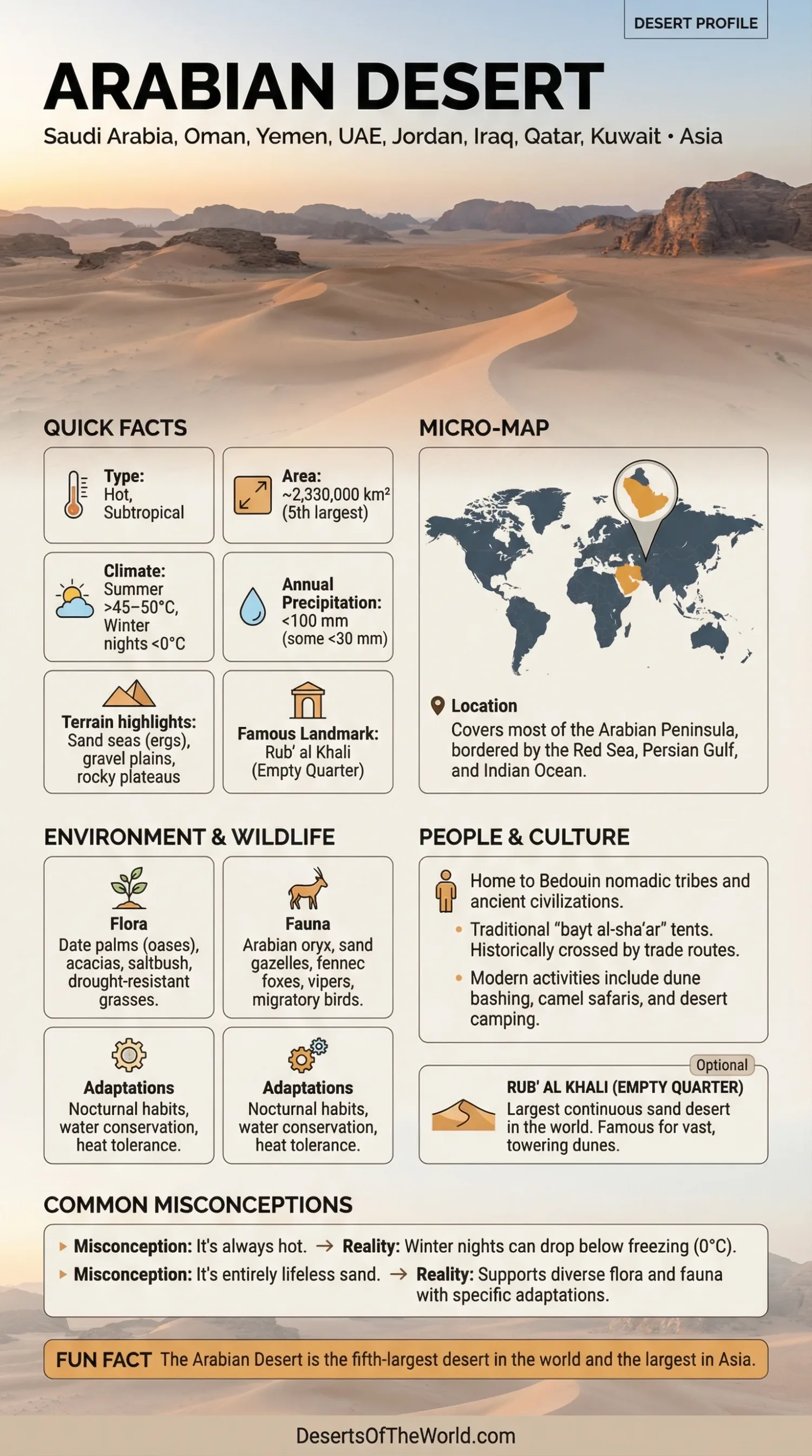
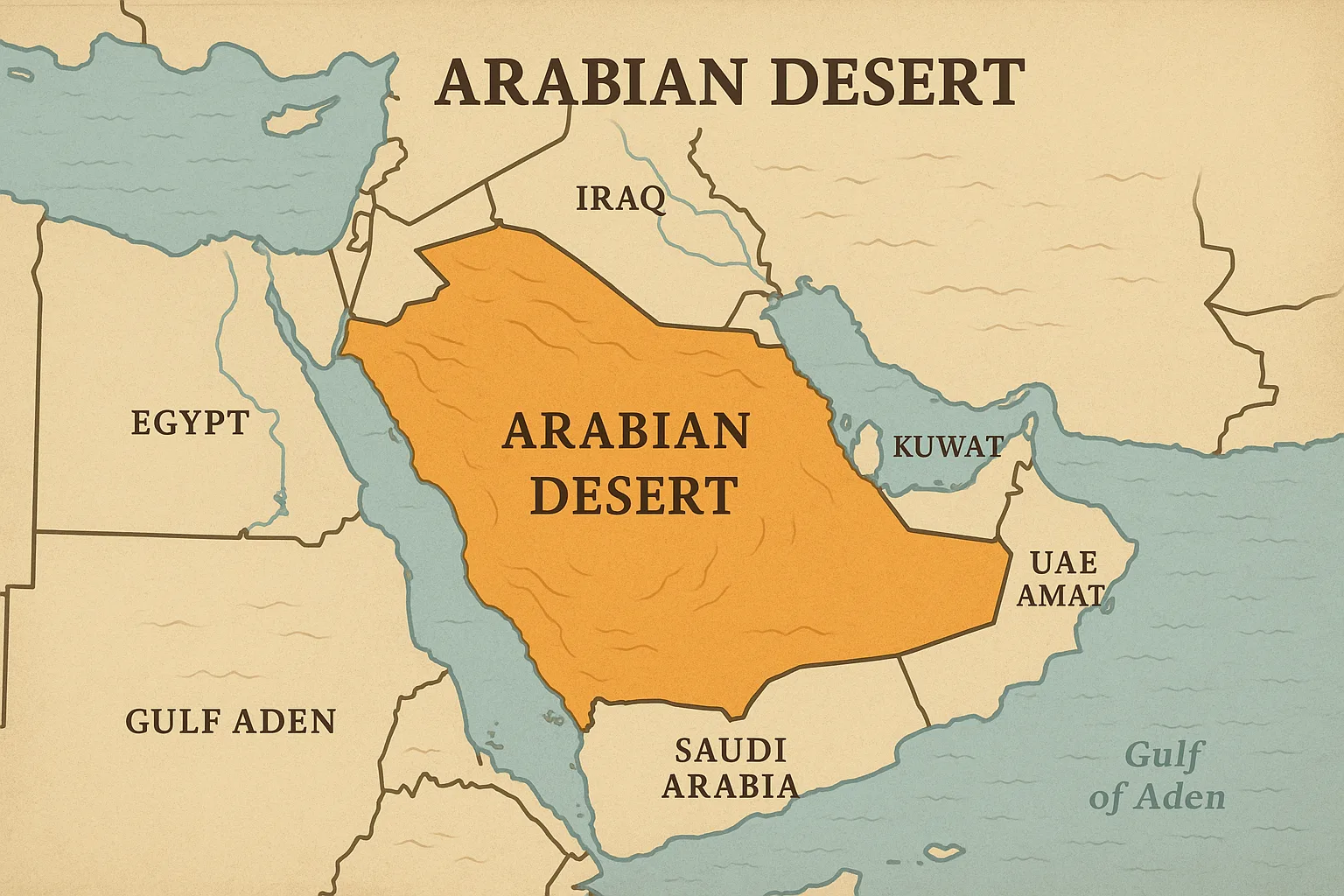
Location & Continent
Continent: Asia
Countries: Saudi Arabia, Oman, Yemen, United Arab Emirates, Jordan, Iraq, Qatar, Kuwait
Coordinates: 22°N, 45°E
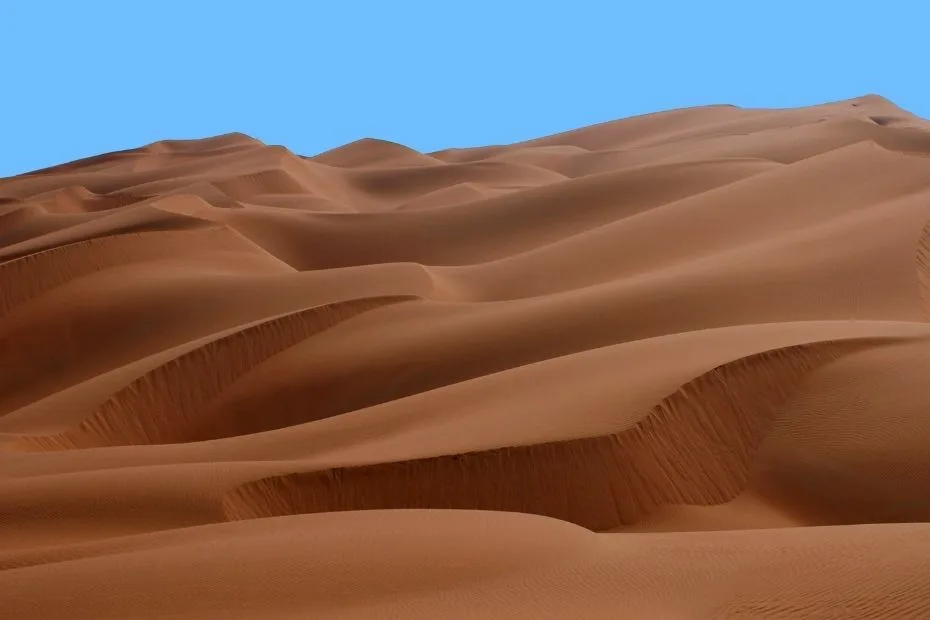
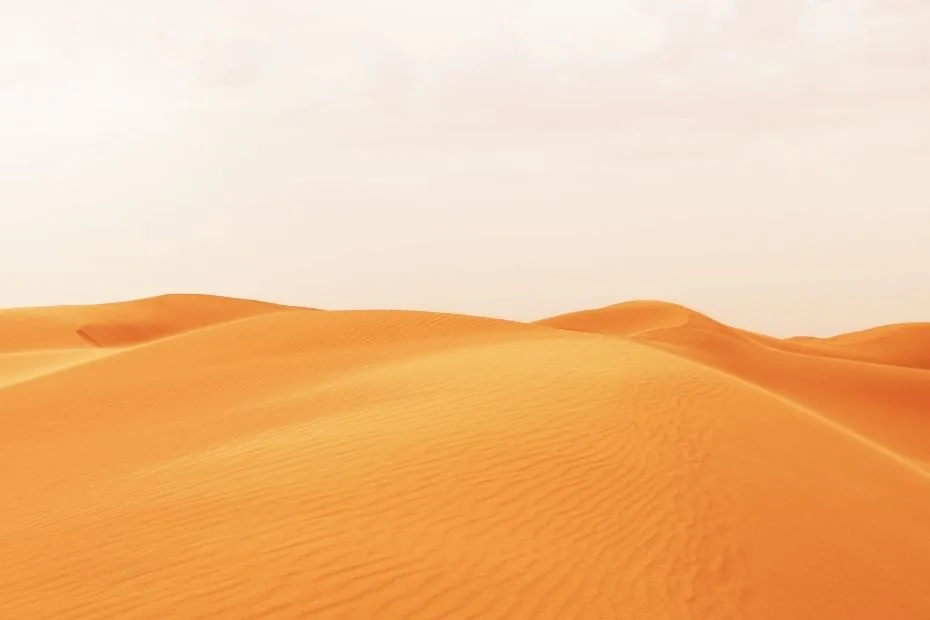
Photos of the Arabian Desert
Physical Features
Area: ~2,330,000 km²
Length: About 2,300 km
Width: About 1,100 km
Elevation: Generally 300–1,000 m; the Jabal Shammar region includes mountains exceeding 1,800 m
Climate & Precipitation
Temperature: Summer highs often exceed 45°C and can approach 50°C; winter nights in some inland and higher areas can fall below 0°C
Precipitation: Generally less than 100 mm annually across the driest areas, with some regions receiving under 30 mm
Ecological Features
Ecozone: Palearctic
Biome: Deserts and xeric shrublands
Major desert landscapes: Rub’ al Khali (Empty Quarter), An Nafud and the Ad-Dahna sand belt
Flora & Fauna
Flora: Date palms in cultivated oases, saltbush, acacias, tamarisk and desert grasses
Fauna: Arabian oryx, sand gazelles, Arabian red foxes, jerboas, vipers, desert monitors and migratory birds
Geology & Notable Features
Geology: Sand seas (ergs), gravel plains, salt flats, volcanic fields and rocky plateaus
Notable Features: Rub’ al Khali (Empty Quarter), An Nafud Desert, Ad-Dahna Desert and Harrat volcanic fields
Introduction
The Arabian Desert covers approximately 2,330,000 km² across much of the Arabian Peninsula. Its landscapes range from enormous sand seas to gravel plains, rocky plateaus, salt flats and volcanic terrain. The desert has also shaped settlement, pastoralism and trade across the peninsula for centuries.
Geography of the Arabian Desert
The Arabian Desert extends across much of the Arabian Peninsula, with the Persian Gulf to the northeast, the Red Sea to the west and the Arabian Sea and Gulf of Aden toward the south. It is centered on Saudi Arabia and extends into neighboring parts of Jordan, Iraq, Oman, the United Arab Emirates and Yemen. Its geographical features include:
- Sand Dunes: The Rub’ al Khali, or Empty Quarter, is the world’s largest continuous sand desert and occupies a large part of the southern Arabian Peninsula.
- Mountain Ranges: Mountainous terrain along the western and southwestern margins rises sharply above adjoining desert plains.
- Gravel and Rocky Plains: Large areas outside the major sand seas consist of gravel surfaces, rocky plateaus and exposed desert pavement.
The climate is predominantly hot and dry, with summer temperatures in low-lying interior areas sometimes approaching 50°C (122°F).
Climate and Weather Patterns
Summers across the Arabian Desert are extremely hot, while winter conditions range from mild days to cold nights. Rainfall is scarce and highly variable, and the driest interior areas may receive only a few tens of millimeters in a year. Short periods of rainfall can trigger temporary plant growth and desert blooms. Other weather features include:
- High UV Exposure: Intense sunshine and limited cloud cover produce very high ultraviolet exposure during much of the year.
- Wind and Dust: Strong winds can lift large amounts of sand and dust, sharply reducing visibility during dust and sand storms.
Flora and Fauna
Plants and animals of the Arabian Desert survive long dry periods through water-saving adaptations, deep or widespread root systems, seasonal growth and behaviors such as nocturnal activity.
| Species | Type | Habitat |
|---|---|---|
| Date Palm | Plant | Oases and cultivated settlements |
| Arabian Oryx | Mammal | Gravel plains, dunes and open desert |
| Sand Gazelle | Mammal | Sandy and gravel desert |
| Arabian Red Fox | Mammal | Rocky and sandy desert |
The Arabian oryx is one of the desert’s best-known large mammals and has returned to parts of its former range through conservation and reintroduction programs.
Restoration and Conservation in 2026
Land restoration across Saudi Arabia became an international focus in August 2026, when the country’s National Greening Program was recognized as a UN World Restoration Flagship under the UN Decade on Ecosystem Restoration. The program covers degraded rangelands, forests, deserts, urban areas and coastal ecosystems.
According to the United Nations Environment Programme, by June 2026 about 1 million hectares of degraded land were under restoration and 159 million trees had been planted. The program’s 2030 targets are 2.5 million hectares under restoration and 215 million trees.
Restoration work is not limited to tree planting. Activities include:
- Controlled grazing: Managing livestock pressure to allow damaged vegetation and rangelands to recover.
- Rainwater harvesting: Capturing limited rainfall for vegetation and land rehabilitation in dry areas.
- Treated wastewater: Reusing treated water to support restoration where freshwater is scarce.
- Native vegetation: Reforestation and natural regeneration using vegetation suited to arid conditions.
- Wildlife reintroduction: Returning native species such as the Arabian oryx, gazelles and ibex to restored habitats.
The initiative forms part of Saudi Arabia’s longer-term national target of restoring 40 million hectares and planting 10 billion trees by 2100.
Cultural Significance
The Arabian Desert has long influenced the cultures and livelihoods of people living across the peninsula. Bedouin communities traditionally relied on mobility, livestock and detailed knowledge of water sources and seasonal conditions. Elements associated with desert life include:
- Architecture: Traditional tents known as bayt al-sha’ar, historically made from woven goat and sheep hair.
- Oral Tradition and Literature: Poetry and storytelling have preserved accounts of travel, tribal history and life in desert environments.
- Trade Routes: Routes across Arabia connected settlements and trading centers carrying incense, spices and other goods between southern Arabia, the Mediterranean and surrounding regions.
Tourism and Exploration
Parts of the Arabian Desert are visited for desert landscapes, wildlife, archaeology and outdoor activities. Common activities include:
- Dune Driving: Off-road travel is offered in designated desert tourism areas, particularly around established destinations in the Gulf states.
- Camel Excursions: Camel rides remain available at many desert camps and tourism sites.
- Desert Camping: Open desert areas offer dark skies and broad views, although temperatures can change sharply between day and night.
Travel conditions vary widely across the region. Heat, water availability, remote terrain and sand or dust storms should be considered before entering isolated desert areas.
Arabian Desert Today
The Arabian Desert remains one of the largest arid regions in Asia, with landscapes ranging from the Rub’ al Khali’s immense dune fields to rocky plateaus, gravel plains and volcanic terrain. Its ecosystems continue to support specialized desert plants and wildlife, while large-scale restoration programs are now adding controlled grazing, water management, vegetation recovery and native-species reintroduction to the ways these dry landscapes are managed.