
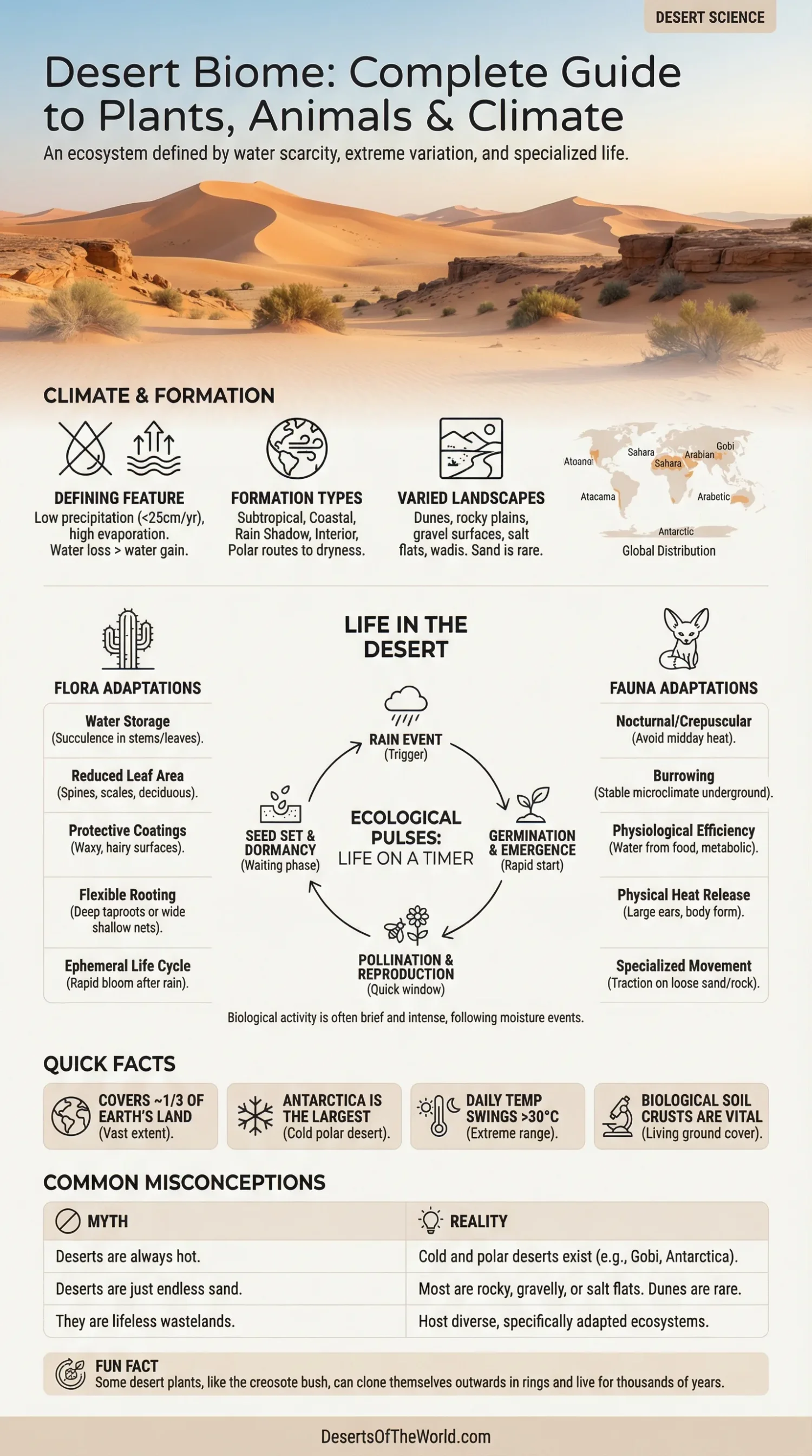
The desert biome is defined less by heat than by water. Some deserts are fiercely hot, some stay cool for much of the year, and some are cold enough to hold ice. What joins them is very low precipitation, sparse and patchy plant cover, and a living system shaped by water loss that often outweighs water gain. Deserts cover a large share of Earth’s land, yet they still get reduced to a simple image: sand, sun, and emptiness. That picture misses most of the story. A desert can be rocky, gravelly, fog-fed, salt-crusted, wind-carved, or snow-dusted. And full of life, it can be.
| Feature | What It Usually Means in a Desert Biome | Why It Matters |
|---|---|---|
| Rainfall | Usually very low and often irregular | Plants and animals must store water, avoid loss, or stay dormant |
| Evaporation | Often higher than rainfall | Even brief moisture can disappear fast |
| Temperature | Can swing hard between day and night | Activity often shifts to night, shade, burrows, or short wet seasons |
| Ground Cover | Sparse, open, and patchy rather than continuous | Soil, stones, crusts, and surface water flow shape the habitat |
| Biological Rhythm | Long quiet periods broken by rain pulses | Blooming, feeding, breeding, and seed germination can happen fast |
What Makes a Desert Biome a Desert
A desert biome forms where available moisture stays low for most of the year. Many definitions use an annual precipitation limit of about 25 centimeters (10 inches), but rainfall alone does not tell the whole story. Dry air, strong sun, wind, open ground, and fast evaporation all matter. In practical terms, the land loses water faster than most plants can easily replace it.
That is why deserts can look so different from one another. A subtropical sand sea, a cold basin in Central Asia, a foggy Pacific coast, and the icy interior of Antarctica can all fit the desert pattern. Strange at first, maybe. Yet the logic is simple: desert means dry first, hot second.
Another common mistake is to picture dunes everywhere. In reality, dunes occupy only a small part of the global desert area. Many deserts are dominated by gravel plains, rocky plateaus, bare mountain fronts, salt flats, or hard-packed basins. Even where sand does gather, it rarely tells the whole ecological story.
How Desert Biomes Form
Deserts do not all come from the same weather setup. Different routes can lead to the same dry result.
- Subtropical deserts form under descending dry air near the tropics. The Sahara and Arabian Desert belong to this broad pattern.
- Coastal deserts develop where cold ocean currents and stable air limit rainfall. Fog may be common, while rain stays rare. The Atacama and Namib are classic examples.
- Rain Shadow deserts sit on the dry side of mountain ranges. Moist air loses water on the windward slope, then descends warmer and drier on the other side.
- Interior deserts lie deep inside continents, far from moisture sources. By the time air masses arrive, little moisture remains.
- Polar deserts stay dry because cold air holds very little moisture. Antarctica is the largest desert on Earth.
Many school texts also sort deserts into hot and dry, semi-arid, coastal, and cold deserts. That simpler grouping works well too. Either way, the point stays the same: there is no single desert climate template. Dryness unites them; the local route to dryness changes the details.
Climate Pattern of the Desert Biome
Desert climate works in extremes, but not always in the way people expect. Heat can be intense in hot deserts, yet the air is often so dry and cloud cover so limited that the land sheds warmth quickly after sunset. The result is a wide daily range. Afternoon heat. Cool night. Then back again.
Rainfall is usually low, uneven, and hard to predict. A desert may go long stretches with almost no useful moisture, then receive a short storm that reshapes a wash, wakes dormant seeds, and fills shallow depressions for a brief window. Some places rely on winter rain, some on summer storms, and some on fog or dew more than steady showers.
Not every desert is a furnace. Cold deserts can have freezing winters, snowfall, and long dormant seasons. Coastal deserts may feel milder than inland deserts because nearby ocean influence reduces the hottest highs. In the Sonoran Desert, some areas even receive two moisture peaks each year, which helps explain why life there can be unusually varied for a dry biome.
Ground Surface, Soil, and Water Movement
Look closely at a desert surface and the biome becomes more interesting. Open ground is not just empty space between plants. It controls how water runs, where seeds collect, where heat builds, and how wind moves sediment. In many desert landscapes, the ground surface matters almost as much as the vegetation.
You may find:
- Rocky plains and plateaus, where exposed stone stores heat and sheds water quickly
- Gravel surfaces, which reduce erosion and can protect finer soil below
- Dunes, where sand shifts with the wind and plant roots must anchor unstable ground
- Arroyos or wadis, dry channels that may stay empty for months, then carry sudden runoff
- Alluvial fans, where streams drop gravel and sand at mountain fronts
- Playas and salt flats, flat basin floors where water briefly gathers and then evaporates
One of the most overlooked pieces of desert ecology is the biological soil crust. Bare ground is not always bare. In many drylands, the top layer includes cyanobacteria, lichens, mosses, algae, fungi, and other tiny organisms that bind soil particles together. This crust helps reduce erosion, improve water retention, and add fertility. In some areas, it covers most of the living ground surface between larger plants.
Fragile is what it is. A footprint, tire track, or repeated trampling can break a crust that took years to form.
Plants of the Desert Biome
Desert plants survive by solving the same problem in different ways: hold onto water, lose less of it, or finish life quickly when water briefly appears. Some store moisture. Some reduce leaf area. Some keep roots shallow and wide to catch light rainfall. Others reach deep. Many do more than one of these at the same time.
Cacti dominate the desert image, especially in the Americas, but they are not the universal desert plant. In other desert regions, shrubs, grasses, salt-tolerant plants, succulents that are not cacti, and short-lived annuals may shape the landscape more strongly. A desert flora is always local.
| Plant Strategy | How It Helps | Typical Expression |
|---|---|---|
| Water Storage | Keeps a reserve during long dry periods | Fleshy stems or leaves in cacti, agaves, and other succulents |
| Reduced Leaf Surface | Lowers water loss | Small leaves, spines, scales, or leaf drop during drought |
| Protective Surface | Slows evaporation and softens heat load | Waxy coatings, hairs, pale color, tough outer tissue |
| Flexible Rooting | Captures either brief surface moisture or deeper reserves | Wide shallow roots, deep taproots, or both |
| Night Gas Exchange | Reduces daytime water loss during photosynthesis | CAM photosynthesis in many succulents |
| Short Life Cycle | Uses a brief wet period fast | Ephemeral wildflowers and annual herbs |
Some desert plants grow leaves only during favorable periods and shed them when the ground dries. Others keep photosynthesis in green stems rather than in broad leaves. Spines do more than defend tissue; they also help shade the plant surface and disturb drying airflow. Small leaves matter for the same reason. Less exposed area, less water lost.
Roots tell another part of the story. Mesquite is often cited for depth. Many desert shrubs, by contrast, spread roots near the surface so they can absorb a quick rain before it vanishes. And then there are the ephemerals: plants that wait as seeds for months or years, then germinate, flower, and set seed in a short burst after moisture arrives. Brief, but effective.
In some coastal deserts, plants even make use of fog. Not heavy rain. Fog. That small difference changes entire hillsides.
Animals of the Desert Biome
Desert animals meet the same water problem through behavior, body form, and timing. Timing often matters more than strength. Many species avoid midday heat, remain hidden in burrows or shade, and become active at night or during cooler hours. This pattern is so common that nocturnal activity is one of the clearest animal signatures of the desert biome.
Water-saving traits vary, but the goal stays familiar: lose less, waste less, find moisture where others do not. Some mammals get much of their water from food and metabolic processes. Some reptiles reduce activity during the hottest hours. Many birds and mammals move between microhabitats through the day, using shrubs, rocks, burrows, and slope shade as thermal shelters.
| Animal Pattern | What It Does | Examples |
|---|---|---|
| Burrowing | Escapes heat and slows water loss | Rodents, foxes, many reptiles, desert tortoise |
| Nocturnal or Crepuscular Activity | Uses cooler hours for movement and feeding | Kangaroo rats, jerboas, many snakes, foxes |
| Heat Release Through Body Form | Helps regulate temperature | Large ears in jackrabbits and fennec foxes |
| Low Direct Water Demand | Reduces need to drink often | Seed-eating rodents, many insects, some reptiles |
| Efficient Movement on Loose or Hot Ground | Lowers heat load or improves traction | Sidewinding snakes, broad-footed mammals, camels |
Reptiles fit deserts well because many can function with limited water and use shade, rock cracks, and burrows efficiently. Arthropods do too. Beetles, ants, scorpions, and spiders often form a large part of desert food webs. Birds remain important as seed dispersers, insect feeders, and predators. Mammals range from tiny seed specialists to hoofed grazers and browsers in drier savanna-desert transitions.
What looks like stillness in the daytime can be misleading. Wait until evening, and the biome changes.
Life Runs on Pulses, Not Steady Rain
One of the best ways to understand a desert is to stop expecting a smooth seasonal rhythm. In many deserts, life runs on pulses. A rainfall event may trigger seed germination, insect emergence, fresh plant growth, pollinator activity, and animal breeding in a short sequence. Then the pulse fades, and the system returns to a quieter state.
This is why desert bloom years can feel sudden. Seeds, bulbs, and underground storage organs may wait through long dry periods before enough moisture arrives. When it does, color can spread across slopes and basin margins with surprising speed. These events do not mean the desert has stopped being a desert. They show how desert life is built to respond fast when its moment comes.
Water in desert systems is often brief, patchy, and unevenly distributed. A wash may run in one valley while the next remains dry. A storm over high ground can send runoff into lower basins, making those spots greener than the surrounding plain. Microtopography matters. So does luck.
Food Webs and Ecological Links
Desert food webs are usually less dense than those in wetter biomes, but they are far from simple. Primary production comes from shrubs, grasses, succulents, annual herbs, algae, and biological soil crusts. Herbivores feed on seeds, stems, leaves, nectar, fruit, or sparse seasonal growth. Predators feed on insects, rodents, reptiles, or birds. Scavengers and decomposers finish the cycle.
A few ecological links stand out:
- Pollination windows can be short, so timing between flowering plants and pollinators matters a great deal.
- Seed predation and seed storage help shape which plants return after the next rain.
- Burrows create cooler, safer microsites used by more than one species.
- Oases, washes, and fog-fed slopes act like local hotspots inside a wider dry matrix.
Patchiness is normal in a desert. Productivity may sit low across a broad area, then rise sharply in a few favorable pockets. Those pockets can hold far more life than the surrounding ground suggests.
Desert Biome Examples Around the World
- Sahara: vast subtropical desert with dunes, gravel plains, rocky hamadas, wadis, and oasis systems
- Arabian Desert: hot subtropical dryland with dune fields, gravel surfaces, and strong evaporation
- Namib: coastal desert shaped by fog, with specialized plants and animals adapted to moisture from the air
- Atacama: coastal hyper-arid desert where fog can matter more than rainfall in some zones
- Sonoran: species-rich desert with giant cacti in some areas and two seasonal moisture peaks in many landscapes
- Mojave: desert of basins, ranges, Joshua tree zones, and strong rain shadow influence
- Gobi: cold desert with large seasonal temperature range and winters that can be severe
- Patagonian Desert: broad rain shadow desert east of the Andes
- Antarctic Polar Desert: the clearest reminder that a desert does not need heat to be a desert
Common Misunderstandings About the Desert Biome
- “Desert means hot.” Not always. Cold deserts are real, and Antarctica is the largest desert on Earth.
- “Desert means sand.” No. Many deserts are mostly rock, gravel, basin clay, salt flats, or ice.
- “Sparse vegetation means empty land.” Also no. Open ground often supports soil crusts, seeds, invertebrates, and brief but active food-web pulses.
- “All desert plants are cacti.” Cacti matter in the Americas, but many deserts are shaped more by shrubs, grasses, succulents of other groups, and short-lived annuals.
- “If it rains, it stops being a desert.” Deserts can receive sudden storms and still remain deserts because moisture stays limited over the long run.
References
- National Geographic Education – Desert Biome (desert rainfall threshold, biome extent, four main desert categories, plant and animal adaptations)
- National Geographic Education – Desert (five desert formation types, dunes as a small share of deserts, Antarctica as the largest desert, day-night temperature contrast)
- Encyclopaedia Britannica – Desert (desert definition, ecosystem view, global desert distribution, climate and biota context)
- NASA – Biome: Desert (desert climate basics, temperature swing, low annual precipitation, plant survival patterns)
- U.S. National Park Service – Plant Adaptations (small leaves, waxy surfaces, stem photosynthesis, root strategies in desert plants)
- U.S. Geological Survey – Biological Soil Crusts: Webs of Life in the Desert (what biocrust is and how it supports erosion control, water retention, and soil fertility)
- U.S. National Park Service – Sonoran Desert Network Ecosystems (why the Sonoran Desert supports high landscape and species diversity, including bimodal precipitation)
- NASA JPL EMIT – Mapping Desert Blooms (ephemeral flowering, desert bloom dynamics, and how rain pulses can briefly reshape dryland ecology)