
Desert plants survive by doing three things at once: catching water fast, losing as little of it as possible, and staying ready for long dry gaps. A desert is often described as a place with less than 250 millimetres of annual rainfall, yet dryness is only part of the story. Evaporation is high, soils can be salty or low in organic matter, and rain may arrive in short bursts rather than in a steady pattern. That changes everything for a plant.
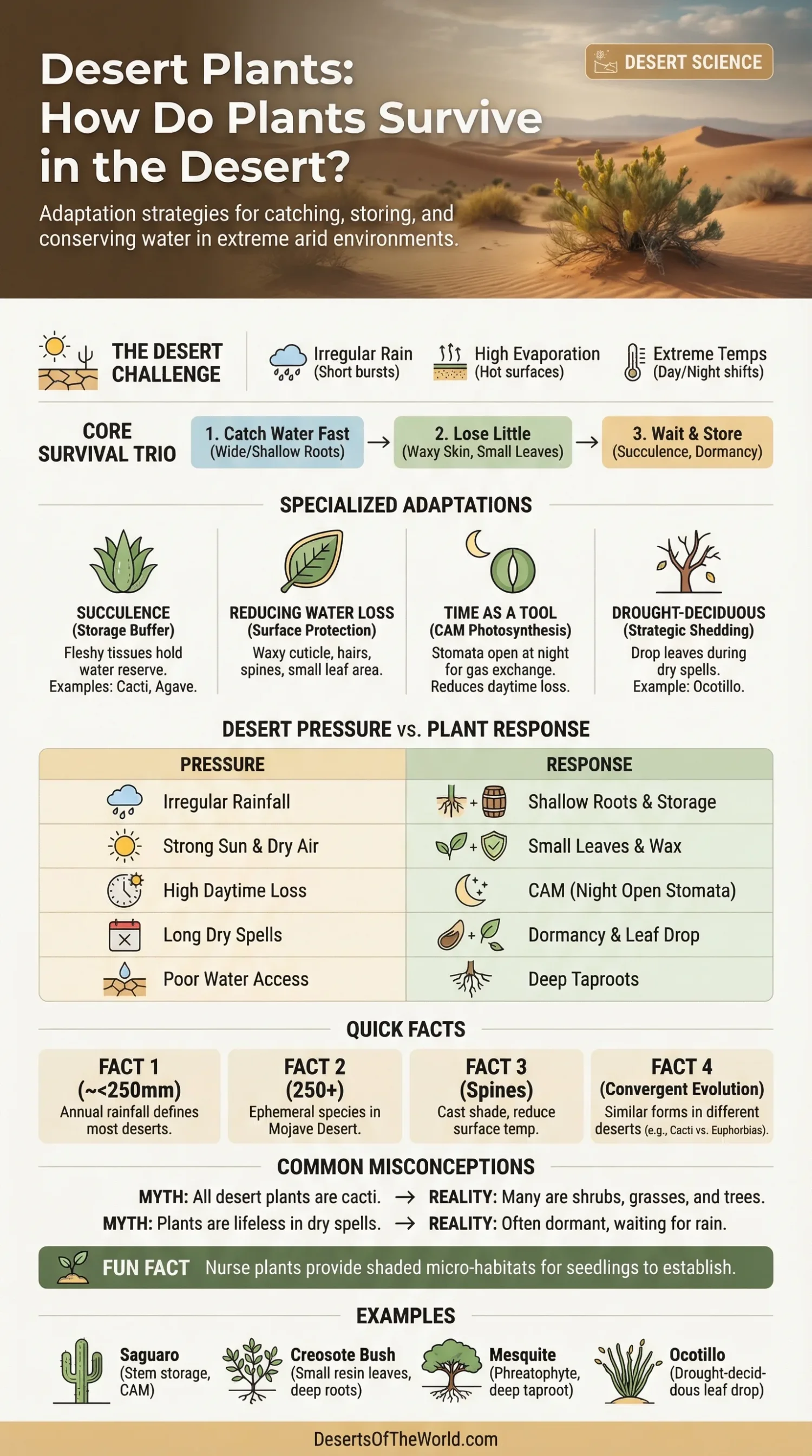
So the classic image of a cactus is only one part of desert botany. Many desert plants are shrubs, short-lived annuals, grasses, or deep-rooted trees. Some store water in fleshy tissue. Some drop leaves and wait. Some open their stomata at night. Some spend most of their lives as seeds. Quiet strategies, mostly. Very effective.
| Desert Pressure | Plant Response | Common Examples |
|---|---|---|
| Little and irregular rainfall | Shallow spreading roots, fast uptake after rain, water storage in stems or leaves | Cacti, agaves, many succulents |
| Strong sun and dry air | Small leaves, waxy cuticle, pale or hairy surfaces, reduced leaf area | Creosote bush, sagebrush, brittlebush |
| High daytime water loss | CAM photosynthesis, with stomata opening mainly at night | Cacti, many agaves, some euphorbias |
| Long dry spells | Seed dormancy, slow growth, drought-deciduous leaf drop | Desert annuals, ocotillo, many shrubs |
| Poor or patchy access to water | Deep taproots or groundwater-reaching root systems | Mesquite and other phreatophytes |
What Makes Desert Life Hard for Plants
Water shortage is the obvious part, though not the only one. Desert plants also deal with:
- brief and uneven rain events
- hot soil surfaces that dry quickly after a shower
- wide day–night temperature shifts
- wind that pulls moisture from leaves and stems
- salty ground in basins, flats, and old lake beds
Even when rain comes, the soil may hold that moisture for only a short time. A plant that reacts late loses its chance. A plant that spends water freely will not last. Desert vegetation works on a strict budget.
How Desert Plants Keep Water Inside the Plant
Succulent Tissues Hold Water for Lean Periods
Many desert species store water in thick stems, leaves, or roots. This trait is called succulence. The stored water does not make these plants carefree; it gives them a buffer. During dry periods, they live off that reserve while growth slows.
Cacti show this clearly. Their stems swell after rain, then shrink as stored water is used. Agaves and aloes do something similar in their leaves. In several deserts outside the Americas, unrelated plants evolved comparable forms. Similar problem, similar shape.
A Waxy Skin Slows Evaporation
Leaves and stems of many desert plants have a thick outer coating called a cuticle. It acts like a light seal over the plant surface, reducing water loss through transpiration. This coating also helps reflect part of the sun’s heat load.
Some shrubs add another layer of protection with tiny hairs. These hairs trap a thin layer of still air over the surface and soften the drying effect of wind. Silver-grey foliage often does more than look pale; it helps keep leaf temperature lower.
Small Leaves Solve a Big Problem
Large leaves lose more water and heat up more easily in exposed desert light. That is why many desert plants keep their leaves tiny, narrow, short-lived, or absent for much of the year. Some move most of their photosynthesis into green stems instead.
That shift matters. Less leaf area means less evaporating surface. It also means the plant can keep functioning when true leaves would be too costly to maintain.
Spines Are More Than Defence
Spines reduce browsing, of course, but they also change the plant’s microclimate. They cast light shade over the surface, slow moving air, and slightly reduce direct heat on the stem. In cacti, the leaf has mostly been replaced by a spine, while the stem takes over photosynthesis and water storage.
How Desert Plants Use Time as a Survival Tool
Night-Time Gas Exchange With CAM Photosynthesis
One of the smartest desert adaptations is CAM photosynthesis (Crassulacean Acid Metabolism). In many CAM plants, stomata stay closed during the day and open mainly at night, when air is cooler and water loss is lower. Carbon dioxide enters then, is stored in chemical form, and is used the next day for photosynthesis.
This is why many cacti can keep functioning in places where daytime gas exchange would waste too much water. Not all desert plants use CAM, though many iconic succulents do.
Open at night, work by day. A neat solution to a dry climate.
Drought-Deciduous Plants Drop Leaves on Purpose
Some desert shrubs keep leaves only when moisture is available. After rain, they leaf out fast, photosynthesize, and grow. As the soil dries, they drop those leaves and cut their water loss. Ocotillo is a well-known example of this stop-and-start rhythm.
This pattern can look lifeless from a distance, yet the plant is not failing. It is saving itself.
Annuals Escape Drought Instead of Enduring It
Many people think desert plants must all be tough, woody, and long-lived. Not so. A large share of desert diversity comes from ephemeral annuals—plants that germinate after rain, flower quickly, set seed, and disappear back into the soil seed bank. Their living phase may last only a few weeks.
In the Mojave Desert alone, at least 250 species of ephemeral plants have been recorded, mostly winter annuals, and many are found only there. These species do not try to outlast every dry month as adult plants. They wait as seeds and emerge only when the odds improve.
Seed Dormancy Spreads Risk Across Years
Desert rain is unreliable, so germinating every seed after one storm would be a poor gamble. Many annuals keep a portion of their seeds dormant. Some sprout this year. Others remain buried and wait for a better season. Ecologists often describe this as a bet-spreading strategy, and it fits desert life very well.
Rarely does a desert plant rely on one trick alone. It uses timing, structure, chemistry, and patience together.
How Roots Work in Dry Ground
Wide Shallow Roots Capture Brief Rain Pulses
After a desert shower, much of the fresh water stays near the upper soil for a short time. Plants with shallow, widespread roots can absorb this pulse before heat and dry air take it back. Many succulents and shrubs use this layout.
The system is broad rather than deep. Efficiency matters more than size.
Deep Roots Reach Hidden Moisture
Other desert plants invest in taproots or very deep root systems. These roots may follow cracks, deeper soil moisture, or groundwater. Plants that depend on groundwater are often called phreatophytes. Mesquite is the familiar example in many North American drylands.
Deep roots are costly to build, so this strategy suits plants that stay in one place for a long time. It is a long-game approach.
Why Not All Desert Plants Look Like Cacti
Cacti draw attention, but desert landscapes are usually shaped by shrubs, grasses, and small woody plants as much as by succulents. Creosote bush, saltbush, saxaul, ephedra, acacias, and many Artemisia species show that desert survival often depends on restraint rather than storage.
Some keep leaves small and tough. Some use resinous or aromatic coatings. Some tolerate salty soil. Some maintain photosynthesis during short mild seasons and coast through harsher months with very little visible change.
There is another point worth noting: plants that look alike in different deserts are not always close relatives. True cacti are native to the Americas, while many African drylands feature euphorbias and other succulents that developed a similar silhouette by convergent evolution. Same pressure, similar answer.
The Ground Around the Plant Matters Too
Nurse Plants Help Seedlings Get Started
Seedlings face the hardest stage of desert life. Open ground may be too hot, too bright, and too dry for a young plant to survive. In many deserts, larger shrubs create safer pockets of shade and slightly cooler soil beneath their canopy. Young plants often establish there first. These older shrubs are called nurse plants.
This small shelter can lower heat stress, reduce evaporation from the topsoil, and trap litter that later improves soil texture. A desert plant often begins life in someone else’s shadow.
Biological Soil Crusts Support the Surface
In many arid landscapes, the bare-looking ground is not truly bare. It can be covered by biological soil crust—a living layer made of cyanobacteria, lichens, mosses, algae, and fungi. These crusts help stabilize soil, support nutrient cycling, and play a quiet part in making plant life possible.
That living skin does not replace roots or rainfall, yet it shapes the ground that seeds and seedlings depend on. Many general articles skip this. They should not.
Desert Plant Survival in Different Desert Types
Hot Deserts
In hot deserts such as the Sonoran, Sahara margins, Arabian deserts, and parts of inland Australia, the main pressures are heat, intense sunlight, and fast evaporation. Succulence, reduced leaves, pale surfaces, and night-time gas exchange are common here.
Cold Deserts
Cold deserts add freezing winters to summer dryness. Plants here often stay low, compact, and conservative in growth. Some use dense branching or tough woody tissues to protect buds and limit water loss. The challenge is not only thirst. It is thirst plus cold.
Coastal Fog Deserts
In places such as the Namib and parts of the Atacama margin, moisture may come less from rain and more from fog and condensation. Some plants capture that moisture directly on leaves or stems, while others benefit when fog dampens the upper soil. Desert survival, then, is not always about rainfall totals alone.
Examples of Desert Plants and Their Main Strategies
- Saguaro cactus — stores water in a pleated stem, uses CAM photosynthesis, has spines instead of leaves.
- Creosote bush — small resin-coated leaves, deep and wide roots, strong drought tolerance.
- Mesquite — deep roots that can reach lasting moisture, often acts as a phreatophyte.
- Ocotillo — leafs out after rain, then drops leaves as the soil dries.
- Welwitschia — a desert specialist from the Namib, built for scarce moisture and long persistence.
- Saltbush — handles dry, mineral-rich soils and often thrives where salinity limits other plants.
Why Desert Plants Matter Beyond Their Own Survival
Desert plants shape the whole habitat. They anchor soil, slow erosion, add organic matter, feed insects and herbivores, shelter reptiles and birds, and create cooler patches where other life can begin. A single shrub can alter wind flow, surface temperature, and seed capture around it. Small plant, large local effect.
That is why desert vegetation should not be described as sparse and simple. It may look open from afar, yet its ecology is tightly layered. Each trait has a cost. Each trait has a use.
Sources
- U.S. National Park Service – Plant Adaptations (desert plant surfaces, stems, leaves, and root strategies)
- Arizona State University – Crassulacean Acid Metabolism (how CAM photosynthesis works and why stomata open at night)
- U.S. Geological Survey – Desert Scrublands (desert rainfall threshold and data on Mojave ephemeral plant diversity)
- U.S. Geological Survey – Biological Soil Crust Science (biocrust roles in soil stability and nutrient cycling in arid lands)
- Duke University – Xerophytes Collection (xerophyte traits and convergent evolution in dry environments)
- NASA Science – Desert Biome (desert climate basics, short life cycles, and general plant adaptations)