
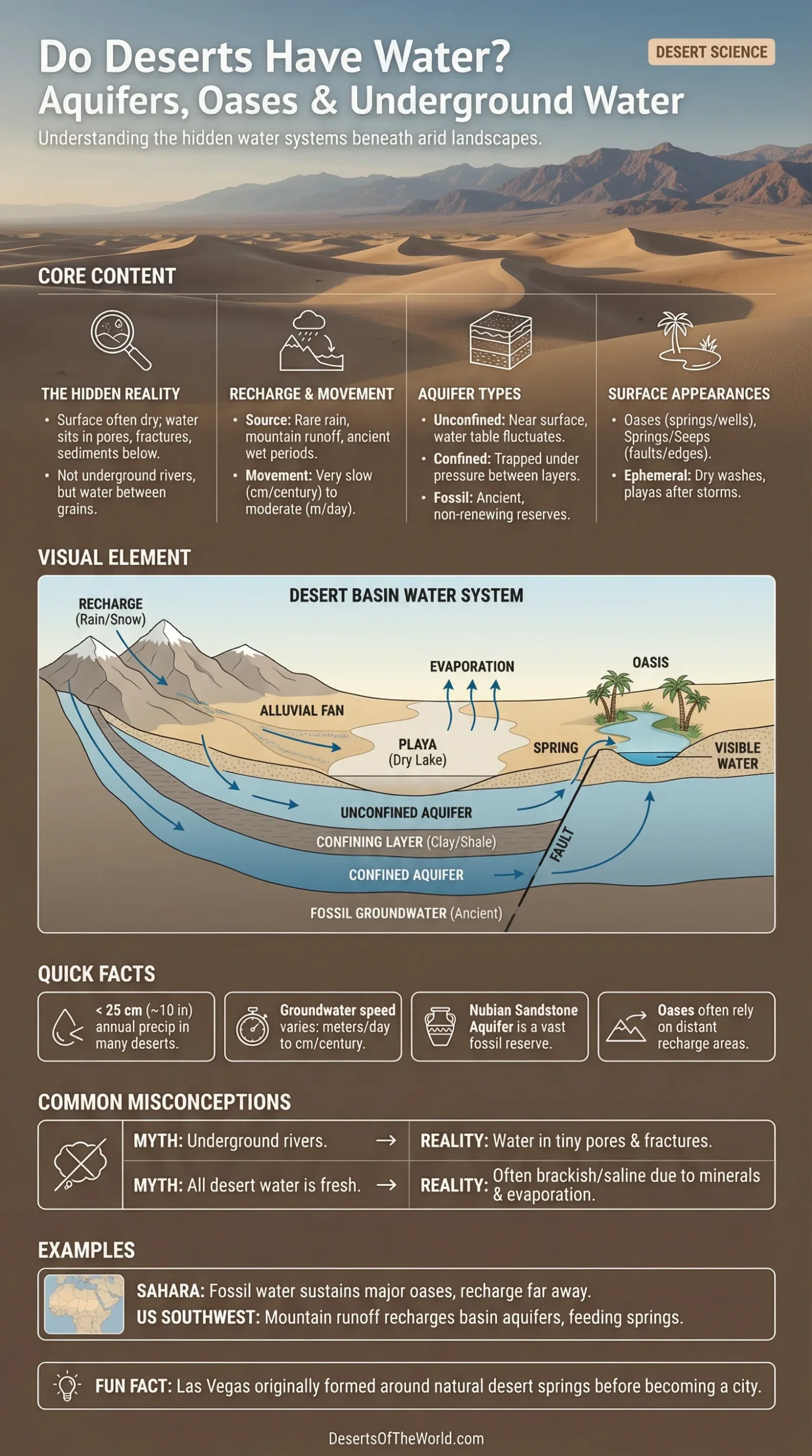
Do deserts have water? Yes, many of them do. The catch is simple: in desert country, water is often hidden rather than absent. It may sit in aquifers below sand, gravel, or fractured rock, rise at springs, collect around an oasis, or move slowly underground for years before it appears at the surface. Still, a desert is dry for a reason. Rain is sparse, evaporation is high, and not every underground store of water is shallow, fresh, or easy to reach.
| Water Form | Where It Is Found | How It Gets There | What It Means in a Desert |
|---|---|---|---|
| Aquifer | Below sand, gravel, sandstone, or fractured rock | Rare rain, runoff, mountain recharge, or older wet periods | The main hidden water store in many desert regions |
| Oasis | At the surface in an otherwise dry area | Spring flow or wells tapping groundwater | A place where desert water becomes visible and usable |
| Spring or Seep | Fault zones, basin edges, low ground | Groundwater reaches the land surface naturally | Shows that underground water is moving |
| Ephemeral Surface Water | Dry washes, wadis, playas, shallow basins | Short-lived runoff after storms | Brief surface water that may also help recharge aquifers |
| Fossil Groundwater | Deep regional aquifers | Stored during much wetter climatic periods | Ancient water that may refill very slowly, or not on a human timescale |
Why Deserts Can Be Dry and Still Hold Water
A desert is usually defined by low precipitation, not by a total lack of water. Many desert regions receive no more than about 25 centimeters, or 10 inches, of precipitation in a year. That tells you how little fresh water arrives from above. It does not mean the ground below is empty.
Some desert water comes from rare storms. Some comes from rain and snow falling in nearby mountains, then sinking into basin-fill sediments farther downslope. Some of it is very old water left behind from wetter climatic periods. So the surface may look bare, while below it, water is stored in pores, fractures, and sediment layers.
That contrast matters. A dune field can look bone-dry and still sit above groundwater. A rocky desert can look harsh and still feed a spring. Dry at the surface, wet in the subsurface. Often that is the real story.
Underground Water Is Usually Not a Hidden Lake
People often picture desert groundwater as underground rivers or caverns full of open water. Most of the time, that picture is wrong. In many deserts, groundwater fills tiny spaces between grains of sand and gravel, or it sits in cracks and fractures within rock. An aquifer is simply a body of rock or sediment that can store water and let it move.
Movement can be slow. Very slow, sometimes. In more permeable material, groundwater may move several meters in a day. In tighter material, it may move only a few centimeters in a century. That is one reason desert water can stay out of sight for so long.
How Aquifers Work in Desert Landscapes
Recharge Often Starts Far From the Driest Ground
Many desert aquifers do not refill evenly across the whole desert floor. Recharge often happens near mountain fronts, alluvial fans, fractured bedrock zones, and normally dry stream channels after runoff. Water from higher ground sinks into sand and gravel, then travels toward lower basin areas.
In desert basins of the American Southwest, for example, recharge commonly comes from rainfall and snowmelt at higher elevations, plus infrequent runoff through dry washes. From there, groundwater moves toward the center of the basin and may later discharge into springs, wetlands, streams, or playas. So even brief storms can matter a great deal. Not because they create a lasting lake, but because they can feed the hidden reservoir below.
Confined Water and Artesian Pressure
Not all aquifers behave the same way. Some are unconfined and sit close to the water table. Others are trapped between less permeable layers such as clay or shale. When water in that kind of confined aquifer sits under pressure, it can rise in a well without heavy pumping. In certain places it may even flow naturally. That is artesian pressure, and it helps explain why a spring or oasis can appear in country that looks too dry to support one.
Geology decides a lot here. A fault, a fold, a buried layer of sandstone, a basin edge made of coarse sediment—small changes underground can decide whether water stays buried or reaches the surface.
Some Desert Water Is Ancient
This is one of the most overlooked parts of the topic. Not all desert groundwater is part of a fast, modern water cycle. Some of it is ancient water stored during wetter climatic periods long ago. That water is often called fossil groundwater.
Large desert aquifer systems in North Africa are a well-known example. The Nubian Sandstone Aquifer System beneath the Sahara is one of the best known on Earth. It holds vast amounts of old groundwater, yet that does not mean it refills quickly. In practical terms, some deep desert water behaves less like a yearly income and more like stored savings. Once heavily withdrawn, it may not recover on any timescale that matters to local communities.
How Oases Form
An oasis is not a desert miracle. It is a groundwater story at the surface.
An oasis forms where freshwater becomes available in an otherwise arid setting. That can happen in a few different ways:
- A natural spring brings groundwater to the surface.
- The water table lies close enough to the land surface for plants to thrive.
- A fault or pressure change pushes water upward.
- People tap an aquifer with wells and maintain the water supply over time.
Most oases depend on underground water. Some are tiny, little more than palms around a spring or well. Others support irrigated fields and long-settled communities. In the Sahara, many major oases rely on aquifers, and in some cases the recharge area for those aquifers may lie far away from the oasis itself. Water can enter a sandstone aquifer at one location and reappear hundreds of kilometers away where conditions let it rise or be tapped.
That is why an oasis should not be treated as a random wet patch. It is tied to bedrock, sediment, groundwater pressure, recharge history, and local landform. The green surface is only the visible end of a larger underground system.
Is Desert Groundwater Always Fresh?
No. This part gets missed all the time. A desert may have underground water, yet that does not guarantee easy drinking water.
| Water Quality Type | Why It Happens | What It Means |
|---|---|---|
| Fresh Groundwater | Recharge from rainfall, mountain runoff, or relatively recent infiltration | Can support springs, wells, irrigation, and oasis farming |
| Brackish or Saline Groundwater | Long contact with mineral-rich sediments, evaporation, or mixing with deeper salty water | May need treatment or may be unsuitable for many uses |
| Hard or Mineral-Rich Water | Dissolved minerals picked up during underground flow | Usable in some cases, though taste and chemistry may limit it |
| Shallow Temporary Water | Short-lived storm runoff pooling in low areas | Useful for a short period, but unreliable |
Why Salinity Is So Common in Arid Groundwater
Desert settings favor salt buildup. Evaporation is intense, recharge is limited, and groundwater may spend a long time moving through sediments and rock. As water travels, it can dissolve minerals. In closed basins, salts can accumulate because there is no easy outlet.
Heavy pumping can add another layer of trouble. Water levels fall, shallow springs weaken, and in some places deeper or saltier water may start to mix into freshwater zones. So when someone asks whether a desert has water, the smarter follow-up is this: What kind of water, how deep, and how fresh?
Where Desert Water Usually Appears at the Surface
Even in very dry regions, hidden groundwater can show itself in recognizable ways:
- Oases, where springs or wells support vegetation and farming.
- Springs and seeps, often along faults, escarpments, or basin margins.
- Wetlands and marshy pockets, where groundwater discharge stays near the surface.
- Playas and low basins, where stormwater gathers and may interact with shallow groundwater.
- Dry washes and wadis, where brief runoff events may recharge subsurface stores.
Some famous desert places began as water points rather than cities. Before modern growth, Las Vegas was known for springs that brought aquifer water to the surface in the Mojave Desert. The green patch came first. Settlement followed.
Not Every Desert Holds Water in the Same Way
Deserts are not all sand seas, and their water systems are not all alike.
Sand and Gravel Basins
These often store groundwater in pore spaces between grains. Basin-fill aquifers can hold large volumes of water, especially where coarse sediments have built up over time.
Sandstone Deserts
Sandstone can act as a good aquifer when pores remain open and connected. Some large oases depend on sandstone aquifers fed from distant intake zones.
Rocky Deserts
Here, groundwater may be controlled more by fractures than by open pore space. A spring may depend on cracks, faults, or weathered rock zones rather than thick loose sediment.
Coastal Fog Deserts
In places like the Namib, life may depend partly on fog and dew. That moisture can be vital for plants and animals, yet it is not the same as a deep aquifer. Useful moisture, yes. A large underground reserve, not necessarily.
Examples That Show How Desert Water Really Works
Sahara Desert
The Sahara is dry at the surface but far from empty below ground. Many of its major oases are supplied by aquifers. In parts of the Libyan Desert, underground water feeding oasis wells and springs may come from sandstone aquifers with recharge areas far away. Beneath the wider Sahara, the Nubian Sandstone Aquifer System shows another side of desert hydrology: very old groundwater, vast in storage, yet not readily renewed on a human timescale.
Southwestern United States
Desert basins in Arizona and nearby areas show the mountain-to-basin pattern clearly. Recharge often happens at higher elevations or along normally dry channels during infrequent runoff events. Groundwater then moves toward basin centers and may discharge into springs, wetlands, streams, or playas. This is a good reminder that a desert aquifer is rarely fed by local rainfall alone.
What People Often Get Wrong About Water in Deserts
- Dry land does not mean zero water. It often means water is hidden, patchy, or hard to access.
- An oasis is not separate from geology. It exists because groundwater can reach the surface or be tapped there.
- Underground water is not always fresh. Salinity and mineral content matter.
- Not every aquifer refills quickly. Some desert groundwater is ancient and only weakly renewed.
- Surface emptiness can be misleading. A barren basin may still overlie a working groundwater system.
Sources
- U.S. Geological Survey – Aquifers and Groundwater (how aquifers store water, groundwater movement, confined and artesian conditions)
- U.S. Geological Survey – Desert Basins of the Southwest (desert basin recharge, dry washes, groundwater flow, springs, wetlands, playas)
- National Geographic Education – Oasis (how oases form and why most depend on aquifers)
- National Geographic Education – Desert (desert definition, precipitation threshold, dryland context)
- IAEA – The Water Is Ancient, The Secrets Are Many (ancient groundwater and the Nubian Sandstone Aquifer System beneath the Sahara)
- Britannica – Oasis (oases supplied by underground water and sandstone aquifers, including Sahara examples)