
Sand dunes form when loose, mostly dry grains meet wind that can move them and a surface where that moving sand can slow down and settle. The recipe sounds simple. The result is not. A dune can begin as a thin patch of trapped sand beside a stone, a clump of grass, driftwood, or a low rise in the ground. After that, the dune starts to shape the wind around itself, and the wind starts to shape the dune in return. Grain by grain, a mound becomes a landform.
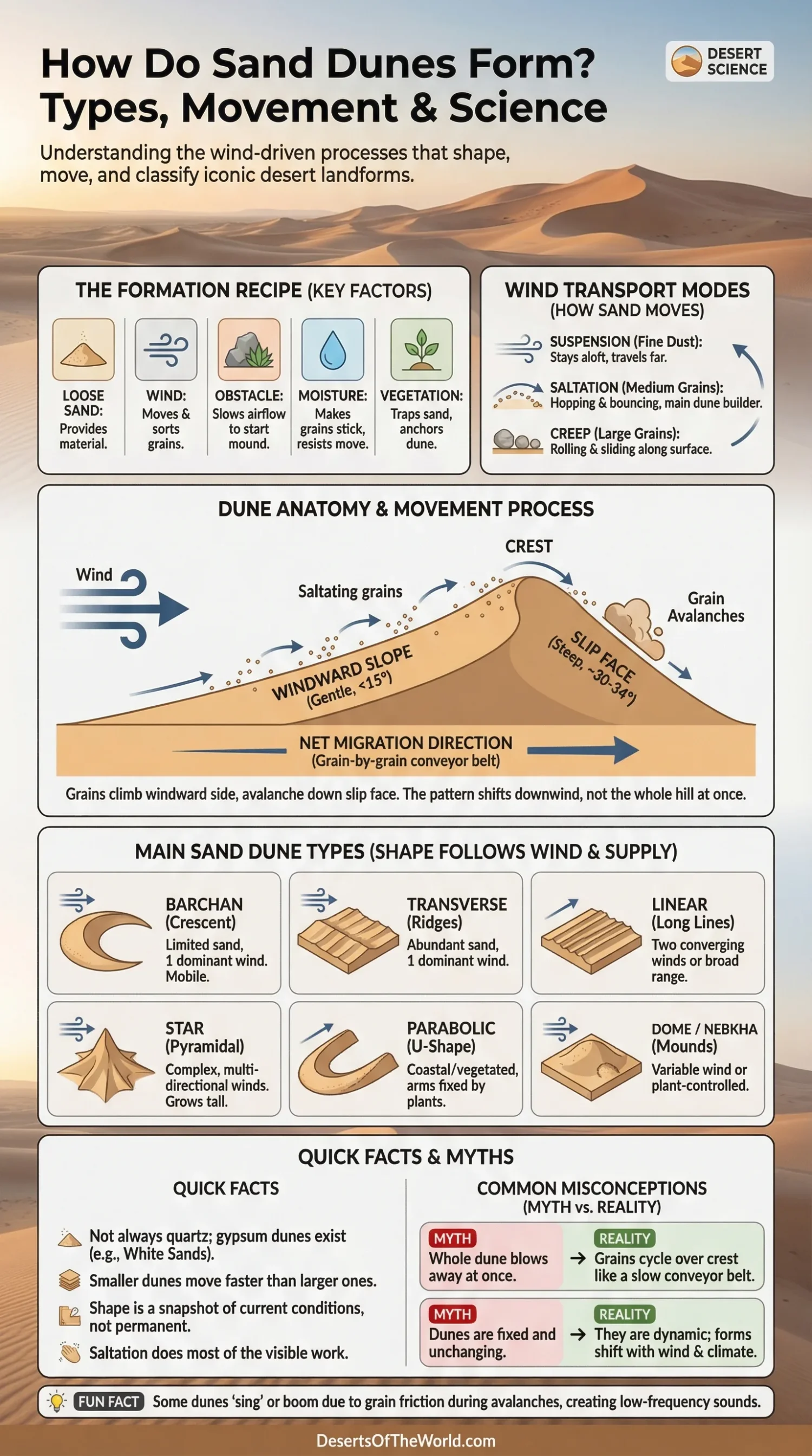
That process works in desert basins, on coasts, beside dry lakes, and in a few unusual places where the sand is not quartz at all. Wind, sand supply, surface moisture, vegetation, and topography decide what kind of dune appears, how fast it moves, and whether it stays bare or settles into a more stable form.
| Control | What It Does | Plain-English Effect |
|---|---|---|
| Loose Sand | Provides material that wind can pick up and sort | No loose sand, no dune |
| Wind | Moves grains, piles them up, and reshapes the mound | Stronger or steadier wind usually means more active dunes |
| Obstacle | Slows airflow so grains drop out | A rock, branch, or grass tuft can start the first mound |
| Moisture | Makes grains stick together | Wet sand resists movement; dry sand travels more easily |
| Vegetation | Traps sand and can anchor parts of a dune | Plants often turn mobile sand into a more fixed dune form |
| Wind Direction Pattern | Controls dune shape | One dominant wind builds one set of forms; shifting winds build others |
What Starts a Sand Dune
A dune usually starts in a modest way. Wind carries sand across the ground. Then the airflow meets an obstacle and loses speed. The heavier or less mobile grains drop first. That tiny deposit becomes a better windbreak than the object that started it, so even more sand settles there. The mound grows. Small at first, then not so small.
This is why dunes often begin around roughness on the surface: a pebble ridge, a shrub, drift material on a beach, or a patch of grass. Not by wind alone, then. Wind needs something to work against.
Dryness matters too. When grains hold too much moisture, they cling together and resist motion. When the surface dries, the same grains become much easier for wind to move. That is one reason dunes are common in arid interiors and on broad beaches where sand can dry between waves and tides.
Why Sand Size Matters
Sand is almost ideal for wind transport. Very fine dust can stay high in the air and travel far, but it does not usually build classic dunes by itself. Coarser gravel is too heavy for ordinary wind to move often. Sand sits in the middle. Mobile enough to travel. Heavy enough to settle and accumulate.
Where the Sand Comes From
Dune sand can come from many sources:
- weathered bedrock in desert basins
- river sediments spread across dry plains
- beach sand delivered by waves and coastal currents
- lake beds and playas exposed during dry periods
- evaporite minerals such as gypsum in rare dune fields
That last point gets missed often. Not every dune is made of ordinary quartz sand. White Sands in New Mexico is built mainly from gypsum, which gives the field its bright color and unusual setting.
How Wind Moves Sand
Wind does not move all grains in the same way. It uses three main transport modes, and dunes grow from their combined effect.
- Creep: larger grains roll or slide along the surface.
- Saltation: medium grains hop in short jumps, strike the ground, and knock other grains loose.
- Suspension: very fine particles stay aloft in turbulent air for much longer distances.
For dune building, saltation does much of the visible work. A hopping grain lands, rebounds, and bumps into other grains. That repeated chain reaction pushes sand up the gentle wind-facing side of a dune. Once enough grains gather near the crest, they spill over the other side.
The surface itself records this motion. Small ripples often form before or alongside dunes. They show that the sand bed is responding to wind stress, grain impacts, and shifting zones of deposition.
Why Dunes Have Two Slopes
Most dunes look uneven because they are. The side facing the wind is usually longer and gentler. The sheltered side is steeper and often ends in a slip face. This steep face forms when sand piles up beyond a stable angle and then slides down in tiny grain avalanches.
That stable limit is called the angle of repose. For dry dune sand, it is often close to the low-30-degree range. So a dune keeps rebuilding its steep side over and over as new sand reaches the crest.
That is the moment many people miss. A dune does not move because the whole hill blows away at once. It moves because grains climb the windward slope, pass the crest, fall down the lee side, and reset the shape a little farther downwind. Think of it as a slow conveyor belt made of sand. Same dune body, new grain positions all the time.
Main Sand Dune Types
Dune classification can look messy because scientists use slightly different schemes. In broad terms, the shapes below explain most dune fields people see and search for. The best way to read them is simple: shape follows wind pattern, sand supply, and plant cover.
| Dune Type | Shape | Typical Setting | Movement Style |
|---|---|---|---|
| Barchan | Crescent with horns pointing downwind | Limited sand, one dominant wind, little vegetation | Usually quite mobile |
| Transverse | Long ridges set across the wind | Abundant sand, one dominant wind | Migrates as ridges move downwind |
| Linear | Long, narrow ridges | Two dominant wind directions or a broad wind range | Often grows lengthwise and shifts more slowly |
| Star | Pyramidal mound with several arms | Complex, multidirectional winds | Tends to grow upward more than it travels far |
| Parabolic | U or V shape with arms pointing upwind | Coasts and vegetated sandy areas | Nose advances while arms stay partly anchored |
| Nebkha | Small mound around a plant | Vegetated margins, sand sheets, dry washes | Usually local and plant-controlled |
| Dome | Rounded mound with weak or no clear slip face | Variable wind settings, lower relief areas | Less visually dramatic, still wind-built |
Barchan and Transverse Dunes
These are the classic forms for areas with one prevailing wind direction. A barchan appears where sand supply is limited, so the dune stays isolated and crescent-shaped. With more sand, many crescents link together and become transverse ridges that lie roughly at right angles to the wind.
Barchans are often the easiest dunes to recognize from photos or satellite views. They are also among the fastest-moving dune forms in very active desert surfaces.
Linear Dunes
Linear dunes are long ridges, sometimes astonishingly long, built where winds arrive from two main directions or where airflow varies within a narrower band. Instead of spreading into crescents, the sand organizes into stretched ridges that run with the net direction of transport.
These dunes can dominate whole sand seas. Long, parallel, orderly. Seen from above, almost like brushstrokes.
Star Dunes
Star dunes form where winds come from several directions during the year. Sand climbs different faces at different times, so the dune grows upward around a central peak rather than marching strongly one way. That is why star dunes can become very tall. They are common in large desert dune fields where the wind regime is complex.
Parabolic Dunes
Parabolic dunes are common on coasts and in places with enough vegetation to hold part of the dune in place. Their arms point upwind because those arms are anchored by plants, while the central nose remains active and moves forward. This shape often surprises people because it looks like a reversed barchan. In a sense, it is. Vegetation flips the geometry.
Why One Dune Shape Becomes Another
Dune types are not rigid labels stamped forever onto the land. Change the wind regime, sand supply, or plant cover, and the form can change too. A bare crescentic dune may shift into a ridge when more sand arrives. A mobile dune in a coastal setting may become parabolic once grasses trap its flanks. A blowout can cut into a vegetated dune and restart active movement.
So when people ask, “What type is this dune?” the fuller question is better: “What conditions are acting on it now?” Shape is a snapshot, not a final identity.
How and Why Dunes Move
Yes, dunes move. Some creep along slowly over years. Others can shift much faster under active winds and open sand supply. The speed depends on dune size, grain size, wind strength, vegetation, moisture, and whether fresh sediment keeps feeding the system.
As a rule, smaller dunes move faster than larger ones. A low barchan can migrate far more quickly than a tall star dune because it takes less sand transfer to shift its shape. Large dunes may still be active, but their overall form changes more slowly.
Measured rates vary a lot. In some dune fields, movement can be only a few feet per year. In more active settings, parts of a dune field may shift by meters in a year, and short-term movement can be much quicker during strong wind events. Studies at White Sands, for example, show small dunes near the upwind edge moving by several meters per year, while very active dunes in other park settings can show striking day-to-day changes.
Do Dunes Move as Whole Hills
Not really. What travels is the pattern created by repeated grain transport. Sand climbs one side, avalanches down the other, and the crest shifts downwind. That is why buried soils, older dune layers, and even former landscapes can sit beneath a newer active dune.
What Slows Dune Movement
- higher moisture in the sand
- denser vegetation
- reduced sand supply
- rough ground that breaks wind flow
- changes in topography that trap or redirect airflow
Once plants gain a hold, especially on coastal dunes, movement often drops sharply. Roots bind the surface. Stems trap new grains. Organic matter starts to build. Over time, the dune may become partly fixed, though not always forever.
Inside the Science of Dune Growth
Dune science is more than a list of names. It is a story of feedback. Wind reshapes the ground, and the new ground reshapes the wind. This is why dunes often organize into repeating fields instead of random piles.
A few ideas matter most:
- Self-organization: dunes interact with airflow and with nearby dunes, producing repeating spacing and patterns.
- Collision and merger: faster small dunes can catch slower large dunes, and the masses may combine.
- Source-to-sink movement: sand often travels from a source area such as a beach, floodplain, or playa toward a trap where topography or wind reversal helps it accumulate.
- Vegetation feedback: once plants trap sand, they can change dune shape, reduce mobility, and create new forms.
These ideas help explain why dune fields do not all look alike, even when they sit under similar climates. Local airflow, sediment source, and surface conditions matter. A lot.
Where Sand Dunes Form Beyond Hot Deserts
Dunes are closely linked with deserts, and for good reason, but they are not limited to hot, dry sand seas. They also form:
- behind beaches with wide dry sand zones and onshore winds
- around dry lake margins and salt flats
- in river valleys with exposed sand bars
- in cold regions where loose sand, sparse vegetation, and strong wind combine
This wider setting matters because many readers picture dunes as purely Saharan landforms. They are broader than that. Coastal foredunes, inland parabolic dunes, gypsum dune fields, and desert crescentic dunes all follow the same physics, even though the landscape around them may look very different.
Questions People Often Have About Sand Dunes
Are Sand Dunes Permanent?
Some are active for long periods. Some become stable when vegetation and soil development take over. Some reactivate later if plant cover is removed or the sediment supply changes. A dune can look settled and still hold a mobile past under the surface.
Why Do Dunes Usually Face One Way?
Because the dominant wind direction leaves a visible imprint on the landform. The gentle slope points into the wind, and the slip face forms on the sheltered side. Where winds vary a lot, the shape gets more complex.
Why Are Some Dunes White, Red, or Darker Than Others?
Color depends on mineral content. Quartz-rich dunes tend to look pale tan or golden. Iron coatings can push dunes toward red or orange tones. Gypsum dunes appear much whiter. The dune process stays much the same even when the mineral makeup changes.
Can Vegetation Create a Dune Instead of Just Stabilizing It?
Yes. Plants do more than hold dunes still. They can start them by trapping grains, build small nebkha mounds, anchor parabolic dune arms, and help foredunes grow along coasts.
Sources
- U.S. National Park Service — Monitoring Aeolian Features and Processes (wind transport modes, dune shapes, wind regime, sand supply)
- U.S. Geological Survey — Eolian Processes (saltation, creep, slip face formation, downwind migration)
- U.S. Geological Survey — Types of Dunes (major dune forms, movement notes, linear dune length)
- Sleeping Bear Dunes National Lakeshore — Sand Dune Geology (how dunes start around obstacles and grow)
- Great Sand Dunes National Park and Preserve — Geology (movement variability in active dune fields)
- U.S. National Park Service — Constructing the Dune-Field Pattern at White Sands (measured migration rates, dune interaction, dune growth)
- Indiana Dunes National Park — Mount Baldy Restoration (foredunes, vegetation trapping sand, parabolic dunes, blowouts)
- White Sands National Park — Sand (gypsum dune composition and rare mineral-based dune setting)