
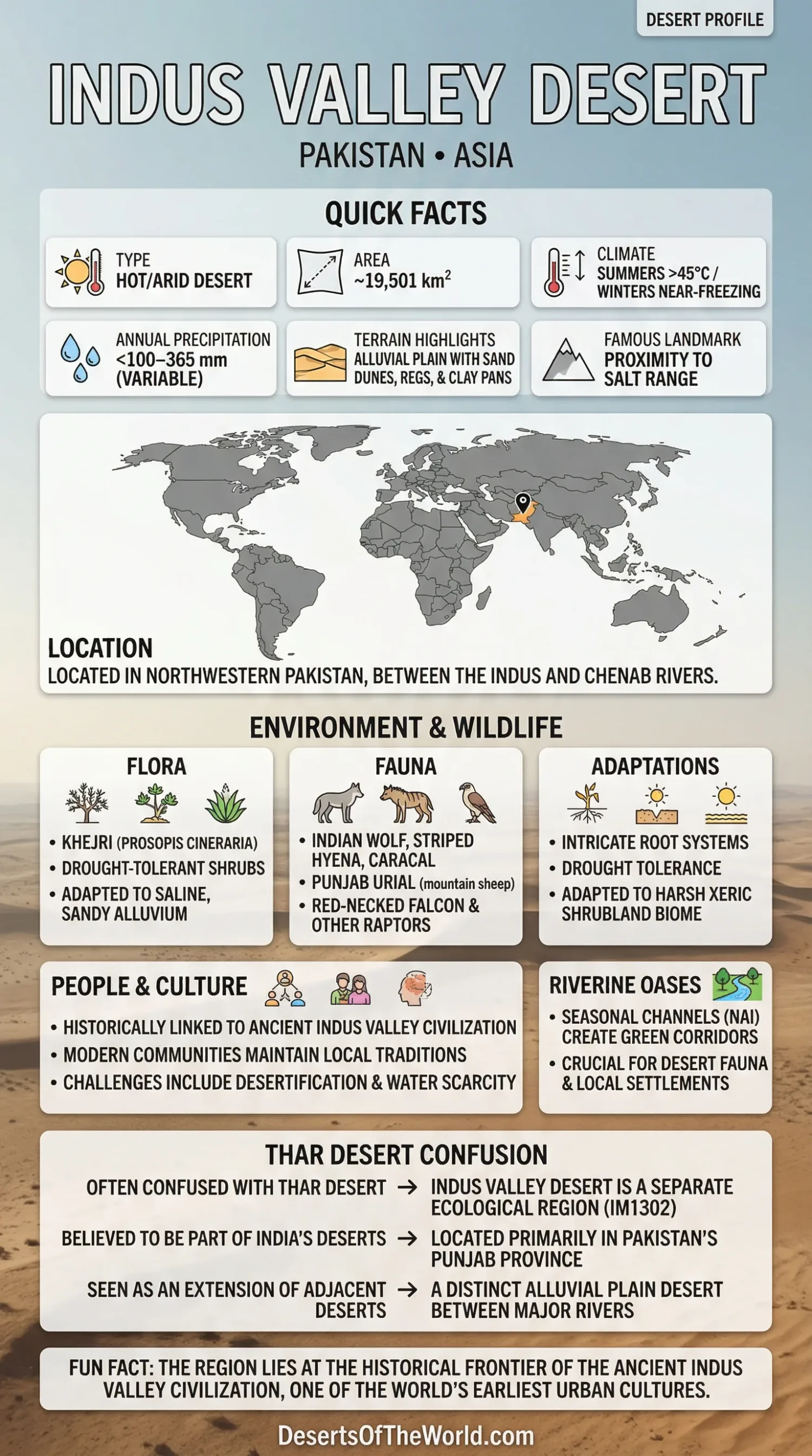
Location & Continent
Continent: Asia
Country: Pakistan
Province: Punjab
Coordinates: 31.250°N, 71.667°E
Physical Features
Area: 19,501 km² (WWF ecoregion IM1302)
Setting: Alluvial plain between the Indus and Chenab rivers, fringed by the Salt Range to the north
Landforms: Aeolian sand sheets and low dunes, gravelly regs, clay pans, and seasonally active dry channels (nai)
Elevation: Mostly ~150–300 m above sea level across the Punjab plain
Climate & Precipitation
Temperature: Near-freezing winter nights; summers frequently exceed 45 °C
Seasonality: Hot, arid climate with brief monsoonal influence (July–September)
Precipitation: Low and highly variable; parts of the lower Indus basin receive <100 mm annually, while basin-wide long-term averages are ~365 mm with strong north–south gradients
Ecological Features
Ecozone (Realm): Indomalayan
Biome: Deserts & xeric shrublands
Ecoregion: Indus Valley Desert (IM1302)
Adjacent Ecoregions: Northwestern thorn scrub forests; Thal Desert and other Indus plains xeric systems
Flora & Fauna
Characteristic flora: Khejri (Prosopis cineraria) with drought-tolerant shrubs and grasses adapted to saline, sandy alluvium
Large mammals: Indian wolf (Canis lupus pallipes), striped hyena (Hyaena hyaena), caracal (Caracal caracal), Indian leopard (Panthera pardus), and Punjab urial (Ovis vignei punjabiensis)
Notable birds: Red-necked (red-headed) falcon and other raptors using dune and scrub mosaics for hunting
Conservation notes: Natural habitats remain patchy but comparatively intact away from irrigation corridors; major pressures include illegal hunting and fragmentation near settlements and canals
Geology & Notable Features
Geology: Young alluvial sediments from the Indus system with wind-reworked sands forming dune fields; inter-dunal pans reflect high evaporation and episodic runoff
Notable features: Proximity to the Salt Range escarpment; interface with the Thal dune belt; riverine oases along seasonal channels
Introduction
The Indus Valley Desert is an arid ecoregion in Punjab, Pakistan, between the Indus and Chenab rivers. Covering about 19,501 square kilometers, it forms part of the dry landscapes of the Indus plains and is distinct from the much larger Thar Desert farther southeast. Its landscape combines low dunes, sandy plains, dry channels and sparse xeric vegetation. Its distinctive landscape, climate, ecology, and cultural setting distinguish the Indus Valley Desert from surrounding drylands while also allowing useful comparison with other desert regions.
Geography
The geography of the Indus Valley Desert is shaped by the broad alluvial plains of Punjab. The ecoregion lies between the Indus River and Chenab River, with the Salt Range to the north and the Thal dune belt nearby. Wind-reworked sand, dry channels, gravelly surfaces and clay pans create a varied desert landscape.
Geographical Comparison
| Desert Name | Location | Area (sq km) | Main Features |
|---|---|---|---|
| Indus Valley Desert | Punjab, Pakistan | 19,501 | Low dunes, sandy alluvial plains, dry channels and xeric scrub |
| Sahara Desert | North Africa | ~9,200,000 | Sand seas, gravel plains, rocky plateaus, mountains and oases |
Climate
The climate in the Indus Valley Desert is predominantly arid, with very hot summers and cool winters. Summer temperatures frequently exceed 45°C (113°F), while winter nights can approach freezing. Rainfall is sparse and irregular, with most seasonal moisture associated with the summer monsoon. Rainfall varies sharply across the wider Indus basin, so basin-wide precipitation figures should not be treated as uniform conditions throughout the desert ecoregion.
Desert Ecology and Wildlife
The Indus Valley Desert supports plants and animals adapted to high temperatures, limited rainfall and sandy or saline soils. Vegetation includes khejri (Prosopis cineraria), drought-tolerant shrubs and grasses. Wildlife associated with the desert and neighboring drylands includes:
- Indian wolf
- Striped hyena
- Caracal
- Red-necked falcon
Habitat quality varies across the region, with relatively undisturbed patches separated by settlements, roads, irrigation canals and cultivated land.
Cultural Context
The Indus Valley Desert lies within the wider Indus basin, a region with a long record of human settlement. The ancient Indus Valley Civilization developed major urban centers and trade networks elsewhere across this wider river system. In the desert and surrounding Punjab plains today, settlement patterns, livestock grazing and agriculture remain closely tied to access to rivers, canals and groundwater.
Modern Challenges
The Indus Valley Desert faces pressures from habitat fragmentation, water scarcity, agricultural expansion, settlement growth and illegal hunting. Irrigation has transformed parts of the surrounding plains, while remaining natural scrub and dune habitats are divided into smaller patches. Conservation efforts focus on protecting native wildlife and preserving remaining desert and semi-desert habitats.
Indus Valley Desert in the Regional Landscape
The Indus Valley Desert is a distinct desert ecoregion of Pakistan rather than another name for the Thar Desert. Its position between major river systems, proximity to the Salt Range and connection with the Thal drylands give it a different geographical setting from the deserts farther southeast. Dunes, alluvial surfaces, xeric vegetation and fragmented wildlife habitat define much of its present landscape.
References
Indus Valley Desert — Wikipedia
Indus Valley desert — DOPA Explorer (European Commission JRC)
Precipitation Trends over the Indus Basin — NOAA (U.S. Gov.)
Indus basin rainfall & temperature indicators — GRID-Arendal (UNEP partner)
Punjab Urial profile — Punjab Wildlife & Parks Department (Gov. of Punjab)
FAQ
Where exactly is the Indus Valley Desert?
It lies in northwestern Punjab, Pakistan, between the Indus and Chenab rivers, centered near 31.250°N, 71.667°E.
How large is it?
The ecoregion covers about 19,501 square kilometers, making it a compact but distinct desert within the Indus plains.
How hot and dry does it get?
Summer days commonly exceed 45 °C. Rainfall is sparse and erratic, with some lower-basin sectors receiving less than 100 mm per year, while the wider basin average is roughly 365 mm.
Is it part of the Thar Desert?
No. It is a separate ecoregion (IM1302), though it borders other arid landscapes of the Indus plains, including the Thal dune belt.
Which animals are emblematic?
Top carnivores include the Indian wolf, striped hyena, caracal, and leopard. The Punjab urial is a notable mountain sheep of the broader region, and the red-necked falcon is a characteristic bird of open scrub.