
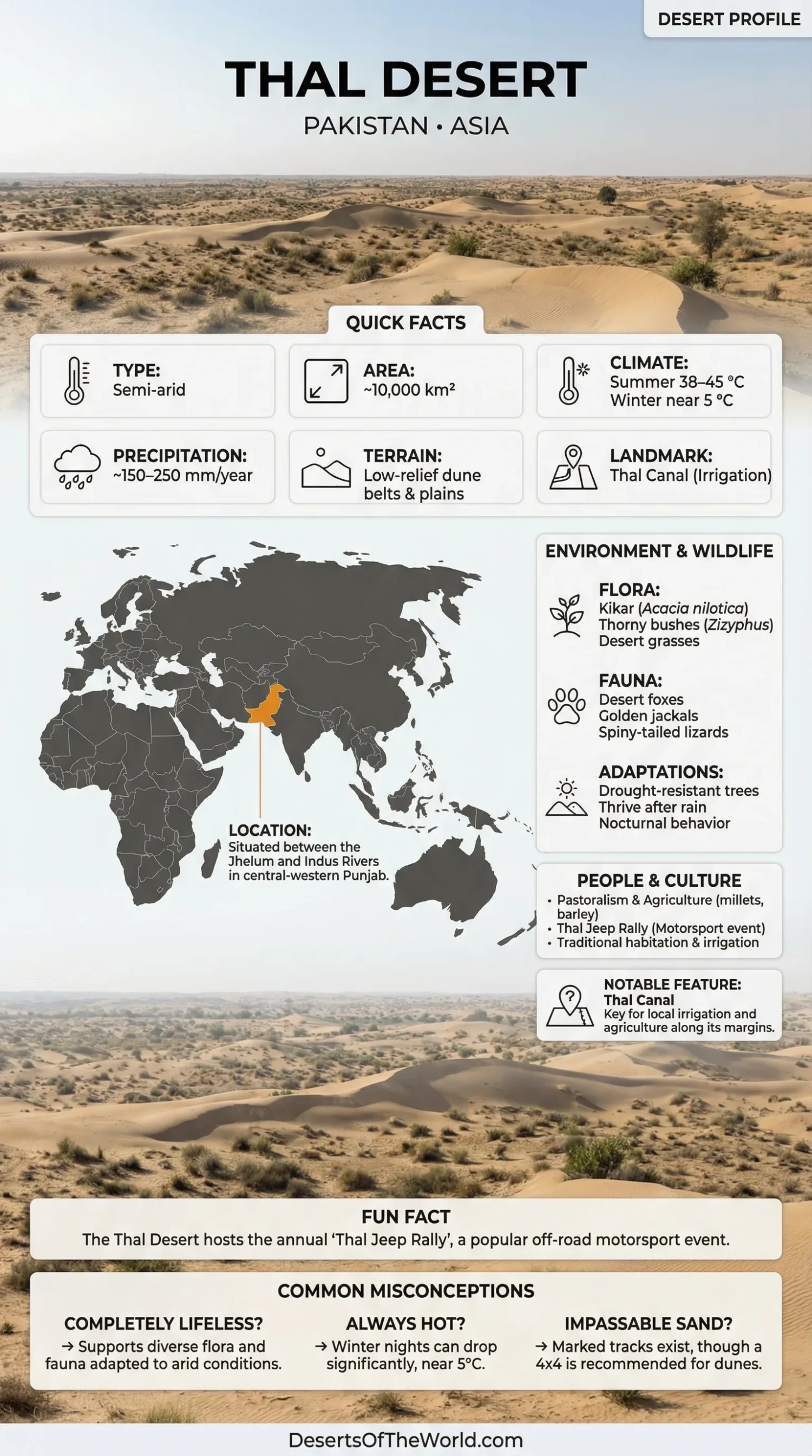
Location & Continent
Continent: Asia
Country: Pakistan (Punjab Province – between the Indus River floodplain to the west and the Jhelum and Chenab river floodplains to the east; districts including Bhakkar, Khushab, Mianwali, Layyah, Muzaffargarh, Jhang and parts of Sargodha)
Coordinates: 31.2000°N, 71.0000°E (central Thal)
Thal Desert – Map & Street View
Physical Features
Area: ~23,000 km²
Length: ~300–310 km (north–south)
Width: Up to ~110–119 km
Elevation: Roughly 120–200 m above sea level across much of the desert; low-relief dune belts and inter-dunal plains dominate the landscape
Climate & Precipitation
Temperature: Very hot summers, with maximum temperatures around 44 °C in the tract and higher readings possible during heatwaves; winter temperatures can fall below 0 °C.
Precipitation: Low and variable, ranging roughly from 170 mm annually in the south to about 385 mm in the northeast. The regional average is around 275 mm, with most rainfall arriving during the summer monsoon.
Ecological Features
Ecozone: Indomalayan
Biome: Desert and xeric shrubland
Regional setting: Subtropical sandy desert of Punjab’s Indus plain, bordered by the Indus floodplain to the west and the Jhelum and Chenab floodplains to the east
Flora & Fauna
Flora: Sand-loving shrubs and grasses including Calligonum polygonoides, Haloxylon salicornicum, Leptadenia pyrotechnica, Ziziphus nummularia, Capparis decidua, tamarisk (Tamarix spp.), and resilient grasses such as Cenchrus ciliaris and Cymbopogon jwarancusa. Irrigated patches support millet and fodder crops.
Fauna: Indian fox (Vulpes bengalensis), golden jackal, desert hare, chinkara gazelle in local pockets, Indian spiny-tailed lizard (Uromastyx), sand boa, saw-scaled viper and monitor lizards; wintering raptors and occasional houbara bustards occur in the wider region.
Geology & Notable Features
Geology: Wind-built dune fields arranged over alluvial sandy deposits between major river floodplains. Dune ridges and rolling sand plains alternate with flatter inter-dunal areas, while seasonal winds continue to rework exposed sand.
Notable Features: Extensive dune corridors near Mankera and Layyah; inter-dunal saline flats; historic routes between riverine settlements; Thal Canal irrigation margins; and the annual Thal Jeep Rally motorsport event on marked off-road stages.
Introduction
The Thal Desert is a sandy arid to semi-arid region in Punjab, Pakistan, extending between major river floodplains in the central-western part of the province. Covering about 23,000 square kilometers, it contains shifting and stabilized dunes, sandy plains, grazing lands, cultivated areas and scattered settlements. Its dune landscapes, harsh climate, ecosystems, and long-established pastoral and farming communities distinguish the Thal Desert from many other arid regions.
Geography
The Thal Desert lies between the Indus River floodplain to the west and the Jhelum and Chenab river floodplains to the east, south of the Salt Range and Pothohar Plateau. Covering approximately 23,000 square kilometers, it extends for about 300–310 kilometers from north to south and reaches roughly 110–119 kilometers at its widest point. Much of the terrain consists of dune ridges and rolling sandy plains separated by narrower, flatter areas that are more suitable for cultivation.
Climate
The Thal Desert has an arid to semi-arid subtropical climate with very hot summers and cool winters. Summer maximum temperatures commonly approach 44°C, while winter temperatures can fall below freezing in parts of the region. Annual rainfall varies considerably across Thal, from roughly 170 mm in the south to about 385 mm in the northeast, with most precipitation received during the summer monsoon.
Flora and Fauna
The Thal Desert supports plants and animals adapted to sandy soils, high summer temperatures and long dry periods. Some characteristic plant species include:
- Jand (Prosopis cineraria) – a drought-tolerant tree found in dry parts of the region.
- Karir (Capparis decidua) and phog (Calligonum polygonoides) – shrubs adapted to dry sandy ground.
- Desert grasses – including Cenchrus ciliaris and Cymbopogon jwarancusa, which provide forage for livestock.
Animal life includes:
- Indian foxes and golden jackals – predators adapted to open dry habitats.
- Hares and rodents – common inhabitants of sandy plains and dune areas.
- Reptiles – including spiny-tailed lizards, sand boas and saw-scaled vipers.
- Birds – including sandgrouse and raptors using the open desert and grasslands.
Human Adaptation and Lifestyle
The Thal Desert has supported settled and pastoral communities for generations. Agriculture and livestock rearing are major sources of livelihood, with farming dependent on a mixture of rainfall, groundwater and canal irrigation. Crops grown in the region include millet, wheat, gram, cotton, sorghum and fodder crops, while grazing lands support cattle, sheep, goats and other livestock.
Comparison Table: Thal Desert vs. Other Major Deserts
| Desert Name | Location | Area (sq km) | Annual Rainfall (mm) | Climate Type |
|---|---|---|---|---|
| Thal Desert | Punjab, Pakistan | ~23,000 | ~170–385 | Arid to semi-arid |
| Sahara Desert | North Africa | ~9,200,000 | Mostly below 100 | Arid to hyper-arid |
| Gobi Desert | Mongolia/China | ~1,295,000 | ~50–200 | Cold desert |
| Atacama Desert | Chile | ~105,000 | Extremely low; some areas near zero | Hyper-arid |
Local Economy
Agriculture and livestock rearing support many communities across the Thal Desert. Rain-fed farming remains vulnerable to dry years, while irrigation from the Thal Canal and other water sources has allowed cultivation to expand in some areas. Livestock grazing remains closely tied to the desert’s grass and shrub vegetation. Events such as the Thal Jeep Rally also bring visitors to parts of the region.
Environmental Challenges
Water scarcity, wind erosion, shifting sand and pressure on grazing land affect parts of the Thal Desert. Overgrazing, removal of native vegetation and expansion of cultivated land can reduce plant cover and leave sandy soils more exposed to erosion. Rainfall also varies sharply between years, affecting both farming and natural vegetation.
Landscape and Livelihoods
The Thal Desert is shaped by sandy soils, dune systems, limited rainfall and the river plains surrounding it. Native grasses, shrubs and trees support desert wildlife as well as livestock, while irrigation has converted parts of the sandy landscape to farmland. The balance between grazing, cultivation and remaining natural vegetation continues to shape the desert today.
References
Punjab Forest, Wildlife & Fisheries Department – Thal Desert Rangelands
Pakistan Council of Research in Water Resources – Pakistan’s Deserts: Land and Water Resources Development
Government of Punjab – Bhakkar Natural Resources and Thal Desert
Bhakkar Climate Averages – timeanddate.com
Encyclopaedia Britannica – Thal Desert
FAQ
Where exactly is the Thal Desert?
It lies in central-western Punjab, Pakistan, between the Indus floodplain to the west and the Jhelum and Chenab floodplains to the east, across districts including Bhakkar, Khushab, Mianwali, Layyah, Muzaffargarh, Jhang and parts of Sargodha.
When is the best time to visit?
Late October to March generally offers milder daytime temperatures and cooler nights. Summer is extremely hot and can also bring dusty, windy conditions.
Do I need a 4×4 to explore the dunes?
A high-clearance 4×4 with an experienced local driver is recommended for soft sand and remote dune belts. Established tracks are safer than attempting unfamiliar routes across open dunes.
Is there wildlife in Thal?
Yes. Indian foxes, jackals, hares, spiny-tailed lizards, sand boas and several raptors occur in the desert and surrounding drylands. Wildlife should be observed from a distance without feeding or chasing animals.
What is the Thal Jeep Rally?
It is an annual off-road motorsport event held on designated routes across parts of the Thal Desert. Dates and routes can change from year to year.
Can I camp and stargaze?
Yes, where local access rules and land conditions allow. Choose durable ground away from vegetation, secure tents against wind, remove all waste and prepare for large temperature changes after sunset.
Are permits or guides required?
Access requirements can vary by route, land ownership and event area. Travelers heading into remote dune fields should check local conditions before departure and use an experienced local guide when unfamiliar with the terrain.