
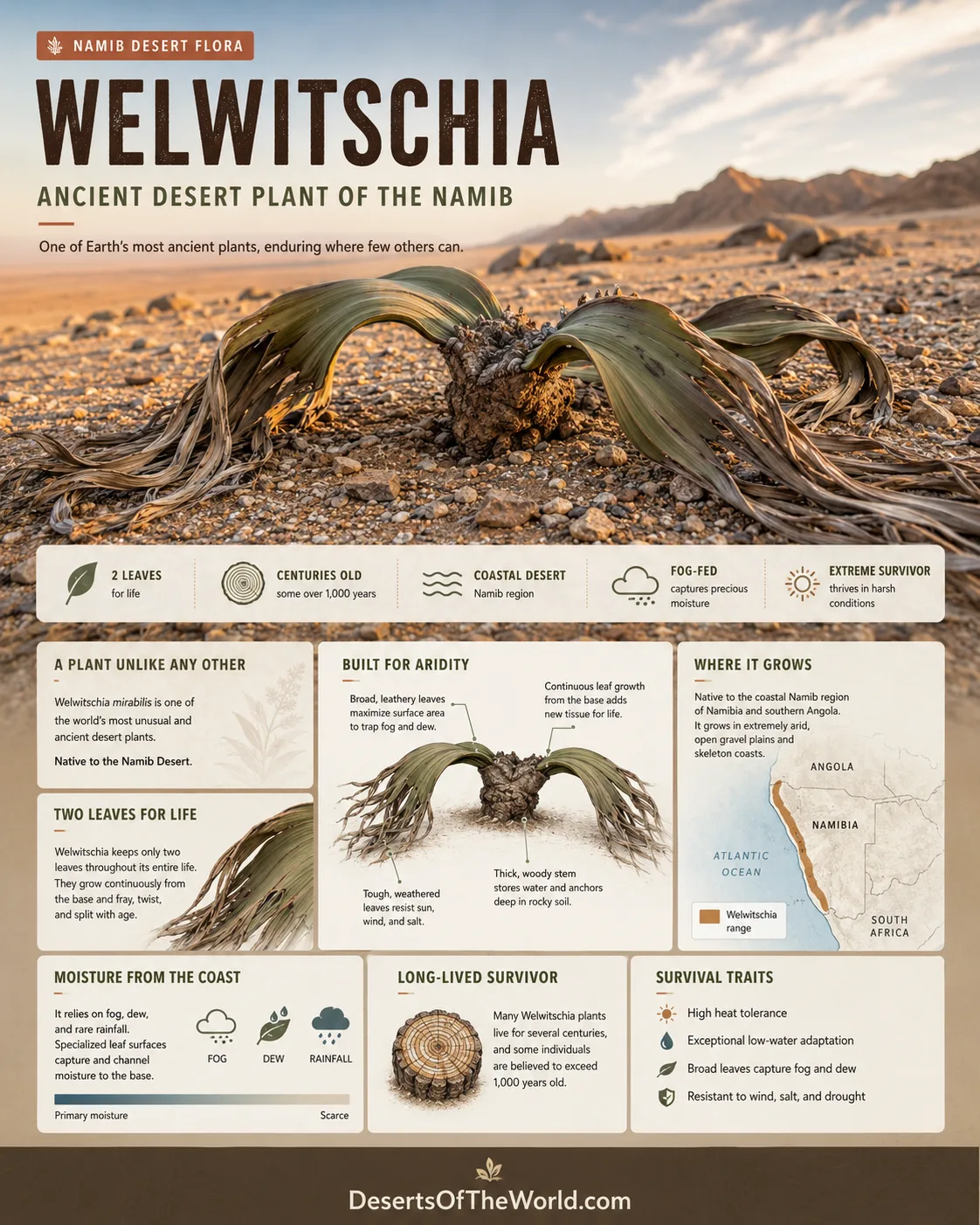
Welwitschia mirabilis is one of the Namib Desert’s most unusual plants: low to the ground, long-lived, cone-bearing, and built around only two permanent leaves. It grows in a narrow desert belt of Namibia and southern Angola, where Atlantic fog, rare rain, gravel plains, dry riverbeds, and deep underground moisture shape its form. Many articles call it a living fossil. The better way to read it is simpler: Welwitschia is a desert survivor with a very old lineage and a body plan found nowhere else on Earth.
It is not a cactus, not a palm, and not a flowering shrub. It is a gymnosperm in its own family, Welwitschiaceae, with pollen cones and seed cones carried on separate plants. Strange at first sight, yes. Random, no.
Main Details About Welwitschia
| Feature | Welwitschia Detail |
|---|---|
| Scientific name | Welwitschia mirabilis Hook.f. |
| Family | Welwitschiaceae |
| Plant group | Gymnosperm; part of the gnetophyte lineage |
| Native range | Southwestern Angola to northwestern and west-central Namibia |
| Desert setting | Namib Desert gravel plains, dry washes, rocky outcrops, and fog-influenced coastal desert |
| Leaf pattern | Only two true leaves, growing from the base for the life of the plant |
| Reproduction | Dioecious: pollen cones and seed cones grow on separate male and female plants |
| Known age range | Often hundreds of years old; some plants are thought to exceed 2,000 years, though exact aging is difficult |
| IUCN Red List status | Not Evaluated at the global IUCN level |
| Protection notes | Protected by law in Namibia and regulated in international trade under CITES Appendix II |
Where Welwitschia Grows in the Namib Desert
Welwitschia grows only in the Namib Desert region of Namibia and southern Angola. Its range is long and narrow rather than broad. Botanical sources describe isolated communities along roughly 1,000 km of desert coast, from the Kuiseb River area in central Namibia northward toward the Moçâmedes region of Angola. Most plants occur within about 100 to 150 km of the Atlantic coast.
That coastal distance matters. The plant’s range follows the Namib fog belt, where cool Atlantic air linked to the Benguela Current meets warmer desert air. Fog often rolls inland at night and fades after sunrise. On the ground, this makes a desert that is dry by rainfall totals but not empty of moisture.
The Fog Belt Habitat
The fog belt is not a lush zone. It is a quiet strip of gravel, stone, dry channels, salt-tolerant plants, lichens, and wind-shaped surfaces. Welwitschia fits this landscape because it does not need deep shade, rich soil, or frequent rain. It needs long stability, open ground, and enough moisture pulses to keep its slow system alive.
In Namibia, Welwitschia is associated with parts of the central and northern Namib, including landscapes linked with Dorob National Park, Namib-Naukluft surroundings, and the wider Kaokoveld/Skeleton Coast desert region. In Angola, it continues into the southern desert where the Namib extends northward.
Why Dry Riverbeds and Gravel Plains Matter
Many Welwitschia plants grow in or near dry watercourses. These channels may look empty for long periods, but they can carry runoff after rare rain and may store moisture below the surface. Gravel plains also help because they reduce heavy plant competition. In places where taller savanna plants become common, Welwitschia often has more competition for space and water.
What Kind of Plant Is Welwitschia?
Welwitschia is a cone-bearing seed plant, not a flowering plant. Its seeds are “naked” in the gymnosperm sense, as with conifers and cycads, rather than enclosed in a fruit. Yet it does not look like a pine, a cycad, or any familiar desert shrub.
Taxonomically, it sits in the order Welwitschiales and the family Welwitschiaceae. The genus Welwitschia has one accepted living species: Welwitschia mirabilis. That single-species status is part of why botanists treat it as a botanical outlier.
Why Welwitschia Is Not a Cactus
The confusion is easy to understand. Welwitschia lives in a desert, grows slowly, and has a tough body. Still, cactus traits are missing. It has no cactus pads, no areoles, no spines arranged from areoles, and no cactus-style succulent stem. Its survival strategy is different: a low woody stem, two strap-like leaves, cones, and a root system that works with desert moisture stored out of sight.
The Gnetophyte Connection
Welwitschia belongs to a small and odd gymnosperm branch often discussed with Ephedra and Gnetum. Those relatives do not look much like it. This makes Welwitschia useful for understanding plant evolution, especially how a seed plant lineage can survive in a desert after close relatives have disappeared from the living flora.
Leaves, Stem, Root, and Cones
The whole plant can be understood through four parts: two leaves, a low stem, a root system, and cones. It sounds simple. In the field, it looks anything but simple, because the leaves split into ribbons and curl across the ground with age.
| Plant Part | What It Looks Like | What It Does |
|---|---|---|
| Two leaves | Long, strap-like, often split into many ragged strips | Photosynthesis, fog drip collection, and long-term growth from the base |
| Stem base | Low, woody, often wider than it is tall | Supports leaves and cones; older stems may become broad and corky |
| Taproot and side roots | Mostly hidden below the gravel or sand | Connects the plant to deeper or stored soil moisture |
| Pollen cones | Smaller cones on male plants | Produce pollen and nectar-like secretions that attract pollinators |
| Seed cones | Larger cones on female plants | Produce winged seeds after successful pollination |
Two Permanent Leaves That Keep Growing
Welwitschia makes two true leaves early in life, then keeps them. Those leaves grow from a basal meristem, a living growth zone near the stem. The leaf tips become worn, dry, shredded, and wind-torn, while the base keeps adding new tissue. That is why an old plant can look as if it has many leaves, though botanically it still has two.
This leaf design suits the Namib. The broad surface can catch fog droplets and guide water down toward the root zone. It also lies close to the ground, where wind, sand, and heat all leave their marks. The plant does not try to stay neat. It stays alive.
A Low Woody Stem Built for Long Life
Kew describes the stem as an inverted cone shape, often around 30 cm tall and about 90 cm across on average. Older plants can become wider, with broad woody crowns and corky tissue. Research profiles also note that the stem can exceed 1.5 m across in large plants while staying low.
That low shape helps the plant avoid the cost of building a tall trunk in a windy, water-limited desert. It also keeps the growing tissues close to the ground, where fog drip and runoff may briefly collect.
Roots and Hidden Water
Welwitschia has often been described as a plant of fog, but fog is only part of the water story. The plant also depends on water in the ground. Dry channels, rocky surfaces, and gravel beds can direct rare rainfall below the surface, where roots can reach it later.
One ecohydrology study site in the hyper-arid Namib reported mean annual precipitation near 31 mm, groundwater roughly 57 to 75 m deep, and about 50 to 90 fog events per year. Those numbers show the strange balance around the plant: rain is scarce, fog is frequent, and usable water may sit in scattered layers beneath dry ground.
How Welwitschia Handles Fog, Rain, and Drought
Welwitschia does not survive by one trick. It uses several small advantages that work together: low growth, long leaves, durable tissues, a root system tied to underground moisture, and the timing of growth after rare rain.
Fog Helps, But It Is Not the Whole Answer
Older descriptions sometimes suggested that Welwitschia drinks fog directly through its leaf pores. Later field work has treated that idea with more care. The leaves can collect condensation and guide droplets toward the soil, yet the plant still relies on root uptake and additional water sources. In plain terms: fog supports the habitat, but the roots still matter.
Fog can add moisture in a region where summer rainfall may be very low, sometimes around 10 to 100 mm in areas described for the plant. In some years, no useful rain falls at all. Under those conditions, a plant must grow slowly and wait well.
Rare Rain Can Shape Growth and Seedlings
Long-term growth research found that Welwitschia growth can respond strongly after episodic summer rainfall. In one study, leaf growth averaged about 0.37 mm per day, varied sharply within individual plants, and rose after rain events above 11 mm. A recorded natural recruitment event followed a 13 mm rainfall at the end of summer.
This matters because seedling establishment is the hard stage. Old plants can endure long dry spans. Tiny seedlings cannot. A small rain event at the right time may create a whole age group in one colony, while many dry years may produce little or no recruitment.
Cones, Seeds, and New Plants
Welwitschia is dioecious. Male and female cones occur on separate plants, so a population needs both sexes for seed production. The cones produce nectar-like secretions that attract pollinators, and the mature seeds have papery wings for wind movement.
Male and Female Plants
Male plants carry pollen cones. Female plants carry seed cones, usually larger and more rounded. This separation of sexes is one reason plant demography matters: a stand with many old individuals but poor sex balance or little seedling survival may not renew itself easily.
Winged Seeds and Rain-Timed Germination
SANBI describes Welwitschia seeds as winged and dispersed by wind when the female cone breaks apart. In nature, many seeds are lost before they can become seedlings. Germination usually needs fairly heavy rain spread across several days, not just a brief damp surface.
That explains why some Welwitschia colonies show many plants of similar size or age. They may have started after the same rare wet period. Then the desert closed again.
Age, Growth, and the Long Life of Welwitschia
Welwitschia is famous for age, but exact ages are hard to prove. Many plants live for centuries, and some are thought to be more than 2,000 years old. The safe wording is “thought to be,” because old desert plants do not always offer easy annual rings the way many trees do in wetter climates.
The plant’s life is slow in a practical sense. It does not race upward. It keeps adding leaf tissue from the base, replaces damage by growth, and holds its place in a harsh but steady landscape. Its long life comes from persistence more than speed.
What Genome Research Adds
A 2021 Nature Communications paper reported a chromosome-level genome assembly for Welwitschia mirabilis of about 6.8 Gb. The study linked the plant’s unusual biology with genome history, gene regulation, and stress-related traits. For readers, the main point is not that a genome “solves” Welwitschia. It gives researchers another way to study why its leaves can keep growing and why the plant can remain active across such long desert lifespans.
Role in the Namib Desert Ecosystem
Welwitschia is part of a sparse but finely tuned desert community. Its leaves may be browsed by desert herbivores during dry periods, and its cones, seeds, shade, and stem spaces can affect small desert organisms around it. It also marks certain Namib habitats where fog, gravel, dry channels, and low rainfall meet.
In a desert plant library, Welwitschia pairs naturally with other Namib species such as the !nara melon (Acanthosicyos horridus), pencil bush, dollar bush, lichens, and hardy shrubs of the central desert. These plants do not form a forest. They form a spaced-out map of survival.
Browsing Without Ending the Plant
Large herbivores may chew the leaves for moisture, especially during dry periods. The tough fibers are not always fully eaten, and damage to leaf ends does not end the plant because new tissue grows from the base. That basal growth zone is the plant’s quiet advantage.
Welwitschia Compared With Other Desert Plants
Welwitschia becomes easier to understand when compared with familiar desert plants. It shares the same broad problem—how to live with heat and scarce water—but solves it in its own way.
| Plant | Main Desert Region | Plant Group | Main Survival Pattern |
|---|---|---|---|
| Welwitschia | Namib Desert | Gymnosperm | Two lifelong leaves, low woody stem, fog-linked habitat, root access to scarce moisture |
| Saguaro Cactus | Sonoran Desert | Flowering cactus | Water-storing stem, ribs that expand, spines, shallow roots after rain |
| !Nara Melon | Namib Desert | Flowering desert plant | Leafless spiny stems, deep roots, dune and dry river habitat |
| Saxaul | Central Asian deserts | Flowering shrub or small tree | Reduced leaves, woody stems, sand-stabilizing growth |
Common Misreadings About Welwitschia
| Common Idea | Better Explanation |
|---|---|
| “It has many leaves.” | It has two true leaves. They split into many strips as they age. |
| “It is a cactus.” | It is a gymnosperm in Welwitschiaceae, not a cactus family plant. |
| “It lives only by absorbing fog through leaves.” | Fog helps the habitat, but roots and stored soil moisture are also part of the water supply. |
| “Every plant is 2,000 years old.” | Many are centuries old, and some may exceed 2,000 years, but age varies by plant and site. |
| “It grows anywhere in the Namib.” | Its natural range is limited, mostly tied to the northern and central Namib fog belt and nearby dry drainage settings. |
Conservation Status and Protected Habitat
Welwitschia is globally listed by Kew as IUCN Not Evaluated, not as a globally assessed threatened species. SANBI notes that it is still common in its habitat and variable in form, while also protected by law. Namibia’s biodiversity records list it as a protected plant and show CITES Appendix II status, meaning international trade is controlled.
Protection is still worth taking seriously. Long-lived plants replace themselves slowly. A damaged adult may have stood in one place for many human generations, and a seedling may need a rare weather window to establish. Habitat stability, careful route management in desert viewing areas, and respect for protected plant rules all help keep Welwitschia populations intact.
Climate Research and Habitat Change
Recent research has examined how future climate conditions may affect Welwitschia habitat, plant health, reproductive status, and population patterns. These studies do not turn the plant into a simple symbol of decline. They show something more useful: long-lived desert plants can look stable while seedling recruitment, cone production, or local habitat suitability shifts slowly.
For a plant that may live for centuries, change can be slow to appear. Slow does not mean absent.
Name, Discovery, and Meaning
The scientific name honors Friedrich Welwitsch, the Austrian botanist who documented the plant in southern Angola in 1859. The species was described by Joseph Dalton Hooker and first published in 1862. The word mirabilis means wonderful or remarkable in Latin, a name that fits the plant’s odd form without needing exaggeration.
Common names also tell part of the story. “Tree tumbo” appears in English sources, while the Afrikaans name tweeblaarkanniedood is often translated as “two leaves that cannot die.” Names like these are not technical labels, but they show how quickly people notice the same thing: two leaves, long life, desert endurance.
Sources
- Royal Botanic Gardens, Kew: Welwitschia Plant Profile (plant description, family, IUCN status, native habitat, cones, and age notes)
- Kew Plants of the World Online: Welwitschia mirabilis (accepted scientific name, taxonomy, and native range)
- SANBI PlantZAfrica: Welwitschia mirabilis (distribution, fog-belt ecology, seed behavior, growth form, and conservation notes)
- Namibia Ministry of Environment, Forestry and Tourism: Dorob National Park (central Namib habitat context and listed vegetation, including Welwitschia)
- PLOS ONE: Climate Change Effects on Welwitschia mirabilis (research on habitat suitability, health, reproduction, and population patterns)
- Nature Communications: The Welwitschia Genome (genome assembly and research on longevity-related biology)
- Plant Ecology: Long-Term Growth Patterns of Welwitschia mirabilis (leaf growth rates, rainfall response, and recruitment observations)