
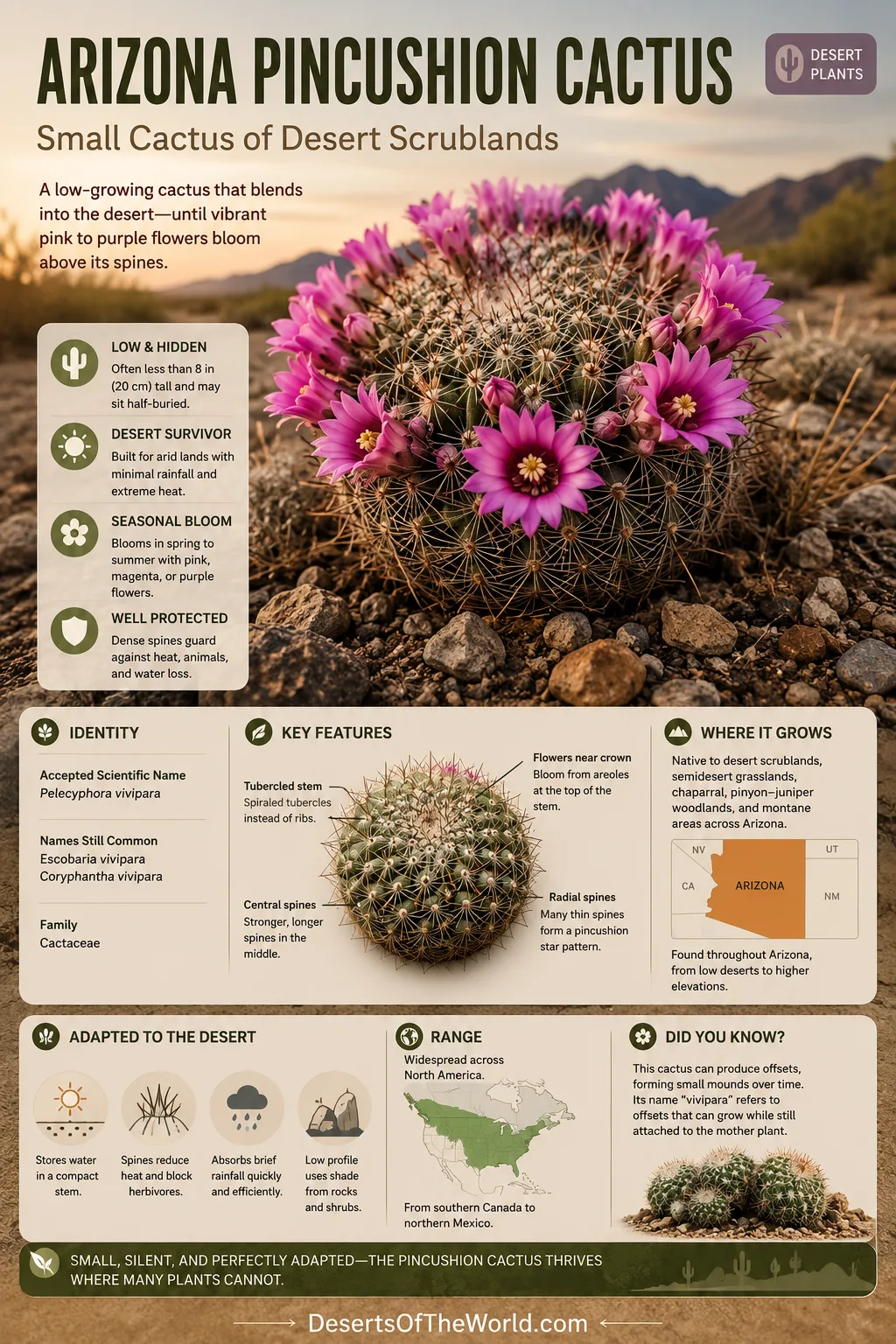
The Arizona pincushion cactus sits so close to the ground that it can vanish among gravel, dry grass, limestone fragments, and low desert shrubs. For much of the year, its compact stem and dense spines blend into the surface. Then pink or purple flowers rise from the crown, sometimes forming a loose ring above the needles. The change is brief and easy to miss.
This small cactus belongs to a much larger dryland story. It occupies places where rainfall arrives in short pulses, surface soils drain quickly, and plant cover breaks into scattered patches rather than a continuous layer. Its form reflects that setting: a water-storing stem, leaves reduced to spines, slow growth, and a seasonal rhythm that spends very little when moisture is scarce.
| Plant Detail | Arizona Pincushion Cactus |
|---|---|
| Accepted Scientific Name | Pelecyphora vivipara |
| Names Still Common in References | Escobaria vivipara and Coryphantha vivipara |
| Plant Family | Cactaceae |
| Growth Form | Low, rounded to short-cylindrical stem; solitary or forming a small mound |
| Stem Surface | Spiraled tubercles rather than continuous ribs |
| Typical Flower Color | Pale rose, deep pink, magenta, or purple, often with a lighter center |
| Arizona Flowering Window | Usually spring through summer, with local timing shaped by elevation and rainfall |
| Recorded Arizona Habitats | Desert scrub, semidesert grassland, chaparral, pinyon–juniper woodland, and some montane settings |
| Wider Native Range | Southern Canada through the western and central United States to northern Mexico |
What the Name Arizona Pincushion Cactus Refers To
The common name Arizona pincushion cactus is useful in ordinary language, yet it does not always lead to one consistent scientific label. Current plant databases accept Pelecyphora vivipara. Many park pages, floras, herbarium records, field manuals, and older botanical works still list the same plant as Escobaria vivipara or Coryphantha vivipara.
The change to Pelecyphora followed a 2022 phylogenetic study of related cactus groups. That study placed species formerly treated in Escobaria within a broader Pelecyphora lineage. The older names remain useful because decades of ecological and regional information were published under them.
Arizona records add another layer. Names such as Coryphantha vivipara var. arizonica and the Bisbee form appear in regional literature. Current global taxonomy treats several of those historic names within Pelecyphora vivipara. Other closely related Arizona cacti, including Pelecyphora alversonii, Pelecyphora robbinsiorum, and Pelecyphora sneedii, remain separate accepted species.
For this page, Arizona pincushion cactus means Arizona populations of Pelecyphora vivipara. The plant is native to Arizona, though it is not endemic to the state. Its wider range reaches from the Canadian prairies to northern Mexico.
The separate species Pelecyphora tuberculosa should not be used as the botanical basis for this Arizona profile. Its current Kew distribution covers southern New Mexico, western Texas, and northern Mexico rather than Arizona.
A Ground-Hugging Form Shaped by Dry Country
Large desert cacti advertise themselves across the skyline. Arizona pincushion cactus works at ground level. A single stem may be nearly spherical, egg-shaped, or short and cylindrical. Older plants can produce offsets until several stems form a low mound.
Arizona Cooperative Extension records plants with one to 24 stems and a height under about 8 inches (20 centimeters). Many remain smaller. During winter or a dry period, more than half of a stem may sit below the surrounding soil surface, while the exposed crown becomes flatter and harder to notice.
This low profile suits rocky scrubland in several ways:
- It reduces the amount of stem exposed above the hottest, driest layer of moving air.
- It allows nearby stones to cast short periods of shade across the plant.
- It keeps the water-storing body compact.
- It helps the cactus occupy narrow soil pockets where larger shrubs cannot root as easily.
- It places new growth near the surface, where brief rain can wet the upper soil.
Small size does not prove that a plant is young. Growth can remain slow for years when rain is irregular, soils are thin, or summer heat shortens the period suitable for new tissue. A mature cactus may still fit within the space between two stones.
Why the Stem Resembles a Pincushion
The stem has no long vertical ribs like a saguaro or many hedgehog cacti. It is divided into tubercles, small conical projections arranged in spirals. Each tubercle carries an areole, the specialized cactus structure that produces spines and, in the upper part of the plant, flowers.
A shallow groove runs along the upper surface of a mature tubercle. That groove, combined with the position of flowers between the tubercles near the crown, helps separate the plant from several superficially similar small cacti.
Radial and Central Spines Create the Star Pattern
Two spine sets shape the plant’s appearance. Radial spines spread around an areole and lie relatively close to the stem. Central spines project farther outward. Arizona Extension descriptions record roughly 10 to 40 radial spines and 3 to 14 central spines per areole, though counts vary among plants and regional forms.
The spines are commonly white, grayish, or pinkish, with darker reddish-brown tips. Overlapping rows can hide most of the green stem. Seen from above, each areole looks like a small starburst. Repeated across a rounded body, those starbursts produce the pincushion effect.
Spines Change the Stem’s Immediate Environment
Spines protect the water-rich stem from browsing animals, but their role extends beyond physical defense. A dense spine layer breaks direct sunlight into many small patches of shade. It also slows air movement immediately beside the stem and can soften the drying effect of wind.
These effects should be read as normal cactus functions rather than precisely measured performance values for this one species. Spine density, angle, color, season, and local exposure all affect how much shade or airflow reduction a plant receives.
A Crown of Pink Flowers Above the Spines
The flowers emerge near the top of the stem, where the newest tubercles form. Several flowers may open around the crown at the same time, creating a ring of color above the white and reddish spines. The display makes the cactus look much larger than it does during the rest of the year.
Flower color ranges from pale rose to reddish pink, magenta, or purple. Narrow pointed tepals surround orange-yellow anthers and a pale stigma. The open flowers often sit above the spine layer, giving visiting insects a clear landing area.
Arizona records place flowering mainly from April through August. The range is broad because the cactus grows across a large elevation gradient. A plant in warm desert scrub does not follow the same calendar as one on a cooler plateau or woodland edge. Local rainfall also shifts the timing. Arizona Extension notes that summer flowers may appear about six days after rain under suitable conditions.
Rain Can Trigger a Fast Visible Change
Desert plants often wait through long periods with little outward change. When soil moisture and temperature align, the Arizona pincushion cactus can move quickly from a quiet crown to active buds and flowers. The response does not mean the whole life cycle began with that storm. Bud development, stored water, plant condition, and earlier weather all influence the result.
The short flowering pulse fits dryland life. Flowers cost water and energy. Keeping them open through a long season would waste both. A compact bloom period concentrates reproduction into the part of the year when the plant can support it.
Desert Scrubland Is a Patchwork of Small Habitats
“Desert scrub” can sound like one uniform plant community. On the ground, it is a mosaic. Gravel pockets, limestone layers, shallow slopes, grass openings, shrub margins, exposed flats, and small runoff channels can differ over only a few meters.
Arizona pincushion cactus often occupies open, well-drained ground where taller vegetation does not form a closed canopy. The soil may be sandy, gravelly, stony, or mixed with limestone. The surface usually sheds or absorbs water without staying saturated for long periods.
| Microsite Feature | How It Shapes the Cactus Site |
|---|---|
| Loose Gravel or Sandy Soil | Allows storm water to enter the upper soil while limiting long-lasting saturation |
| Limestone Layers or Fragments | Create cracks, shallow pockets, and mineral-rich surfaces used by many dryland plants |
| Rock Edges | Provide short shade periods and collect small amounts of runoff and windblown material |
| Open Shrub Gaps | Offer strong light with less root competition from dense woody cover |
| Semidesert Grass Openings | Combine seasonal moisture with exposed mineral soil between grass clumps |
| Gentle Slopes | Move excess water away while creating small deposition pockets below stones and plants |
The cactus does not need a large area of ideal ground. It needs a suitable pocket. That scale matters. A hillside can appear uniform from a distance while holding warm, cool, dry, and temporarily moist sites side by side.
Arizona Range Extends Beyond the Hottest Desert Floor
The title “desert cactus” can suggest a plant restricted to low, hot basins. Arizona pincushion cactus has a wider ecological reach. Arizona Cooperative Extension records it from about 700 to 8,800 feet (roughly 210 to 2,680 meters), spanning desert scrub, interior chaparral, semidesert grassland, pinyon–juniper woodland, and montane conifer settings.
This range places the species across several dryland boundaries:
- Warm desert scrub: open ground, strong heat, sparse shrubs, and fast-drying soil.
- Semidesert grassland: summer rain pulses, bunchgrasses, exposed soil gaps, and cooler nights.
- High desert and plateau country: cold winters, rocky soils, and stronger frost exposure.
- Woodland edges: broken pinyon–juniper cover with sunny openings and shallow mineral soil.
The species’ wide North American distribution supports the same reading. It tolerates far more winter cold than a lowland saguaro. Arizona populations therefore belong to both hot-desert and cold-dryland stories, depending on location.
How the Cactus Manages an Irregular Water Budget
Rain in Arizona drylands often arrives unevenly. A storm may wet one slope while leaving another almost dry. Summer moisture can come in short, intense bursts, while winter precipitation may arrive more gently and persist longer in cool soil. Arizona pincushion cactus has to use moisture when it appears and limit loss afterward.
The Stem Stores Water Without Building a Large Body
The green stem performs the work that leaves perform on many other plants. It carries out photosynthesis and stores water in succulent tissue. After useful rain, the stem can become fuller. During a long dry interval, it may contract as stored water is used.
A compact body keeps the storage system close to the ground and limits exposed surface compared with a taller, branching form. The trade-off is slow visible growth. This cactus saves tissue rather than replacing it often.
Night-Time Gas Exchange Reduces Water Loss
Like other stem cacti, Arizona pincushion cactus uses CAM photosynthesis. Its stomata open mainly at night, when the air is cooler and the vapor pressure pulling water from plant tissue is lower. Carbon dioxide enters during those cooler hours and is stored in chemical form for use in daylight photosynthesis.
The plant still loses water, and drought still places it under stress. CAM simply lowers the cost of gas exchange. It turns time into an adaptation: collect carbon at night, process it by day.
Fast Drainage Matters as Much as Rainfall
A drought-adapted cactus needs water, yet roots and lower stems cannot remain in saturated ground indefinitely. Sandy and rocky soils create a useful balance. They accept a brief pulse, hold some moisture around particles and cracks, then release the excess.
This helps explain why the cactus often appears in limestone layers, gravelly flats, and open slopes. The plant gains access to rain without depending on a wet soil profile. In dryland ecology, drainage can separate a usable storm from a damaging period of waterlogging.
The Seasonal Rhythm of a Small Desert Cactus
The cactus does not remain equally active through the year. Its annual cycle follows moisture, temperature, day length, and stored resources.
- Cool or dry rest: visible growth slows, the stem may flatten or contract, and the crown remains quiet.
- Moisture uptake: useful rain raises water content in the rooting zone and stem.
- Crown growth: young tubercles develop near the apex.
- Bud and flower production: flowers rise from the upper tubercle axils.
- Fruit development: green fruits form close to the crown after successful pollination.
- Return to restraint: growth slows as the soil dries or temperatures move outside the favorable range.
Not every plant flowers every year. A small individual may conserve resources after a dry season. Nearby plants can also behave differently because a rock, shrub, slope angle, or soil pocket changes how much water reaches each root zone.
From Crown Flowers to Green Fruit and Seed
After pollination, fruit develops near the upper stem. Arizona descriptions record a green, juicy fruit about one-half to one inch long (roughly 1.3 to 2.5 centimeters), sometimes tinged purple at maturity. Inside are reddish-brown seeds.
The flower and fruit remain close to the crown because that is where mature tubercles produce reproductive growth. This placement differs from cacti that bear flowers farther down the stem or along pronounced ribs.
A Short Flowering Window Requires Timely Visits
The bright open flowers provide pollen and floral rewards to insects active during the bloom period. The visiting community can change with elevation, weather, and surrounding vegetation. Local observation matters more than assigning one universal pollinator to every Arizona population.
Several flowers open near one another on a mature mound, which can make the plant easier for insects to locate. A solitary stem offers fewer blooms, though it can still reproduce when compatible pollen reaches it.
Seedling Establishment Is the Narrow Part of the Cycle
An adult cactus can store water and retreat into a low, well-armored form. A new seedling has almost none of that protection. Its tiny root system occupies the hottest and fastest-drying part of the soil.
Successful establishment depends on a rare sequence:
- seed reaches a suitable mineral-soil pocket;
- moisture lasts long enough for germination;
- the young root enters a crack or stable soil layer;
- surface heat remains within a tolerable range;
- later rain arrives before the seedling exhausts its small reserve.
Rock edges, grass clumps, and light shrub cover can create safer microsites by reducing afternoon heat and slowing surface drying. Too much shade or root competition can work in the opposite direction. The useful site is often a narrow middle ground.
How a Single Stem Becomes a Low Cactus Mound
Some Arizona pincushion cacti remain solitary. Others produce offsets from the base and gradually form clusters. Each rounded head belongs to the same connected plant unless separate seedlings have established tightly together.
Clustering offers several possible advantages. If one stem loses active tissue, another may continue growing. A mound also carries more flowering crowns within a small area. Dense spines from neighboring stems overlap, making the center of the cluster less exposed.
Stem count alone cannot provide a dependable age. Growth rate changes with rainfall, elevation, soil depth, frost, shading, and past damage. A cluster with many heads may be old, yet a favorable run of seasons can also speed offset production.
How to Separate It From Other Small Arizona Cacti
Arizona supports many low, round, densely spined cacti. Common names overlap, and flower color can mislead. Reliable identification uses several traits together: stem architecture, tubercle grooves, spine form, flower position, fruit, and geographic setting.
| Plant Group | Useful Distinction | Reason for Confusion |
|---|---|---|
| Arizona Pincushion / Spinystar Pelecyphora vivipara | Grooved tubercles in spirals, mostly straight radial and central spines, flowers near the crown, green fruit | Small rounded body and pink flowers resemble several other cactus groups |
| Fishhook Pincushions Mammillaria species | One or more central spines may form a clear hook; tubercle and fruit characters differ | Both can form small globes with pink flowers near the upper stem |
| Mountain Ball Cacti Pediocactus species | Flower, fruit, seed, bract, and areole traits provide the better separation | Sterile plants can share a compact tubercled form and pale radial spines |
| Hedgehog Cacti Echinocereus species | Stems usually show ribs, with areoles arranged along those ribs | Young or short stems can form low clumps and carry vivid pink flowers |
| Other Pelecyphora Species | Spine number, tubercle form, flower traits, fruit, seed, and range must be checked together | Close relatives share the same basic body plan and older references may use different genera |
Straight Spines and Fishhooks Need Careful Reading
The word “pincushion” describes a general appearance, not one botanical lineage. Many small cacti carry the name. A distinct hooked central spine often points toward a fishhook-type Mammillaria or another hooked-spine cactus, while Arizona pincushion cactus normally has rigid, needle-like spines without a strong terminal hook.
A slightly curved or weathered spine does not settle the identification. The tubercle groove, flower origin, fruit form, stem ribs, and local range remain part of the decision.
Flowers Alone May Not Settle the Species
Deep pink flowers look distinctive in photographs, yet related species can produce very similar blooms. Regional flora accounts note that the flowers of Pelecyphora vivipara can resemble those of certain other pincushion and beehive cacti closely enough that vegetative material is needed.
A sound field record includes the whole plant, tubercle surface, several areoles, spine arrangement, flower position, substrate, elevation, and broad location. Fruit and seed characters can become relevant when close species overlap.
Dormancy, Water Stress, and Nonliving Remains Look Different
A living Arizona pincushion cactus can look dry, flattened, or partly buried. That appearance is often a normal seasonal response. The green tissue contracts behind the spines, making the plant seem smaller and duller than it appeared after rain.
A Resting Plant Keeps an Organized Crown
During a dry or cold period, the stem may show little fresh growth. The spine pattern remains attached and orderly, and the crown still has intact tissue beneath the areoles. Color may become muted, especially when the stem contracts deeper into the soil.
A Water-Stressed Stem Loses Visible Volume
More pronounced contraction can draw the green surface inward between tubercles and spines. The cactus may appear sunken or wrinkled. Stress does not automatically mean irreversible decline. A later moisture pulse can restore stem volume when roots and crown tissue remain functional.
Old Remains Lose Living Crown Tissue
Weathered spine clusters can persist after the succulent tissue has broken down. They may become loose, hollow, or detached from a firm rooted stem. Visual uncertainty is common, especially in winter. Digging, cutting, or pulling the plant apart to test it damages the site and may destroy a living cactus.
Its Ecological Role Begins at a Very Small Scale
Arizona pincushion cactus does not build tall shade, large cavities, or broad root islands. Its ecological role is quieter. Flowers add a seasonal food source for insects. Fruit offers moisture and seed-bearing tissue to small animals. The spine mound creates a tiny sheltered structure at the soil surface.
The plant also marks a particular kind of ground: open enough for strong light, stable enough to hold a slow-growing perennial, and well drained enough to avoid long saturation. Finding one cactus often draws attention to the surrounding microtopography—stone edges, runoff lines, grass spacing, and thin soil pockets.
Rain, Stone, and Plant Cover Work Together
During a storm, water does not spread evenly across desert scrub. Stones divert flow. Grass bases slow it. Shrub litter absorbs part of it. Small depressions collect it. A low cactus may receive more moisture from a few square meters of runoff than the rainfall measured directly above its stem would suggest.
That pattern also changes erosion. Stable gravel and biological soil crust can hold fine particles near the plant, while repeated surface disturbance can remove the shallow pocket on which the cactus depends. The habitat is measured in centimeters as much as in hectares.
Ground-Level Change Can Reshape a Local Population
The species has a broad continental range, but broad distribution does not make every local group secure. Small cacti can be affected when the exact places they occupy change faster than new plants can establish.
Local pressures include:
- repeated crushing of low plants along informal travel lines;
- removal or rearrangement of rocks that shape shade and runoff;
- soil compaction that changes infiltration around shallow roots;
- dense invasive grass cover that closes open germination sites;
- altered fire behavior in scrub and grassland mosaics;
- long dry sequences that reduce flowering or seedling survival;
- removal of wild plants from their habitat.
Adult plants may persist through difficult seasons, while recruitment quietly declines. A site can still contain old mounds even when few young plants are joining the population. That delay makes seedling habitat as relevant as the condition of visible adults.
Observing the Cactus Without Changing Its Microsite
The best field view often comes from kneeling at a respectful distance and reading the plant together with its ground. The slope, stones, nearby grass, shrub spacing, and soil texture explain more than a close photograph of the flower alone.
- Stay on durable surfaces and established routes where they exist.
- Do not clear stones, grass, litter, or soil from around the stem.
- Avoid pressing equipment against the cactus or its rooting pocket.
- Use broad location descriptions rather than publishing a precise point for a small wild population.
- Photograph the full plant and habitat before moving closer for structural details.
Arizona pincushion cactus rewards patient observation. Its small body records the dryland conditions around it: brief rain, open mineral soil, cold or heat depending on elevation, and long intervals when conserving water matters more than growing. The flower may draw the eye first. The ground explains the plant.
Sources
- Plants of the World Online: Pelecyphora vivipara (accepted name, synonyms, and native distribution)
- PhytoKeys: Phylogenetic Relationships in Coryphantha and Implications for Pelecyphora and Escobaria (2022 taxonomic research behind the genus placement)
- Plants of the World Online: Pelecyphora tuberculosa (accepted range used to separate this species from the Arizona profile)
- Arizona Cooperative Extension: Escobaria vivipara (Arizona morphology, elevation, habitat, flowering, spine, and fruit records)
- University of Arizona Campus Arboretum: Spinystar (plant structure, flowers, fruit, range, and historical names)
- Grand Canyon National Park: Cacti and Desert Succulents (Arizona park description of spinystar growth, spines, flowers, soil, and fruit)
- Petrified Forest National Park: Cacti and Desert Succulents (northern Arizona field appearance and comparison with nearby cactus forms)
- SEINet Arizona–New Mexico Chapter: Coryphantha vivipara (regional morphology, synonymy, and identification notes)