
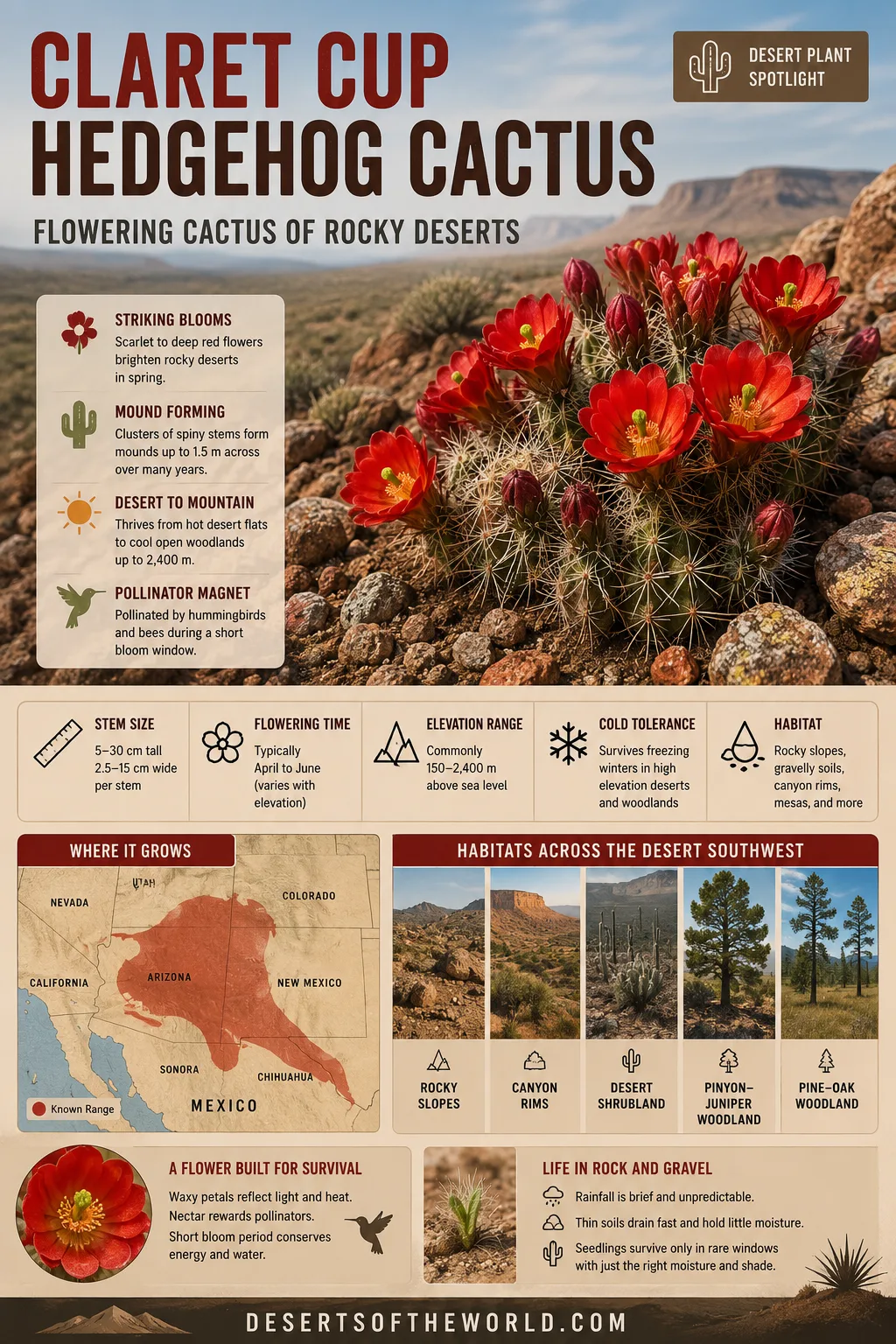
Claret cup hedgehog cactus can remain visually quiet for much of the year, its ribbed green stems blending with sandstone, gravel, volcanic rock, and dry woodland ground. Flowering changes that appearance within days. Scarlet cups open across the mound, often above a surface where soil is thin, water drains quickly, and temperatures shift sharply between sunlit afternoons and cold nights.
Known botanically as Echinocereus triglochidiatus, this cactus belongs to the drylands of the American Southwest and northern Mexico. Its story is not only about drought tolerance. Rock position, winter cold, seasonal rain, pollinator activity, and rare windows for seedling survival all shape where the plant grows and when its red flowers appear.
Claret Cup Hedgehog Cactus Profile
| Feature | Typical Description |
|---|---|
| Scientific name | Echinocereus triglochidiatus |
| Plant family | Cactaceae |
| Common names | Claret cup cactus, kingcup cactus, mound hedgehog cactus, red-flowered hedgehog cactus, strawberry cactus |
| Growth form | A single cylindrical stem or, more often in mature plants, a rounded mound of connected stems |
| Stem size | Usually about 5–30 cm tall and 2.5–15 cm wide per stem |
| Mound size | Often below 50 stems, though some old plants can carry far more and spread up to about 1.5 m across |
| Flower color | Scarlet, crimson, red-orange, or deep red |
| Flowering period | Usually April to June at lower and middle elevations; later in colder uplands |
| Main pollinators | Hummingbirds and bees |
| Primary habitat | Rock crevices, gravelly slopes, mesas, canyon rims, desert shrubland, dry grassland, and open pinyon–juniper or pine–oak woodland |
| Documented elevation | Roughly 150–2,400 m across reviewed populations, with local records varying by region and taxonomic treatment |
The Plant Behind the Claret Cup Name
The common name refers to the flower rather than the stem. “Claret” describes a dark red color, while “cup” reflects the upright, bowl-like shape of the bloom. “Hedgehog cactus” points to the clustered, spine-covered stems that can resemble a compact group of prickly animals when viewed from a distance.
The scientific name also carries a physical description. Echinocereus combines Greek roots associated with a hedgehog and a candle-like cactus form. The species name triglochidiatus refers to pointed or barbed structures, linking the name to its straight spines.
Why Botanical Sources Draw Different Range Maps
Claret cup cactus belongs to a variable group, and botanical treatments do not always draw its boundaries in the same place. Some authorities treat Mojave populations as Echinocereus mojavensis, a separate species. Others retain them as Echinocereus triglochidiatus subsp. mojavensis.
This difference affects range descriptions. A broad treatment may extend the claret cup group through Arizona, California, Colorado, Nevada, New Mexico, Utah, and northwestern Mexico. A narrower treatment places E. triglochidiatus proper mainly in Arizona, Colorado, New Mexico, Chihuahua, and Sonora. The disagreement does not mean the plants are poorly studied. It reflects how botanists interpret variation in chromosome number, flower biology, spine form, and geography.
For field identification, flower color alone is not enough. Location, stem shape, rib count, spine arrangement, flower structure, and the botanical treatment used for that region all matter.
Where Claret Cup Cactus Grows in Rocky Drylands
Claret cup hedgehog cactus is associated with the dry interior of western North America, yet it does not belong to one narrow desert scene. It occurs on mesas, ridges, canyon walls, gravelly hills, rocky grasslands, and open woodland slopes. Some populations face hot desert summers. Others endure snow, frost, and a much shorter growing season.
From Desert Shrubland to Open Woodland
At lower elevations, the cactus can grow among creosote bush, bursage, yucca, desert grasses, prickly pears, and scattered shrubs. Moving uphill, it may enter pinyon–juniper woodland, chaparral, pine–oak communities, or open ponderosa pine country. These habitats remain dry, but they are not uniformly hot.
This range makes the species useful for understanding desert boundaries. A desert plant does not need to stand on bare sand. Many dryland species follow water balance, drainage, exposure, and competition rather than a simple map label. Claret cup cactus often occupies the broken edge between true desert, semiarid grassland, and dry mountain woodland.
An Unusual Population Near Gypsum Dunes
White Sands in New Mexico shows how flexible the species can be. There, claret cup cactus occurs in the Tularosa Basin, mainly north of the active gypsum dunes and on stable flats between slow-moving dune forms. The soil can be silty, alkaline, and influenced by a shallow water table—quite different from the exposed rock cracks often linked with the species.
That population still grows in an arid setting, but its roots encounter a different moisture pattern. It is a useful reminder that the cactus responds to local soil and water conditions, not to rock alone.
A Living Mound Made of Many Stems
A mature claret cup cactus may look like one rounded body, but the mound consists of many cylindrical stems. New stems arise as offshoots from older growth. Over time, the plant expands sideways and fills available space among stones, ledges, or shallow soil pockets.
Ribs, Areoles, and Water-Storing Tissue
Each stem has vertical ribs that allow the surface to expand after moisture enters the tissues and contract as stored water is used. Areoles sit along the ribs and produce clusters of straight spines. Reviewed descriptions commonly place the spine count around eight to twelve per areole, though local plants vary.
The stems carry out photosynthesis because the cactus has no ordinary leaves. Their thick tissue stores water collected during brief wet periods. At night, pores in the stem open and take in carbon dioxide. The plant stores that carbon for use during daylight, reducing the amount of water lost while the sun is strongest. This night-time gas exchange is known as CAM photosynthesis.
Why Clonal Growth Suits Broken Terrain
Offshoots let a well-placed plant keep expanding even when seedling establishment is poor. Fallen stem pieces may also root when they land in a stable, suitable position. This gives the cactus two routes of persistence: sexual reproduction through flowers and seeds, and vegetative growth through connected or detached stems.
Clonal growth is especially useful in rocky country. A mature root system already occupies a proven moisture pocket, while a seed must locate one by chance. The mound can therefore survive long stretches when new seedlings are scarce.
Why Rocky Ground Shapes the Cactus
Rock is not a decorative background for claret cup cactus. It changes how water moves, where seeds settle, how quickly the soil heats, and how much competition reaches the roots.
Fast Drainage with Short Bursts of Runoff
Water may rush over a bare slope during a storm, then collect briefly in a crack, beneath a ledge, or behind a small stone barrier. Fine soil and organic particles gather in these places. Roots gain access to moisture, yet excess water can drain away before the site remains saturated for long.
This balance matters. Drought-adapted roots still need oxygen. A rocky pocket can deliver a short pulse of water without holding the root zone wet for days.
Shade, Heat Storage, and Cold-Air Exposure
A south-facing rock surface can become hot in direct sun, while the shaded side of the same boulder stays cooler. After sunset, stone releases stored heat at a different rate than loose soil. Cracks also alter wind flow and can shield part of a stem or seedling from drying air.
The result is a patchwork of tiny climates. Two plants only a few metres apart may experience different temperatures, snow cover, evaporation, and flowering dates.
Thin Soil Limits Neighbors as Well as Roots
Rocky slopes hold less continuous soil than valley bottoms. That restricts grasses and shrubs, leaving open spaces where a slow-growing cactus can receive direct light. The same setting also limits root volume. Claret cup cactus succeeds by using narrow soil pockets efficiently rather than by spreading through deep, rich ground.
The Seasonal Route from Winter Rest to Red Flowers
Flowering begins long before the first petals open. The plant must pass through winter with enough stored energy and living stem tissue to form buds when temperatures rise.
Cold and Dry Conditions During Dormancy
Many claret cup populations spend winter in dry soil under cold air, and some remain covered by snow for short periods. The stems may lose water and contract as growth slows. This seasonal dehydration can help cold-hardy cacti tolerate freezing conditions because less free water remains in vulnerable tissues.
Winter is not simply a period of inactivity. It separates the previous growing season from the next flowering cycle and helps synchronize bloom with spring conditions.
Why Bloom Dates Shift with Elevation
Across much of its range, claret cup cactus flowers from April through June. Warm lowland sites tend to bloom first. In colder uplands, flowering may move into June or July. National Park Service records from western Colorado, for example, place some claret cup flowering in mid-summer rather than early spring.
Latitude, slope direction, snowmelt, spring temperature, and recent moisture all influence the calendar. A fixed date cannot describe every population.
A Short-Lived Flower Displayed in Sequence
The flowers open during the day and may reopen for two or three mornings. One bloom is brief, but a mound can carry buds at different stages. As one flower fades, another opens nearby. This staggered pattern extends the flowering display without requiring each individual flower to remain active for long.
Inside the Scarlet Cup
Claret cup flowers usually point upward from the upper part of a stem. Their petals and petal-like sepals form a firm cup or short funnel, colored from red-orange to dark crimson. Numerous stamens surround the central style.
The flower stands above the dense spines rather than hiding among them. On a large mound, many blooms can open within the same period, creating a broad patch of red that is easy for flying visitors to locate against pale rock and dry vegetation.
Why Red Works in an Open Desert Landscape
Red flowers provide a strong visual signal to hummingbirds. The open cup also gives a hovering bird access to nectar while keeping its body clear of much of the spine cover. Flower form and color fit bird visitation well, but the relationship is not exclusive.
Bees also pollinate claret cup cactus. The floral tube is not so narrowly specialized that only a hummingbird can use it. This mixed pollination system can help across a range where bird activity, bee communities, elevation, and flowering weather differ from one site to another.
A Seasonal Nectar Source for Hummingbirds and Bees
At low elevations, claret cup cactus can be among the earlier hummingbird food plants to flower. Broad-tailed and rufous hummingbirds have been observed visiting its blossoms in Arizona mountain country. Bees collect floral resources as well and may move pollen between flowers on the same mound or between separate plants.
A dense mound offers more than one bloom in a small area. For a pollinator crossing open dryland, that concentration reduces the distance between feeding points.
From Red Flower to Fleshy Fruit
Successful pollination leads to a fleshy red fruit filled with small dark seeds. The developing fruit carries spines, but these can loosen and fall as it ripens. The mature fruit is juicy, and wildlife may eat it before every seed is released beside the parent plant.
How Seeds Leave the Parent Mound
Small mammals and rabbits feed on the fruit and can move seeds through the surrounding habitat. Ants also carry seeds or fruit material, sometimes leaving seeds on or near their mounds. Wind may shift exposed seeds over short distances, although the tiny seeds often settle quickly in cracks, moss, litter, or rough soil.
Seed loss can be high in some years. A mound covered in flowers does not automatically produce a matching number of new plants. Fruit consumption, dry weather, poor seedbeds, and early seedling death all narrow the path from bloom to established cactus.
Tiny Seeds Enter a Harsh Surface Environment
Claret cup seeds measure only about 0.8–2 mm across. A seed this small carries little stored water and energy. Once it germinates, the young plant sits close to the soil surface, where heat and drying act quickly.
An adult mound can withstand long dry intervals because it holds water in many stems and has an established root system. A seedling has neither advantage. The difference is large.
Why New Claret Cup Seedlings Are Uncommon
Seedling recruitment appears in episodes rather than as a steady annual process. Several favorable events may need to overlap: viable seed, a protected landing place, repeated summer moisture, limited grazing, and enough time for roots to develop before the surface dries again.
Shade and Shelter Beneath Nurse Plants
At White Sands, many young claret cup plants were found beneath fourwing saltbush or Fremont cottonwood. The canopy reduced exposure, while moss beneath some shrubs provided a moist, stable seedbed. The shrub acted as a nurse plant during the cactus’s most fragile stage.
As the cactus grows, its need for shelter changes. An old mound may remain after the original nurse shrub has declined, leaving the impression that the cactus always developed in full exposure.
What a Small White Sands Study Recorded
A field study followed 17 seedlings for three years at White Sands. Nine died during that period. The surviving plants grew by an average of about 15 percent per year, and the researchers estimated that a seedling could take around 14 years to grow from roughly 1 cm to 40 cm under those local conditions.
These figures describe one population rather than a universal growth rate. Even so, they show why a mature mound represents years of successful survival, not one unusually wet season.
Roots That Search Beyond the Visible Mound
Claret cup cactus usually has a fibrous root system with some longer horizontal roots. The pattern suits brief rainfall: many fine roots can absorb moisture near the surface, while longer roots explore nearby soil pockets.
At the shallow-water-table site studied in White Sands, horizontal roots extended as far as about 2 m from some clusters, while recorded vertical roots reached around 0.4 m. A few fine roots approached or broke the soil surface. Root form changes with the site, so a plant in a narrow rock crack may not match one rooted in a deep basin flat.
How an Old Mound Persists Through Dry Years
A claret cup mound does not depend on every stem surviving forever. Outer stems may age, lean, scar, or die while younger offshoots continue growing from other parts of the plant. The colony renews itself in pieces.
This modular form spreads risk. Damage to one stem does not always end the whole plant, and connected stems share access to an established root zone. Dense outer growth may also shelter some interior tissue from brief heat exposure.
Repeated photographs from a Grand Canyon site documented several clonal clusters that remained present across roughly a century. That observation does not set a fixed lifespan for every plant, but it confirms that established clones can persist for many decades when their site remains suitable.
Claret Cup and Other Red-Flowered Hedgehog Cacti
Several Echinocereus cacti carry red or orange-red flowers, and common names overlap. A photo labeled “claret cup” may represent a different species concept depending on location and source.
| Plant Name | Why Confusion Occurs | Useful Identification Context |
|---|---|---|
| Echinocereus triglochidiatus | The traditional claret cup or kingcup name covers a variable group in older references | Check the regional flora, chromosome-based treatment, stem ribs, spines, flower structure, and exact locality |
| Echinocereus mojavensis | Some authorities treat it as a separate species, while others place it below E. triglochidiatus | Mojave and Great Basin geography can help, but a reliable identification should not rely on region alone |
| Echinocereus coccineus | It also forms clumps and produces red flowers | Flower reproductive structure and local botanical records may separate it from nearby claret cup forms |
| Other hedgehog cacti | Stem shape and flower color overlap across the genus | Pink, magenta, orange, and red shades vary; color by itself cannot confirm the species |
What Can Be Checked Without Disturbing the Plant
- Geographic region and elevation
- Rock type, slope position, and surrounding plant community
- Whether stems grow singly, loosely clustered, or in a dense mound
- Number and form of ribs
- Spine count, length, color, and arrangement
- Flower direction, shape, color range, and reproductive structures
- Whether a current regional flora recognizes varieties, subspecies, or separate species
Close-up photographs can support identification, but they cannot reveal chromosome number and may miss traits needed by a botanical key. A cautious label is better than a forced species name.
Its Place in the Desert Food Web
Claret cup cactus connects several parts of the dryland community. Flowers supply nectar and pollen. Fruits feed small mammals and rabbits. Ants interact with fallen fruit and seeds. Dense spines can create a sheltered space near the base, and small rodents sometimes use the mound as cover.
These interactions can help or harm the plant depending on timing. An animal that eats fruit may disperse seeds, while heavy fruit loss can reduce local seed supply. Ant activity may move seeds into a favorable site, though nests beneath a cactus can also alter roots and soil conditions.
Fire and Exposure in Rocky Habitat
Succulent stems do not burn like dry grass, but they can scorch, blister, or suffer damage to their growing tips. Dense spines may singe, and a plant can decline after the visible fire has passed. Small single-stem plants have less tissue shielding than broad mounds.
Rocky refuges often carry less continuous fuel than grass-filled ground. A cactus rooted on bare stone or in a sparse crevice may escape flames that move through nearby vegetation. Where dry grasses form an unbroken layer, heat can reach more stems.
The same low growth that protects the cactus from wind also places it near surface heat and foot traffic. Stable rocky sites support long-lived mounds best when stems and shallow roots remain undisturbed.
Sources
- USDA Forest Service Fire Effects Information System: Echinocereus triglochidiatus (taxonomy, habitat, stem measurements, elevation, flowering, pollination, roots, seed dispersal, seedling studies, and fire ecology)
- Royal Botanic Gardens, Kew: Plants of the World Online (accepted name, classification, distribution, and infraspecific treatment)
- White Sands National Park: Cacti and Desert Succulents (Tularosa Basin habitat, flowering, mound form, and fruit development)
- Arches National Park: Claret Cup (plant form, ribs, flowering months, habitat communities, and CAM photosynthesis)
- Colorado National Monument: Claret-Cup Hedgehog (regional stem form, rib structure, and dryland occurrence)
- Lady Bird Johnson Wildflower Center: Echinocereus triglochidiatus (native habitat, moisture needs, light, soil, and flowering information)