
Australian desert animals live in places that look empty from a distance, yet the red sand, spinifex grasslands, rocky ranges, dry creek beds, salt lakes, and mulga scrub hold a layered wildlife system. Some animals stay underground through the hottest hours. Some move only after rain. Many leave clearer signs in sand than they do in open view.
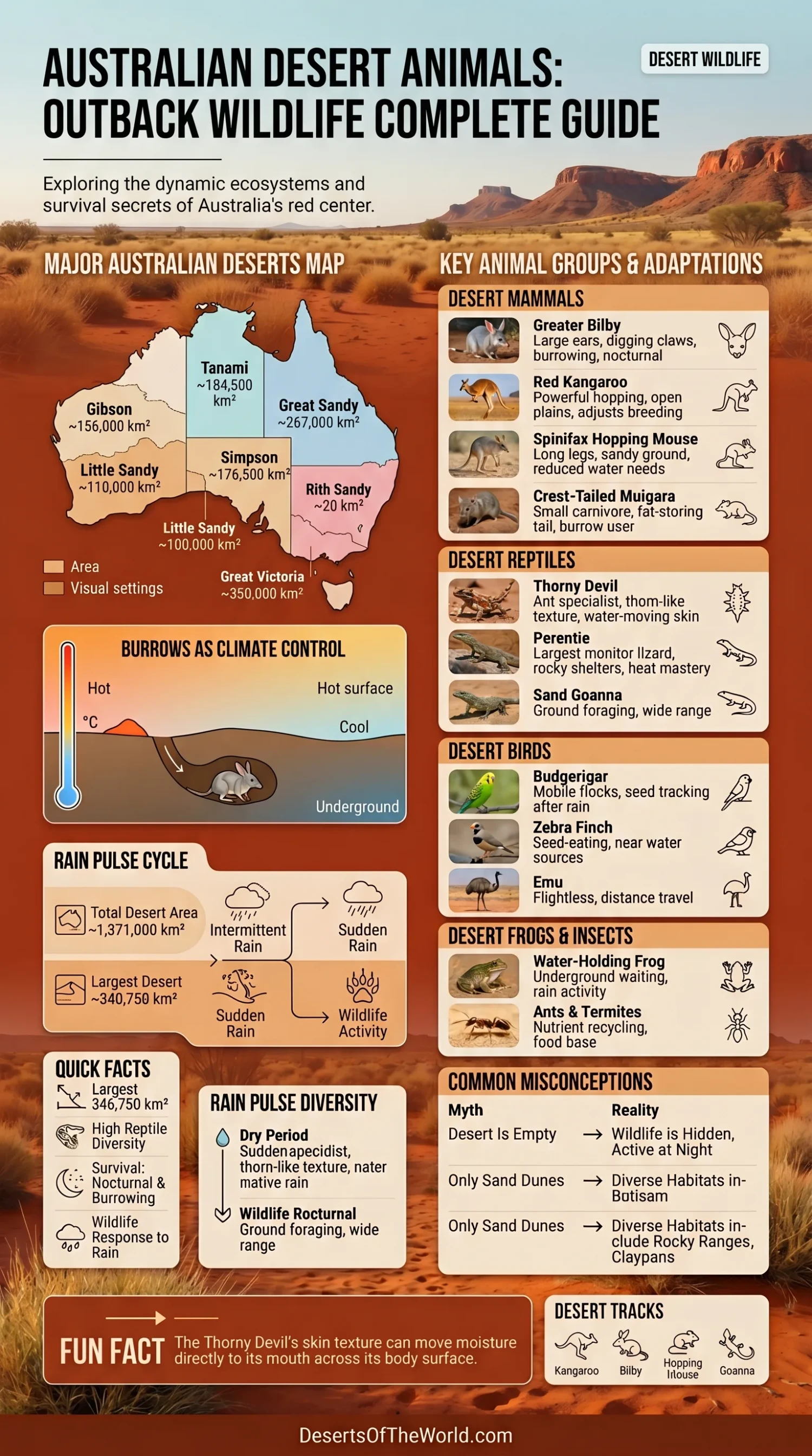
The Australian outback is not one single desert. It is a broad dry interior made of several named deserts, arid shrublands, stony plains, dune fields, saltbush country, and scattered waterholes. This is why outback wildlife includes far more than kangaroos and lizards. It also includes burrowing marsupials, tiny desert rodents, parrots, raptors, frogs that wait for rain, insects that shape the soil, and reptiles that use heat with great care.
| Theme | What It Means For Animals |
|---|---|
| Climate | Large parts of inland Australia are arid or semi-arid, with low and irregular rainfall. |
| Main Habitat Types | Sand dunes, spinifex grasslands, rocky ranges, claypans, salt lakes, dry river channels, and shrublands. |
| Common Survival Pattern | Many species avoid daytime heat by sheltering in burrows, rock cracks, logs, grass clumps, or shaded hollows. |
| Best-Known Animal Groups | Marsupials, desert rodents, kangaroos, reptiles, birds, frogs, insects, and other invertebrates. |
| Wildlife Rhythm | Animal activity often rises after rain, when seeds, insects, flowers, and temporary pools appear. |
Where Australian Desert Animals Live
Australia’s mainland deserts cover about 1,371,000 square kilometres, or roughly 18% of the continent. The largest named desert is the Great Victoria Desert, followed by the Great Sandy, Tanami, Simpson, Gibson, Little Sandy, Strzelecki, Sturt Stony, Tirari, and Pedirka deserts.
Those names are useful, but animals do not follow map labels neatly. A perentie may use rocky shelter near desert plains. A spinifex hopping mouse may favor sandy ground with grass cover. A budgerigar may travel widely after rain. A bilby may depend on sandy or loamy soil where it can dig deep burrows. Habitat matters more than the line on a map.
| Desert | Approximate Area | Wildlife Setting |
|---|---|---|
| Great Victoria Desert | 348,750 km² | Spinifex, dune fields, mallee, and remote shrublands used by reptiles, birds, small mammals, and larger grazing animals. |
| Great Sandy Desert | 267,250 km² | Red sand plains, dunes, and grasslands where burrowing mammals, goannas, parrots, and desert reptiles occur. |
| Tanami Desert | 184,500 km² | Sandy plains and spinifex country with nocturnal mammals, ground-foraging birds, and many reptiles. |
| Simpson Desert | 176,500 km² | Long parallel dunes, salt lakes, claypans, and temporary wetlands after rain. |
| Gibson Desert | 156,000 km² | Gravel plains, low dunes, shrublands, and spinifex habitats used by reptiles, small marsupials, and birds. |
Why Desert Wildlife In Australia Is So Different
The dry interior works on a pulse. Long quiet periods can be followed by sudden growth after rain. Seeds sprout. Insects emerge. Temporary pools fill. Birds arrive. Small mammals breed when food improves. Then the land dries again, and many animals return to slower, hidden routines.
Not all desert life is rare or hard to understand. Some patterns are plain once the landscape is read properly:
- Burrows are shelter systems. They protect animals from heat, dry wind, and surface temperature swings.
- Spinifex is more than grass. It gives cover, nesting space, shade, and food for many insects and small animals.
- Dry creek beds act like wildlife corridors. Their deeper soils and tree lines can hold more shade and food than open sand.
- Rocky ranges create cool pockets. Cracks, caves, and shaded slopes help animals shelter through harsh hours.
- Rain changes everything. A plain that seems still can become busy with frogs, insects, flowers, and feeding birds.
Seen quickly, the desert may look spare. Look closer, and it becomes a map of shelters, tracks, feeding marks, nests, and seasonal movement.
Main Animal Groups Of The Australian Desert
Desert Mammals
Australian desert mammals are often better heard, tracked, or inferred than seen. Many are nocturnal. Small species may spend daylight in burrows, then emerge after sunset to feed on seeds, insects, roots, fungi, leaves, or small animals.
Important desert mammals include:
- Greater bilby — a burrowing marsupial with long ears, strong claws, and a pointed snout.
- Spinifex hopping mouse — a small native rodent that moves with long hops across sandy ground.
- Crest-tailed mulgara — a small carnivorous marsupial that shelters in burrows and stores fat in its tail.
- Dunnarts — tiny marsupials that feed on insects and other small prey.
- Kowari — a desert marsupial known from stony and gibber plains in central Australia.
- Red kangaroo — a large grazing mammal strongly associated with open inland country.
- Euro or common wallaroo — often linked with rocky ranges and dry hills.
- Short-beaked echidna — found across many Australian habitats, including dry regions, where ants and termites support its diet.
Greater Bilby
The greater bilby is one of the best-known Australian desert animals because it shows several classic outback adaptations in one body. Its large ears help with hearing and heat release. Its strong forelimbs dig burrows. Its long snout helps it find food below the surface.
Bilbies can dig deep burrow systems in sandy or loamy ground. These burrows are not only hiding places. They also create cooler, more stable microclimates. A bilby may use several burrows within its home area, which helps it avoid spending too long in one exposed place.
Its food can include seeds, bulbs, insects, fungi, and plant material. This flexible diet matters in the desert, where one food source may be abundant after rain and scarce later.
Spinifex Hopping Mouse
The spinifex hopping mouse is small, but it gives a clear lesson in desert design. Its long hind legs allow quick movement across loose sand. It is mostly nocturnal, which keeps it away from the hottest part of the day. It can also use moisture from food, reducing its need for open water.
Its name points to one of the most important plants in the Australian interior: spinifex. Dense spinifex clumps help create shade, cover, nesting areas, and insect-rich feeding zones. For small animals, that cover can be the difference between open exposure and a usable home.
Crest-Tailed Mulgara
The crest-tailed mulgara is a small marsupial carnivore of arid Australia. It shelters underground and feeds on insects, spiders, small reptiles, and other small animals. Its thick tail can store fat, giving it backup energy when food is harder to find.
It is a good example of a desert animal that does not need to be large to be well fitted to the outback. Small body. Careful timing. A secure burrow. That is enough.
Desert Reptiles
Reptiles are one of the strongest animal groups in the Australian desert. Their body temperature depends on outside heat, so they can use the desert’s warmth with skill. They bask when warmth is useful. They retreat when the surface becomes too hot. Many feed less often than mammals and birds, which can be an advantage in dry country.
Commonly discussed Australian desert reptiles include:
- Perentie — Australia’s largest monitor lizard, often linked with rocky outback habitats.
- Thorny devil — a small lizard with thorn-like body texture and a diet based mainly on ants.
- Sand goanna — a ground-foraging monitor found across dry and semi-dry landscapes.
- Central netted dragon — a small dragon lizard often seen in open desert country.
- Woma python — a desert snake that can use burrows and sandy habitats.
- Desert skinks — burrowing or shelter-using lizards that live among sandy soils, spinifex, and dry plains.
- Geckos — many are nocturnal and active on warm nights.
Thorny Devil
The thorny devil is one of the most recognizable desert reptiles in Australia. Its body is covered with thorn-like spines, and its slow walk fits a life spent feeding on small ants. Rather than chasing large prey, it uses patience.
One of its most interesting features is the skin texture that can help move moisture across the body surface. In a dry setting, even tiny amounts of moisture matter. The animal’s shape, diet, and slow movement all match the demands of desert life.
Perentie
The perentie is a large monitor lizard of inland Australia. It is associated with open dry country, rocky shelters, and warm ground. Like other monitors, it uses a forked tongue to sample scent particles and read its surroundings.
It may look bold, but it still depends on shelter. Rock cracks, burrows, shade, and timing all help a large reptile avoid overheating. Even desert specialists need escape from the sun.
Desert Skinks
Desert skinks show how much life can fit into sandy and spinifex habitats. Some species build burrow systems. Others use plant cover, loose sand, or ground litter. Their lives are closely tied to soil texture, cover, and temperature.
That is a useful point for understanding outback wildlife: a “desert animal” is not just adapted to dryness. It is adapted to a certain kind of ground.
Desert Birds
Birds bring movement to the Australian desert, especially after rain. Some species stay in certain regions. Others move widely in response to food, water, flowering, seeding grasses, and insect bursts.
Important desert and outback birds include:
- Budgerigar — a small parrot that can gather in large flocks when conditions are favorable.
- Zebra finch — a seed-eating bird often linked with dry grasslands and inland water sources.
- Emu — a large flightless bird that can travel across open inland country.
- Australian bustard — a large ground bird found in open plains, grasslands, and dry country.
- Brown falcon — a raptor often seen across open inland landscapes.
- Black-breasted buzzard — a raptor of inland Australia, often linked with open country.
- Crimson chat — a small inland bird that may appear in greater numbers after good rain.
Budgerigar
The wild budgerigar is not just a familiar pet-store bird. In the Australian interior, it is a mobile desert parrot shaped by rainfall and seed supply. After rain, grasses can seed heavily, and budgerigar flocks may build quickly where food and nesting conditions improve.
Mobility is its strength. Instead of staying tied to one small patch of land, it follows opportunity across wide inland areas.
Zebra Finch
The zebra finch is small, fast, and closely linked with seed availability and water access. It often lives in dry grasslands, scrub, and open country. Its presence near inland water points can make it one of the easier desert birds to notice.
Small birds in dry country must balance energy, heat, and water. Shade and timing matter. So do seeds.
Emu
The emu is built for distance. In the outback, it can move across large areas in search of food and water. Its diet may include seeds, fruits, shoots, and insects, depending on what the season offers.
As a large ground bird, it connects many parts of the desert food web. It feeds on plants and small animals, moves through open country, and can carry seeds across distance through its droppings.
Desert Frogs And Temporary Water
Frogs may seem out of place in the desert. In Australia, several frogs survive dry periods by waiting underground or in sheltered soil until rain arrives. Then, suddenly, they call, feed, and breed in temporary pools.
The water-holding frog is often used as the classic example. It can remain underground during dry spells and become active after heavy rain. Other inland frogs also use temporary water bodies, claypans, flooded tracks, and short-lived pools.
This part of desert wildlife is easy to miss because it may be silent for months. Then one night after rain, the ground seems to speak.
Insects And Other Small Desert Life
Insects and other invertebrates are the working layer of the desert. They pollinate flowers, break down plant material, aerate soil, feed birds and reptiles, and give small mammals much of their protein.
Important groups include:
- Ants — a major food source for thorny devils, echidnas, and many other animals.
- Termites — soil engineers and food for mammals, reptiles, and birds.
- Beetles — common in sandy and dry habitats, especially after moisture improves plant growth.
- Moths — active after dark and important for night-feeding animals.
- Grasshoppers — tied to grasses and seasonal plant growth.
- Spiders and scorpions — part of the night-time hunting layer of the desert.
Small life supports larger life. Without insects, many desert birds, reptiles, frogs, and mammals would lose a major food base.
How Australian Desert Animals Survive Heat And Dryness
They Avoid The Worst Hours
Many desert animals are active at dawn, dusk, or night. This pattern lowers heat stress and reduces water loss. It also changes what visitors see. A midday walk may show tracks and burrows. Night reveals more movement, though many animals still remain hidden.
Daytime absence does not mean wildlife is absent. Often, it is simply underground.
They Use Burrows As Climate Control
Burrows are one of the great desert tools. Soil below the surface stays cooler in the day and warmer at night than open ground. Burrows also protect animals from dry wind.
Bilbies, mulgaras, desert rodents, reptiles, and some frogs all use underground shelter in different ways. A burrow is not just a hole. In desert country, it is a private weather system.
They Get Water From Food
Some desert animals do not need to drink often from open water. They can draw moisture from seeds, insects, roots, leaves, or prey. Others conserve water by producing dry droppings or concentrated urine.
This does not mean water is unimportant. It means the animal’s body and behavior reduce direct dependence on pools, creeks, or waterholes.
They Follow Rain And Food
Many birds and larger animals move when food changes across the landscape. After rain, grasses seed, flowers bloom, insects rise, and temporary water appears. The response can be fast. Budgerigars, finches, chats, raptors, frogs, and insects may all become more visible.
The desert is not still. It waits, then moves.
They Use Color, Shape, And Texture
Many Australian desert animals blend with sand, stone, bark, and dry vegetation. Pale browns, reds, greys, and mottled patterns help them stay less visible. Body shape also helps. A low lizard can flatten against warm ground. A small mammal can vanish into spinifex shadow.
Camouflage is not decoration. It is daily protection.
Important Habitats For Outback Wildlife
Spinifex Grasslands
Spinifex grasslands are one of the defining habitats of the Australian interior. The grass forms hard, spiky hummocks with open spaces between them. To people, spinifex may look rough and simple. For animals, it creates shade, cover, nest sites, hunting edges, and insect habitat.
Spinifex country supports small mammals, lizards, snakes, insects, and seed-eating birds. Some animals move through the spaces between hummocks; others shelter deep inside the clumps.
Sand Dunes And Sand Plains
Dune country gives shelter to burrowing mammals, reptiles, insects, and frogs. Tracks show well in sand, so animal signs can be easier to read than in rocky areas. Small footprints, tail marks, diggings, and burrow entrances reveal night activity after the animals have disappeared.
Loose sand can be harsh in heat, but it is also diggable. That matters.
Rocky Ranges
Rocky desert ranges create shade, cracks, caves, and ledges. These cooler spaces help reptiles, bats, wallaroos, birds, and small mammals. Rainwater can also collect in rock holes and drainage lines, making rocky areas useful wildlife refuges during dry periods.
Dry Creek Beds
Dry creek beds often hold larger trees, deeper soil, and more shade than nearby open plains. Even when no water is visible, moisture may remain below the surface for longer. Animals use these lines for movement, shelter, nesting, and feeding.
In many desert landscapes, a dry creek is the closest thing to a green corridor.
Claypans And Salt Lakes
Claypans and salt lakes may look bare for long periods. After rain, they can hold temporary water and attract birds, frogs, insects, and other animals. The change may be brief, but it can be rich while it lasts.
That short window is part of the desert’s rhythm.
Australian Desert Animal Adaptations By Group
| Animal Group | Common Adaptations | Examples |
|---|---|---|
| Small Mammals | Nocturnal activity, burrows, flexible diets, water conservation, strong smell and hearing. | Greater bilby, mulgara, dunnarts, spinifex hopping mouse. |
| Large Mammals | Long-distance movement, grazing or browsing flexibility, use of shade and cooler hours. | Red kangaroo, euro, wallabies in rocky dry country. |
| Reptiles | Heat-based activity timing, low water needs, basking, burrowing, use of rocks and shade. | Thorny devil, perentie, skinks, geckos, woma python. |
| Birds | Mobility, seasonal breeding, seed tracking, use of water points and flowering areas. | Budgerigar, zebra finch, emu, crimson chat, brown falcon. |
| Frogs | Underground waiting, rapid activity after rain, breeding in temporary pools. | Water-holding frog and other inland frogs. |
| Invertebrates | Night activity, soil nesting, rapid response to rain, close links with plants and seeds. | Ants, termites, beetles, moths, grasshoppers, spiders. |
Well-Known Australian Desert Animals
Greater Bilby: Burrowing Desert Marsupial
The greater bilby is a desert marsupial with a long snout, large ears, silky fur, and strong digging claws. It belongs to the bandicoot group and is now best associated with parts of Western Australia, the Northern Territory, South Australia, and Queensland.
Its burrows can be long and angled, helping it stay below the hot surface. Bilby diggings also turn soil over, which can help seeds, fungi, and small soil life. For that reason, the bilby is more than a rare animal people like to name. It is part of the desert’s soil work.
Wild Deserts And The Return Of Native Marsupials
In 2026, the NSW Government and UNSW Sydney extended the Wild Deserts partnership for another 10 years, continuing work in Sturt National Park to restore desert ecosystems and return mammals that had disappeared locally.
The program has reintroduced six native marsupial species to the park after more than a century of local extinction: the greater bilby, crest-tailed mulgara, Shark Bay bandicoot, golden bandicoot, burrowing bettong, and western quoll. The releases are paired with feral-cat and fox control, fenced predator-free areas, and a larger training zone where researchers are testing how reintroduced mammals cope with low levels of introduced predators.
Several of the reintroduced populations are now breeding successfully in areas protected from feral cats and foxes. For bilbies, the work is part of a wider effort to rebuild self-sustaining populations rather than simply maintain animals behind fences. Researchers are also tracking how digging mammals affect soil turnover, seed movement, and other desert processes as populations establish.
Red Kangaroo
The red kangaroo is one of the most familiar mammals of inland Australia. It uses open plains, grasslands, and shrublands, often resting in shade during hot hours and feeding when conditions are cooler.
Its large body, strong legs, and efficient hopping help it move across open country. It also adjusts breeding and movement patterns to environmental conditions, which is useful in places where rain and grass growth change sharply.
Thorny Devil: Ant-Eating Desert Lizard
The thorny devil is small, slow, and highly specialized. It feeds mainly on ants and blends well with red and sandy ground. Its thorn-like body texture makes it look unusual, but its survival method is simple: move carefully, feed steadily, and avoid waste.
Perentie: Australia’s Largest Monitor Lizard
The perentie is Australia’s largest monitor lizard. It can live in dry inland landscapes where shelter, warm basking sites, and prey are available. It is often linked with rocky or open desert areas.
Large reptiles still need careful timing. The desert gives heat, but too much heat is a problem. Perenties use shade, rocks, burrows, and movement patterns to manage that balance.
Budgerigar: Mobile Parrot Of The Interior
Wild budgerigars belong to the interior, not just cages. They travel in flocks, feed on grass seeds, and respond strongly to rain-fed growth. In good seasons, they may gather in large numbers where food and nesting conditions line up.
Emu: Long-Distance Outback Bird
The emu is a tall, flightless bird that can travel long distances across open country. It feeds on plant material and insects, depending on what the land offers. In desert and semi-arid regions, this mobility helps it use scattered food and water.
Water-Holding Frog
The water-holding frog shows one of the desert’s quiet tricks. During dry periods, it can remain underground and reduce activity. After rain, it emerges to feed and breed in temporary water.
For much of the year, it may be unseen. Then rain arrives, and the animal’s life speeds up.
Why Reptiles Are So Visible In Australian Deserts
Visitors often notice lizards before they notice mammals. There is a reason. Many mammals rest underground during the day, while reptiles may bask, forage, or cross tracks when temperatures suit them.
Australia also has a very rich reptile fauna in dry regions. Lizards, geckos, dragons, skinks, monitors, pythons, and other snakes use the variety of desert surfaces well: sand, stone, bark, leaf litter, spinifex, clay, and rock cracks.
Reptiles also handle low food availability differently from warm-blooded animals. Many can survive on less frequent feeding. That gives them an edge in places where insects, seeds, and small prey rise and fall with weather.
Rain, Fire, And Seasonal Change
Rain Pulses
In Australian deserts, rain can change wildlife activity quickly. Seeds germinate, insects emerge, frogs call, birds breed, and mammals may find better feeding conditions. Some animals time breeding to these better periods.
Not every rainfall event produces the same result. Soil type, season, temperature, previous dry periods, and plant seed banks all shape the response.
Dry Periods
During dry phases, animal activity becomes harder to see. Some species move. Some reduce activity. Some remain underground. Birds may leave one area and appear elsewhere after better conditions.
This makes desert wildlife records uneven. A place may seem quiet in one month and lively in another.
Fire In Spinifex Country
Fire has long shaped parts of inland Australia. In spinifex landscapes, different ages of regrowth can create different shelter and feeding conditions. Fresh regrowth may favor some animals, while older dense cover may shelter others.
The pattern matters more than a single burned or unburned patch. A mixed landscape can support more needs: feeding places, nesting cover, open movement space, and safe shelter.
Animal Signs In The Sand
Australian desert animals are often read through signs. Tracks, scats, diggings, feathers, burrows, scratch marks, and seed husks can all show what happened overnight.
Common signs include:
- Bilby diggings — cone-shaped holes where the animal searched for food.
- Hopping mouse tracks — paired hind-foot marks with tail traces in soft sand.
- Goanna tracks — footprints with a dragging tail line between them.
- Bird prints — small three-toed marks around water, seed patches, or soft ground.
- Burrow entrances — openings under shrubs, logs, grass clumps, dunes, or termite mounds.
- Ant and termite activity — mounds, trails, soil caps, and disturbed ground.
Tracks can fade quickly after wind. Early morning often gives the clearest reading of night activity.
How Desert Animals Fit Into The Food Web
The desert food web starts with plants, seeds, flowers, roots, fungi, algae in temporary pools, and small soil life. Insects feed on plants and dead material. Small mammals and reptiles feed on insects and seeds. Birds feed on seeds, insects, reptiles, and small mammals. Larger animals graze, browse, scavenge, or hunt depending on the species.
Termites and ants deserve special attention. They are small, but they move nutrients, build soil structures, and feed many animals. Thorny devils, echidnas, birds, reptiles, and small mammals all benefit from insect abundance.
Soil turnover also matters. Digging animals loosen soil and create small traps for seeds and organic material. Over time, these tiny disturbances help shape plant growth.
Australian Desert Animals By Habitat Type
| Habitat Type | Typical Wildlife Links | Why The Habitat Matters |
|---|---|---|
| Spinifex Hummocks | Skinks, geckos, hopping mice, insects, small birds. | Cover, shade, nesting space, and insect life. |
| Sandy Plains | Bilbies, hopping mice, goannas, dragons, burrowing frogs. | Diggable soil and clear track surfaces. |
| Rocky Ranges | Perenties, euros, bats, raptors, reptiles. | Crevices, ledges, shade, and water-holding rock pockets. |
| Dry Creek Lines | Birds, kangaroos, insects, reptiles, small mammals. | Trees, shade, deeper soil, and seasonal food. |
| Claypans And Temporary Pools | Frogs, waterbirds, insects, finches, chats. | Short-lived water and fast food bursts after rain. |
| Saltbush And Mulga Country | Kangaroos, emus, parrots, small mammals, insects. | Browse, seeds, shade, and shelter in open dry country. |
Less Obvious Desert Animals Worth Knowing
Dunnarts
Dunnarts are tiny marsupials, often mistaken in general description for mice, though they are not rodents. They feed on insects and other small animals. Many have pointed snouts, quick movements, and night-time habits.
Because they are small and mostly nocturnal, they are easy to overlook. Yet they are part of the active insect-feeding layer of the desert.
Desert Bats
Bats use caves, rock cracks, tree hollows, and other sheltered roosts in dry regions. At night they feed on flying insects. Rocky desert places, especially those with crevices and nearby feeding areas, can support bat activity even when surface conditions look bare.
Australian Bustard
The Australian bustard is a large ground bird found in open country, including dry grasslands and inland plains. It feeds on a mix of insects, seeds, fruits, and small animals. Its tall stance makes it easier to notice than many smaller desert birds.
Termites
Termites are not showy, but their role is large. They break down plant material, build soil structures, and provide food for echidnas, reptiles, birds, and other animals. In dry country, recycling nutrients is slow work. Termites help keep it moving.
Common Misunderstandings About Australian Desert Wildlife
“The Desert Is Empty”
It can look that way at noon. Much of the animal life is underground, shaded, distant, or waiting for the right season. A quiet surface can hold burrows, tracks, eggs, seeds, insects, and dormant frogs.
“All Desert Animals Need Waterholes”
Some do use waterholes, soaks, rock pools, and temporary pools. Others get much of their moisture through food or reduce water loss through behavior and body function. Open water is important, but it is not the only path to survival.
“Sand Dunes Are The Whole Desert”
Australian deserts include sand dunes, but also stony plains, rocky ranges, shrublands, salt lakes, claypans, mulga woodlands, and dry creek systems. Different animals use different pieces of that mosaic.
“Most Animals Are Easy To See”
Many are not. The more useful question is often not “Where is the animal?” but “What sign did it leave?” Tracks and diggings may tell the clearer story.
Desert Wildlife And Plant Connections
Plants shape where animals can live. Spinifex, saltbush, mulga, desert oaks, acacias, grasses, and flowering herbs all create food and shelter in different ways.
- Spinifex shelters reptiles, small mammals, and insects.
- Mulga provides shade, seeds, insects, and perching sites for birds.
- Saltbush supports grazing and browsing animals in dry plains.
- Desert flowers after rain attract insects, which then feed birds, reptiles, and small mammals.
- Tree hollows and fallen logs create shelter for reptiles, mammals, insects, and birds.
In a desert, shade is habitat. Seeds are timing. A fallen branch can become a roof.
Australian Desert Animals And Named Desert Regions
Central Australia
Central Australia includes some of the country’s best-known dry landscapes, with red sand plains, rocky ranges, spinifex, mulga, and dry river systems. Wildlife can include red kangaroos, euros, perenties, thorny devils, zebra finches, budgerigars, emus, desert skinks, and nocturnal small mammals.
Great Victoria Desert
The Great Victoria Desert stretches across parts of Western Australia and South Australia. Its size and variety mean wildlife is spread across dune fields, sand plains, mallee, spinifex, and shrublands. Reptiles are especially important in this kind of arid habitat.
Simpson Desert
The Simpson Desert is known for long parallel dunes and dry basins. After rain, temporary water and plant growth can bring sharp changes in animal activity. Birds and frogs may become much more noticeable during these short productive periods.
Tanami Desert
The Tanami includes sandy plains, spinifex country, and dry woodland patches. It is part of the broader arid-zone habitat used by small mammals, reptiles, birds, and insects that depend on shelter and seasonal food pulses.
Great Sandy Desert
The Great Sandy Desert includes red sand, grasslands, and remote dry-country habitats. Burrowing animals, monitor lizards, parrots, finches, and many reptiles use this region where local conditions allow.
Why Some Desert Animals Are Hard To Count
Desert wildlife surveys can be difficult because animals are unevenly spread. Some species occur at low density. Some appear in larger numbers after rain. Some leave clear tracks but are rarely seen. Others move across wide areas.
This is why tracking, camera surveys, burrow searches, acoustic recording, and local ecological knowledge can all be useful. One method alone may miss part of the picture.
For small desert mammals, a good survey often reads the ground as much as the animal itself. Diggings, scats, tracks, burrows, and feeding marks all matter.
Safe And Respectful Wildlife Viewing
Desert wildlife is best understood with patience. Many animals are active when light is low, and many shelters are easy to damage by accident. A burrow entrance, a hollow log, or a patch of spinifex may be an animal’s safe place.
- Stay on marked tracks where they exist.
- Do not reach into burrows, hollow logs, rock cracks, or dense vegetation.
- Watch from a calm distance.
- Leave tracks, nests, eggs, bones, feathers, and shells where they are.
- Avoid disturbing animals at water sources.
- Use a red-filtered or low-impact light when observing nocturnal animals where allowed.
- Check local park rules before entering protected areas or remote tracks.
Quiet observation works best. The desert gives more away when it is not rushed.
Australian Desert Animals List By Type
| Animal | Group | Useful Identification Point | Desert Link |
|---|---|---|---|
| Greater Bilby | Marsupial mammal | Long ears, pointed snout, strong digging claws. | Burrows in sandy or loamy dry country. |
| Spinifex Hopping Mouse | Native rodent | Long hind legs and hopping movement. | Linked with sandy spinifex habitats. |
| Crest-Tailed Mulgara | Marsupial mammal | Small body, thick tail used for fat storage. | Nocturnal burrow user in arid regions. |
| Red Kangaroo | Marsupial mammal | Large body, powerful hind legs, open-country movement. | Uses inland plains, shrublands, and grasslands. |
| Thorny Devil | Lizard | Thorn-like body texture and slow ant-feeding behavior. | Lives in sandy and dry inland habitats. |
| Perentie | Monitor lizard | Large size, forked tongue, strong limbs. | Uses rocky and open dry landscapes. |
| Budgerigar | Parrot | Small green-and-yellow wild parrot, often in flocks. | Moves with seed supply after rain. |
| Zebra Finch | Small bird | Compact seed-eater often near inland water. | Common in dry grassland and outback habitats. |
| Emu | Flightless bird | Tall body, long legs, open-country travel. | Moves across inland plains in search of food and water. |
| Water-Holding Frog | Frog | Can remain underground through dry periods. | Becomes active after rain and temporary pooling. |
Sources
- Geoscience Australia — Areas Of Australian Mainland Deserts (official desert names, areas, and national desert coverage)
- Australian Government Department Of Climate Change, Energy, The Environment And Water — Outback Australia: The Rangelands (arid and semi-arid rainfall definitions and inland land context)
- Bureau Of Meteorology — Australian Climate Zones (Australian climate zone context and dry subtropical desert setting)
- Parks Australia — Uluṟu-Kata Tjuṯa National Park Animals (examples of desert birds, reptiles, amphibians, and mammals in Central Australia)
- Australian Government Department Of Climate Change, Energy, The Environment And Water — Greater Bilby (greater bilby status and Australian range information)
- Australian Museum — The Red Centre (desert animal examples and survival adaptations in arid Australia)
- UNSW Sydney — UNSW and NSW Government Extend Wild Deserts Partnership for Another Decade (10-year partnership extension, six reintroduced native marsupials, and breeding in predator-free areas)
- NSW Government — Native Species Back From the Brink (renewed Wild Deserts partnership and threatened-species recovery in Sturt National Park)