
The Arabian Desert covers about 2.3 million square kilometres and occupies almost the whole Arabian Peninsula. Still, it is not one flat, empty expanse. Al Nafud, Ad Dahna, the vast Rub’ al Khali, gravel plains, rocky plateaus, salt flats, and dry valleys all create different living conditions for animals. That is why the wildlife of this region is more varied than many short summaries suggest. Arabian oryx, sand gazelles, houbara, foxes, jerboas, spiny-tailed lizards, geckos, beetles, and desert birds each use a different part of the land, often at a different hour of the day.
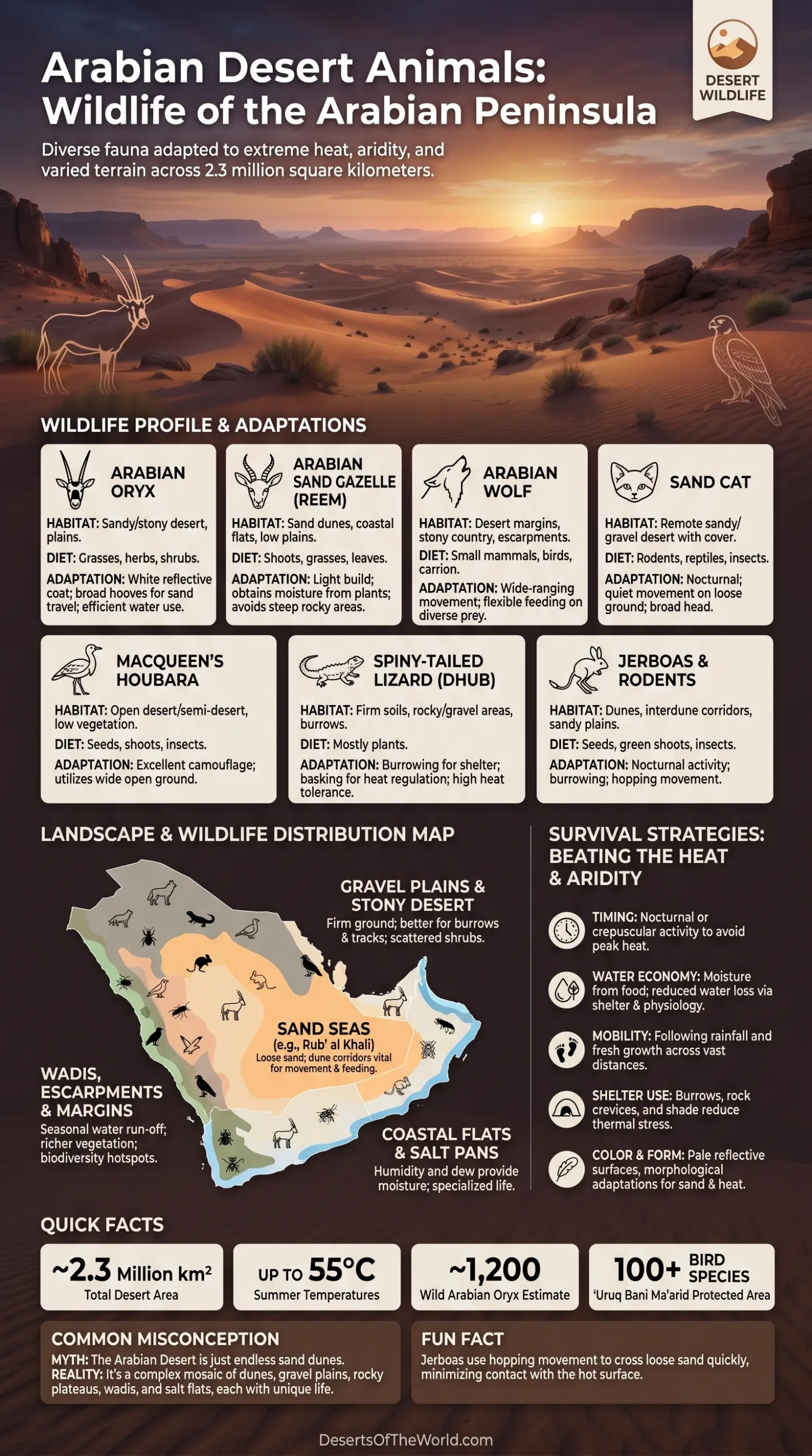
Heat shapes everything here. In some parts of the interior, summer temperatures can rise to about 55°C, while rainfall stays sparse and unreliable. Yet life persists because the desert stores opportunity in small places: a shallow depression that holds seed after rain, a gravel corridor between dunes, a wadi edge with shrubs, a coastal flat touched by humidity, a rocky ledge that stays cooler than open sand. Desert animals do not survive by resisting the land. They survive by reading it well.
Arabian Desert Wildlife Profile
| Animal | Main Desert Setting | Food | Adaptation That Stands Out |
|---|---|---|---|
| Arabian Oryx | Sandy and stony desert, open plains, reserve landscapes | Grasses, herbs, desert shrubs | White coat reflects heat; broad hooves move well on sand |
| Arabian Sand Gazelle | Sand dunes, coastal flats, low desert plains | Grasses, herbs, leaves, shoots | Light build, efficient water use, strong preference for open lowland desert |
| Arabian Wolf | Desert margins, stony country, escarpments, open steppe | Small mammals, birds, carrion, reptiles | Wide-ranging movement and flexible feeding |
| Sand Cat | Remote sandy or gravel desert with cover | Rodents, reptiles, insects | Night activity and quiet movement across loose ground |
| MacQueen’s Houbara | Open desert and semi-desert with low vegetation | Seeds, shoots, insects, small invertebrates | Camouflage and use of wide open ground |
| Spiny-Tailed Lizard | Firm desert soils, rocky or gravel areas, burrow country | Mostly plant matter | Burrowing, basking, and strong heat tolerance |
| Jerboas and Other Small Rodents | Dunes, interdune corridors, sandy plains | Seeds, green shoots, small insects | Night activity and burrow-based shelter |
Why the Landscape Matters So Much
People often imagine Arabian Desert animals living only on dramatic dune fields. In reality, open dunes are only one part of the story. Many animals concentrate in the seams between landforms rather than on the most exposed sand crests.
Dunes, Interdune Corridors, and Sand Sheets
Loose sand favours specialists. Oryx can cross it with ease, sand gazelles use suitable flatter sections, and smaller mammals move through it mostly after dark. Interdune corridors matter as much as the dunes themselves. They collect windblown seed, support low shrubs after rain, and become feeding lanes for herbivores and granivores.
Gravel Plains and Stony Desert
These surfaces may look barren from a distance, but they are often more useful to wildlife than pure sand. Tracks hold better, burrows remain more stable, and scattered shrubs create cover. Many lizards, foxes, and ground birds use these firmer surfaces heavily.
Wadis, Escarpments, and Desert Margins
When rain falls, even briefly, wadis become biological shortcuts. Water runs off hard ground, sinks into sediment, and allows shrubs and grasses to linger longer than they do in open flats. Desert margins and escarpment edges also bring variety in shade, slope, and plant growth. That variety draws insects, then birds, then predators. Quietly does the food web expand.
Salt Flats and Humid Edges
Some desert sectors near coasts and low basins gain moisture from humidity, fog, or dew rather than steady rain. This does not turn the land green. It does soften the dryness just enough to help certain plants, invertebrates, and small vertebrates persist where absolute aridity would leave almost nothing active.
Mammals That Define the Arabian Desert
Arabian Oryx
The Arabian oryx is the best-known large mammal of the region, and for good reason. It is built for open desert travel: a bright coat that reflects sunlight, sturdy limbs, and splayed hooves that handle sand better than a narrow-footed grazer could. It can go long periods without drinking directly, drawing moisture from desert plants and adjusting its activity around cooler parts of the day.
This species also carries real ecological weight. When oryx move across wide ranges, they link feeding patches, clip vegetation, and redistribute nutrients. They are not just symbols. They are working herbivores. After disappearing from the wild in the early 1970s, the species returned through reintroduction work, and current estimates place the wild population at roughly 1,200 animals. That recovery makes the oryx one of the clearest wildlife stories tied to the Arabian Peninsula.
Arabian Sand Gazelle
The Arabian sand gazelle, often called reem, belongs to a slightly different desert niche. It is closely tied to sand dunes and coastal flats and tends to avoid steep rocky country. That habitat choice matters. The Arabian Desert is not home to one generic gazelle scattered evenly across all terrain. Different gazelles sort themselves by ground type, vegetation, and escape routes.
Arabian sand gazelles feed on fresh shoots, grasses, herbs, and leaves when available. In dry spells, they rely on sparse browse and the hidden moisture inside plants. One detail worth noting: this species is known in the region for twin births more often than other local gazelles. It is a small biological note, though it says a lot about how breeding strategy can matter in a hard landscape.
Arabian Wolf
The Arabian wolf is a desert-edge predator rather than an animal of giant central dune seas. It tends to use stony country, escarpments, open steppe, and rough desert margins where prey is more dependable. Smaller than northern wolf populations, it survives through flexibility. Rodents, birds, reptiles, carrion, and young ungulates can all enter its diet depending on what the season offers.
In a desert ecosystem, a predator like this is a measure of depth. If a landscape still supports a wide-ranging carnivore, it usually means the lower levels of the food web still function across a broad area.
Sand Cat, Foxes, and the Small Mammal Layer
The most active mammal life in the Arabian Desert often stays out of sight. Sand cats, foxes, hedgehogs, gerbils, and jerboas form the quieter layer of the system. These animals make use of burrows, shrub shadows, and short windows of activity after sunset or before sunrise. Their role is easy to understate. Yet they move seeds, consume insects, feed larger predators, and keep the desert night busy.
Jerboas deserve special mention. Their hopping movement helps them cross loose sand quickly, and their burrow habits reduce heat loss and water stress. Small bodies face sharp limits in desert climates, so timing is everything. They solve that problem with behaviour as much as anatomy.
Bird Life of Open Ground, Shrub Desert, and Seasonal Windows
Birdlife in the Arabian Desert is far richer than a simple list of “desert birds” suggests. Some species live in the region year-round, some move through on passage, and others track the brief surge of feeding opportunity that follows local rain.
MacQueen’s Houbara
MacQueen’s houbara is one of the best-known desert birds of the wider Arabian and Central Asian dry belt. It uses open desert and semi-desert with low cover, where camouflage works and visibility stays wide. It feeds on seeds, shoots, and invertebrates, so it sits at the meeting point between plant response and insect response after rain.
The houbara is often treated as a single emblem of the desert, though its real value in an article like this is broader: it shows that Arabian wildlife is not just about mammals. Ground birds are central to how these dry systems function.
Sandgrouse, Larks, Wheatears, and Ravens
These birds give the desert its everyday pulse. Sandgrouse can travel long distances between feeding areas and water, larks use open ground and sparse cover, wheatears exploit rocky patches and edges, and ravens remain among the most adaptable birds in the region. They respond quickly to local conditions. A little green growth appears, insect numbers rise, seeds build up, and bird movement follows.
Raptors and Scavengers
Short-toed snake eagles, vultures in suitable sectors, falcons in broader arid landscapes, and other raptors rely on the abundance below them. Their presence tells a plain story: there is enough reptile, rodent, bird, and carrion biomass to support hunters at the top. In some protected parts of the Empty Quarter, breeding and regular use by large birds have become one of the clearest signs that desert conservation can work.
Reptiles and Invertebrates Carry More of the Desert Than Many People Realise
In the full heat of the Arabian Desert, reptiles often become the most visible vertebrates. They need less water than mammals, use external heat for activity, and can shift between basking, shade, and shelter with fine control.
Spiny-Tailed Lizards
Spiny-tailed lizards are among the most recognisable reptiles of Arabia. They favour firm ground where burrows can be maintained, and many feed largely on plant matter. That makes them part grazer, part soil engineer. Their burrows alter the ground around them, create micro-shelter, and provide refuge used by other small animals as well.
Geckos, Skinks, and Desert Monitors
Geckos dominate the night shift on many desert surfaces. Skinks handle loose ground with striking ease, and monitor lizards patrol more openly where prey is available. Each group solves the same problem in a different way: avoid overheating, find food in a sparse landscape, and stay hidden long enough to do both.
Beetles, Ants, and Other Small Desert Workers
Without invertebrates, the Arabian Desert food web would collapse. Beetles process plant matter, ants move seeds and organic scraps, and many other small species turn brief pulses of productivity into usable energy for birds, reptiles, and mammals. They rarely headline a wildlife article. They should still be there.
How Arabian Desert Animals Handle Heat, Water, and Distance
The survival methods of Arabian Desert animals fall into a few recurring patterns.
- Timing: Many species feed at dawn, dusk, or night and remain inactive through the hottest hours.
- Water Economy: Herbivores draw moisture from plants; small mammals reduce water loss through shelter and activity timing.
- Mobility: Wide-ranging species move toward fresh growth after local rain rather than staying fixed to one patch.
- Shelter Use: Burrows, shrub shade, wadis, rock crevices, and dune lee slopes reduce heat stress.
- Colour and Form: Pale coats, sand-matched plumage, broad feet, and low, energy-saving movement all help.
What looks empty at noon can be busy just before sunrise. That contrast matters. Desert wildlife is often less about abundance in one moment and more about rhythm across a full day, a full season, and a full year.
Protected Areas and the Return of Desert Wildlife
One of the strongest examples in the Arabian Peninsula is ‘Uruq Bani Ma’arid on the western edge of the Empty Quarter. This protected area covers about 12,765 square kilometres and is especially useful for understanding Arabian wildlife because it contains several land types in one place: dunes, gravel plains, valleys, and escarpment country. Recent official reporting for the site notes 104 bird species, 18 reptile species, and 121 plant species. That mix makes a point many casual summaries miss: even the Empty Quarter is not biologically flat.
‘Uruq Bani Ma’arid is also tied closely to the return of the Arabian oryx and the re-establishment of gazelles in suitable habitat. In Abu Dhabi, the Arabian Oryx Protected Area spans about 5,975 square kilometres and supports the world’s largest population of Arabian oryx. Protected breeding zones for houbara in the western UAE show the same principle from the bird side: desert wildlife recovery depends on space, habitat quality, and continuity across large dry landscapes.
Where pressures such as habitat fragmentation, heavy disturbance, or predator losses interrupt that continuity, the desert still looks wide on a map but functions as a smaller place for wildlife. Good conservation in Arabia is not just about fencing a scenic dune field. It is about keeping movement routes, breeding ground, feeding patches, and seasonal refuge linked together.
Sources
- Britannica: Arabian Desert (overview of the desert’s size, geography, and ecological setting)
- Britannica: Arabian Desert Climate (temperature, humidity, dew, and broad climate pattern)
- UNESCO: ‘Uruq Bani Ma’arid (World Heritage overview and wildlife value of the protected area)
- National Center for Wildlife: Uruq Bani Ma’arid (official figures for birds, reptiles, plants, and reserve context)
- Fauna & Flora: Arabian Oryx (range, desert adaptations, and current wild population estimate)
- Environment Agency Abu Dhabi: Arabian Sand Gazelle (habitat preference, status, and species notes)
- BirdLife DataZone: Asian Houbara (distribution and conservation data for MacQueen’s houbara)
- Environment Agency Abu Dhabi: Sheikh Zayed Protected Areas Network (Arabian oryx area figure and houbara breeding-zone references)
- National Center for Wildlife: Terrestrial Wildlife Conservation (official conservation context for mammals and habitat pressures in Saudi Arabia)