
Desert Locust outlook in the Western Region
FAO published Desert Locust Bulletin No. 574, replacing the previous July bulletin as the latest monthly update.
- Summer breeding was expected to continue in the Western Region during August and September, particularly in Mauritania and other Sahelian breeding areas.
- FAO’s seasonal outlook indicated that the risk of outbreaks could increase from September onward if favorable breeding conditions persist.
- The September outlook describes an elevated risk; it does not confirm that a new outbreak has begun.
The Sahara is often described as empty. It is not. Animal life here follows water, shade, wind, soil, and timing with almost surgical precision. A dune sea, a gravel plain, a date-palm oasis, a rocky plateau, and a seasonal pool can sit within the same broad desert belt, yet each supports a different set of species. Read the Sahara as one flat sheet of sand and its wildlife looks sparse. Read it as a mosaic, and suddenly the pattern appears.
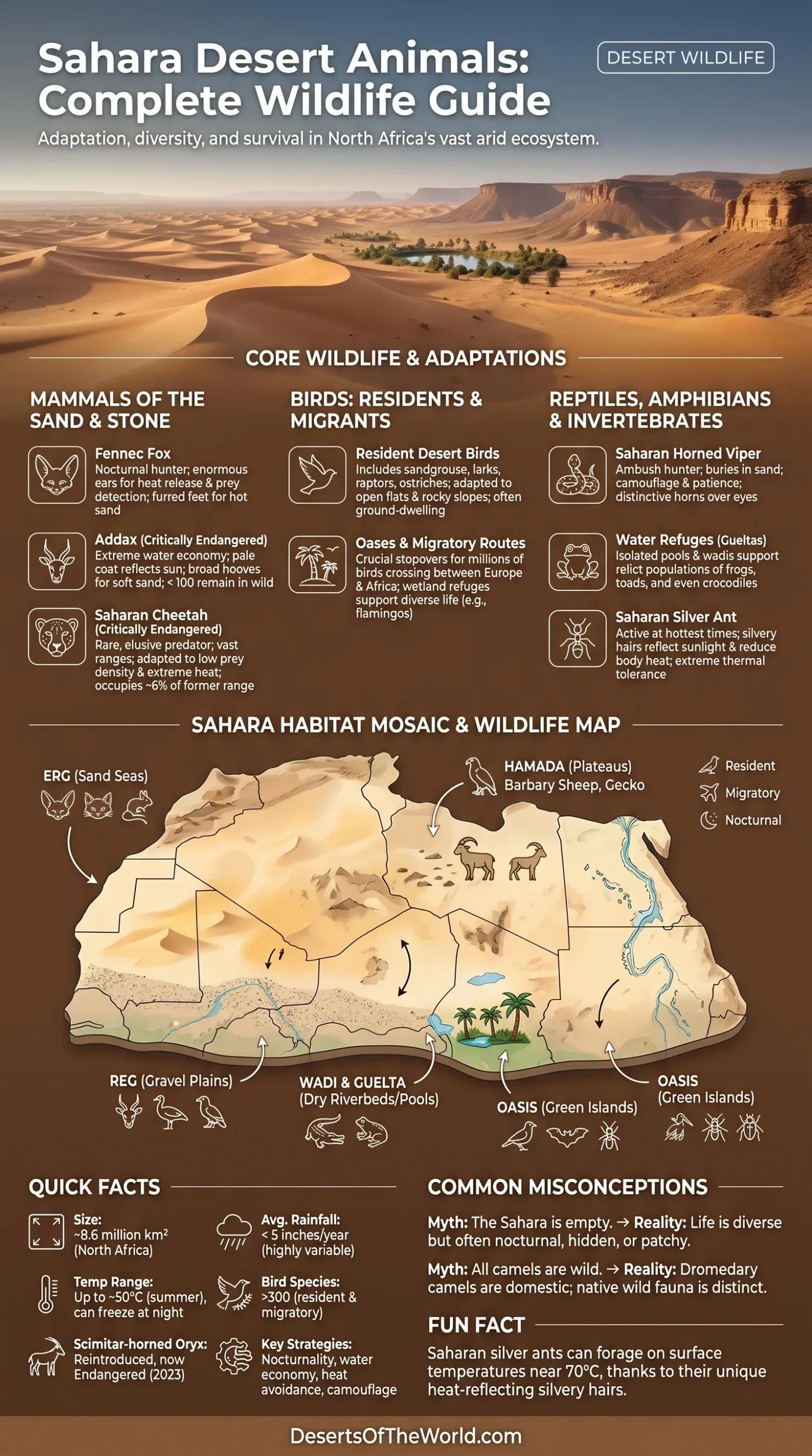
The desert itself covers about 9.2 million square kilometers across most of North Africa. Average precipitation is low, roughly five inches a year overall, though many places receive far less. Summer heat can climb to around 50°C in the hottest spells, while nights and uplands may turn cold enough for frost. Those swings shape almost everything about Saharan animals: when they move, where they hide, how they keep water, and how they shed heat.
Another point matters, and it is missed in many short articles: not every famous animal seen on a camel trek belongs to the native wild fauna. The dromedary camel is central to Saharan life and travel, but a wildlife overview makes more sense when it separates long-established domestic animals from native wild mammals, birds, reptiles, amphibians, and invertebrates.
| Habitat Type | What It Is | Animals Commonly Linked to It | Why It Matters |
|---|---|---|---|
| Erg | Large dune fields and sand seas | Fennec fox, sand cat, jerboas, sand-dwelling lizards | Loose sand favors burrowers, soft-footed hunters, and nocturnal species |
| Reg | Gravel plains with sparse scrub | Dorcas gazelle, foxes, larks, beetles | Open ground supports fast-moving grazers and wide-ranging foragers |
| Hamada | Rock plateaus and stony uplands | Barbary sheep, geckos, skinks, owls, ravens | Crevices, shade, and cliffs create shelter in an otherwise harsh setting |
| Wadi and Guelta | Dry riverbeds and isolated water pockets | Frogs, toads, crocodiles in a few refuges, insects, visiting birds | Even a small, persistent water source changes the whole food web |
| Oasis | Groundwater-fed green islands with palms and crops | Migratory birds, bats, foxes, rodents, reptiles | Acts as a stopover, feeding site, and nesting zone in an arid matrix |
| Chott or Sebkha | Salt flats and seasonally wet basins | Crustaceans after rain, shorebirds, insects | Short-lived water pulses create brief bursts of feeding activity |
Why Sahara Wildlife Looks Sparse but Is Not
Many Saharan animals stay invisible by design. They move at dusk, by moonlight, or in the narrow cool hours before sunrise. They rest in burrows, under shrubs, in rock shade, or inside old riverbanks. Some remain dormant through dry spells. Desert snails may aestivate for years and revive after rain. Frogs and toads wait near seasonal water. Migratory birds use oases and wetlands as stepping stones. So yes, wildlife density can look low in midday heat. Still alive it is, just operating on a schedule that suits the land better than the human eye.
This is why a simple “top 10 Sahara animals” list never quite captures the desert. The Sahara supports resident wildlife, seasonal visitors, and highly local populations tied to rare water sources. Distribution can also be patchy. One species may be widespread across North Africa but absent from huge stretches of bare dune where prey or cover is poor. Another may survive only in a few isolated refuges. In the Sahara, patchiness is normal.
Mammals of the Sahara
Fennec Fox
The fennec fox is the Sahara’s most familiar wild carnivore, though most people know the face before they know the habitat. It is built for dune country: pale coat, furred feet, and ears so large they seem almost oversized for the head. Those ears do two jobs at once. They help release heat, and they help the fox detect prey moving under sand.
Fennecs favor sandy deserts and semi-deserts, often in areas with stable dunes and sparse vegetation. They rest in burrows through the day and become active after dark. Their diet is flexible, which suits an unpredictable desert. Rodents, insects, eggs, reptiles, and plant matter may all appear on the menu. That flexibility helps.
Across much of its range, the fennec fox is still classed as Least Concern. Even so, local pressure near roads, settlements, and tourist activity can affect some populations. In other words, the species is not disappearing across the whole Sahara, but calm habitat still matters.
Addax
If one large mammal shows what true desert specialization looks like, it is the addax. This antelope once ranged widely across Saharan countries. Today it survives in a far smaller wild range, and the remaining population is tiny. Recent conservation summaries place the wild addax at fewer than 100 individuals.
Its body tells the story of desert living. The addax has a very pale coat in the hot season, short broad hooves that spread weight on sand, and a physiology that saves water with unusual efficiency. It can go for long periods without drinking, drawing moisture from dew and desert plants. Its nasal passages help cool inhaled air, and highly concentrated urine limits water loss. Elegant animal, but no soft creature it is.
Because the addax is so close to vanishing from the wild, it now carries extra weight in any discussion of Sahara wildlife. It is not just a desert antelope. It is a measure of how much intact desert range still remains.
Dorcas Gazelle
The dorcas gazelle is one of the Sahara’s better-known wild ungulates and one of the most widely associated with open plains, shrublands, and semi-arid margins. It remains more widespread than the addax, yet its populations are under pressure in many places. Current Sahara-focused conservation summaries list it as Vulnerable, with about 100,000 individuals remaining and a declining trend.
Dorcas gazelles are built for mobility and thrift. They can feed on leaves, shoots, flowers, and desert grasses, taking much of their moisture from food rather than standing water. They move lightly across open ground, often in areas where vegetation is sparse and scattered. During hotter periods, activity shifts toward cooler hours. That rhythm repeats across the Sahara, from stony plains to shrub-filled edges near the Sahel.
Sand Cat
The sand cat is the small wild cat most closely linked to true desert conditions. It is the only cat species found primarily in true desert, and it handles temperature extremes that would overwhelm many other small carnivores. Thick fur covers the soles of its feet, helping it move over very hot sand, and its large low-set ears sharpen its ability to locate prey in open country.
Unlike a fox that may roam widely through different sandy habitats, the sand cat tends to favor areas where sparse vegetation, sandy ground, and prey availability line up just right. It hunts mainly at night and often spends the day in burrows. Water is not taken from pools or streams in the usual way; much of its moisture comes from prey.
The species is currently listed as Least Concern on the global Red List, but that label should not be read as “secure everywhere.” Sand cats are hard to census, often occur at low densities, and show local declines where roads, grazing pressure, off-road traffic, and disturbance break up habitat.
Jerboas, Gerbils, and Other Small Mammals
Small mammals carry a large share of the Sahara’s ecological work. Jerboas, gerbils, hedgehogs, hares, and other modest-sized species move seeds, feed predators, and turn thin plant growth into animal biomass. Jerboas in particular fit the desert well: hopping rodents, light on the ground, well adapted to North African deserts and steppes. By day many of these animals stay underground. By night, the desert floor becomes busy.
These species matter for another reason. They are the prey base for foxes, sand cats, owls, snakes, and larger reptiles. Remove the small mammals and the rest of the web begins to thin.
Barbary Sheep and Other Large Desert Mammals
The Sahara is not only dunes. Rocky massifs, escarpments, and broken uplands support animals that need cliffs, ledges, and rougher ground. Barbary sheep belong to that side of the desert. So do various smaller carnivores and cliff-using birds. In broad wildlife writing, these stony habitats are often underplayed. They should not be. A rock plateau in the Sahara is not an empty gap between dune fields. It is its own habitat system.
Saharan Cheetah
The Saharan cheetah is among the desert’s rarest large predators. It now occupies only about 9% of its former range and is classed as Critically Endangered. Sightings remain scarce, and that rarity is part of the story. A large carnivore in a food-poor desert will never appear in dense numbers, yet the present range loss still marks a steep decline.
Its life differs from the better-known image of cheetahs on richer African savannas. In the Sahara, movement is wider, encounters are fewer, and prey fields are thin. The animal becomes almost spectral in that setting. Rarely seen, yet real.
Birds of the Sahara
Resident Desert Birds
The Sahara supports a bird community far richer than casual observers expect. Britannica notes that, counting resident and migratory populations together, Sahara birdlife exceeds 300 species. Residents include ostriches in suitable areas, sand larks, ravens, owls, bustards, raptors, and other birds tied to open desert, rocky slopes, or semi-arid scrub.
Bird structure often mirrors the habitat. Ground-running species suit open flats. Raptors work cliffs, thermals, and broad hunting ranges. Sandgrouse and similar birds exploit scattered feeding grounds and may travel far between food and water. Desert birds are not spread evenly. They cluster around opportunity.
Oases, Wetlands, and Migratory Routes
One of the easiest ways to misunderstand Sahara birdlife is to focus only on permanent desert residents. Oases and wetlands change the picture completely. These green and wet pockets act as rest stops and feeding stations for birds crossing between Europe and Africa. A WWF page on the Ouled Saïd oasis in Algeria notes that 71 species of migratory birds have been recorded there, including flamingos.
That matters because a wildlife guide to the Sahara should not treat oasis birds as side notes. They are part of the desert system. Water, palms, reeds, insects, fruit, and shade turn an oasis into an ecological node. Lose enough of those nodes, and the map for trans-Saharan migrants becomes harder to cross.
Reptiles, Amphibians, and Desert Water Refuges
Lizards, Skinks, and Geckos
Reptiles fit the Sahara well because the desert offers abundant sun, warm surfaces, and countless microhabitats. Lizards, chameleons, skinks, and geckos use rocks, shrub bases, dunes, and wadis in different ways. Some bask openly for short periods, then retreat. Others remain active in sand or under cover. Body shape, toe structure, and color often match the substrate closely. It is hard to overstate how much reptile life depends on that match between body and ground.
Saharan Horned Viper
The Saharan horned viper is one of the desert’s signature snakes and one of its best-known ambush hunters. It occurs across much of North Africa and uses sandy deserts, wadis, and dune systems. In loose sand it can partly bury itself, reducing exposure while waiting for prey. Many people know the species for its distinctive “horns,” though not every individual shows them clearly.
In ecological terms, the horned viper represents something broader than a single snake species. It shows how the Sahara rewards stillness, camouflage, and energy-saving hunting styles.
Frogs, Toads, and Crocodiles Where Water Persists
Amphibians seem out of place in the Sahara until one remembers that the desert is not dry in the same way everywhere. Pools, gueltas, springs, and seasonal basins hold water long enough for frogs and toads in scattered sites. Crocodiles, too, survive in a few relict refuges. Research from Mauritania notes that crocodile populations persisted in Saharan habitats even after wider desert drying pushed many populations into local extinction.
This is a useful reminder: water in the Sahara is not only a human story. It is a wildlife story as well, often the difference between a broad barren landscape and a living node full of tracks, calls, insects, and visiting birds.
Invertebrates: Small Bodies, Huge Ecological Role
The Sahara’s invertebrates keep the desert running. Ants, beetles, locusts, spiders, termites, brine shrimp in temporary waters, and land snails all feed larger animals or recycle scarce nutrients. They are easy to ignore because they are small. That would be a mistake.
Saharan Silver Ant
The Saharan silver ant is one of the desert’s most striking examples of heat adaptation. It forages during the hottest part of the day, when many predators pull back and when dead or heat-stricken arthropods become available. Its silvery hairs reflect sunlight and also help release body heat. Research linked to this species shows that the hairs can reduce body temperature by several degrees, and that the ants may work under ground temperatures near 70°C.
That is not just a curious desert fact. It shows how far Saharan evolution can push an animal toward a narrow but workable thermal window.
Desert Snails and Temporary Aquatic Life
Snails may not be the first animals that come to mind in the Sahara, yet they are part of the food web and can survive long dry periods through dormancy. Temporary waters add another layer. After rain, shallow basins may support brine shrimp and other small aquatic life for short periods. Those pulses can feed birds and other animals before the water disappears again. The Sahara does not stay biologically static for long. It waits, then responds.
How Sahara Animals Survive
Heat Management
- Large ears, pale coats, reflective hairs, and insulated feet help shed or block heat.
- Many species shift activity into the night, dawn, or dusk.
- Burrows, rock crevices, shrub shade, and den systems buffer daily extremes.
Water Economy
- Some mammals take much of their moisture from food and dew.
- Highly concentrated urine and dry feces reduce water loss.
- Short bursts of feeding after rainfall help animals exploit brief green periods.
Movement Across Sand and Stone
- Broad hooves help addax move over soft sand.
- Furred foot pads protect foxes and cats from heated surfaces.
- Body shapes, toe fringes, and digging limbs often match the ground type.
Timing
Timing may be the most important adaptation of all. The Sahara rewards animals that do the right thing at the right hour: feed when the surface cools, rest before the sun peaks, breed after rainfall, move when plants flush, and use oases during migration windows. Desert life is not slow. It is well timed.
Food Webs and Seasonal Pulses
Saharan food webs look simple from far away, but they are not crude. Plants respond to brief moisture. Insects and small mammals respond to the plants. Reptiles, foxes, cats, owls, raptors, and larger mammals respond to the prey base. Oases add fruit, insects, shade, and water. Seasonal pools add amphibians and aquatic invertebrates. Dry riverbeds guide movement. A rain event can redraw local wildlife activity within days.
That is why fixed species lists tell only part of the story. In the Sahara, habitat structure and timing matter almost as much as species identity.
Conservation, Recovery, and What Deserves Attention
The Sahara still holds impressive wildlife, but the balance is delicate in places. Some species remain fairly widespread. Others survive in small or fragmented populations. Water extraction, expanding roads, disturbance in remote habitats, habitat degradation around oases, and pressure on prey species can all reshape desert wildlife even when the landscape still looks open from a distance.
There is also good news, and it deserves space here. The scimitar-horned oryx, once declared Extinct in the Wild, was reclassified as Endangered in 2023 after reintroduction work in the Sahelo-Saharan region. That does not solve every desert conservation issue, but it proves a point: recovery is possible when habitat protection, breeding, release planning, and long-term follow-up come together.
For readers trying to understand Sahara wildlife clearly, the best mental model is this: the desert is not empty, and it is not uniform. It is a living system of ergs, regs, hamadas, wadis, gueltas, and oases. Its animals are not random survivors either. They are specialists, opportunists, migrants, burrowers, browsers, ambush hunters, and heat managers, each fitted to a different piece of the same vast arid map.
Sources
- https://www.britannica.com/place/Sahara-desert-Africa (Sahara area, extent, and general geography)
- https://www.britannica.com/place/Sahara-desert-Africa/Climate (Rainfall and temperature patterns in the Sahara)
- https://www.britannica.com/place/Sahara-desert-Africa/Animal-life (Animal groups, bird diversity, desert snails, reptiles, amphibians)
- https://nationalzoo.si.edu/animals/fennec-fox (Fennec fox heat control, foot fur, and desert adaptations)
- https://www.canids.org/species/view/PREKPF521541 (Fennec fox range, habitat, and current conservation status)
- https://www.mnhn.fr/en/addax (Addax body and physiological adaptations for desert life)
- https://saharaconservation.org/sahel-and-sahara-fauna/addax/ (Addax status and remaining wild population summary)
- https://saharaconservation.org/sahel-and-sahara-fauna/dorcas-gazelle/ (Dorcas gazelle status, range, and population note)
- https://www.catsg.org/living-species-sandcat (Sand cat ecology, distribution, and status)
- https://nc.iucnredlist.org/redlist/amazing-species/felis-margarita/pdfs/original/felis-margarita.pdf (Sand cat temperature tolerance and furred feet)
- https://www.britannica.com/animal/jerboa (Jerboas as desert-adapted leaping rodents of North Africa and beyond)
- https://animaldiversity.org/accounts/Cerastes_cerastes/ (Horned viper range and habitat in the Sahara)
- https://journals.plos.org/plosone/article?id=10.1371/journal.pone.0014734 (Relict crocodile populations in Saharan water refuges)
- https://www.biology.ox.ac.uk/publication/545954/scopus (Saharan cheetah range contraction and rarity)
- https://www.washington.edu/news/2015/06/18/saharan-silver-ants-use-hair-to-survive-earths-hottest-temperatures/ (Saharan silver ant heat-reflecting hairs and thermal performance)
- https://www.unesco.org/en/mab/oasis-du-sud-marocain (Oasis biodiversity in southern Morocco)
- https://wwf.panda.org/wwf_news/?4505%2FSaharan-fruit-growing-IfoggaraI-style= (Ouled Saïd oasis, migratory birds, and wetland value in the Algerian Sahara)
- https://saharaconservation.org/species-recovery/the-scimitar-horned-oryx-reintroduction/ (Scimitar-horned oryx recovery and 2023 status change)
- https://www.fao.org/locust-watch/information/ (FAO Desert Locust Bulletin No. 574, published August 7, 2026)
- https://www.fao.org/locust-watch/information/six-month-precipitation-maps/en (FAO seasonal breeding and precipitation outlook for August 2026–January 2027)