
When people search for Gobi Desert animals, they often expect a short list: camel, snow leopard, maybe a fox, then silence. The real picture is fuller than that. The Gobi is a cold desert spread across southern Mongolia and northern China, and much of it is not loose sand at all but gravel plains, bare rock, dry valleys, salt basins, and mountain fronts. That landform mix shapes the wildlife. Hoofed grazers cross open steppe and semi-desert, ibex hold to broken slopes, snow leopards patrol high ridges, jerboas vanish into the dark, and birds gather where cliffs, springs, and seasonal wetlands interrupt the dry ground.
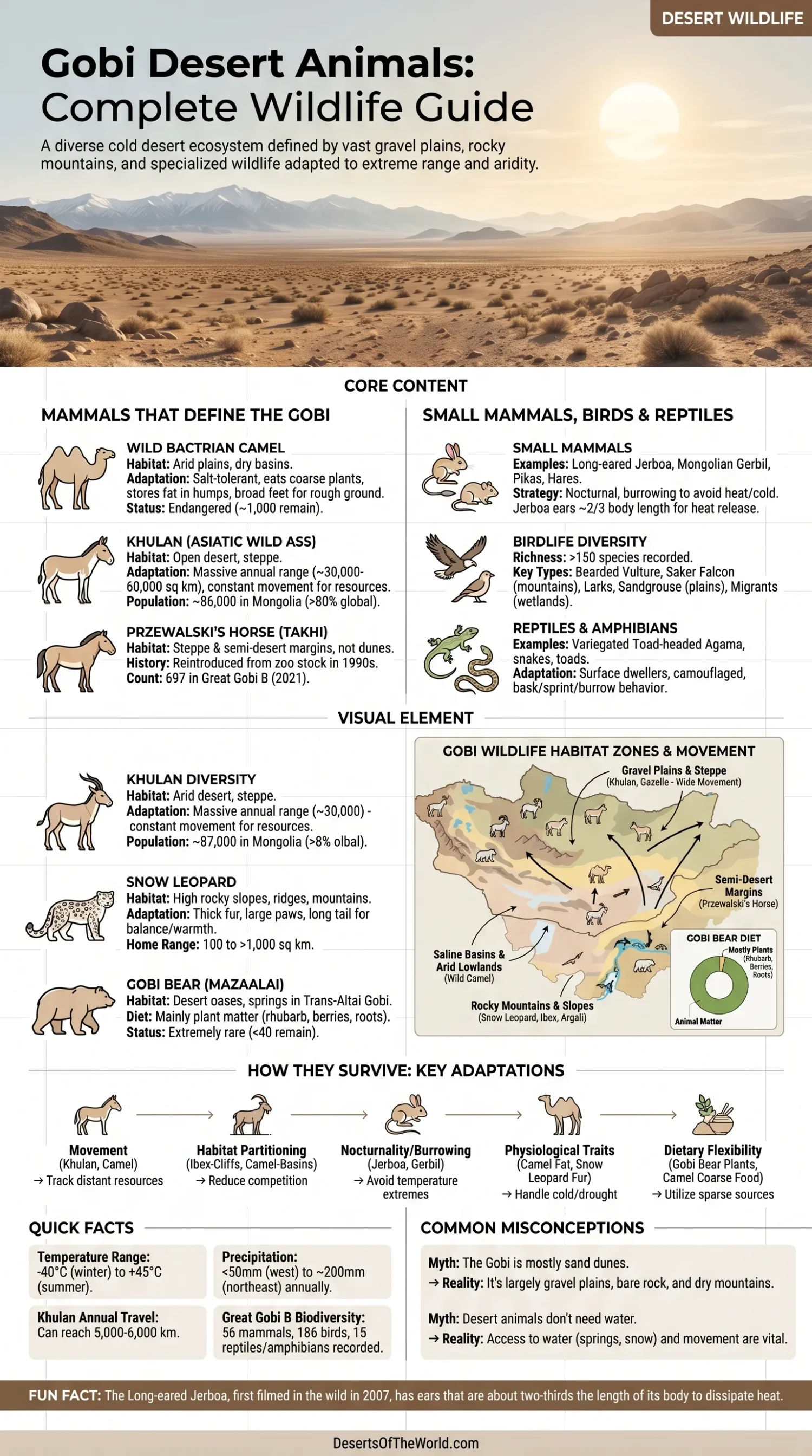
That is why a useful wildlife page on the Gobi cannot be just a random animal list. It has to show where species live inside the desert system, how they handle cold, drought, and distance, and why movement matters so much in a place where food and water shift from season to season.
| Feature | What It Means For Wildlife |
|---|---|
| Range | The Gobi stretches across southern Mongolia and northern China and covers about 1.3 million square kilometers, so its animals live across many habitat types rather than one uniform desert surface. |
| Climate | Winter lows can reach about -40°C, summer highs can climb to about 45°C, and annual precipitation ranges from under 50 mm in the driest western parts to about 200 mm in the wetter northeast. |
| Ground Surface | Much of the Gobi is rocky or gravelly, not dune-covered, so climbers, runners, burrowers, and cliff birds all find different niches. |
| Wildlife Richness | In the Great Gobi protected landscape alone, more than 49 mammal species, over 150 bird species, and 15 reptile and amphibian species have been recorded. In Great Gobi B and adjacent areas, 56 mammal species have been recorded. |
| Movement Pattern | Many Gobi ungulates do not stay in one small range. They move widely to track forage, water, snow cover, and safer ground. |
What Makes Gobi Wildlife Different
The Gobi Is A Cold Desert, Not A Classic Sand Sea
The Gobi does have dunes, and some are famous. Still, that is only part of the story. Large parts of the desert are stony, wind-cut, dry, and open. Springs, shallow wetlands, mountain outcrops, and semi-desert steppe create a patchwork rather than a single endless sand field. Because of that, the wildlife is layered. A wild camel fits a saline basin. A khulan needs room to roam. A Siberian ibex wants cliffs. A snow leopard follows prey into higher, rougher country. Same desert. Very different ground.
Water Matters, But So Does Access To Water
In many deserts, the question is simply whether water exists. In the Gobi, access is just as important. A species may live in a region with hidden groundwater, snow patches, or scattered springs, yet still need long daily or seasonal movement to reach drinkable water. That pattern shows up clearly in khulan, wild camels, and reintroduced Przewalski’s horses.
Distance Is Part Of The Ecology
Some desert animals survive by sitting tight in burrows. Others survive by covering huge distances. The Gobi holds both strategies. Jerboas and gerbils solve heat and exposure by staying low and going out at night. Large herbivores solve the same problem by moving over vast areas, shifting between better grazing, water points, and sheltering terrain. That contrast is one of the clearest features of Gobi wildlife.
Mammals That Define The Gobi
Wild Bactrian Camel
The wild Bactrian camel is the animal most people connect with the Gobi, and for good reason. It is built for places that look nearly empty: arid plains, dry basins, harsh wind, and very sparse plant cover. Its double hump stores fat, not water, but that fat reserve helps it ride out poor feeding periods. Its broad feet work on rough, hot, stony ground as well as softer patches.
One of its most striking traits is water tolerance. Wild camels can drink highly saline water that domestic Bactrian camels will not handle well. That matters in parts of the Gobi where fresh water is scarce and brackish sources may be the only option. Older pages still describe the species as critically endangered, but the IUCN status was updated to Endangered in 2025. Even with that change, the animal remains highly threatened, and only around a thousand survive in the wild across northwestern China and southwestern Mongolia.
Wild camels are not dune mascots. They are animals of harsh, open desert country where endurance matters more than speed.
Khulan, Or Asiatic Wild Ass
The khulan may be the best example of how the Gobi works as a living landscape rather than a postcard. This wild equid needs room, and a lot of it. In the Mongolian Gobi, khulan roam across huge annual ranges, averaging about 30,000 square kilometers in the South Gobi and reaching as much as 60,000 square kilometers in some cases. Their cumulative yearly movement can reach 5,000 to 6,000 kilometers. That is not wandering for the sake of it. It is how the species survives a dry and unpredictable environment.
Khulan live in open desert, semi-desert, and steppe where they can keep moving between forage and water. Their social structure is also flexible. Groups form, split, and reform, which suits a landscape where resources do not stay evenly distributed. About 86,000 khulan are thought to live in the Mongolian Gobi, which means the region holds over 80% of the global population.
That good news comes with a warning. Khulan are animals of open space, and fences can block that space in a very literal way. They do not easily jump or crawl under barriers, so fenced rail lines and border fences can cut movement routes and split habitat that once functioned as one connected range.
Przewalski’s Horse
Przewalski’s horse, called takhi in Mongolia, is the only true wild horse. It belongs to the Gobi system, but not in the way many short animal lists imply. This is not a dune specialist. It is more accurate to think of it as an animal of steppe and semi-desert margins linked to the broader Gobi region. The Smithsonian notes that the Gobi where the last wild horses survived was not mostly sand, but a dry region with springs, steppe, forests, and high mountains.
The species disappeared from the wild in the 20th century and was reintroduced in Mongolia from zoo-bred stock beginning in the 1990s. In Great Gobi B, official monitoring counted 697 Przewalski’s horses in 2021. That number reflects one protected landscape, not the whole species total, yet it shows how deeply reintroduction has reshaped the desert-steppe edge.
Przewalski’s horse tells an important truth about Gobi wildlife: “desert animal” does not always mean “sand animal.”
Goitered Gazelle
The goitered gazelle is one of the most graceful runners in the region. In the Gobi context, it prefers open plains, sandy-gravel ground, and semi-desert where sightlines are long and fast escape matters. Its body is light, alert, and made for distance over exposed terrain.
This gazelle is one of the Gobi’s emblematic open-country herbivores, yet it does not get the same attention as camel or snow leopard. That is a mistake. It fills a central grazing role in lowland desert and semi-desert habitats and helps define the prey base for carnivores. The species is listed as Vulnerable on the IUCN Red List. In Great Gobi B, 2021 monitoring counted 3,893 black-tailed or goitered gazelles.
Snow Leopard
The snow leopard is often treated as a mountain animal first and a Gobi animal second. In practice, both are true. It is not an animal of the flat desert floor. It belongs to the Gobi’s high, broken country: rocky slopes, cliff lines, mountain fronts, and ridges where ibex, argali, marmots, pika, and hares are available as prey.
Its body fits that terrain almost perfectly. The long tail works as a counterweight on steep ground and as insulation when the cat rests. Large paws spread weight over snow and loose surfaces. Thick fur and a wide nasal cavity help in cold, dry air. In Mongolia, snow leopard home ranges can be very large; WWF notes that they can exceed 193 square miles, and the Cat Specialist Group reports South Gobi home ranges from 100 to over 1,000 square kilometers.
This is why snow leopard sightings in the Gobi are tied to mountains, not to broad sandy flats. The desert alone does not define the species. Relief does.
Siberian Ibex And Argali
Siberian ibex and argali anchor the Gobi’s rocky side. Ibex are cliff users, agile on broken slopes, ledges, and steep escarpments where fewer large grazers can follow. Argali, the largest wild sheep, use open mountain and hill country, often favoring broad uplands and broken steppe-mountain transitions rather than the sharpest cliff faces.
These ungulates matter for two reasons. First, they show that the Gobi is not just lowland desert. Second, they support the predator system, especially snow leopard. Remove mountain ungulates from the picture and the Gobi’s upper food chain stops making sense.
Gobi Bear
The Gobi bear, or mazaalai, is one of the rarest bears on Earth and one of the least expected desert mammals anywhere. It survives only in southwestern Mongolia, in the Trans-Altai Gobi. This is not a big, fish-eating northern bear shifted into dry country. It is a desert-edge specialist tied to oases, springs, and sparse plant food.
Research from the Gobi Bear Project indicates that fewer than 40 individuals remain in the wild. A long-term genetic study found annual population size in the range of 23 to 31 bears, with a strong male bias. Recent habitat modeling suggests that only about 12,830 square kilometers of habitat remain for the bear in the Trans-Altai Gobi and that its historical range has shrunk by about 60% since the 20th century.
Its diet is another surprise. Gobi bears feed mainly on plant matter such as wild rhubarb rhizomes, berries, reeds, wild onion, and other vegetation supported by desert springs. Animal matter appears to form only a very small share of the diet. In other words, this is not a bear thriving by brute force. It survives by finding scattered food in a very lean landscape.
Small Mammals: Jerboas, Gerbils, Pikas, And Hares
Small mammals give the Gobi much of its hidden life. They are easy to miss in broad daylight, but they hold the food web together. Jerboas, gerbils, pikas, and hares feed predators, turn over soil, consume seeds and shoots, and make use of niches too fine-scaled for large animals.
The long-eared jerboa is the best-known example. It was first filmed in the wild in the Gobi in 2007, and its ears are famous for their size, reaching about two-thirds of body length in one National Geographic description. That odd silhouette is not decoration. Large ears help release heat, and long hind limbs allow quick, springing movement over open ground at night.
Great Gobi B data also list the three-toed jerboa, small five-toed jerboa, and Mongolian gerbil among regionally threatened mammals. Pikas and Tolai hares add another layer, especially along steppe-desert transitions and foothill country.
Birds, Reptiles, And Other Often-Missed Wildlife
Birdlife Is Stronger Than Many Readers Expect
A wildlife page that talks only about mammals leaves out a large part of the Gobi story. In the Great Gobi protected landscape, over 150 bird species have been recorded. In Great Gobi B, a 2023 survey recorded 186 bird species from 42 families and 18 orders. That is a strong reminder that desert birdlife depends on habitat variety: cliffs, wetlands, river corridors, springs, gravel plains, and semi-desert steppe all add something different.
Mountain and cliff zones support birds such as the bearded vulture and saker falcon. Wetlands and lakes pull in migrants and breeding birds. Open plains host larks, wheatears, sandgrouse, and raptors that can hunt by sight over wide ground. The Gobi is dry, yes, but it is not bird-poor.
Reptiles Belong To The Desert Surface
Reptiles fit the Gobi in a quieter way. Official Great Gobi B data point to high reptile and amphibian diversity in the area, including 12 lizard species, 3 snake species, and 1 toad species. Among the most familiar desert reptiles is the variegated toad-headed agama, a small lizard well adapted to arid ground and often well camouflaged against sand and gravel.
These animals occupy the thin, hot layer of life right at the surface. They bask, sprint, freeze, vanish, and reappear. Large mammals give the Gobi its scale. Reptiles give it detail.
How Gobi Animals Survive
- They use different parts of the same desert. Camels use dry basins, khulan use broad open country, ibex use cliffs, snow leopards use high broken terrain, and bears stay close to spring-fed patches.
- They move when they need to. In a dry year, a fixed home range may fail. Wide-ranging herbivores stay alive by shifting position rather than waiting for local conditions to improve.
- They avoid heat and exposure in different ways. Jerboas go nocturnal. Larger herbivores travel early or late and use topography for shelter.
- They handle temperature swings, not just dryness. The Gobi can swing from deep winter cold to hot summer days, so fur, fat storage, burrows, and seasonal behavior all matter.
- They make use of sparse food. Gobi diets are often flexible. Khulan can switch between grazing and mixed feeding, wild camels can use coarse desert plants, and Gobi bears rely heavily on plants tied to oases and spring moisture.
Main Wildlife By Habitat Zone
| Habitat Zone | Typical Animals | What Favors Them There |
|---|---|---|
| Open Gravel Plains And Semi-Desert Steppe | Khulan, goitered gazelle, foxes, larks | Long sightlines, wide movement corridors, sparse but usable forage |
| Saline Basins And Harsh Arid Lowlands | Wild Bactrian camel | Ability to use poor forage, tolerate saline water, and travel between scattered water points |
| Rocky Slopes, Escarpments, And Ridges | Siberian ibex, argali, snow leopard, cliff-nesting raptors | Escape terrain, cooler microhabitats, and access to mountain prey routes |
| Springs, Oases, And Wetland Edges | Gobi bear, migratory birds, small mammals | Reliable moisture, denser plant growth, and seasonal food concentration |
| Night-Active Surface And Burrow Systems | Jerboas, gerbils, hares, reptiles | Lower night temperatures, cover from predators, and energy-saving daytime shelter |
| Steppe-Semi-Desert Margins Of The Gobi System | Przewalski’s horse, khulan, gazelles | Better grazing, access to water, and broad movement routes |
Why Gobi Wildlife Protection Depends On Connected Land
In many deserts, protection starts with a water source or a breeding site. In the Gobi, that is not enough on its own. The desert’s larger mammals need connected land between feeding areas, springs, mountain shelter, and seasonal ranges. A single fenced line can matter more than a lack of dunes, because it can interrupt movement in a landscape where movement is the survival strategy.
Khulan make that plain. Their routes are long, irregular, and often too wide to fit neatly inside one protected boundary. Snow leopards also need room, since prey in dry mountain systems is spread thinly. Wild camels and Gobi bears depend on scattered resource points, not on a single rich core area. So the Gobi works best when protected areas, buffer zones, and movement corridors still connect rather than stand apart like islands.
The best wildlife reading of the Gobi is not “Which animal lives here?” It is “Which part of the Gobi, in which season, under which conditions?” Ask that, and the desert becomes much more legible.
Sources
- Encyclopaedia Britannica — Gobi (location, size, landforms, and the fact that much of the Gobi is rocky rather than sandy)
- Encyclopaedia Britannica — Gobi Climate (temperature range and precipitation pattern across the desert)
- UNESCO World Heritage Centre — Desert Landscapes Of The Mongolian Great Gobi (recorded mammal, bird, reptile, and amphibian richness in the Great Gobi protected landscape)
- Management Plan For The Great Gobi B Strictly Protected Area (2025–2035) (official species counts, bird survey totals, reptile data, and Przewalski’s horse, khulan, and gazelle monitoring figures)
- Smithsonian’s National Zoo — Przewalski’s Horse (the horse’s link to the Mongolian Gobi and the non-sandy character of much of the region)
- Zoological Society Of London — Conservation Of Mongolia’s Wild Camels (wild camel numbers, saline water tolerance, and conservation notes)
- Wild Camel Protection Foundation — The Wild Camel (current status notes and Mongolia–China distribution of surviving wild camels)
- Convention On Migratory Species — Khulan: Mongolian Gobi Fact Sheet (khulan population share, movement range, annual travel distances, and fence-related fragmentation)
- World Wildlife Fund — Snow Leopard (range, prey, and home-range scale in Mongolia)
- IUCN Cat Specialist Group — Snow Leopard (body form, behavior, and South Gobi home-range data)
- Gobi Bear Project (current bear numbers, diet, and ecology around desert springs)
- Proceedings Of The Institute Of Biology — Habitat Modeling And Conservation Concerns Of The Gobi Bear (remaining habitat estimate and decline from historical range)
- National Geographic — Long-Eared Jerboa (ear proportions and first filming in the wild in the Gobi)
- Animal Diversity Web — Goitered Gazelle (range and ecology of the gazelle across arid Central Asian habitats)
- Animal Diversity Web — Siberian Ibex (mountain habitat and ecology of this Gobi-edge ungulate)