
Desert stargazing works best when four things line up: dry air, low light pollution, stable weather, and wide horizons. Sand alone does not make a sky better. A famous dune field can still lose detail to haze, moonlight, or coastal fog. A quieter inland basin can beat it with ease.
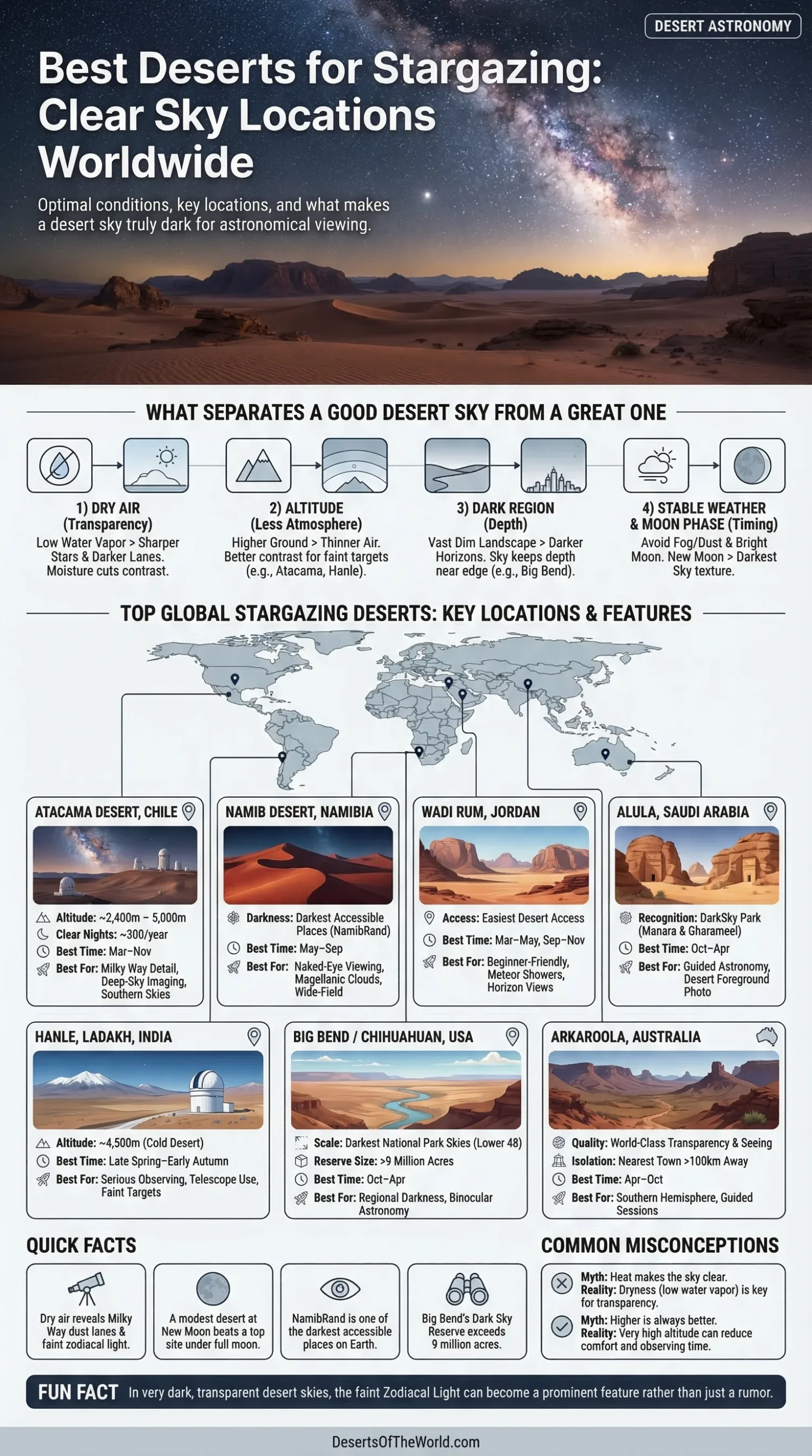
That is why the best desert skies are not all the same. Some places are better for the Milky Way core. Some give cleaner views for deep-sky targets. Some are easier for first-time visitors who want a dark, readable sky without chasing extreme altitude. Below, the focus stays on deserts and desert-edge landscapes that pair clear night conditions with real sky quality, not just pretty daytime scenery.
| Desert Location | Why It Stands Out | Technical Edge | Best Time for Sky Quality | Best For |
|---|---|---|---|---|
| Atacama Desert, Chile | Very dry air, high plateau, very low cloud cover | About 300 clear nights a year in observatory zones; major sites from roughly 2,400 m to 5,000 m | March to November | Milky Way detail, zodiacal light, deep-sky imaging |
| Namib Desert, Namibia | Very low light pollution and vast open horizons | NamibRand is recognized as one of the darkest accessible places on Earth | May to September | Naked-eye viewing, Magellanic Clouds, wide-field photos |
| Wadi Rum, Jordan | Open sandstone basins and easy desert access | Low local light and broad horizon lines | March to May, September to November | First-time desert stargazing, meteor showers, horizon viewing |
| AlUla, Saudi Arabia | Protected dark-sky areas in a remote rock desert | DarkSky Park recognition at AlUla Manara and AlGharameel | October to April | Milky Way viewing, desert-sky photography, guided astronomy |
| Hanle, Ladakh, India | High cold-desert air and a research observatory setting | Observatory altitude around 4,500 m; dark-sky reserve around Hanle | Late spring to early autumn | Serious observing, telescope use, faint targets |
| Big Bend, Chihuahuan Desert, United States | Huge dark region rather than one isolated viewpoint | Darkest measured skies among national parks in the lower 48; nearby reserve exceeds 9 million acres | October to April | Regional darkness, camping, binocular astronomy |
| Arkaroola, Australian Outback | Arid outback air with formal dark-sky protection | Very strong atmospheric transparency and seeing quality; town glow remains far away | April to October | Southern Hemisphere skies, Magellanic Clouds, guided observatory nights |
What Separates A Good Desert Sky from A Great One
Dry Air Helps More than Heat
The best desert skies come from low water vapor, not from heat alone. Moisture softens stars, brightens the low horizon, and cuts contrast in the Milky Way. In very dry places, the dark lanes in our galaxy look sharper, and faint glow near the horizon has a better chance of showing through. Transparency is the word astronomers often care about here.
Altitude Reduces the Amount of Air Above You
Higher ground usually means less atmosphere between your eyes and the sky. That helps with contrast and can make faint targets easier to hold. It is one reason observatories cluster in places like the Atacama and Hanle. Still, higher is not always better for every traveler. Very high sites may improve the sky and reduce comfort on the same night.
Darkness Works Best When the Whole Region Stays Dark
A single remote camp is useful. A dark region is better. That is why places such as Big Bend feel stronger after dark than many isolated viewpoints near growing towns. When the surrounding landscape stays dim for long distances, the sky keeps its depth closer to the horizon. You notice it fast.
Fog, Dust, and Seasonal Weather Still Change the Result
Deserts are not all equally clear every month. The Atacama can see summer storm patterns on the high plateau. The Namib coast is famous for fog, which is excellent for desert ecology but less useful for crisp stars. The best desert sky is often a dry inland sector, not the most photographed roadside stop.
The Moon Can Undo Any Ranking List
Under a bright moon, even a top desert loses much of its faint sky texture. That includes the Milky Way dust lanes, zodiacal light, and many dim clusters. A modestly dark desert near new moon often beats a famous one under a bright lunar sky. It really is that simple.
Best Deserts for Stargazing
Atacama Desert, Chile
The Atacama Desert sits near the front of any serious stargazing list because it combines three things that rarely arrive together: extreme dryness, high elevation, and persistent clear weather. Observatory sites in the region are known for about 300 clear nights a year, and some of the world’s most advanced facilities stand here for that reason. ALMA operates at roughly 5,000 meters above sea level, while easier visitor bases such as San Pedro de Atacama sit around 2,400 meters.
What the eye notices first is not only the number of stars. It is the contrast. The Milky Way looks harder-edged here, darker in its rifts, and more textured near the core. In moonless conditions, zodiacal light can become a real feature rather than a rumor, and southern-sky prizes such as the Large and Small Magellanic Clouds sit comfortably within reach.
There is a detail many short travel articles skip: the Atacama is not one uniform sky product. Lower desert towns are easier for long observing sessions. Very high sites can produce cleaner air but put more strain on the body. For many travelers, the sweet spot is a high desert base rather than the very highest plateau.
Best Match: Milky Way structure, deep-sky imaging, southern constellations, and dry-season astronomy travel.
Namib Desert, Namibia
The inland Namib Desert, especially around NamibRand Nature Reserve, ranks among the darkest accessible desert skies on Earth. DarkSky describes NamibRand as one of the most naturally dark places that people can still reach without turning the trip into a full expedition. That matters because true darkness is harder to find than dramatic terrain.
The setting helps in several ways. Human settlement stays sparse. Horizons remain broad. The air is dry for much of the year. When conditions line up, the sky over the dune fields and gravel plains feels almost oversized, with a dense Milky Way arc and very clean black space between the brighter star clouds.
One nuance matters here. The coastal Namib is famous, but the shoreline also deals with fog. For sharper night skies, the better choice is often farther inland, where marine haze loosens its grip. That split between coast and interior is useful to know, and it changes expectations in a big way.
Namibia also has a Southern Hemisphere advantage. The Southern Cross, the Coal Sack, and the Magellanic Clouds all add weight to the viewing experience. For naked-eye stargazing, the Namib can feel very full without needing a telescope at all.
Best Match: raw darkness, wide-field astrophotography, naked-eye Milky Way viewing, and southern-sky observing.
Wadi Rum, Jordan
Wadi Rum is one of the easiest deserts to recommend when the goal is a real dark-sky feel without a punishing learning curve. Jordan promotes the area for its clear views of constellations, planets, and the Milky Way, and that fits what the landscape offers: broad sandstone basins, a low local light footprint, and long horizons that keep the sky open from edge to edge.
Its strength is not only darkness. It is readability. The sky feels easy to follow here because the terrain does not crowd the horizon too much, and desert camps make it simple to stay out long enough for full dark adaptation. Bright planets look clean on the rise. Meteor showers read well. Moonlit rock and sand also photograph nicely when you want more than a black foreground.
Wadi Rum is also strong for people who want the desert sky experience without chasing very high elevation or highly remote logistics. Rarely does a place balance access and sky character this well. That makes it a very good choice for first-time astro-travel in an arid landscape.
Best Match: beginner-friendly desert stargazing, horizon viewing, meteor showers, and simple night photography.
AlUla, Saudi Arabia
AlUla has moved from an under-the-radar desert sky to a much more visible name, helped by the official dark-sky recognition of AlUla Manara and AlGharameel. The setting is well suited to astronomy: remote desert, very open sight lines, limited nearby light, and rock formations that give shape to the foreground without covering too much sky.
What makes AlUla interesting is the blend of clear desert air and usable visitor structure. Some darker deserts ask for heavier planning and more self-reliance. AlUla keeps the sky strong while making the trip easier to build around. For many travelers, that trade works better than a slightly darker but far more awkward location.
It also adds variety to a worldwide shortlist because it shows how protected lighting practice and desert tourism can work together. Not every great desert sky sits in total isolation. Sometimes it comes from keeping development dim, directional, and limited. Done right, the result is still very readable after dark.
Best Match: Milky Way viewing, desert foreground photography, guided stargazing, and accessible dark-sky travel.
Hanle, Ladakh, India
Hanle is a different kind of desert sky. This is a cold desert, high and dry, with the Indian Astronomical Observatory at around 4,500 meters above sea level. The surrounding Hanle Dark Sky Reserve covers a zone around the village and observatory area, adding formal protection to a place already known for very dark skies in India.
The atmosphere here feels thin because it is thin. That helps the sky. Faint targets benefit, telescopes do better, and the field of stars can look unusually clean in stable weather. For observers who care about sky quality in a more technical sense, Hanle has real weight behind it. This is not just a scenic stop with a telescope set out for effect.
At the same time, Hanle is not a casual desert pick. The altitude shapes everything: comfort, pace, and the amount of time many people want to spend outside. Thats part of the bargain. The same height that sharpens the night can also shorten the session for visitors who are not yet used to it.
Best Match: high-altitude observing, telescope-based nights, faint deep-sky targets, and cold-desert astronomy.
Big Bend and the Chihuahuan Desert, United States
The Chihuahuan Desert around Big Bend National Park is one of the best places in North America for people who care about regional darkness. The National Park Service notes that Big Bend has the darkest measured night skies of any national park in the lower 48 states. The wider Greater Big Bend International Dark Sky Reserve extends that advantage even further, covering more than 9 million acres.
That scale gives Big Bend a real edge. Many desert destinations have one famous overlook and a lot of weaker sky around it. Big Bend works the other way. The dark quality stretches across a wide landscape, which keeps the horizon cleaner and makes simple binocular observing more rewarding. You do not need a complicated setup to enjoy it.
The desert here is also broad in texture: rocky slopes, river cuts, open flats, and volcanic shapes. For night viewing, that means you can choose between very open horizons and more dramatic foregrounds without leaving the dark zone entirely. Better still, it remains one of the most useful places for travelers who want a serious sky in a national park setting.
Best Match: dark regional skies, binocular astronomy, desert camping, and North American star fields.
Arkaroola and the Australian Outback
Arkaroola Wilderness Sanctuary gives Australia a proper place on this shortlist because it pairs remote desert conditions with formal sky protection and working astronomy experiences. South Australia describes Arkaroola as having world-class atmospheric transparency and seeing quality, helped by its arid setting and elevation. One official tourism page also notes that the nearest town lies more than 100 kilometers away, which keeps artificial sky glow low.
This matters in the Australian outback because darkness is not the only story. Seeing quality matters too. When the atmosphere stays steady, stars twinkle less, planets hold shape better in a telescope, and the whole sky feels calmer. That difference is easy to miss in short ranking articles, but it changes how the night actually performs.
Arkaroola is also a strong Southern Hemisphere option for people who want dark skies plus structure. The Magellanic Clouds, rich Milky Way fields, and dark outback horizons all show well here, yet the site still gives visitors a clearer path into guided observing than many empty interior areas do.
Best Match: Southern Hemisphere observing, guided observatory sessions, astrophotography, and outback dark-sky travel.
Which Desert Fits Which Sky Goal
- For the driest and highest air: Atacama and Hanle.
- For raw darkness with a huge natural sky feel: Namib and Big Bend.
- For easy access without losing the desert mood: Wadi Rum and AlUla.
- For Southern Hemisphere signature objects: Atacama, Namib, and Arkaroola.
- For first-time astro-travel in a desert: Wadi Rum usually feels the easiest to read and use well.
- For wider dark-sky protection rather than one isolated site: Big Bend.
What Desert Skies Show Better than Many Other Landscapes
Good desert skies do not simply show more stars. They often show more structure. In dry, dark conditions, these features stand out much better:
- Milky Way Dust Lanes: the dark splits through the galactic bulge become easier to separate.
- Zodiacal Light: a faint wedge of sunlight scattered by interplanetary dust, easiest in very dark and very clear air.
- Magellanic Clouds: visible from Southern Hemisphere deserts such as Chile, Namibia, and Australia.
- Meteor Showers: wide horizons help you catch longer tracks and lower-angle meteors.
- Low Horizon Constellations: flat terrain lets you hold stars and planets close to rise or set.
This is one reason deserts remain so attractive for astronomy. They often combine horizon width with air clarity, and that mix changes what the sky feels like to the eye, not just what a camera sensor can record.
Season and Moon Phase Matter More than a Simple Ranking
A ranked list helps, but timing still decides a large share of the result. In the Northern Hemisphere, the brighter Milky Way core usually reads best from late spring into early autumn. In the Southern Hemisphere, many desert observers prefer the long run from about April to October. Shoulder seasons often bring a nice balance of darkness, cleaner air, and comfortable night temperatures.
The moon matters just as much. Plan a desert sky trip around new moon or the darker part of the lunar cycle and the sky opens up. Ignore the moon and even a top location can feel only average. Desert rankings are useful. Lunar timing is decisive.
Sources
- ESO – The Rise of Astrotourism in Chile (Atacama clear-night conditions and why major observatories use northern Chile)
- NASA JPL – Detecting Life in the Ultra-dry Atacama Desert (Atacama dryness and desert environment)
- DarkSky – NamibRand Nature Reserve (Night-sky quality in the Namib and dark-sky recognition)
- Visit Jordan – Leisure & Wellness (Official Jordan tourism material covering stargazing in Wadi Rum and other dark locations)
- DarkSky – AlUla Manara and AlGharameel Nature Reserves (Dark-sky park details for AlUla)
- Indian Institute of Astrophysics – About Hanle Dark Sky Reserve (Reserve scale, purpose, and night-sky protection in Hanle)
- Indian Institute of Astrophysics – Indian Astronomical Observatory, Hanle (Observatory altitude and cold-desert setting)
- U.S. National Park Service – Night Skies and Stargazing at Big Bend (Measured darkness and desert stargazing conditions in Big Bend)
- DarkSky – Greater Big Bend International Dark Sky Reserve (Reserve size and cross-border dark-sky protection)
- South Australia – Arkaroola International Dark Sky Sanctuary (Atmospheric transparency, seeing quality, and outback dark-sky context)