
The coldest desert on Earth is Antarctica, often called the Antarctic Desert. That surprises many readers at first, because the word desert usually brings sand and heat to mind. Yet deserts are defined by dryness, not by temperature. Antarctica gets so little precipitation that it fits the desert definition with room to spare.
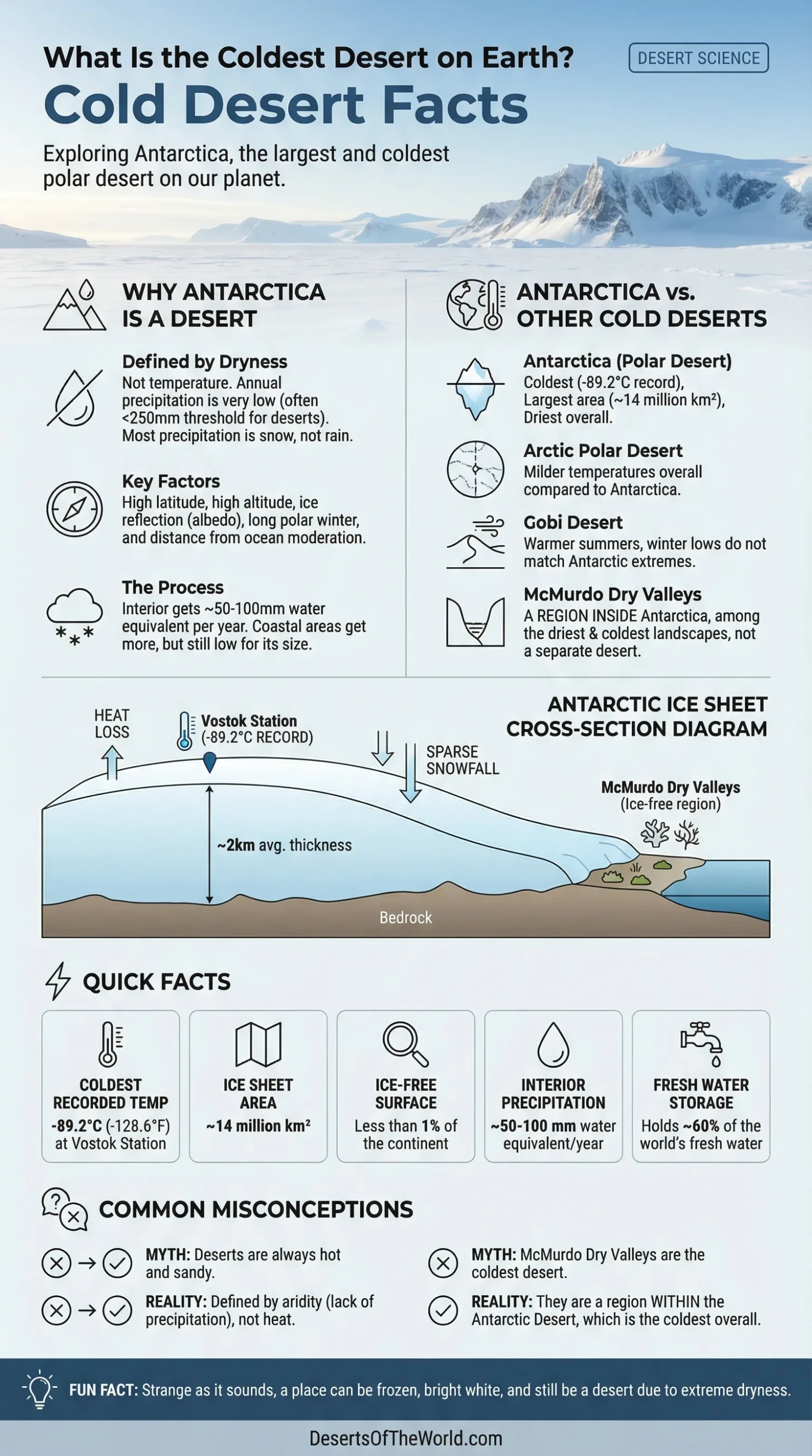
It is not just the coldest desert. It is also the largest desert on Earth. Much of the continent stays buried under an immense ice sheet, but that ice does not cancel its desert status. Strange as it sounds, a place can be frozen, bright white, and still be a desert.
| Feature | Antarctic Desert |
|---|---|
| Type | Polar desert |
| Location | Antarctica, around the South Pole |
| Why It Counts as a Desert | Very low annual precipitation, especially in the interior |
| Coldest Recorded Air Temperature | -89.2°C (-128.6°F) at Vostok Station |
| Area Covered by the Ice Sheet | Nearly 14 million km² |
| Interior Precipitation | About 50 to 100 mm water equivalent per year in some interior areas |
| Ice-Free Surface | Less than 1% of the continent |
What Makes Antarctica a Desert
A common scientific rule is simple: if a place receives very little precipitation each year, it can be classed as a desert. Many references use 250 millimeters (10 inches) or less annually as a rough threshold. Antarctica sits well below that in large parts of its interior.
Most of the continent’s precipitation falls as snow, not rain. Even then, the amounts are small. In the interior, estimates often fall around 50 to 100 millimeters of water equivalent per year. British Antarctic Survey material also notes snowfall equivalent to only about 150 millimeters of annual rain across Antarctica in broad terms. For a landmass this large, that is very little moisture.
So the defining trait is not heat. It is aridity. Dry air, sparse snowfall, and very little available liquid water shape the Antarctic Desert far more than people expect.
Why Antarctica Is the Coldest Desert
Antarctica reaches lower air temperatures than any other desert for several reasons, and they work together.
- It sits at high latitude, close to the South Pole, where sunlight arrives at a shallow angle.
- The interior stands high above sea level, and higher ground is colder.
- Snow and ice reflect much of the Sun’s energy, so the surface does not warm easily.
- The long polar winter removes solar heating for months at a time.
- The interior is far from ocean moderation, especially on the elevated plateau.
Along the coast, winter temperatures often range from about -10°C to -30°C. Inland, winter temperatures can drop below -60°C. At Vostok Station, the lowest directly measured surface air temperature on Earth reached -89.2°C. Cold it is. Colder than any other desert, by a clear margin.
Another detail matters here: Antarctica is a continent, while the Arctic is an ocean surrounded by land. That landmass, capped by a vast ice sheet, helps Antarctica cool much more deeply than the Arctic.
Antarctic Desert Facts
The Antarctic Desert has a set of features that make it unlike any other desert on the planet.
- It is a polar desert, not a hot subtropical one.
- It is the largest desert on Earth by area.
- The Antarctic Ice Sheet covers nearly 14 million km².
- That ice sheet is, on average, about 2 kilometers thick, and in places it is much thicker.
- Less than 1% of Antarctica is ice-free.
- The ice sheet stores about 60% of the world’s fresh water.
- Only around 0.4% of the surface is free of snow and ice in one BAS factsheet summary.
- Interior snowfall is so low that much of the continent qualifies as desert land despite the ice cover.
That mix is what makes Antarctica so unusual. It is a desert built from cold, dryness, altitude, and ice. Not from dunes.
Life in the Antarctic Desert
The Antarctic Desert is not empty. Life exists there, but it lives within tight limits.
On land, the options are few. In the ice-free pockets, you may find lichens, mosses, liverworts, algae, and microscopic communities that survive with very little moisture. Trees and shrubs do not grow there. The interior supports even less visible life, since liquid water is scarce and conditions stay hostile for most of the year.
Near the coast and in the surrounding Southern Ocean, life becomes much richer. Penguins, seals, seabirds, krill, and whales are part of the broader Antarctic system, though most of that richness depends on the sea rather than the frozen interior land. This distinction matters. The inland desert is sparse; the ocean edge is far more biologically active.
In some of the driest valleys, microorganisms live beneath rocks or in protected niches where tiny amounts of moisture appear for a short time. Quiet survivors, really.
Antarctic Desert vs. McMurdo Dry Valleys
This is where many articles lose clarity. Some readers see the phrase coldest desert on Earth and think of the McMurdo Dry Valleys. They are famous, and for good reason. They are among the driest and coldest desert landscapes on Earth, and they are one of the best-known ice-free parts of Antarctica.
Still, the full answer to the question is the Antarctic Desert, not only the Dry Valleys.
The McMurdo Dry Valleys are a region inside Antarctica. They are nearly devoid of snow and ice in many places, and they often appear in scientific studies because their exposed ground, low moisture, and cold conditions make them useful for geology, ecology, and even Mars analog research. NASA and NSF both highlight them for this reason.
So the relationship is straightforward:
- Antarctic Desert = the coldest desert on Earth as a whole
- McMurdo Dry Valleys = one of the coldest and driest desert regions within Antarctica
That distinction clears up a very common mix-up.
How Antarctica Compares With Other Cold Deserts
Antarctica is not the only cold desert. The Arctic has polar desert areas. The Gobi is also widely known as a cold desert, with bitter winters and large seasonal swings. Parts of Greenland and high mountain basins in Asia and South America also fit the cold-desert pattern.
Even so, they do not reach Antarctic conditions.
| Cold Desert | Why People Mention It | Why It Is Not the Coldest |
|---|---|---|
| Arctic Polar Desert | Very dry and very cold in parts of the far north | Overall temperatures are milder than Antarctica |
| Gobi Desert | Harsh winters and strong temperature swings | Summer warming is much higher, and winter lows do not match Antarctic extremes |
| McMurdo Dry Valleys | Among the driest and coldest desert landscapes known | They are part of Antarctica, not a separate answer above it |
| Greenland Polar Desert Areas | Cold, dry, and ice-dominated | Still warmer overall than Antarctica |
Why the Antarctic Desert Matters in Earth Science
The Antarctic Desert helps scientists study more than cold weather. Its ice preserves old climate records. Its dry valleys show how life can persist with very little water. Its atmosphere, ice, and surrounding ocean affect global circulation. And because much of the landscape changes slowly, it can preserve landforms and environmental signals for long periods.
That makes Antarctica useful in glaciology, climatology, geology, ecology, and planetary science. Not because it is dramatic, but because it is clear. Processes that are hidden elsewhere can stand out in Antarctica.
Sources
- https://www.bas.ac.uk/about/where-we-work/antarctica/ (British Antarctic Survey page on Antarctica, ice sheet area, ice thickness, temperatures, and ice-free land)
- https://www.bas.ac.uk/about/education-and-schools/antarctic-factsheet/ (BAS factsheet with snowfall equivalent, record low, and surface conditions)
- https://www.nasa.gov/frequently-asked-questions-about-antarctica/ (NASA FAQ on why Antarctica is a desert and what life can survive there)
- https://www.nsf.gov/news/weather-anomaly-experienced-mcmurdo-dry-valleys (U.S. National Science Foundation page on the McMurdo Dry Valleys)
- https://wmo.int/media/news/wmo-concludes-evaluation-of-possible-new-record-antarctic-temperature (World Meteorological Organization page confirming Antarctic temperature records)
- https://www.usgs.gov/programs/land-management-research-program/deserts (U.S. Geological Survey page on desert definition and annual precipitation threshold)
- https://education.nationalgeographic.org/resource/desert/ (National Geographic page on how deserts are defined and why Antarctica counts)
- https://education.nationalgeographic.org/resource/antarctica/ (National Geographic Antarctica page with precipitation and climate notes)