
Desert agriculture begins with a simple limit: plants need water, while arid regions lose water fast. Yet farming still happens in dry valleys, oases, gravel plains, desert margins, and protected greenhouses. It works when people match crops, soil, irrigation, shade, drainage, and timing to the desert’s rhythm instead of treating the land like a humid farm.
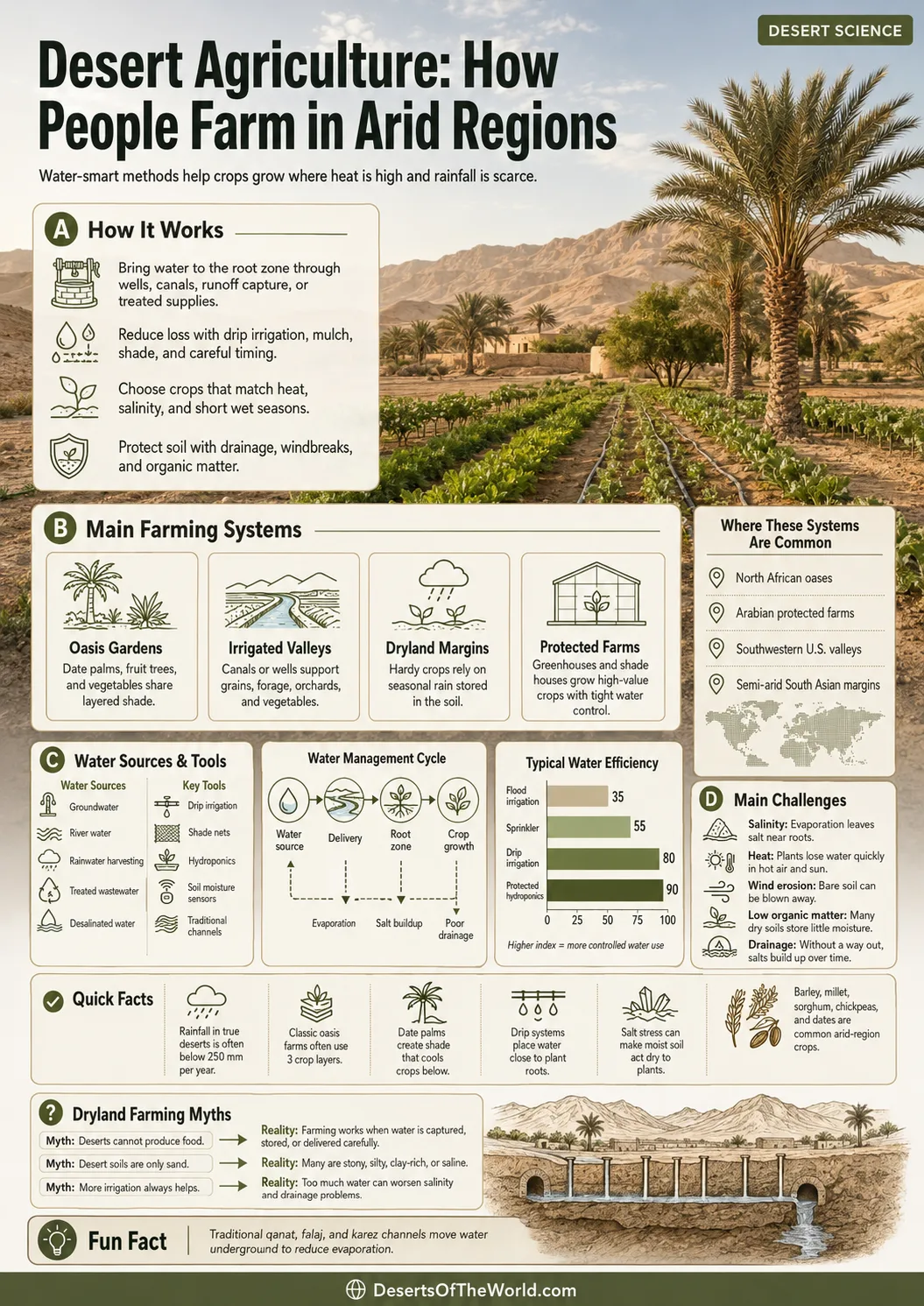
Desert agriculture is the practice of growing crops or raising useful plants in places where rainfall is low, evaporation is high, and soils may be sandy, stony, salty, or low in organic matter. It includes oasis farming, dryland farming, irrigated desert valleys, date palm gardens, greenhouse production, salt-tolerant cropping, and carefully managed grazing lands.
Not every desert farm looks the same. Some depend on groundwater. Some use seasonal runoff. Some grow only after rare rains. Others rely on drip irrigation, treated wastewater, desalination, shade nets, or hydroponics. The shared idea is narrow but clear: use every usable drop with care.
| Desert Farming Setting | Usual Water Source | Common Crops | Main Limitation |
|---|---|---|---|
| Oasis Gardens | Springs, shallow groundwater, wells, traditional channels | Date palms, figs, pomegranates, vegetables, fodder | Salt buildup and limited land |
| Desert River Valleys | River diversion, canals, reservoirs, managed irrigation | Cotton, wheat, vegetables, citrus, alfalfa, dates | Water allocation, drainage, soil salinity |
| Dryland Desert Margins | Rainfall stored in soil, runoff capture | Barley, millet, sorghum, chickpea, lentil, pasture plants | Erratic rain and soil moisture loss |
| Protected Desert Farms | Drip irrigation, desalinated water, treated water, hydroponic systems | Tomatoes, cucumbers, peppers, leafy greens, herbs | Energy use, cooling, nutrient control |
| Saline Or Coastal Drylands | Brackish groundwater, blended water, saline drainage water in limited cases | Salt-tolerant forage, barley, quinoa, halophytes | Salt management and safe drainage |
Why Farming Is Possible In Deserts
A desert is dry, not dead. Many arid regions have strong sunlight, long growing seasons, and low disease pressure compared with wetter climates. The weak point is water. When water can be delivered at the right time and in the right amount, desert soils can produce food, fruit, forage, and seed crops.
Desert farming usually works through one of three routes:
- Use stored water: groundwater, springs, aquifers, reservoirs, or treated water.
- Capture short rainfall events: runoff channels, terraces, bunds, cisterns, and small storage ponds.
- Reduce loss: drip irrigation, mulching, shade, windbreaks, soil cover, and better planting dates.
That last point matters more than it seems. In a hot desert, water can disappear from bare soil before roots use it. A field can receive water and still stay thirsty. Farming in arid land is often less about adding more water and more about keeping water where roots can reach it.
Arid, Semi-Arid, And Hyper-Arid Farmland
Desert agriculture covers several dryland types. A true desert may receive very little rain, while a semi-arid margin may receive enough seasonal rainfall for grazing, hardy grains, or pulse crops in favorable years. Farmers read these differences closely because one method cannot fit every dry place.
| Dryland Type | Farming Potential | Typical Approach |
|---|---|---|
| Hyper-Arid Land | Very limited without outside water | Oases, greenhouses, desalinated water, protected systems |
| Arid Land | Possible where groundwater, river water, or runoff exists | Drip irrigation, date palms, fodder, vegetables, orchards |
| Semi-Arid Land | Often suitable for dryland farming in seasonal patterns | Millets, sorghum, barley, legumes, grazing, water harvesting |
| Desert Fringe | Variable, often productive when soil and water are managed | Mixed cropping, agroforestry, supplemental irrigation |
Rainfall totals alone do not tell the whole story. Timing matters. A small amount of rain that arrives during planting can be more useful than a larger storm after harvest. Soil depth matters too. Deep loam can store water for roots; shallow gravel cannot. Flat fields, gentle slopes, salty basins, and wadi floors all behave differently after rain.
Main Types Of Desert Agriculture
Oasis Farming
Oasis farming is one of the oldest forms of agriculture in dry regions. It appears where water reaches the surface or sits close enough for wells and channels. The classic oasis is layered: tall date palms above, fruit trees in the middle, vegetables or fodder below. This layered planting is practical. Palms give shade, shade cuts heat stress, and smaller crops use the cooler microclimate.
Date palms are especially valuable because they tolerate heat and can handle drier air better than many fruit trees. Their shade also protects soil from direct sun. In a good oasis layout, the garden feels like a living water-saving device.
Dryland Farming On Desert Margins
Dryland farming uses rainfall without full irrigation. It is common along desert edges where rain is low but not absent. Farmers choose hardy crops, leave crop residues on the soil, avoid unnecessary tillage, and plant when seasonal moisture is most likely.
Common dryland crops include barley, millet, sorghum, chickpea, lentil, cowpea, sesame, and drought-tolerant forage plants. These crops do not make deserts wet. They simply cope better with short growing windows.
Irrigated Desert Valleys
Some of the most productive arid farms sit in desert river valleys and alluvial plains. Water from rivers, canals, reservoirs, or wells supports vegetables, grains, orchards, and fodder. These systems can produce high yields, but they also carry a hidden risk: salt accumulation.
Most irrigation water contains dissolved salts. In humid regions, rainfall may wash salts downward. In deserts, evaporation pulls water upward and leaves salts behind near the root zone. Over time, this can reduce plant growth unless drainage and leaching are managed carefully.
Protected Farms, Shade Houses, And Greenhouses
Modern desert farming often uses shade houses, net houses, tunnels, and greenhouses. These structures reduce wind, soften heat, and allow water to be delivered with more control. Hydroponic systems can grow leafy greens, tomatoes, cucumbers, peppers, and herbs with little soil contact.
This approach works well where land is dry but sunlight is abundant. It is not a simple fix. Cooling, water treatment, nutrient balance, and energy use must be planned. A greenhouse in the desert can save water yet still fail if heat builds up faster than plants can tolerate.
Salt-Tolerant And Brackish-Water Farming
Some arid farms use moderately saline water or grow salt-tolerant crops. Barley, certain forage grasses, quinoa, date palms, and some halophytes can handle more salinity than sensitive vegetables. This does not mean saltwater farming is easy. Plants differ widely in tolerance, and soil can degrade when salts are allowed to build.
The safer pattern is careful testing: measure water salinity, soil salinity, drainage, crop tolerance, and irrigation depth. Guesswork is costly here.
Water Sources Used In Arid Farming
Water in desert agriculture comes from many places. Each source has a different risk profile. Some are renewable only in wet seasons. Some are fossil groundwater stored over long periods. Some need heavy treatment before crops can use them.
| Water Source | Where It Is Used | Strength | Concern To Watch |
|---|---|---|---|
| Groundwater | Oases, inland basins, desert farms | Reliable when wells are managed | Falling water levels and salinity |
| River Water | Desert valleys and canal systems | Can support large planted areas | Allocation, evaporation, drainage |
| Rainwater Harvesting | Semi-arid slopes, wadis, village fields | Uses local runoff | Variable rainfall from year to year |
| Treated Wastewater | Near towns and planned farms | Can reduce pressure on freshwater | Treatment quality and crop rules |
| Desalinated Water | Coastal deserts and high-value protected farms | Useful where seawater and energy are available | Cost, brine handling, energy demand |
| Fog Or Dew Capture | Coastal fog deserts and test sites | Can support small systems in suitable microclimates | Limited volume and local suitability |
Drip Irrigation
Drip irrigation delivers water near the plant root zone through emitters. In arid regions, this reduces wet soil surface area and can cut evaporation compared with flood irrigation. It also allows fertilizer to be applied in smaller, more controlled doses.
Still, drip irrigation is not magic. Salts often move to the edge of the wetting pattern. If there is no planned leaching or drainage, salts can return to the root zone later. A good drip system needs filtration, pressure control, emitter maintenance, soil monitoring, and a salt plan.
Water Harvesting
Water harvesting means catching runoff and guiding it into soil, planting basins, terraces, cisterns, or small storage structures. It is especially useful where rain falls in short bursts. Instead of letting stormwater rush away, the land is shaped to slow it down.
Common forms include:
- Contour bunds: low earth banks that slow water along a slope.
- Stone lines: rows of stones that trap sediment and encourage infiltration.
- Micro-catchments: small basins around trees or shrubs.
- Terraces: stepped landforms that reduce runoff speed.
- Cisterns: storage tanks or underground chambers for later use.
Small structures can matter. A few centimeters of runoff held in the right place may support a tree seedling through a dry spell.
Traditional Channels And Underground Systems
Many desert societies developed water systems that reduce evaporation. Underground channels, known in different regions by names such as qanat, karez, foggara, or falaj, move water through shaded or buried routes. Their exact design differs by region, but the purpose is similar: bring water from uplands or aquifers to fields while limiting loss.
These systems also show a lesson modern farms still need. In deserts, water delivery is social as well as technical. Channels, turns, gates, maintenance, and shared rules decide whether a water source lasts.
Soil Problems In Desert Farming
Desert soils are not all sand. Some are clay-rich. Some are stony. Some form crusts after rain. Some contain gypsum, calcium carbonate, or salts. Many have low organic matter because plant growth is sparse and decomposition works differently under heat and dryness.
Low Organic Matter
Organic matter helps soil hold water, feed microbes, and form stable crumbs. In arid lands, adding compost, manure, crop residues, or cover crops can improve soil function, but inputs must be managed carefully. Too much fresh manure can add salts or nutrients faster than crops can use them.
Surface Crusting
Some desert soils seal after rainfall or irrigation. A thin crust can stop seedlings from emerging and reduce infiltration. Farmers reduce crusting by keeping residue on the surface, adding organic amendments, using gentle irrigation, and avoiding unnecessary disturbance.
Wind Erosion
Bare soil is easy for wind to move. Windbreaks, shelterbelts, crop residues, strip cropping, and rough soil surfaces can reduce soil loss. In open desert margins, wind protection may decide whether young plants survive their first weeks.
Salinity And Drainage
Salinity is one of the central problems in irrigated desert farming. Salt enters through irrigation water, fertilizers, shallow groundwater, or naturally salty soil layers. It becomes a bigger problem when evaporation is high and drainage is poor.
Plants under salt stress struggle to take up water even when the soil looks moist. That is the strange part: salty soil can make a plant act thirsty.
How Farmers Manage Salt In Arid Land
Salt management is not a single action. It is a cycle of testing, irrigation control, drainage, and crop selection.
- Test irrigation water: salinity, sodium hazard, and boron levels can affect crop choice.
- Measure soil salinity: surface readings and root-zone samples show where salts collect.
- Use enough leaching when possible: extra water can move salts below roots, but only if drainage exists.
- Install or maintain drainage: without a way out, salts may simply move and return.
- Select tolerant crops: barley, dates, cotton, some forages, and quinoa tolerate more salt than beans or many fruit crops.
- Avoid over-irrigation: too much water can raise shallow groundwater and bring salts upward.
Drainage deserves special attention. A field can receive excellent irrigation and still decline if water cannot leave the root zone. In desert agriculture, the drain can be as important as the pump.
Crops Commonly Grown In Arid Regions
Crop choice depends on water quality, heat tolerance, soil depth, market access, and the length of the growing season. Desert agriculture often favors crops that either tolerate stress or justify the cost of precise water management.
| Crop Group | Examples | Why It Fits Some Arid Regions | Main Caution |
|---|---|---|---|
| Palms And Fruit Trees | Date palm, fig, pomegranate, olive, citrus in suitable zones | Deep roots, high-value fruit, shade layers | Young trees need reliable establishment water |
| Dryland Grains | Barley, millet, sorghum | Short seasons and better drought tolerance than many cereals | Yields vary with rainfall |
| Legumes | Chickpea, lentil, cowpea, faba bean in suitable drylands | Useful food crops; some improve soil nitrogen | Heat during flowering can reduce harvest |
| Vegetables | Tomato, pepper, cucumber, onion, melon, leafy greens | High value under drip irrigation or protected systems | Sensitive to heat waves and salinity |
| Forage Crops | Alfalfa, salt-tolerant grasses, fodder shrubs | Support livestock and oasis systems | Some forage crops use large water volumes |
| Halophytes | Salicornia, Atriplex, saltbush | Can grow in saline settings where regular crops struggle | Uses are more limited and site-specific |
Desert Orchards And The Value Of Shade
Shade changes a desert field. It lowers soil temperature, slows evaporation, and protects tender plants from harsh afternoon sun. Traditional oasis gardens use this idea through layered planting, while modern farms may use shade cloth or net houses.
Agroforestry can also help on desert margins. Trees and shrubs may reduce wind speed, provide fodder or fruit, and improve microclimates. Yet tree planting only works where establishment water is available. Planting trees without a water plan can create stress rather than solve it.
Seasonal Timing In Arid Farming
In many dry regions, farmers avoid the hottest period instead of fighting it. They plant cool-season crops after seasonal rain, grow vegetables during milder months, or schedule irrigation around night and early morning periods to reduce losses.
Timing can be quiet work. Seed goes in when soil moisture is likely to stay long enough. Transplants move after heat drops. Harvest happens before dry winds damage quality. Not dramatic, but very effective.
Dry Farming Versus Irrigated Desert Farming
People often use “desert farming” as if it always means irrigation. That misses a large part of arid agriculture. Dry farming and irrigated farming solve different problems.
| Feature | Dry Farming | Irrigated Desert Farming |
|---|---|---|
| Water Source | Rain stored in soil | Rivers, wells, treated water, desalination, or canals |
| Crop Choice | Hardy grains, legumes, forage, low-water crops | Vegetables, orchards, grains, fodder, high-value crops |
| Field Design | Moisture conservation, fallow, residue, contour work | Delivery systems, pumps, filters, drainage, scheduling |
| Main Risk | Rainfall failure | Salinity, water cost, groundwater decline |
| Best Fit | Semi-arid margins and seasonal rainfall zones | Valleys, oases, planned farms, protected production areas |
Technology Used In Modern Desert Agriculture
Modern arid farming often blends old water wisdom with sensors, maps, and controlled irrigation. The goal is not to make the desert disappear. The goal is to reduce waste and match water to plant demand.
Soil Moisture Sensors
Soil moisture sensors help growers decide when to irrigate. In sandy soils, water moves fast and storage is low. In clay soils, water may stay longer but can be harder for roots to use. Sensors give a better picture than the soil surface alone.
Remote Sensing And Salinity Mapping
Satellite imagery, drone surveys, and field sensors can show patterns of crop stress, bare soil, salt patches, and uneven irrigation. These tools are useful because desert fields often change across short distances. One corner may be healthy while another carries hidden salt.
Greenhouses And Hydroponics
Hydroponics can grow crops without field soil, using water with dissolved nutrients. In deserts, this can reduce soil salinity problems and allow tight control of irrigation. The tradeoff is technical care: water chemistry, cooling, disease control, and power supply must stay stable.
Desalination And Water Blending
Some coastal desert farms use desalinated water, while others blend fresh and brackish water to reach a crop-safe level. This can support high-value crops, especially under protected systems. Brine disposal and energy demand must be handled responsibly.
Animals, Fodder, And Mixed Desert Farms
Desert agriculture is not only about vegetables and orchards. Livestock systems often shape arid land use. Goats, sheep, camels, and cattle may depend on fodder crops, rangelands, crop residues, and shrubs. In many dry regions, crop farming and animal husbandry support each other.
Manure can improve soil organic matter. Crop residues can feed animals. Fodder shrubs can stabilize soil and provide feed during dry periods. The balance is delicate. Overuse of grazing land can reduce plant cover, while careful rotation helps land recover.
Regional Patterns In Desert Agriculture
Sahara And North African Oases
Oasis systems across the Sahara and nearby drylands often rely on palms, wells, springs, and carefully shared water. Date palms form the upper layer, while fruit trees and vegetables may grow in the shade below. Salt control and groundwater depth are long-term concerns.
Arabian Peninsula Farms
Arid farms in the Arabian Peninsula use date palms, protected agriculture, desalinated water in some coastal areas, and modern irrigation. Greenhouses and shade houses help growers manage heat, while water cost shapes crop choice.
Atacama And Coastal Fog Deserts
In some coastal deserts, fog can be collected with mesh systems where moist air meets dry land. This water source is local and limited, but it can support small-scale planting, research plots, or community gardens in suitable sites.
Southwestern United States And Northern Mexico
Arid farms in the Sonoran, Chihuahuan, Mojave, and Colorado River regions often use irrigation, water-saving technology, and crop scheduling. Salinity, groundwater, heat, and river management all shape what can be grown.
Central Asian And Middle Eastern Drylands
Barley, wheat, lentils, chickpeas, and small ruminant systems are common in many dryland farming zones. Water harvesting, conservation agriculture, and drought-tolerant varieties help farms work with short rainy seasons.
Thar Desert And Semi-Arid South Asia
Millet, pulses, sesame, fodder crops, and hardy livestock systems fit many semi-arid areas. Rainfall timing is the main limit, so soil moisture conservation and drought-ready crops matter more than lush field appearance.
Water Use Efficiency Is Not The Whole Story
“More crop per drop” is a useful idea, but desert agriculture needs a wider view. A farm can use efficient irrigation and still damage soil if drainage is poor. A greenhouse can save water and still need careful energy planning. A drought-tolerant crop can survive dry weather but still fail in salty soil.
Good arid farming asks several questions at once:
- Is the water source renewable at the scale being used?
- Does the soil drain well enough to prevent root-zone salinity?
- Can the crop tolerate heat during flowering and fruiting?
- Will wind expose seedlings or strip soil from the field?
- Can the system be maintained with local skills and materials?
- Does the crop choice match food needs, markets, and water limits?
Common Mistakes About Desert Farming
Assuming Sand Is The Only Soil Type
Many desert farms are not on loose dunes. Productive fields often sit on alluvial fans, river terraces, wadi floors, clay basins, or loamy oasis soils. Sand is common, but it is not the whole picture.
Ignoring Drainage
Adding water without drainage can push a field toward salinity. This is one of the most common long-term problems in irrigated arid regions. Water must enter, serve the crop, and leave safely when needed.
Planting Water-Hungry Crops In The Wrong Place
Some crops can grow in deserts only because irrigation is heavy. That does not always make them a good fit. High-water forage or sensitive fruit crops may be suitable in one valley and wasteful in another.
Treating Technology As A Substitute For Local Knowledge
Sensors, desalination, and greenhouses help when they fit the site. They do not replace field observation. Farmers still need to know wind direction, soil patches, seasonal heat, water taste, pest cycles, and the behavior of each crop.
How Desert Farms Reduce Evaporation
Evaporation is a constant pressure in arid farming. Reducing it can improve crop survival without expanding water supply.
- Mulch: plant residues, gravel mulch, or other covers reduce direct soil exposure.
- Shade: palm layers, shade cloth, or net houses reduce heat stress.
- Windbreaks: trees, shrubs, fences, or shelterbelts slow drying winds.
- Drip lines: water goes near roots instead of wetting the whole field.
- Night or early irrigation: cooler timing can reduce immediate loss.
- Soil cover: residues and cover crops protect the surface where water enters.
Small changes add up. Bare, hot, windy soil loses water quickly. Covered, shaded, calmer soil gives roots more time.
Desert Agriculture And Soil Life
Dry soil still contains life: bacteria, fungi, algae, insects, roots, and seed banks. Biological soil crusts can stabilize some desert surfaces, while farm soils benefit from organic matter and careful disturbance. The aim is not to make arid soil behave like rainforest soil. The aim is to help it hold water, resist erosion, and support roots.
Compost, manure, crop residue, reduced tillage, and rotations can improve soil condition. In very salty or hot sites, progress may be slow. Slow is still progress.
When Desert Agriculture Works Best
Desert agriculture is most reliable when the system fits the place. That means choosing crops for climate and water quality, sizing farms to water supply, protecting soil from salt and wind, and avoiding designs that depend on endless pumping.
| Condition | Why It Helps | Practical Example |
|---|---|---|
| Reliable Water Accounting | Prevents overuse of wells and canals | Measuring pump output, crop demand, and seasonal supply |
| Good Drainage | Reduces root-zone salinity | Field drains, graded beds, leaching only when drainage exists |
| Crop Fit | Reduces stress and water waste | Dates in hot oases; barley in dryland margins; vegetables under drip |
| Soil Cover | Protects moisture and reduces wind erosion | Residue retention, mulch, windbreaks, cover strips |
| Local Maintenance | Keeps systems working after installation | Clean filters, repaired emitters, maintained channels |
Frequently Asked Questions
Can Crops Really Grow In Desert Soil?
Yes, when water, salinity, drainage, and heat are managed. Desert soil is not automatically infertile, but it often has low organic matter, weak structure, or salt problems. Some sites need compost, careful irrigation, wind protection, or raised beds before crops perform well.
What Is The Most Common Crop In Desert Oases?
Date palm is one of the most common and useful oasis crops. It tolerates heat, provides fruit, creates shade, and allows smaller crops to grow beneath it in layered systems.
Is Drip Irrigation Enough To Farm A Desert?
No. Drip irrigation helps deliver water efficiently, but the farm still needs good filtration, crop planning, salinity monitoring, and drainage. Without those parts, salt can collect near roots.
Why Is Salt Such A Big Problem In Desert Farming?
High evaporation leaves salts behind as water disappears. Irrigation water may also bring dissolved salts into the field. If salts remain in the root zone, plants struggle to take up water and nutrients.
Can Rainfed Farming Work In Deserts?
It can work on semi-arid desert margins where seasonal rainfall is low but usable. True desert interiors usually need irrigation, groundwater, oases, fog capture, or protected systems.
Are Greenhouses The Future Of Desert Agriculture?
Greenhouses are useful for high-value crops in some arid regions, especially where water can be controlled. They are not suitable everywhere. Cooling, energy, water treatment, and skilled maintenance decide whether they make sense.
What Makes A Desert Farm Sustainable?
A desert farm is more stable when water use matches local supply, soil salinity is monitored, drainage works, crops fit the climate, and the system can be maintained over time. The farm should protect the land it depends on.
Sources
- FAO — The World’s Drylands (dryland types, land degradation, arid-zone conditions)
- FAO — Water Harvesting And Storage (rainwater harvesting, small storage, rainfed crop support)
- FAO — Water Quality For Agriculture (irrigation water quality, salinity, crop response)
- USDA Agricultural Research Service — Water And Salinity Research In Arid And Semi-Arid Regions (irrigation water, marginal lands, alternative water sources)
- USDA Agricultural Research Service — Drip Irrigation And Soil Electrical Conductivity (salinity monitoring near drip emitters)
- University Of Arizona Water Resources Research Center — Agricultural Water Outlook (arid-region irrigation, reclaimed water, agricultural water planning)
- CGIAR — ICARDA Dryland Agriculture Research (barley, lentil, faba bean, water-use efficiency, dry-area farming systems)