
Desert nomadic cultures grew from a plain fact of arid land: water, grass, shade, salt, and safe routes are rarely found in one fixed place. A family, clan, or camp that moves with the seasons can read the desert like a map written in wind, tracks, stars, plants, and wells. This is not aimless wandering. It is a learned way of living with drylands.
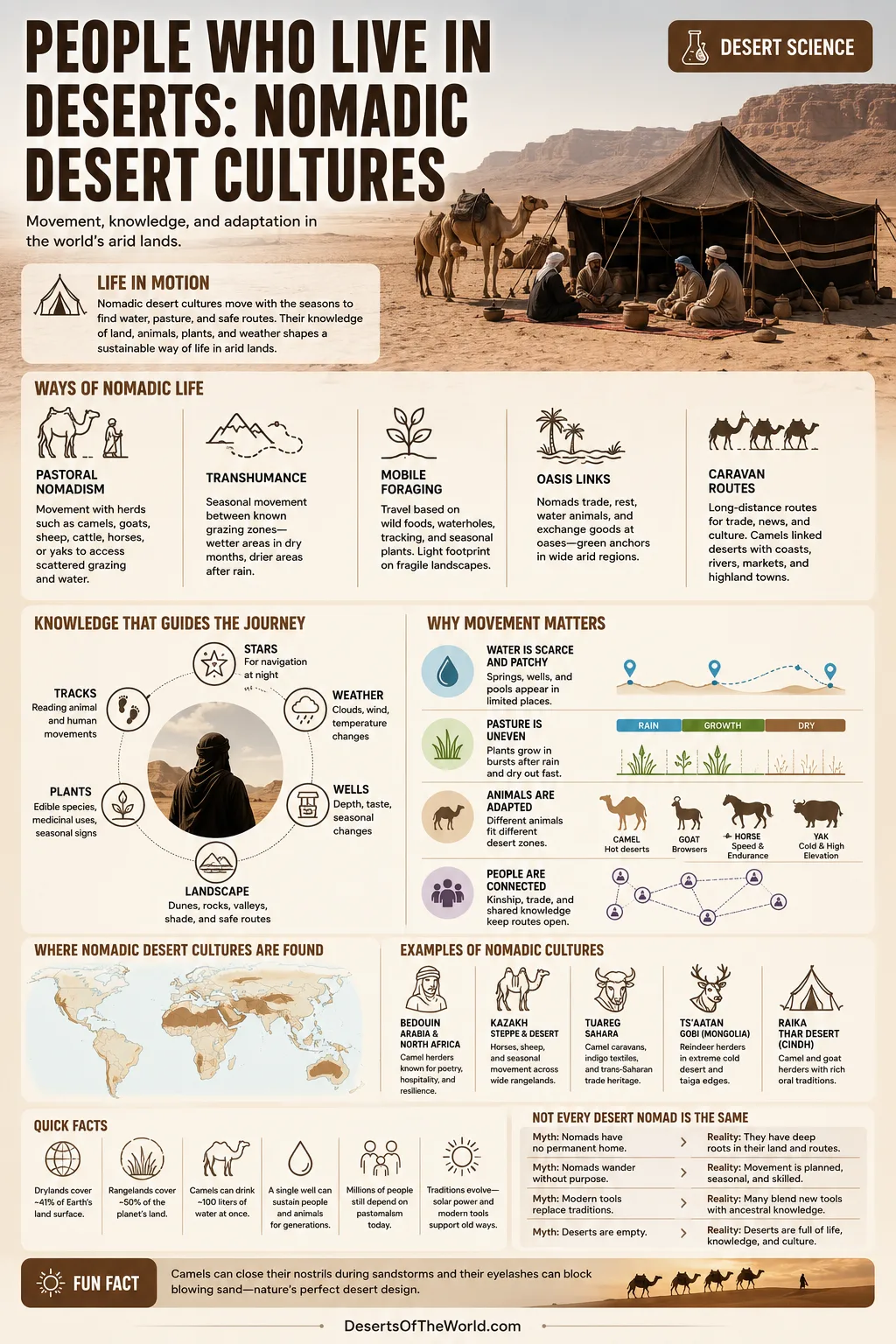
People who live in deserts include oasis farmers, town dwellers, traders, miners, craft workers, and herders. Nomadic desert cultures are one part of that wider human story. Some are fully mobile, some are semi-nomadic, and many now live in towns while still keeping language, animal knowledge, music, weaving, route memory, and desert food traditions alive.
| Theme | What It Means | Desert Connection |
|---|---|---|
| Pastoral Nomadism | Movement with herds such as camels, goats, sheep, cattle, horses, or yaks. | Herders follow scattered grazing and seasonal water instead of keeping animals in one place. |
| Transhumance | Seasonal movement between known grazing zones. | Families may use wetter zones in dry months and drier zones after rain. |
| Mobile Foraging | Travel based on wild foods, waterholes, tracking, and seasonal plants. | Movement keeps pressure light on fragile desert patches. |
| Oasis Links | Nomads trade, rest, water animals, and exchange goods at oases. | Oases act like green anchors in wide arid regions. |
| Caravan Routes | Long-distance movement used for trade and communication. | Camels helped connect deserts with coasts, rivers, markets, and highland towns. |
What Counts As A Nomadic Desert Culture?
A nomadic desert culture is a community whose traditional life includes regular movement through drylands. The movement may be long or short. It may involve tents, portable shelters, pack animals, grazing rights, kinship routes, wells, and seasonal camps.
The word nomadic should be used with care. It does not mean rootless. Desert nomads often know their home territories in fine detail: which well turns salty after a dry year, where acacia pods fall, which valley holds shade at midday, and which dunes hide firm ground beneath loose sand. Fixed walls are not the only kind of home. A known route can also be home.
Three patterns appear again and again across desert regions:
- Pastoral nomadism: families move with livestock to reach grazing and water.
- Seasonal semi-nomadism: people keep a base settlement but move part of the year with animals or for work.
- Mobile foraging: small groups travel between water, edible plants, and animal habitats, often using deep ecological knowledge.
Many communities now combine old and new ways. Trucks may replace pack animals on some routes. Solar panels may power lights in a camp. Children may attend school in a town while relatives continue herding. The culture is still desert-shaped, even when the camp looks different.
Why Deserts Favor Movement
Deserts are not empty. They are uneven. One valley may bloom for two weeks after rain while a nearby plain stays bare. A shallow pan may hold water for a short season. A rocky slope may support hardy shrubs that camels can browse when grasses disappear. In places like this, movement is not a last resort. Movement is timing.
Drylands cover about 41 percent of Earth’s land surface, and rangelands cover about half of the planet’s land area. These zones include deserts, semi-deserts, shrublands, steppes, savannas, and mountain pastures. Pastoralists are found in many of these landscapes because livestock can turn scattered vegetation into milk, meat, wool, hides, transport, and trade goods.
Water Shapes Routes
In a humid forest, a stream may run all year. In a desert, water may appear as a spring, fog drip, seasonal pool, hand-dug well, rock hollow, or deep aquifer reached by an oasis. Nomadic groups learn these water points by name, distance, taste, depth, and season. That knowledge is practical and social: families often coordinate movement so animals do not crowd the same fragile source at once.
Pasture Comes In Patches
Desert plants grow in bursts. After rain, short grasses may rise quickly, flower, seed, and dry. Shrubs and thorn trees offer browse long after the grass has faded. A mobile herd can use each patch when it is ready, then move away before the ground is worn out.
Animals Fit Different Deserts
Dromedary camels suit hot deserts such as the Sahara and Arabian deserts. Bactrian camels suit colder deserts and steppes such as the Gobi. Goats browse thorny shrubs. Sheep graze open ground. Horses, cattle, yaks, and donkeys appear where climate, elevation, and pasture allow. The animal mix tells a story about the desert itself.
Major Nomadic Desert Cultures Around The World
Bedouin Cultures In The Arabian and North African Deserts
Bedouin societies are linked with the Arabian Peninsula, the Syrian Desert, the Negev, Sinai, the Levant, and parts of North Africa. The name is often connected with Arabic words for desert dwellers. Traditional Bedouin life centered on mobile herding, especially camels, goats, and sheep, along with trade, tent making, oral poetry, animal care, and hospitality customs.
In many Bedouin settings, the black goat-hair tent became a smart desert home. It could be packed, repaired, stretched for shade, and opened to wind. It was light enough for movement but strong enough for daily life. Simple, not primitive.
Bedouin mobility also linked deserts to settled zones. Herders exchanged milk, wool, animals, and transport services for grain, dates, tools, and cloth. On the desert edge, the line between nomad, farmer, and trader was often flexible.
Tuareg Cultures Of The Sahara and Sahel
The Tuareg, also known in many contexts as Kel Tamasheq, are associated with the central Sahara and Sahel, especially areas of Niger, Mali, Algeria, Libya, and nearby regions. Their traditions include camel herding, caravan history, leatherwork, metalwork, poetry, music, and a strong sense of desert territory.
Tuareg mobility is closely tied to the Aïr, Ténéré, and other Saharan landscapes where grazing, wells, and seasonal movement matter. Indigo-dyed clothing, finely worked silver, saddles, tents, and leather objects are often recognized as part of Tuareg material culture. These items are not just decorative. Many are made for travel, shade, storage, identity, and daily use.
The Sahara is wide enough to hide a town, a mountain, or a whole season. Tuareg route knowledge made long-distance travel possible across places that look unreadable to outsiders.
Toubou and Teda-Daza Traditions Near The Tibesti and Central Sahara
Toubou communities, including Teda and Daza groups, are associated with the Tibesti region and surrounding Saharan zones of Chad, Libya, Niger, and nearby areas. Traditional livelihoods include camel herding, date-palm oasis links, salt-route knowledge, and movement through rocky desert and mountain-edge terrain.
The Tibesti landscape is not a flat sand sea. It has volcanic mountains, dry valleys, highland routes, and isolated water points. In such country, mobility depends on endurance, animal skill, and memory of terrain. A route may turn on a pass, a spring, or a grazing patch that appears only after rare rain.
Sahrawi and Moorish Pastoral Traditions Of The Western Sahara Region
In the western Sahara and Mauritanian desert region, Hassaniya Arabic-speaking Sahrawi and Moorish pastoral traditions developed around camels, goats, tents, poetry, tea customs, and movement between desert wells and grazing zones. Some communities were closely tied to oasis towns and caravan exchange, while others focused more on herding.
The western Sahara is a land of wide plains, rocky plateaus, dunes, and Atlantic-influenced edges. Desert life here often blended mobility with learning, craft, animal care, and trade links. The tent, the camel saddle, and the water skin were all part of a portable household system.
San Communities Of The Kalahari Region
The San are not usually described as pastoral nomads in the camel-herding sense. Their desert connection is different: many San communities of southern Africa are known for mobile hunter-gatherer traditions in and around the Kalahari region. Their knowledge includes tracking, wild plant foods, seasonal water, animal behavior, fire, shelter materials, and storytelling.
The Kalahari is often called a desert, yet much of it is a dry savanna with grasses, shrubs, pans, and seasonal variation. Traditional mobility allowed small groups to shift between waterholes and food patches. That movement also helped avoid exhausting one place. Light footprints matter in dry land.
Aboriginal Desert Peoples Of Australia
Australia’s interior deserts, including the Great Victoria, Gibson, Great Sandy, Tanami, Simpson, and Little Sandy deserts, are home to many Aboriginal peoples with long, place-based connections to Country. Traditional life in many desert regions involved seasonal travel, waterhole knowledge, seed foods, fire practices, shelters, story routes, and careful reading of animal tracks and plant cycles.
These traditions should not be reduced to the word “nomad” alone. Desert Aboriginal life is deeply tied to named places, kinship, language, ceremony, and responsibilities to Country. Movement followed knowledge. It was not random.
Many Aboriginal desert communities today live in settlements, homelands, and towns while continuing art, language work, land care, weaving, ranger programs, and cultural teaching. The desert remains a living cultural landscape.
Gobi Herders In Mongolia and Northern China
The Gobi is a cold desert and desert-steppe region, not a hot sand desert. Mongolian herding traditions include seasonal movement with sheep, goats, horses, cattle, yaks in cooler highland zones, and Bactrian camels in drier desert areas. Families may move between winter, spring, summer, and autumn camps.
The portable ger suits this rhythm. It can be taken down, loaded, and rebuilt, yet it offers warmth in cold weather and shade in summer. In the Gobi, the desert problem is not only heat. It is wind, distance, sparse pasture, and hard winter cold.
How Nomadic Desert Life Works Day To Day
Camps Are Built For Movement
A desert camp is usually practical before it is pretty. Tents, mats, ropes, water containers, saddles, cooking gear, woven bags, and animal tethers must be useful, repairable, and portable. Heavy furniture makes little sense when a family may move after pasture changes.
Different regions use different materials:
- Goat hair, wool, leather, reeds, palm fiber, felt, grass, and branches can all become shelter materials.
- Pack animals, carts, and today sometimes trucks move household goods.
- Camp layout often reflects shade, wind, animal safety, privacy, and social custom.
Food Comes From Herds, Plants, Trade, and Seasonal Knowledge
Milk is central in many pastoral desert diets because live animals can produce food while moving. Camel, goat, sheep, yak, or cow milk may be consumed fresh, soured, dried, churned, or turned into butter and cheese depending on the culture and climate.
Grain, dates, tea, salt, coffee, wild seeds, edible roots, gum, berries, and traded foods also matter. A desert diet is rarely based on one thing. It changes with animals, trade, season, and local ecology.
Navigation Uses More Than Stars
Stars help in open country, but desert navigation is broader than night sky knowledge. People read wind-shaped dunes, dry riverbeds, plant lines, insect activity, animal tracks, soil color, mountain profiles, and the smell of water or vegetation after rain. A skilled traveler notices small clues. The desert does not shout.
Social Life Travels Too
Mobile cultures carry social systems with them: marriage ties, kinship obligations, guest customs, songs, stories, animal brands, craft patterns, and names for places. A camp can gather, divide, and gather again. This flexibility helps people manage pasture, family needs, ceremonies, markets, and seasonal work.
Nomadic Desert Cultures By Region
| Region | Examples Of Mobile Desert Traditions | Main Landscape Type | Typical Knowledge Base |
|---|---|---|---|
| Sahara and Sahel | Tuareg, Toubou, Sahrawi, Moorish, and other pastoral groups | Sand seas, gravel plains, mountains, oases, dry valleys | Wells, camel routes, grazing cycles, caravan exchange, desert crafts |
| Arabian Desert and Levantine Drylands | Bedouin communities | Sand deserts, basalt plains, wadis, desert steppe | Herding, tent life, oral poetry, animal care, water routes |
| Kalahari Region | San mobile foraging traditions | Dry savanna, pans, dunes, scrubland | Tracking, wild foods, waterholes, seasonal shelters |
| Australian Interior | Many Aboriginal desert peoples | Spinifex plains, dunes, salt lakes, rocky ranges | Water places, seed foods, fire knowledge, story routes, land care |
| Gobi Desert and Desert-Steppe | Mongolian and Inner Asian herders | Cold desert, gravel plains, steppe, mountain edges | Seasonal camps, Bactrian camels, felt homes, winter pasture planning |
| Iranian and Central Asian Drylands | Turkic, Persian-speaking, and other pastoral communities in desert-edge zones | Plateaus, salt deserts, mountain pastures, steppe margins | Transhumance, sheep and goat herding, wool, market exchange |
Mobility Is A Form Of Desert Management
A common misunderstanding describes nomads as people forced to move because deserts are difficult. That misses a central point: mobility can protect both herds and land. When animals remain too long in one dry patch, plants lose time to recover. When herders move at the right moment, grazing can be spread across a wider area.
This does not mean every mobile system works perfectly in every place. Deserts vary. So do herd sizes, markets, roads, borders, wells, and climate. Yet the basic idea is sound: in drylands, flexibility often fits the land better than rigid settlement.
A mobile camp can respond to a local rainstorm. A fixed farm cannot pick itself up and move toward fresh grass. That is the desert logic behind pastoralism.
Oases, Towns, and Nomads Were Always Connected
Nomads and settled people are sometimes described as opposites, but desert history shows constant exchange between them. Oases supplied dates, grain, shade, water, repair work, markets, and religious or learning centers. Nomads brought animals, milk products, wool, leather, transport, news, salt, and long-distance route knowledge.
In the Sahara, oasis gardens often grew date palms with grains, vegetables, and fruit below the canopy. In Arabian and North African drylands, towns and camps depended on each other in different seasons. In Central Asia, herders and market towns formed similar links.
The desert was not a wall. It was a network with hard distances between its nodes.
Common Desert Skills Shared By Many Nomadic Cultures
- Reading animals: knowing when camels, goats, sheep, or horses need water, shade, rest, or new grazing.
- Finding water: remembering wells, springs, rock pools, dry channels, and seasonal waterholes.
- Tracking: reading hoofprints, footprints, droppings, broken twigs, feathers, and wind-softened trails.
- Portable making: producing tents, bags, ropes, saddles, mats, clothing, and containers that can move.
- Weather watching: noticing clouds, wind direction, heat, cold, dust, and plant response after rain.
- Route memory: joining landmarks into safe travel paths across open ground.
- Animal product care: turning milk, wool, hair, hides, and fiber into food, shelter, trade goods, and clothing.
How Desert Nomadic Life Is Changing
Many desert peoples no longer live as full-time nomads. Roads, schools, health services, wage work, national borders, market changes, water projects, phones, and vehicles have changed movement patterns. Some families settle near towns. Some keep animals but move shorter distances. Some split household roles, with one part of the family in a settlement and another part traveling with herds.
Change does not erase culture. A person may live in a house and still speak a desert language, know camel breeds, weave a tent panel, remember old wells, sing herding songs, or teach children the names of plants. Culture can remain mobile in memory, craft, and seasonal return.
For many communities, the future is not a choice between “old nomad” and “new town dweller.” It is a blend. A herder may use a motorcycle. A tent may have a solar panel. A child may learn both school subjects and animal tracks. Real desert life has always adjusted.
Respectful Ways To Understand Desert Nomads
Nomadic desert cultures are sometimes flattened into camel images and sand-dune stereotypes. Better to see them through everyday knowledge: how people water animals, choose a camp, repair a saddle, share milk, read weather, protect seedlings, welcome guests, and remember routes.
Useful points to keep in mind:
- Not all desert people are nomads.
- Not all nomads ride camels.
- Many desert cultures are partly settled today.
- Mobile life can be planned, skilled, and place-based.
- Desert knowledge includes ecology, language, craft, food, music, and memory.
- Each group has its own history; broad labels should not replace local names.
Frequently Asked Questions About Nomadic Desert Cultures
Do People Still Live As Nomads In Deserts?
Yes, but the pattern varies by region. Some families still move with herds across desert and semi-desert rangelands. Others are semi-nomadic, moving during certain seasons. Many now live in settlements while keeping desert skills, herd ownership, language, craft, and seasonal ties.
Why Did Camels Become So Closely Linked With Desert Nomads?
Camels can travel long distances, carry loads, browse tough plants, and cope with dry conditions better than many other large animals. Dromedaries are linked with hot deserts such as the Sahara and Arabian deserts, while Bactrian camels are linked with colder deserts such as the Gobi.
Are Nomads and Pastoralists The Same?
Not always. A nomad is a person or community with a mobile way of life. A pastoralist depends mainly on livestock. Many desert nomads are pastoralists, but some mobile desert cultures are better described as foragers, traders, seasonal herders, or mixed-livelihood communities.
What Is The Difference Between Nomadism and Transhumance?
Nomadism is broader and may involve flexible movement across a territory. Transhumance usually means seasonal movement between known grazing zones, such as dry-season and wet-season pasture. In real life, the two can overlap.
Which Deserts Have The Most Famous Nomadic Cultures?
The Sahara, Arabian Desert, Kalahari region, Australian interior deserts, and Gobi Desert are often linked with well-known mobile cultures. The details differ: Sahara and Arabian traditions often center on pastoralism and camels; Kalahari traditions include mobile foraging; the Gobi includes cold-desert herding with Bactrian camels and other livestock.
Do Nomadic Desert Cultures Harm The Land?
Mobile herding can be well suited to drylands when movement, herd size, water access, and pasture recovery stay balanced. Problems can appear when movement is restricted or animals are concentrated too long in one place. The older desert lesson is simple: dry land needs time to rest.
Glossary Of Desert Nomad Terms
| Term | Meaning | Why It Matters |
|---|---|---|
| Pastoralism | A livelihood based on raising animals such as camels, goats, sheep, cattle, horses, or yaks. | It turns sparse desert vegetation into food, fiber, transport, and trade goods. |
| Nomadism | A mobile way of life based on movement through a known territory. | It helps people respond to changing water and pasture. |
| Transhumance | Seasonal movement between grazing areas. | It links camps, pasture, climate, and herd health. |
| Oasis | A place in a desert where water allows plants and settlement. | Oases connect mobile herders with farms, markets, and rest points. |
| Rangeland | Land used for grazing animals, including grassland, shrubland, desert, and steppe. | Many desert nomadic cultures depend on rangelands. |
| Caravan | A group traveling together, often with pack animals. | Caravans linked desert regions to trade routes and towns. |
| Wadi | A dry riverbed or seasonal watercourse in arid regions. | Wadis may guide travel and hold short-lived water or vegetation. |
Sources
- FAO: International Year Of Rangelands And Pastoralists (global rangelands, pastoralist communities, livestock, and dryland context)
- FAO: Pastoralism In Africa’s Drylands (mobility, grazing zones, and pastoral livelihoods in African drylands)
- UNESCO: Tuareg Nomadic Pastoralists In Aïr And Ténéré Natural Reserves (Tuareg pastoral knowledge and Saharan desert culture)
- Encyclopaedia Britannica: Sahara People (Saharan pastoralists, oases, livestock, and historical desert settlement)
- Yale eHRAF World Cultures: Bedouin Summary (Bedouin societies in arid steppe regions of Arabia and North Africa)
- South African History Online: San Hunter-Gatherer Society (San mobility, shelters, foraging, and Kalahari-region life)
- National Film And Sound Archive Of Australia: Aboriginal People In The Gibson Desert (Australian desert knowledge and Aboriginal cultural context)
- FAO: Grazing Management In Mongolia (Mongolian pastoralism, cold arid climate, livestock, and transhumance)
- UNCCD Global Land Outlook: Drylands Chapter (dryland area, population, livestock, and land context)