
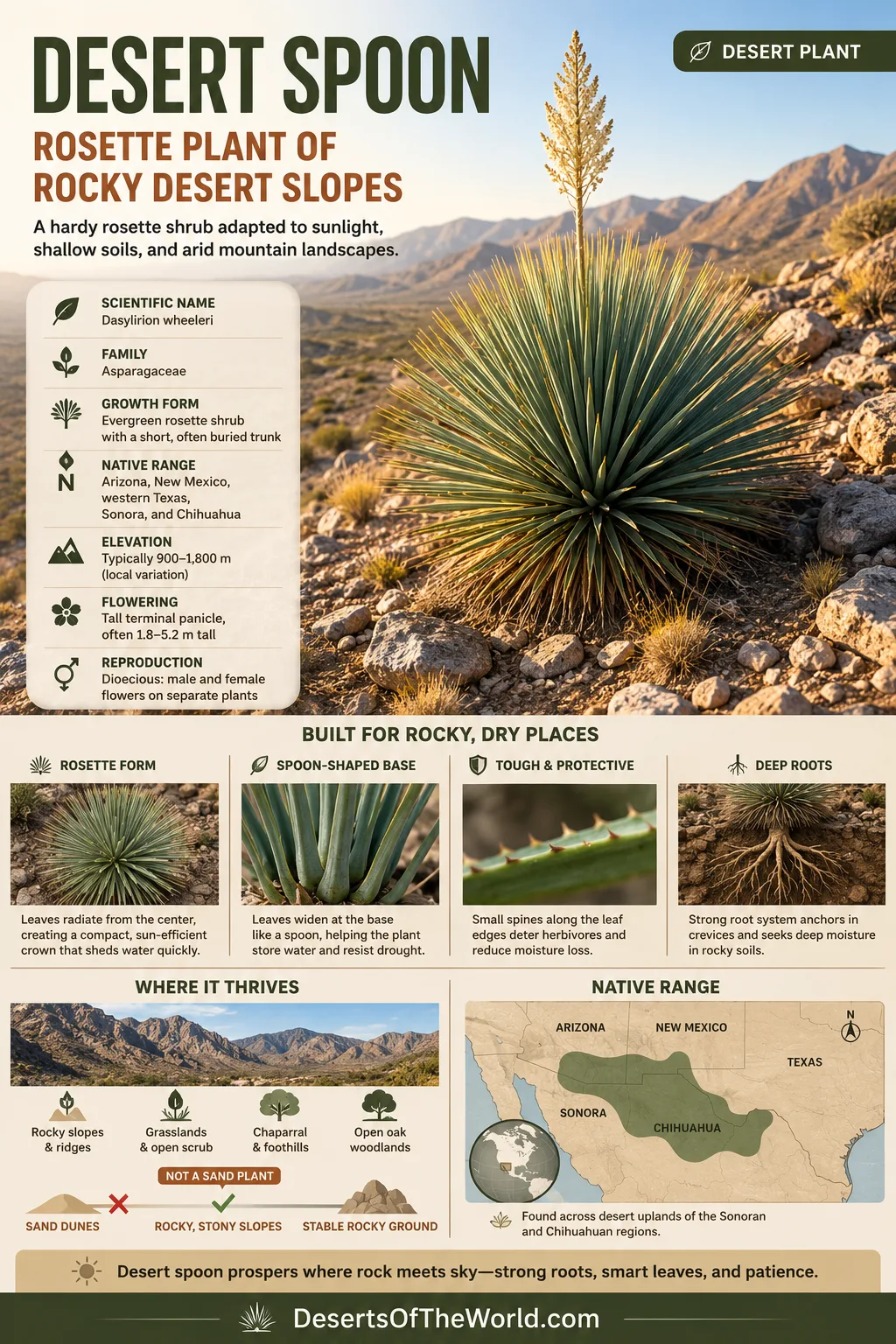
Desert spoon forms a rounded burst of narrow blue-green leaves on dry, broken ground. It is most closely tied to rocky uplands, desert grasslands, open scrub, and the foothill zones that connect low desert basins with higher oak country. The plant is not a cactus, and it is not an agave or yucca. It is Dasylirion wheeleri, an evergreen rosette-forming shrub whose shape, leaf structure, flowering cycle, and buried stem base all fit life on exposed slopes where soil is shallow and water drains away quickly.
Seen from a distance, a mature plant can resemble a stiff fountain anchored among limestone fragments or granite rubble. Up close, the details change the picture: each leaf carries small teeth, the base widens into the spoon-like form behind the common name, and the low rosette may send a flowering column several metres above the hillside. Desert spoon belongs to the dry landscapes of the southwestern United States and northern Mexico, especially the broader Sonoran and Chihuahuan desert regions.
Main Details of Desert Spoon
| Scientific Name | Dasylirion wheeleri S. Watson ex Rothr. |
|---|---|
| Common Names | Desert spoon, common sotol, Wheeler sotol, spoon-leaf |
| Plant Family | Asparagaceae |
| Growth Form | Evergreen shrub with a dense radial rosette and a short, often partly buried trunk or caudex |
| Native Range | Arizona, New Mexico, western Texas, Sonora, and Chihuahua |
| Typical Setting | Rocky or gravelly slopes, desert and semidesert grasslands, chaparral, scrub, and open oak woodland |
| Common Elevation Band | Often recorded from about 900 to 1,800 metres, with local variation |
| Flowering Structure | A tall terminal panicle commonly reported at about 1.8 to 5.2 metres |
| Reproductive Pattern | Dioecious; male and female flowers occur on separate plants |
A Plant of Sonoran and Chihuahuan Desert Uplands
The native distribution of Dasylirion wheeleri runs from southern Arizona and New Mexico into western Texas, then south into Sonora and Chihuahua. This range crosses political borders but follows a recognisable landscape pattern: dry mountain fronts, stony ridges, open grassland, scrub, and upland desert terrain.
Its association with the Sonoran and Chihuahuan Deserts does not mean it is equally common across every low basin. Desert spoon is often more characteristic of rocky uplands and transitional slopes than of broad sandy flats. In Arizona it can appear above classic cactus-rich desert scrub, while in New Mexico and the Trans-Pecos region of Texas it may stand among perennial grasses, agaves, yuccas, prickly pears, low shrubs, and scattered oaks.
This position between desert floor and mountain woodland matters. Temperatures can swing sharply, rainfall may arrive in brief seasonal pulses, and exposed slopes lose moisture fast. Desert spoon lives where dryland communities overlap rather than inside one simple vegetation zone.
Why It Is Not a Sand-Dune Specialist
The word “desert” often brings open dunes to mind, yet desert spoon is not built around shifting sand. Its strongest habitat link is with stable but broken mineral ground: shallow soil mixed with stones, gravel, cobbles, bedrock, or slope debris. These surfaces may look bare, though small pockets between rocks can hold enough fine material for roots and soil organisms.
National Park Service vegetation surveys show the species on mountain backslopes with loose rock, exposed limestone, coarse gravel, and embedded boulders. Such records place the plant within real desert mosaics, where slope angle, rock type, soil depth, and elevation can matter as much as annual rainfall totals.
How the Rosette Fits an Exposed Slope
Desert spoon grows from a central point, sending many long leaves outward in all directions. The result is a rounded or hemispherical rosette. Younger leaves rise from the middle. Older leaves occupy the outer layers, then bend downward as they age.
This radial arrangement keeps the plant compact even when individual leaves extend well beyond the stem. It also places photosynthetic tissue around the full crown rather than along branches. On an open slope, sunlight can reach different parts of the rosette as the sun moves across the sky.
The form is dense, but it is not bulky in the same way as a broad-leaved agave. Desert spoon uses numerous narrow blades. Their combined surface creates a large working crown while allowing air and angled light to pass through the outer layers.
A Crown Made of Different Leaf Ages
The center of the rosette contains the newest growth. These young blades are partly surrounded by mature leaves, while dry outer leaves may remain around the trunk. The plant therefore carries a visible record of growth from the protected center to the weathered lower skirt.
That layering affects more than appearance. The living leaves intercept light and rain, while older material changes airflow and shade close to the stem. Dry leaf accumulation can also alter how a plant responds to fire, especially when flames reach the crown or caudex.
The Small Leaf Feature Behind the Name
The “spoon” in desert spoon does not describe the whole rosette. It refers to the widened, shallowly depressed base of a leaf where it joins the stem. The long upper blade is narrow and strap-like; only near the attachment point does it broaden into the form that inspired the English name.
This detail can be missed when the plant is viewed from several metres away. The rosette looks like a sphere of blades, not a collection of spoons. The name becomes clear only when the leaf base is examined.
Those broad bases remain close together around the stem. As leaves age and dry, their bases may persist, helping form the rough layered surface around an older plant. The feature also explains older common names such as “spoon-leaf.”
Blue-Green Leaves with Saw-Toothed Margins
The leaves of Dasylirion wheeleri are slender, firm, and often blue-green to grey-green. The margins carry repeated prickles or teeth. U.S. Forest Service descriptions place the leaf base at roughly 2 to 4 centimetres wide, though the blade narrows as it extends away from the stem.
The teeth are one of the best field clues. They create a finely serrated edge rather than the smooth margin seen in some superficially similar rosette plants. The blades may arch or twist slightly, so the teeth do not all face the same direction.
- Overall form: a dense, rounded rosette of many narrow leaves
- Leaf colour: commonly blue-green, grey-green, or muted green
- Leaf margin: lined with small but firm teeth
- Leaf base: broadened and spoon-like
- Older growth: outer leaves may bend downward and dry around the stem
The leaf crown should be treated as a physical barrier. The teeth can catch skin or clothing, even though the plant lacks the thick terminal spear typical of many agaves.
The Woody Caudex Beneath the Leaf Crown
The rosette does not sit directly on a simple root cluster. Beneath it lies a thick woody caudex, a persistent stem base that may be mostly below ground. Older individuals can develop a visible short trunk, while younger plants often appear almost stemless.
U.S. Forest Service accounts report trunks up to about 0.91 metre, either partly buried or above the surface. The caudex stores the growing point and supports both the leaf crown and the seasonal flowering structure. It can also produce vegetative sprouts.
This buried or low stem is important after disturbance. When the crown is damaged but the growing tissues survive, regrowth may emerge from the caudex. Survival is not automatic. The result depends on how deeply heat or physical damage reaches into the stem base.
What Is Known and Unknown About the Roots
Desert spoon is often described as though it must have a deep taproot that reaches hidden water. Direct species-level evidence does not support such a neat claim. The U.S. Forest Service notes that detailed information on the longevity and root system of D. wheeleri is limited.
A related species, Dasylirion texanum, has been described with many coarse roots spreading downward and outward from the stem base. That comparison may help researchers form questions, but it should not be presented as a measured root map for desert spoon itself.
The safer reading comes from habitat. D. wheeleri regularly grows where soil is shallow, rocky, and well drained, and where dependable subsurface water is generally unavailable. Its survival therefore reflects tolerance of dry root zones and the ability to use temporary moisture, not a proven connection to a deep permanent water source.
Why Rocky Ground Suits Desert Spoon
Rocky soil is not merely poor soil that the plant happens to endure. It shapes the water conditions around the caudex and roots.
Rain falling on a slope can follow several paths. Some runs over exposed rock. Some enters cracks. Some gathers briefly in small pockets of gravel and fine soil. Because the ground drains quickly, the root zone is less likely to remain saturated for long periods.
Desert spoon occurs on both limestone and granite in the Trans-Pecos region. These rocks weather into different mineral mixtures, yet both can produce shallow, open, fast-draining surfaces. The shared feature is not one exact soil chemistry. It is the physical structure of the site.
| Slope Feature | Effect on the Plant’s Setting |
|---|---|
| Shallow soil | Limits water storage and keeps roots close to rock and coarse mineral material |
| Gravel and cobbles | Create open drainage pathways and small protected soil pockets |
| Exposed bedrock | Directs runoff into cracks, ledges, and lower microsites |
| Slope angle | Moves water downslope and reduces long surface ponding |
| Open vegetation | Exposes the rosette to strong sunlight, wind, and large temperature swings |
Using Brief Rainfall Pulses
Many desert uplands receive moisture in pulses rather than through steady wet periods. A storm can wet the upper soil quickly, then drainage, evaporation, and plant uptake begin at once. Desert spoon keeps a permanent evergreen crown ready to respond when conditions permit.
The rosette does not need to rebuild all of its photosynthetic surface after every dry spell. Living leaves remain in place through the year, though their activity changes with temperature and water availability. This slow, persistent strategy differs from drought-deciduous shrubs that shed leaves and wait for rain before producing a new canopy.
A Desert Rosette That Uses C3 Photosynthesis
Its shape invites comparison with agaves, and that can lead to a common error: assuming desert spoon uses crassulacean acid metabolism, or CAM. A controlled study of evergreen rosette plants from the Chihuahuan Desert classified Dasylirion wheeleri as a C3 plant. Under the temperature treatments used in that research, it did not switch to CAM.
CAM plants generally take in much of their carbon dioxide at night, when cooler conditions can reduce water loss. C3 plants mainly fix carbon through the standard daytime pathway. Desert spoon therefore shows that dryland survival cannot be reduced to one photosynthetic mechanism.
Its success draws on a set of traits working together:
- a persistent evergreen crown;
- narrow leaves rather than broad soft blades;
- a compact radial growth form;
- a woody caudex protected close to the soil;
- occupation of open, fast-draining uplands;
- growth timed to usable moisture and temperature conditions.
The 1982 study remains especially useful because many short plant descriptions repeat the CAM label without checking the species-level evidence.
Life Among Grasses, Yuccas, Shrubs, and Oaks
Desert spoon rarely stands alone. Its neighbours reveal how broad its ecological position can be.
In desert and semidesert grassland, the rosettes may rise above grama grasses, sideoats grama, tanglehead, muhly grasses, and other perennial bunchgrasses. On shrub-covered slopes, they can share space with manzanita, mountain mahogany, desert ceanothus, turpentine bush, and low scrub oaks. Banana yucca, beargrass, agaves, prickly pears, and other rosette or succulent plants may occupy the same hillside.
Higher or cooler sites can include scattered Arizona oak, Emory oak, or related woodland species. Lower and drier exposures may contain more open desert scrub. Desert spoon crosses these boundaries because it is tied strongly to dry upland structure rather than to one narrow list of companion plants.
Its Place in the Hillside Vegetation
A rocky slope can contain several vegetation layers even when plant cover looks sparse:
- low grasses and small seasonal plants near the ground;
- rounded desert spoon rosettes and other stemless or short-stemmed plants;
- scattered shrubs above the grass layer;
- small trees or open oaks on suitable upper slopes.
Desert spoon often occupies the middle of this vertical pattern. Its leaves form a large crown close to the ground, while the flowering stalk briefly lifts the plant into the highest layer.
The Flowering Column Above the Rosette
For much of the year, desert spoon keeps a low profile. During flowering, the scale changes. A terminal panicle rises from the centre and may reach roughly 1.8 to 5.2 metres. The narrow column can tower several times above the leaf crown.
The structure carries thousands of small flowers rather than a few large blooms. From a distance, the inflorescence appears pale, dense, and plume-like. Up close, it is a long branching cluster arranged along a central stalk.
Flowering usually occurs in spring or early summer. Records from the Chihuahuan Desert in New Mexico describe flower-bud initiation in mid- to late May, flowering in June and July, and mature fruit by August. Timing varies with location, elevation, and seasonal conditions.
Male and Female Flowers on Separate Plants
Dasylirion wheeleri is dioecious. One plant bears male flowers, while another bears female flowers. A flowering stalk therefore does not guarantee fruit production. Pollen must move between plants of opposite sex.
Insects visit the many small flowers and can carry pollen across a population. Female plants that receive compatible pollen form dry capsules. Each fruit is one-celled and three-winged, a form that gives the mature fruiting stalk a different texture from the dense flowering stage.
What Happens After Flowering
Desert spoon does not follow the once-only flowering pattern associated with many agaves. The rosette can survive flowering and produce new leaves in later seasons. The old stalk may remain standing for a time after flowers and fruits have finished.
New plants can arise from seed. Vegetative growth from the caudex also occurs. These two routes let a population renew itself through both sexual reproduction and local sprouting.
Fire Survival Depends on Damage to the Crown
Desert spoon lives in grassland and open woodland communities where fire can occur. Its response is mixed. The plant can resprout when the caudex and growing point survive, yet severe heat can destroy those tissues.
Field observations from Arizona show how sharply survival changes with damage level. In one reported study, all lightly or moderately damaged plants survived, while only 3 percent of severely damaged plants survived. Another semidesert grassland study recorded 47 percent mortality on burned sites about eleven and a half months after fire, compared with no mortality on the unburned control site.
These figures describe particular burns, not a universal survival rate. Fuel load, flame duration, drought stress, plant size, leaf accumulation, and the depth of heat injury can all change the result.
Regrowth from the Caudex
Surviving plants may produce new apical growth from the caudex. This ability explains why a scorched crown does not always mark the end of the plant. Yet a green shoot after fire should not be read as proof that the whole population escaped damage. Severe fires can remove many mature individuals before regrowth begins.
Dry leaves around an older trunk can add fuel close to the growing point. The same leaf skirt that records years of growth may therefore change the way heat reaches the stem.
Distinguishing Desert Spoon from Similar Rosettes
Agaves, yuccas, nolinas, and desert spoon can all create strong rosette shapes in North American drylands. Identification improves when several traits are checked together rather than relying on silhouette alone.
| Feature | Desert Spoon | Useful Contrast |
|---|---|---|
| Leaf Shape | Many narrow, strap-like leaves | Many agaves have fewer, broader, thicker leaves |
| Leaf Margin | Repeated small teeth along the edges | Some yuccas and nolinas have smoother or fibrous margins |
| Leaf Base | Widened with a spoon-like depression | The feature is less obvious in many look-alike rosettes |
| Rosette Form | Dense, rounded, fountain-like crown | Yucca crowns may look more upright or trunk-centred |
| Flowering | Tall narrow panicle with many tiny flowers | Yucca flowers are larger and more bell-shaped |
| After Flowering | The rosette can continue living | Many agaves die after a single flowering event |
Why It Is Not an Agave
Agave leaves are commonly thicker, broader, and more visibly succulent. Many species carry a strong terminal spine and store enough resources for one large flowering event, after which the main rosette dies. Desert spoon has much narrower leaves and can flower without ending the life of the rosette.
The difference is botanical as well as visual. Both belong to the order Asparagales, but they are separate genera with different growth and reproductive patterns.
Why Yucca and Nolina Can Cause Confusion
Some yuccas have narrow leaves, and some nolinas form large grass-like crowns. Desert spoon is best recognised by the combination of its dense spherical rosette, saw-toothed leaf margins, widened leaf base, and tall narrow flowering panicle.
A single photograph may not show every useful trait. Flowers, fruits, leaf margins, and the form of the leaf base can provide better evidence than colour alone.
What the Plant Adds to a Rocky Desert Slope
The rosette changes conditions on a small patch of ground. Its leaves cast shade near the center and trap some windblown litter around the base. Rain striking the crown can be redirected along leaves or into spaces beside the stem. The dense foliage also creates sheltered pockets that differ from the exposed rock only a short distance away.
During flowering, the plant adds a tall seasonal food source for insects. After flowering, the standing stalk remains part of the slope structure until it breaks down. The plant therefore shifts between two forms: a permanent low rosette and a temporary vertical column.
Desert spoon also contributes to the visual pattern of desert grassland. Its evergreen crowns remain visible when annual plants disappear and grasses dry. On some slopes, scattered rosettes mark the transition from open desert scrub toward cooler upland vegetation.
Fiber, Leaf Bases, and the Name Sotol
People across the plant’s native region have used Dasylirion leaves and stems in several ways. The long tough leaves have supplied material for mats, baskets, rope, thatch, and paper. The widened leaf bases have also been used in decorative work.
“Sotol” refers both to plants in the genus Dasylirion and to a regional distilled beverage associated with northern Mexico. Several species can be used in that tradition, so the beverage name should not be treated as proof that every plant called sotol is D. wheeleri.
The human record is broader than one product. Fiber work, food use, roofing material, household objects, and local plant knowledge all reflect the usefulness of a rosette that grows where trees and large leafy plants may be scattered.
Reading Desert Spoon in Its Landscape
Desert spoon is easiest to understand when the whole slope is read with it. The rock explains the drainage. The open crown explains its exposure to light. The old leaves show years of slow growth. The hidden caudex explains how the plant can persist and sometimes resprout. The tall panicle connects separated male and female plants through insect-carried pollen.
Its form also corrects several easy assumptions. A desert rosette is not automatically an agave. A plant with dryland leaves is not automatically a CAM plant. A species on a rocky slope does not automatically depend on a deep taproot. Dasylirion wheeleri survives through a more specific combination of structure, physiology, habitat, and seasonal timing.
Sources
- Plants of the World Online: Dasylirion wheeleri (accepted name, family, native range, and biome)
- U.S. Forest Service Fire Effects Information System: Common Sotol (morphology, habitat, reproduction, plant communities, and fire response)
- National Park Service: Cacti and Desert Succulents at White Sands (common-name origin, flowering period, and distinction from agave)
- Arizona-Sonora Desert Museum: Nolina Family (regional habitat, elevation, and natural-history context)
- PubMed: Photosynthetic Pathway Types of Evergreen Rosette Plants of the Chihuahuan Desert (C3 classification and tested absence of CAM switching)