
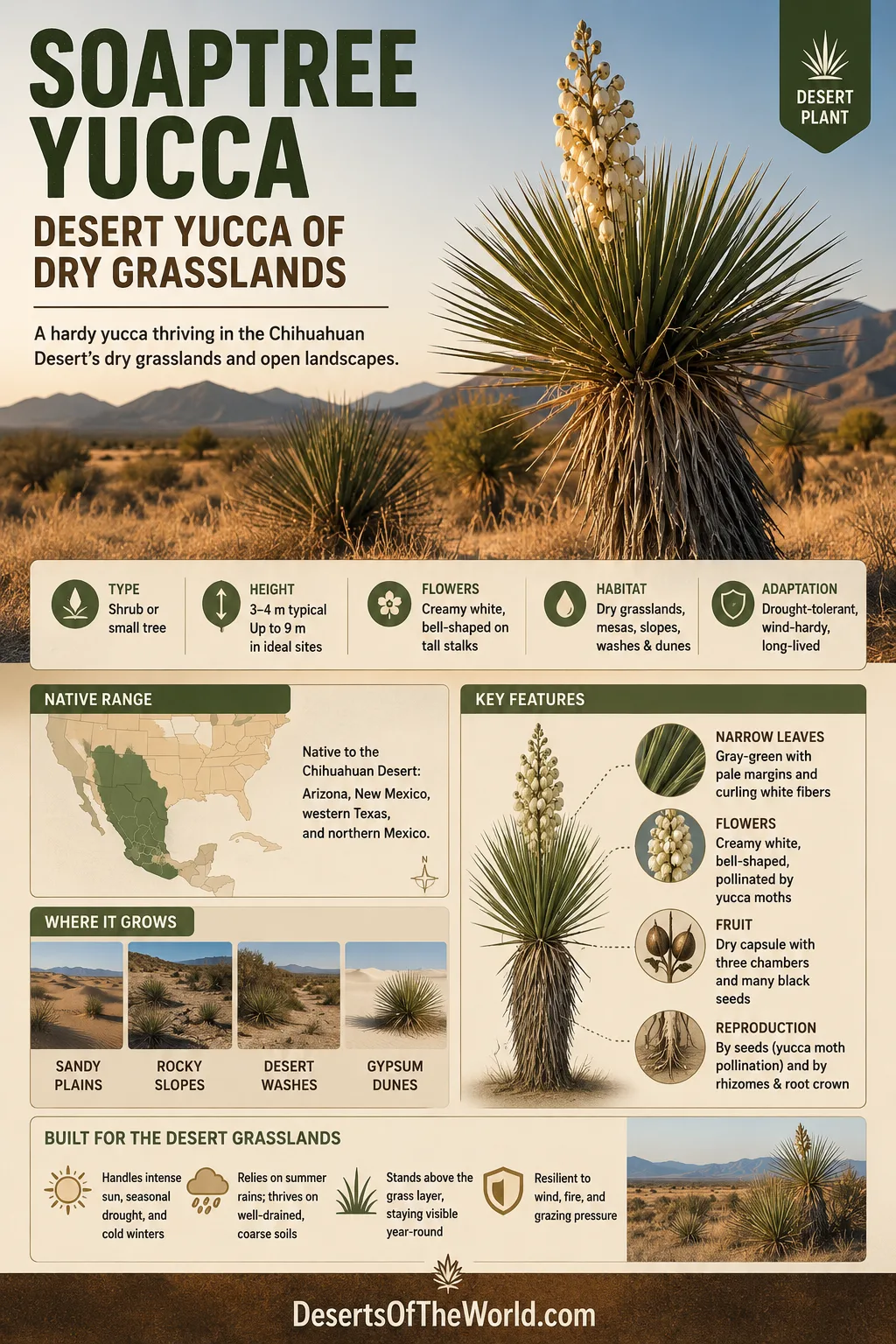
Yucca elata, widely known as soaptree yucca, rises above the open ground of the Chihuahuan Desert with a crown of narrow leaves and a trunk wrapped in dry foliage. Its strongest association is with semidesert grassland: broad plains where summer rain supports grasses, shrubs remain scattered, and exposed soil drains quickly after a storm.
The species also grows on sandy mesas, rocky slopes, desert washes, alluvial surfaces, and gypsum dunes. That range of settings explains why it can appear very different from one place to another. A modest plant among grasses in southern Arizona and a tall yucca emerging from White Sands may belong to the same species, yet they are responding to different soils, moisture patterns, wind exposure, and burial by sand.
| Feature | Soaptree Yucca Profile |
|---|---|
| Scientific Name | Yucca elata |
| Plant Family | Asparagaceae |
| Main Natural Setting | Chihuahuan Desert semidesert grasslands, dry shrublands, sandy plains, mesas, washes, and rocky slopes |
| Native Range | Arizona, New Mexico, western Texas, and northern Mexico |
| Usual Mature Form | Single-trunked or clump-forming shrub or small tree, often about 3–4 m tall in well-developed plants |
| Exceptional Height | About 9 m in unusually tall plants, including specimens growing through moving dunes |
| Leaves | Narrow, sharply pointed, gray-green to blue-green, with pale margins and curling white fibers |
| Flowers | Creamy white, bell-shaped, arranged on a tall branching stalk |
| Fruit | Dry, three-chambered capsule containing many thin black seeds |
| Main Reproductive Paths | Seed production through yucca moth pollination and vegetative sprouting from rhizomes and the root crown |
A Yucca of Desert Grasslands
Soaptree yucca is often introduced as a desert succulent, which is correct but incomplete. Much of its natural range lies in desert grassland, a dry ecosystem positioned between lower, hotter desert scrub and cooler grasslands at higher elevation. The ground may look open and sparse, yet grasses can cover large areas during favorable seasons.
This setting belongs mainly to the Chihuahuan Desert, the high-elevation desert centered on northern Mexico and extending into the southwestern United States. Winter frost, intense summer sun, dry spring weather, and summer rainfall can all occur within the same landscape. Soaptree yucca handles that seasonal swing without shedding its entire crown.
Where Desert and Grassland Meet
A semidesert grassland is neither a continuous prairie nor a bare sand desert. Grasses such as black grama and tobosa may share the terrain with mesquite, creosote bush, fourwing saltbush, cacti, and scattered yuccas. The mixture changes with elevation, soil depth, rainfall, fire history, and grazing pressure.
Soaptree yucca fits this mosaic because it can remain above the grass layer while keeping its long-lived growing points protected within a dense leaf rosette or below the soil. Its upright silhouette is especially visible after the grasses cure and turn pale.
Range across Southwestern North America
Kew recognizes Yucca elata as an accepted species native from Arizona across New Mexico to western Texas and south into northern Mexico. The central range includes parts of the Chihuahuan Desert and adjoining drylands. It also reaches areas commonly described as Sonoran Desert grassland or desert transition country.
Plant names can become less tidy near the edges of a range. Some older treatments included Utah and nearby areas within a broad concept of Yucca elata. Flora of North America separates Utah yucca as Yucca utahensis, while Kew lists two accepted varieties under Y. elata: the widespread typical variety and Y. elata var. verdiensis in Arizona. Location therefore matters when a plant is being identified from a field photograph.
Elevation, Soil, and Seasonal Rain
Soaptree yucca is commonly reported from roughly 457 to 1,828 m above sea level, though local records and taxonomic treatments vary. This elevation band places many populations above the hottest desert basins. Nights can be cool, winter freezes are possible, and summer rain often supplies a large part of the annual moisture.
The species favors coarse, well-drained ground. It occurs in gypsum sand, quartz sand, gravelly alluvium, rocky slopes, and soils formed from igneous material. It does not require one mineral type. Drainage and open exposure matter more than a single soil label.
The Jornada Experimental Range in southern New Mexico offers a useful climate example for soaptree yucca–black grama country. Long-term figures cited in the U.S. Forest Service species account give about 215 mm of precipitation per year, with roughly 64 percent falling from May through September. Those figures describe one research landscape, not the entire distribution, but they show the strong role of warm-season rain.
How to Recognize Soaptree Yucca
Identification is easiest when several traits are read together. Height alone can mislead, and a young soaptree yucca may resemble a large clump of stiff grass. The narrow leaves, white marginal fibers, dry-leaf covering, flower structure, fruit type, and geographic setting form a more dependable combination.
A Trunk Wrapped in Old Leaves
Mature plants often develop one upright trunk, though several stems may rise from a shared underground system. The stem is usually hidden behind old leaves that turn brown, point downward, and remain attached for years. This dry covering creates a shaggy column beneath the living crown.
The retained leaves are more than visual debris. They shield part of the stem from direct sun, cold air, and brief heat exposure. During a low-severity grassland fire, the layers around the stem may also slow heat transfer into living tissue, although the same dry material can burn when flames reach the crown.
Narrow Leaves and White Fibers
The leaves usually measure about 0.6–1 m long. They are slender for a tree-forming yucca, often flexible rather than heavily rigid, and end in a sharp point. Their color ranges from gray-green to blue-green depending on light, age, dust, and moisture.
The best field mark is the leaf edge. A pale margin peels into fine white threads that curl around the rosette and collect near the stem. Big Bend National Park uses these white margins and fibers as a practical way to separate soaptree yucca from nearby species with thicker, stiffer leaves.
Flower Stalk, Blossoms, and Seed Capsules
A mature rosette sends a branching flower stalk from its center, often rising 1.2–1.8 m above the leaves. Dozens of creamy white, bell-shaped flowers hang along the branches. Some blossoms show a faint green or pink cast, especially as they age.
Pollinated flowers develop into dry, woody capsules divided into three chambers. A capsule may hold around 150 thin black seeds. When mature, it opens and releases seeds that can be moved by wind across open ground.
The flower stalk should not be confused with the permanent trunk. It is a seasonal reproductive structure. After fruiting, the stalk dries while the rosette remains alive and can flower again in another favorable year.
Field Comparison with Similar Yuccas
| Species | Useful Field Marks | Typical Setting |
|---|---|---|
| Yucca elata Soaptree yucca | Narrow leaves, white margins, loose curling fibers, often a tall trunk covered by old leaves, dry seed capsules | Chihuahuan Desert grasslands, sandy plains, washes, mesas, dunes, and rocky slopes |
| Yucca torreyi Torrey yucca | Broader, thicker, more rigid leaves; coarse crown; often branched with age | Chihuahuan Desert scrub, rocky plains, slopes, and canyons |
| Yucca baccata Banana yucca | Broad, concave leaves and a thick, fleshy fruit; usually shorter-stemmed | Rocky desert, pinyon-juniper margins, mesas, and canyon country |
| Yucca glauca Soapweed yucca | Narrow fibrous leaves but usually stemless or short-stemmed; forms low colonies | Great Plains and dry prairie farther north and east |
| Yucca brevifolia Joshua tree | Strongly branched tree form with shorter, thick, rigid leaves | Mojave Desert |
Young plants remain harder to separate because they have not formed a trunk or fruit. In that stage, leaf width, edge fibers, local range, and nearby mature plants carry more weight than height.
Growth Above and Below Ground
The visible trunk tells only part of the plant’s history. Soaptree yucca invests heavily below ground, where a descending rhizome, root crown, lateral roots, and protected buds support long-term survival.
The Deep Vertical Rhizome
Most rhizomes are imagined as horizontal stems spreading near the surface. Soaptree yucca is unusual because its main rhizome grows downward before producing lateral extensions. The U.S. Forest Service account describes vertical rhizomes commonly reaching about 1–1.5 m deep and 8–15 cm thick.
This structure should not be reduced to a simple claim that the plant has a deep taproot. A rhizome is a stem with growing points. It stores living tissue below the reach of many surface stresses and can produce new shoots after the original crown is damaged.
Why Several Trunks May Be One Plant
Multiple stems often arise from the same rhizome system. What looks like a small group of separate yuccas may be a single clone with several crowns. This vegetative growth gives the plant another route to persistence when seedling establishment fails.
Sprouts can emerge from the rhizome, the root crown, or undamaged portions of a stem. A clump may therefore record several episodes of injury and recovery. The oldest visible trunk is not always the oldest living part of the organism.
Slow Growth and Long Persistence
Soaptree yucca grows slowly in dry ground. Years with favorable summer rain may produce stronger leaf growth, while dry periods leave shorter annual increments. Old leaves remain attached for three to five years in observations summarized by the Forest Service, creating a layered record around the stem.
Exact age is difficult to read because trunks do not provide clear annual rings and old crowns can be replaced by sprouts. Very large plants may persist for many decades, and some park interpretations describe exceptional specimens as centuries old. Such estimates apply to unusually old individuals rather than every tall yucca.
The Seasonal Cycle of Leaves, Flowers, and Seeds
The plant stays green throughout the year, yet its active growth follows seasonal water and temperature patterns. In southern parts of the range, spring warmth begins the reproductive season before the main summer rains arrive.
Summer Leaf Growth
Studies from the Jornada Experimental Range found new leaf production beginning in May and June and continuing through summer. The fastest elongation occurred late in July during the warm-season growth period. New leaves first stand close to the stem, then angle outward as they age.
This changing geometry keeps the youngest tissue deep within the crown. Older leaves form the outer shield, while the central growing point remains surrounded by tightly packed blades.
Regional Flowering and Fruiting
Across Arizona, New Mexico, and Texas, records summarized by the Forest Service place flowering mainly between mid-May and mid-July. Fruit commonly ripens from August into early October, followed by seed release in September and October. Elevation, local rainfall, temperature, and plant condition can shift these dates.
A dry year may produce fewer flower stalks, and animals may eat part of the floral display before capsules form. A field full of mature yuccas can therefore show uneven flowering even when the plants appear healthy.
The Yucca Moth Partnership
Soaptree yucca depends on specialized yucca moths for successful seed production. This is active pollination: the female moth deliberately gathers pollen and places it on the receptive part of another yucca flower.
How the Female Moth Pollinates
- The female moth visits the anthers and scrapes pollen into a compact mass.
- Special tentacle-like mouthparts hold the pollen beneath her head.
- She moves to a suitable flower, often on another plant.
- She lays a small number of eggs in the ovary.
- She then presses pollen onto the stigma, allowing seeds to develop.
The moth’s larvae later eat some of those developing seeds. The plant still retains enough seeds for reproduction when the relationship remains balanced. Adult yucca moths are short-lived, and their emergence is timed closely with yucca flowering.
Fruit Abortion Limits Seed Loss
A flower receiving too many moth eggs may be dropped before the fruit matures. This selective abortion removes the larvae inside that fruit and prevents an overloaded capsule from consuming more plant resources. Research on Yucca elata found that this process helps regulate the cost of the moth relationship.
The interaction is therefore more exact than the common description of a moth merely visiting a flower. Pollination, egg laying, larval feeding, and fruit retention are tied together within the same reproductive event.
Many Seeds, Few Established Seedlings
A mature capsule can release many windblown seeds, yet new seedlings remain uncommon in many populations. Germination needs enough soil moisture, and a young plant must survive heat, drying winds, unstable soil, and competition before its underground system becomes well developed.
Research summaries suggest that nearby shrubs may sometimes create a more favorable seedling site by reducing exposure and improving short-term moisture conditions. Even with that help, clonal sprouting is often a more dependable path than seed establishment.
How Soaptree Yucca Handles Dry Conditions
Soaptree yucca survives drought through several linked traits rather than one hidden water reservoir. Its leaf crown, protected growing points, coarse-soil preference, long-lived underground stem, and ability to pause visible growth all contribute.
A Leaf Crown Built for Exposure
The narrow leaves present less broad surface area to direct midday sun than wide, flat leaves would. Their upright and outward angles distribute light through the rosette. The tough surface withstands wind-driven grit, and the pointed tips remain a defining feature of the genus.
Rain running along the leaves can reach the center and the soil near the base. The effect is brief in a desert storm, yet water arriving close to the root crown is useful on ground where runoff and evaporation begin quickly.
Living Buds Above and Below the Soil
The central growing point is enclosed by younger leaves. Additional buds remain protected on the root crown and rhizome. If drought or surface damage ends growth in one crown, another bud may later produce a replacement shoot.
This explains why the plant can appear inactive for a long period and then send up new growth after favorable moisture returns. Persistence is often more important than speed in semidesert grassland.
White Sands and the Moving Gypsum Dunes
White Sands National Park presents the most unusual form of soaptree yucca growth. The plant is rooted in the Chihuahuan Desert floor while gypsum sand rises and moves around it. The tall plants visible above the dunes may have much of their stem buried below the surface.
When the Ground Rises Around the Plant
Wind pushes gypsum grains into dunes that migrate across the basin. Research described by the National Park Service found young dunes near the upwind margin moving as much as about 6 m in a year, while larger dunes farther downwind often move more slowly.
A fixed plant faces two problems: burial on the advancing side and loss of support after the dune passes. Soaptree yucca responds to burial by elongating its stem, keeping the living rosette in sunlight above the sand.
Growing Upward Through the Dune
White Sands identifies soaptree yucca as the local plant that uses stem elongation to remain above moving dunes. In this setting, a yucca can reach about 9 m from its rooted base to the crown, though much of that length may remain hidden inside the dune.
This figure should not be treated as the normal visible height throughout the species’ range. It reflects a special response to repeated sand accumulation. On stable desert grassland, the same species usually develops a much shorter exposed trunk.
After the Dune Moves On
When the dune leaves, the elongated stem loses the support once supplied by packed sand. It may lean or fall. New side shoots can then emerge from the fallen stem or the underground system, turning one tall crown into a spreading cluster.
White Sands therefore shows two sides of the plant’s growth strategy: vertical extension while sand accumulates and vegetative renewal after the support disappears.
Fire in Semidesert Grassland
Grassland fire can scorch leaves, damage the crown, or kill the exposed stem. Soaptree yucca is neither untouched by fire nor dependent on complete escape. Its response changes with flame intensity, season, fuel load, plant size, and the interval between burns.
What Happens Above Ground
Fire often kills the top of the plant. The most sensitive point is the apical meristem, the growing region at the center of the crown. Two low-severity spring-fire studies in southeastern Arizona recorded about 25 and 27 percent mortality several months after burning.
Living and dead leaves around the trunk can insulate conductive tissue for a short period. The dense terminal rosette also shields the central bud. Protection has limits, especially where flames remain around the crown or repeated burns reach young regrowth.
Recovery from Rhizomes and the Root Crown
When the original stem is lost, new shoots may rise from belowground meristems. Undamaged stems can resume growth, and a partly injured crown may branch. In field studies, vegetative recovery was far more common than recovery from new seedlings.
Soaptree yucca is therefore best described as a fire tolerator with several recovery routes. A burn may reduce the number of visible stems for a time while leaving the underground organism alive.
Why Fire Frequency Changes Yucca Density
Fire suppression can allow soaptree yucca and other woody or succulent plants to become denser in some grasslands. Regular fire may retain the species while keeping fewer tall stems on the landscape. Very frequent fire, or severe fire during years with heavy grass fuel, can reduce recovery.
Plant presence alone does not reveal the local fire history. Stem height, clump size, the amount of grass between plants, and evidence of recent sprouting provide better context.
A Plant within a Dry Grassland Community
Soaptree yucca changes the structure of an otherwise low landscape. Its flowers, seeds, leaves, shade, dry stalks, and upright stems create resources that remain available at different times of year.
Flowers, Seeds, and Shelter
Yucca moths have the closest reproductive link, though many other animals visit or feed on the plant. Forest Service records describe mule deer, pronghorn, black-tailed jackrabbits, woodrats, and livestock eating flower stalks or other fresh growth. At White Sands, the plant is also listed as a food source for the Apache pocket mouse.
Old flower stalks can persist after seed release and may be used by native bees. Dense crowns and clusters of stems also create small shaded spaces in terrain where low cover dominates.
Does the Yucca Stabilize Sand?
The relationship between soaptree yucca and moving sand differs by site. Early studies of mesquite dunes described the yucca as a secondary colonizer that established after terrain or shrubs had begun to stabilize the surface. Later work in New Mexico reported sand mounds forming around the yucca itself.
Both patterns can occur. A mature crown and trunk slow near-ground wind and trap grains, while a seedling may still need a relatively stable patch to survive. Wind direction, sand supply, plant size, and neighboring vegetation determine whether the yucca follows stability or helps create it.
What Yucca Density Says About the Landscape
A field with many soaptree yuccas is not automatically healthier or more degraded than a field with fewer plants. Density can rise where fire becomes less frequent, where grasses thin, or where clonal expansion continues for a long period. It can also remain naturally high on coarse sandy ground.
Landscape condition must be read from the full plant community: perennial grass cover, bare-soil pattern, shrub density, erosion, seedling recruitment, and the age structure of yucca clumps. The species is one part of that evidence, not a stand-alone score.
Why the Plant Is Called Soaptree
The common name comes from saponin-rich tissue in the roots and trunk. When processed in water, these compounds produce foam, and Indigenous communities of the American Southwest used yucca preparations for washing hair, textiles, blankets, and other materials.
Leaf Fibers as Working Material
The leaves contain long fibers that remain strong after the softer tissue is removed. Different communities used yucca fiber for cordage, rope, baskets, mats, sandals, cloth, and other woven items. The curling threads seen along a living leaf hint at the fibrous structure running through the blade.
These uses varied by community, place, and preparation method. They should not be compressed into the claim that every group used every part in the same way.
Flowers and Young Stalks in Food Traditions
Historical and ethnobotanical records describe the preparation of flowers, buds, young stalks, and selected inner tissues as food. Preparation mattered, and the edible portions were not the same as the saponin-rich material used for washing.
The plant is best understood here as an ecological and cultural species rather than a casual foraging subject.
Botanical Identity and Naming
Yucca elata belongs to the asparagus family, Asparagaceae, within the agave subfamily. Older publications may place yuccas in Agavaceae or Liliaceae because plant-family boundaries changed as botanical classification developed.
The English names soaptree yucca, soap-tree yucca, and soapweed yucca can all appear in field literature. “Soapweed” can also refer to Yucca glauca, so the scientific name prevents confusion.
Yucca is also different from yuca, the Spanish-derived food name commonly used for cassava (Manihot esculenta). Cassava is a tropical root crop in another plant family. The similar spelling does not indicate a close botanical relationship.
What Soaptree Yucca Reveals About Its Desert
A soaptree yucca landscape usually contains more ecological variety than the word “desert” suggests. Open grass, patches of bare mineral soil, summer storm tracks, winter cold, coarse sediment, and scattered shrubs can occupy the same view.
The plant’s form records those conditions. A short, dense clump may reflect repeated sprouting. A tall trunk covered with old leaves suggests long surface stability. A leaning plant may have lost dune support. Fresh basal shoots can follow fire or stem damage. Flower capsules show that moth pollination and seed development occurred during a recent season.
At stable sites, soaptree yucca stands above the grassland for decades. At White Sands, it lengthens through mobile gypsum and may fall when the dune leaves. Across both settings, the living system extends farther below ground than the visible crown suggests.
Sources
- Kew Science — Yucca elata (accepted name, family, native distribution, synonyms, and accepted varieties)
- U.S. Forest Service Fire Effects Information System — Yucca elata (morphology, rhizomes, reproduction, habitat, seasonal growth, fire response, and grassland ecology)
- University of Arizona Campus Arboretum — Soaptree Yucca (field traits, elevation, flowers, capsules, pollination, and traditional materials)
- White Sands National Park — Plant Survival Strategies (stem elongation, dune burial, maximum height, collapse, and side-shoot renewal)
- National Park Service — White Sands Dune-Field Pattern (measured dune growth, movement, and downwind changes)
- U.S. Forest Service — Yucca Moths (active pollen collection, egg laying, larval development, and moth timing)
- Flora of North America — Yucca elata (botanical description and taxonomic treatment)
- New Mexico State University Jornada Research — Fruit Abortion in Yucca elata (research on fruit retention and the yucca moth relationship)