
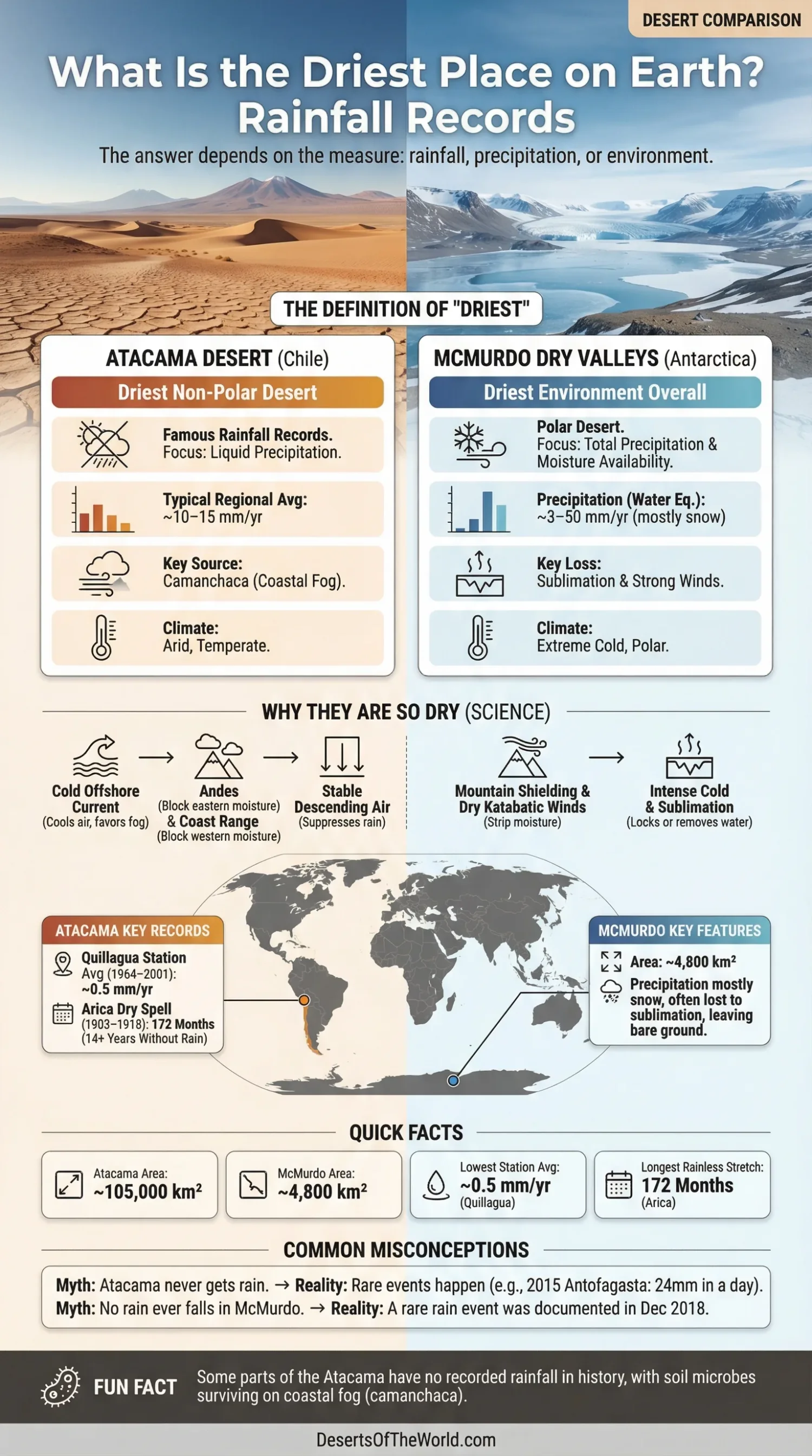
What is the driest place on Earth? The most accurate answer depends on what you are measuring. If you mean the driest environment overall, scientists usually point to the McMurdo Dry Valleys in Antarctica. If you mean the driest non-polar desert and the place most often linked to rainfall records, the answer is the Atacama Desert in Chile. And when the focus turns to station data, places such as Quillagua and Arica stand out for astonishingly low rainfall totals.
| Measure | Place | What the Record Shows |
|---|---|---|
| Driest Environment Overall | McMurdo Dry Valleys, Antarctica | Often treated as Earth’s driest environment when total precipitation and moisture availability are considered |
| Driest Non-Polar Desert | Atacama Desert, Chile | Usually cited as the driest non-polar desert on Earth |
| Lowest Widely Cited Station Average | Quillagua, Chile | 0.5 mm average annual rainfall for 1964–2001 |
| Longest Verified Dry Spell | Arica, Chile | 172 months without rain, from October 1903 to January 1918 |
Why the Answer Depends on the Measure
People often ask this as if there must be one winner. There usually is not. A desert can be measured by rainfall, by total precipitation, by how often liquid water appears, or by how dry the ground stays over long periods. Change the measure, and the leading place can change with it.
That is why the Atacama and the McMurdo Dry Valleys both appear in serious discussions of this question. The Atacama dominates most rainfall conversations. The Dry Valleys dominate the more absolute version of dryness, especially when polar deserts are included.
The Atacama Desert and Its Rainfall Records
The Atacama Desert runs for about 1,000 kilometers along the Pacific side of Peru and Chile and covers roughly 105,000 square kilometers. On a desert-wide scale, it is usually described as receiving around 10 to 15 mm of precipitation a year. That number already sounds tiny. Locally, the figures drop much further.
Station Records That Made the Atacama Famous
The most quoted long-term station record belongs to Quillagua, a small settlement in northern Chile. Its meteorological station averaged only 0.5 mm of rain per year over the 1964–2001 period. That is not “very dry.” It is almost absence.
Arica is another name that appears again and again in rainfall records. It is often cited with an annual average near 0.76 mm. Even more striking, Arica went 172 months without rain, from October 1903 to January 1918. More than fourteen years. One dry season after another.
Then there is the deeper Atacama story. In some sectors of the desert, rain is so rare that it is described as arriving only a few times in a century. Some observational records also note places where rainfall has never been recorded at all. So when people call the Atacama the driest place on Earth, they are not just reaching for a dramatic phrase. They are reacting to numbers that are almost hard to picture.
Why the Atacama Is So Dry
The Atacama is dry for several reasons, and they reinforce one another.
- The cold offshore current cools the lower atmosphere and favors fog more than rain.
- The Andes block moisture from the east.
- The Chilean Coast Range helps block moisture from the west.
- Stable descending air limits cloud growth and suppresses rainfall.
Together, these controls leave the Atacama in a kind of atmospheric shelter. Moisture can be present, but often as camanchaca, the coastal fog, not as ordinary rain. That detail matters. A place can feel dry beyond words and still gather a faint trace of moisture from the air.
Rare Rain Still Happens
Rainfall records can trick readers into thinking the Atacama never gets rain. It does, though rarely and unevenly. A good example came in 2015, when NASA reported that Antofagasta received 24 mm of rain in a single day, while its normal yearly average is about 1.7 mm. One day delivered about fourteen years’ worth of rain.
That does not weaken the Atacama’s dry reputation. It shows something more useful: climate is a long-term pattern, not a single storm. A rare wet event can happen in a desert that stays among the driest places on Earth.
The McMurdo Dry Valleys in Antarctica
If the question is expanded beyond rainfall alone, the McMurdo Dry Valleys enter the conversation immediately. This ice-free region of Antarctica covers about 4,800 square kilometers and is often treated as Earth’s driest environment overall.
Here the comparison changes a little, because researchers usually discuss precipitation rather than rainfall alone. In the Dry Valleys, precipitation falls almost entirely as snow, and review studies describe values of roughly 3 to 50 mm water equivalent per year in parts of the region. Much of that does not remain available to plants, soil, or surface water. It sublimates, blows away, or stays locked in frozen forms.
Why Scientists Often Put the Dry Valleys First
The Dry Valleys are sheltered by mountain barriers and shaped by strong downslope winds. Those winds strip away snow and moisture. The landscape stays bare, cold, and stark. Not much falls from the sky, and even less lingers in a usable way.
That is why many scientific descriptions rank the Dry Valleys ahead of the Atacama in the strictest sense. They are not just dry. They are dry while also being cold enough to hold water away from ordinary surface life for long stretches.
Even Here, Absolutes Can Mislead
Older popular explanations sometimes make the Dry Valleys sound as if no rain ever falls there. The real picture is tighter and more interesting. Long-term research programs have even documented a rare rain event in Taylor Valley in December 2018. So the place is not defined by a magical rule of “never.” It is defined by extreme rarity.
That distinction matters, especially in an article about rainfall records. The driest places on Earth are not places where weather stops. They are places where moisture arrives so rarely, and stays so briefly, that the land seems built for absence.
Atacama vs. McMurdo Dry Valleys
| Feature | Atacama Desert | McMurdo Dry Valleys |
|---|---|---|
| Setting | Coastal desert in western South America | Polar desert in Antarctica |
| Usual Label | Driest non-polar desert | Driest environment overall |
| Typical Moisture Form | Rare rain, coastal fog | Very low snowfall, sublimation, frozen moisture |
| Famous Record | Quillagua 0.5 mm annual average; Arica 172 rainless months | Exceptionally low precipitation and minimal available liquid water |
| Why It Stays Dry | Cold current, double rain shadow, stable descending air | Mountain shielding, dry winds, intense cold, sublimation |
So What Is the Driest Place on Earth?
If you want one short answer for rainfall records, say the Atacama Desert. That is the name most readers expect, and it is backed by famous station records from Quillagua and Arica.
If you want the strictest full-Earth answer, say the McMurdo Dry Valleys. That is the better choice when polar deserts are included and when total precipitation and moisture availability matter more than rain alone.
Put simply:
- Lowest famous rainfall records: Atacama Desert
- Driest non-polar desert: Atacama Desert
- Driest environment overall: McMurdo Dry Valleys
- Most quoted station record: Quillagua, Chile
- Longest verified rainless stretch: Arica, Chile
Why Rainfall Records Need Context
A single number can flatten a complicated landscape. A station total is not the same as a desert-wide average. Rainfall is not the same as total precipitation. A hot desert and a polar desert do not hold or lose moisture in the same way. And a rare storm does not erase a place’s long dry history.
That is why the most careful answer is also the most useful one: the Atacama owns the famous rainfall records, while the McMurdo Dry Valleys push dryness to its furthest limit.
Sources
- Guinness World Records: Driest Place (Quillagua station record and note on Arica’s dry spell)
- Guinness World Records: Driest Desert (Atacama average rainfall, Arica and Quillagua figures, comparison with Antarctica)
- World Meteorological Organization: Drought (official note on the 172-month dry period in Arica)
- NASA JPL: Detecting Life in the Ultra-dry Atacama Desert (Atacama as the driest non-polar desert)
- ESA: The Atacama Desert, Chile (rainfall rarity, fog moisture, and Atacama climate setting)
- NASA Earth Observatory: Flooding in the Chilean Desert (rare 2015 rainfall event and Antofagasta rainfall comparison)
- McMurdo Dry Valleys LTER (official research overview of the Dry Valleys and their Antarctic setting)
- NSF Public Access Repository: The McMurdo Dry Valleys of Antarctica (peer-reviewed discussion of Dry Valleys precipitation and comparison with Atacama)
- McMurdo Dry Valleys LTER: December 2018 Rain Event (evidence that liquid rain, while extremely rare, has been documented in the Dry Valleys)