
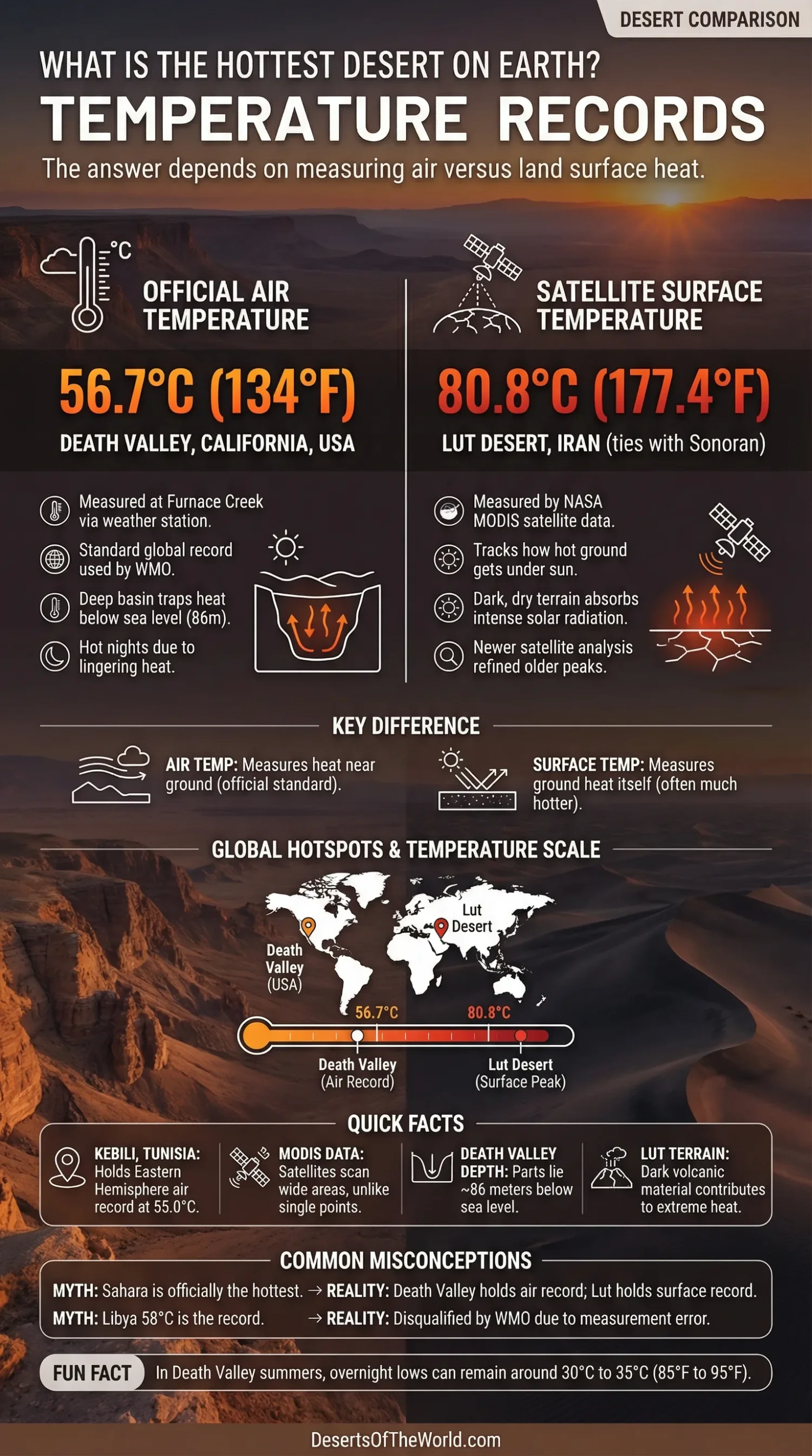
The hottest desert on Earth depends on the yardstick. By the official weather-station standard for air temperature, Death Valley in California holds the standing world mark at 56.7°C (134°F), measured at Furnace Creek on July 10, 1913. By satellite-measured ground heat, the story shifts to Iran’s Lut Desert, where NASA’s MODIS data recorded 70.7°C (159.3°F) in 2005, and later work found an even higher land-surface reading of 80.8°C (177.4°F) in both the Lut and Sonoran deserts. So the cleanest single answer for an official air-temperature record is Death Valley. For surface heat on desert ground, the Lut Desert sits right at the heart of the record discussion.
| Record Type | Desert Or Location | Top Reading | How It Was Measured | Why It Matters |
|---|---|---|---|---|
| Official World Air Temperature Record | Death Valley, California, USA | 56.7°C (134°F) | Weather station air temperature | This is the standing global record used in formal weather archives. |
| Earlier Landmark Desert Surface Record | Lut Desert, Iran | 70.7°C (159.3°F) | NASA MODIS land-surface temperature | This made the Lut Desert widely known as the hottest desert surface on Earth. |
| Updated Satellite Surface Peak | Lut Desert, Iran, and Sonoran Desert, Mexico | 80.8°C (177.4°F) | Newer MODIS-based land-surface analysis | This shows how satellite methods can refine older estimates. |
| Eastern Hemisphere Air Temperature Record | Kebili, Tunisia, within the Sahara region | 55.0°C (131°F) | Weather station air temperature | This helps explain why the Sahara is often brought into the debate. |
Why the Answer Changes With the Measurement
People often ask one simple question: what is the hottest desert on Earth? The trouble is that meteorology and remote sensing do not measure heat in the same way.
- Air temperature tracks how hot the air is near the ground. This is the number used for official weather records.
- Land-surface temperature tracks how hot the ground itself becomes under the sun.
- In deserts, the ground can run much hotter than the air above it. By a lot.
That is why two deserts can lead two different record lists without any contradiction. One tops the formal air-temperature archive. Another tops the ground-heat record from satellites.
Death Valley And the Official Air Temperature Record
For the formal record book, the answer points to Death Valley. WMO’s archive lists Furnace Creek in Death Valley as the site of the highest air temperature officially recognized worldwide: 56.7°C (134°F).
That number has lasted because it sits inside the weather-station record system, which is the standard used for global extremes. Other hot readings have come close, and some newer ones have made headlines, but the standing world mark remains the one from Furnace Creek.
Why Death Valley Gets So Hot
Death Valley’s shape does much of the work. It is a long basin, and parts of it lie 282 feet (86 meters) below sea level. High mountain walls hem it in. Sunlight heats the rocky ground, the ground sends that heat back into the air, and the basin traps the warmth instead of letting it mix out quickly.
The nights stay hot too. In summer, overnight lows can remain around 30°C to 35°C (85°F to 95°F). Rare is the desert where the heat lingers that stubbornly after sunset.
This is one reason Death Valley is the safest answer when the question is framed around official temperature records rather than satellite heat on bare soil.
Lut Desert And the Surface Temperature Record
Switch from air to ground, and the picture changes fast. The Lut Desert in southeastern Iran is one of the fiercest heat landscapes on the planet. NASA’s earlier MODIS analysis found that the Lut held the highest surface temperature on Earth in five of seven studied years, with a peak of 70.7°C (159.3°F) in 2005.
That result mattered because it moved the conversation away from weather stations alone. Deserts are not uniform. A weather station tells you about the air at one point. A satellite can scan wide, hard-to-reach desert surfaces and catch the hottest patches directly.
Why the Lut Desert Heats So Aggressively
The Lut has a few traits that push it toward the top of any heat list:
- Dark, heat-absorbing surfaces in parts of the desert, including terrain affected by volcanic material
- Very dry conditions
- Broad open ground that receives intense solar heating
- Terrain that can limit air movement in some zones
UNESCO also notes that the Lut property often experiences Earth’s highest land-surface temperatures. So even without stretching the claim, the desert clearly belongs among the hottest places ever measured.
What Newer Satellite Work Added
Later MODIS-based analysis pushed the discussion further. Using a longer period and improved surface-temperature estimates, researchers found 80.8°C (177.4°F) in the Lut Desert and the Sonoran Desert. That update does not weaken the Lut’s reputation. It sharpens it.
The older headline was that the Lut was the hottest surface measured from space. The newer picture is slightly more nuanced: the Lut still ranks at the very top, but it now shares the peak surface figure in at least one updated global analysis.
Where the Sahara Fits In
Many readers expect the Sahara to be the answer. That is understandable. It is the world’s largest hot desert, and it produces brutal summer heat across a huge area. Still, the Sahara is not the cleanest record-based answer to this question.
Here is why:
- The standing world air-temperature record belongs to Death Valley, not the Sahara.
- The best-known surface-temperature records point to the Lut Desert, and later to a Lut–Sonoran tie in satellite analysis.
- The Sahara still appears in the record conversation through Kebili, Tunisia, which holds WMO’s Eastern Hemisphere air-temperature record at 55.0°C (131°F).
So the Sahara is part of the story, just not the final answer most readers are looking for.
Why Older “Hottest Ever” Claims Can Be Misleading
One source of confusion is the old Libya reading of 58°C (136.4°F) from El Azizia, often repeated in older books and articles. That value was later thrown out after WMO review. The investigation found problems with the observation and its setup, so it no longer stands as the world record.
That matters because plenty of outdated pages still recycle it. Once that Libya figure was removed, the accepted top air-temperature record shifted back to Death Valley.
How Scientists Check Desert Temperature Records
Record heat is not accepted just because a number looks dramatic. WMO reviews the observation process itself. That can include:
- the station location
- the instrument used
- calibration and maintenance
- observation practices
- how the reading compares with nearby stations
- whether the site reflects the local ground conditions fairly
This is why record lists change only rarely. And when they do, the change usually comes after a long technical review, not a quick headline cycle.
Which Desert Deserves the Title
For a plain-language answer built on temperature records, it helps to separate the titles cleanly.
- Hottest Desert By Official Air Temperature Record: Death Valley
- Hottest Desert By Satellite-Measured Surface Heat: Lut Desert (with newer analysis also finding a tie with the Sonoran Desert)
That split may sound picky at first, but it is the only way to answer the question without mixing two different kinds of heat. And once that distinction is clear, the record map makes sense.
Sources
- World Meteorological Organization — Records of Weather and Climate Extremes (official table listing the standing world air-temperature record and regional heat records)
- NASA Earth Observatory — The Hottest Spot on Earth (explains the difference between air temperature and land-surface temperature and details the Lut Desert’s 70.7°C reading)
- NASA Science — Iran’s Lut Desert (describes why the Lut heats so intensely and notes the newer 80.8°C satellite-based surface reading)
- NASA MODIS Web — Satellite-Based Analysis of Extreme Land Surface Temperatures Across the Hottest Place on Earth (research summary for the updated Lut Desert surface-temperature study)
- UNESCO World Heritage Centre — Lut Desert (official overview of the Lut Desert and its extreme land-surface heat)
- U.S. National Park Service — Weather and Climate in Death Valley (explains why Death Valley becomes so hot and why nights stay warm)
- World Meteorological Organization — WMO Archive of Weather and Climate Extremes (explains how heat records are reviewed and why the old Libya 58°C claim was rejected)