
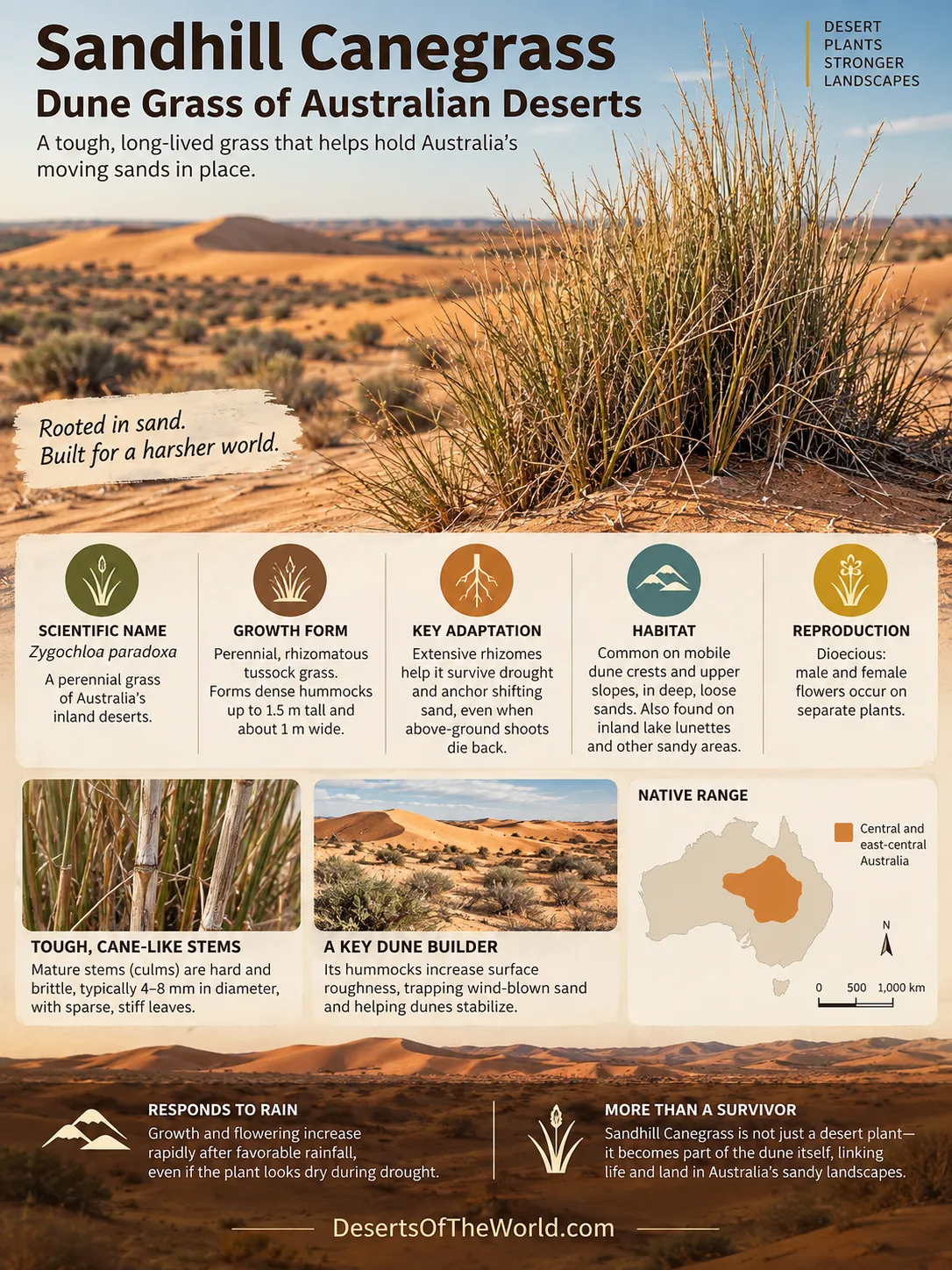
Sandhill Canegrass (Zygochloa paradoxa) is a perennial grass of inland Australia that is closely associated with loose desert sand. It forms tough hummocks on dune crests and upper slopes, where its rhizomes and dense stems help hold wind-moved sand in place. In the Simpson Desert and other inland dunefields, this gives the plant a role that goes beyond simply surviving drought: it becomes part of the physical structure of the dune itself.
The species is especially useful for understanding how vegetation changes across Australian desert dunes. Canegrass often occupies exposed sandy ridges, while spinifex and other plants become more prominent farther down the slopes and across interdune country. Its growth also changes sharply with rainfall, so a dry-looking canegrass hummock can respond rapidly when favorable rain returns.
Sandhill Canegrass Species Profile
| Feature | Sandhill Canegrass |
|---|---|
| Scientific name | Zygochloa paradoxa |
| Family | Poaceae |
| Growth form | Perennial, rhizomatous tussock or hummock grass |
| Typical height | Up to about 1.5 m |
| Typical hummock width | Up to about 1 m in botanical descriptions |
| Main habitat | Sand dunes, mobile dune crests, loose upper slopes and inland lake lunettes |
| Native range | Central and east-central Australia |
| Reproductive system | Dioecious: male and female flowers occur on separate plants |
| Rain response | Growth and flowering respond strongly to rainfall |
| Ecological role | Sand binding, dune-surface roughness and habitat structure |
Royal Botanic Gardens Kew currently accepts Zygochloa paradoxa as the valid name and lists it as native to New South Wales, Queensland, South Australia and the Northern Territory. The plant belongs to the grass family, but its thick, hard culms and large hummock form can make it look more shrub-like than many familiar grasses.
A Grass Adapted to Moving Desert Sand
Sandhill Canegrass is strongly associated with deep, loose sand. Queensland vegetation mapping records Zygochloa paradoxa grassland on mobile dune crests and sandy slopes with very deep white, yellow or red siliceous sands. These surfaces drain quickly and can remain exposed to wind movement between widely spaced plants.
This habitat places a plant under two different pressures. Water may disappear rapidly through porous sand, while wind can remove or redeposit the surface around its stems. Sandhill Canegrass deals with both through a persistent perennial growth form rather than relying only on short-lived above-ground growth.
Rhizomes Keep the Plant Anchored Beneath the Surface
The plant produces elongated rhizomes, underground or partly buried stems capable of supporting new shoots. These give a canegrass hummock a persistent structure beneath the shifting surface.
That distinction matters in a dune. An individual shoot can age or die back during dry conditions while the larger clone remains capable of renewed growth. Changes visible above the sand therefore do not always mean that the plant itself has disappeared.
Hard Culms Create a Dense Hummock
Mature culms are hard, brittle and commonly about 4–8 mm in diameter. Botanical descriptions record plants reaching about 1–1.5 m in height. Branching stems accumulate into an open but substantial clump rather than a soft lawn-like grass cover.
The leaves are comparatively sparse and stiff. Older blades can detach at their narrow junction with the sheath, leaving the strong culms as one of the most visible parts of an established plant.
Where Canegrass Grows on Australian Desert Dunes
One of the most useful ways to understand Sandhill Canegrass is to look at where it sits on a dune. Australian desert dunes are not uniform habitats. The crest, flank and interdune swale differ in sand movement, exposure, soil texture and vegetation.
Dune Crests Are a Characteristic Canegrass Habitat
Sandhill Canegrass is particularly associated with the crest and upper part of longitudinal dunes. Research from the Simpson Desert describes dune crests carrying Zygochloa paradoxa together with plants such as Acacia, Grevillea and Eremophila.
Queensland’s mapped regional ecosystem 5.6.8 places canegrass communities on mobile crests and loose sandy slopes of Quaternary dunes. Bare sand may remain visible between hummocks, especially during dry periods.
Vegetation Changes Down the Dune
Moving away from the crest can produce a clear vegetation transition. In parts of the Simpson Desert, Triodia basedowii, commonly called hard spinifex, dominates dune slopes or swales where canegrass is less prominent.
| Dune Position | Typical Conditions | Vegetation Pattern |
|---|---|---|
| Crest | Loose sand, high exposure, active surface movement | Sandhill Canegrass may be prominent with scattered shrubs and herbs |
| Upper slope | Deep sand with somewhat less crest exposure | Canegrass can continue down the slope, sometimes mixed with spinifex |
| Lower slope and swale | More sheltered position; local soil conditions differ from the crest | Triodia and other dune vegetation often become more prominent |
| Interdune country | May include sandy flats, clay-rich areas or drainage features | Plant communities can shift to shrubs, woodland or other grassland types |
This zonation is not identical on every dune. Rainfall history, sand texture, dune activity and local landform all influence the vegetation. Still, the association between Sandhill Canegrass and exposed sandy ridges is one of the clearest patterns across its desert habitat.
How Sandhill Canegrass Helps Stabilize Dunes
Sandhill Canegrass is widely described as an excellent sand binder. The effect comes from the interaction between the plant and moving sediment rather than from a single root acting like an anchor.
- Wind pushes loose grains across the dune surface.
- Canegrass culms interrupt airflow close to the ground.
- Some moving sand settles within and around the hummock.
- Rhizomes maintain a living structure beneath or within the accumulating sand.
- New shoots can enlarge the hummock when moisture conditions improve.
A vegetated dune surface is therefore rougher than uninterrupted bare sand. That roughness changes near-surface wind flow and reduces the ease with which sand can move through an occupied patch.
A 23-Year Dune Study Shows How Little Cover Can Matter
A long-running study near Menindee in western New South Wales followed a low Sandhill Canegrass dune for 23 years. Live and dead culms provided only about 5.0% to 19.9% areal cover during the observation period, with cover changing according to rainfall.
Despite that sparse cover and an extended four-year drought, researchers reported no major change in the dune profile from erosion during the study. Most changes in canegrass cover came from existing clones expanding or contracting rather than large swings in the number of individual plants.
The finding is useful because desert vegetation does not need to form a continuous green carpet to affect a dune. Widely separated perennial hummocks can still change surface roughness and intercept moving sand.
How Canegrass Responds to Drought and Rain
Sandhill Canegrass can remain associated with extremely dry sites, but its visible condition changes with rainfall. PlantNET describes the species as highly drought resistant and notes that it flowers in response to rain.
During Long Dry Periods
Above-ground growth can contract and culms can die back as dry conditions continue. A hummock may contain large amounts of old or dead material, while living parts persist within the clone.
This is better described as drought evasion through a perennial structure than as continuous lush growth under water shortage. The grass reduces its visible activity when conditions are poor.
After Effective Rainfall
When enough moisture reaches the dune, existing plants can produce fresh shoots and expand their green cover. Flowering may follow the rainfall response, and temporary herbs can also appear in the open sand between canegrass hummocks.
The result can be a sharp visual change across the same dune. A sparse crest during prolonged dry weather may support much more plant growth after a favorable rain period without changing into a permanently dense grassland.
Male and Female Canegrass Grow on Separate Plants
Sandhill Canegrass is dioecious. Individual plants produce either male or female inflorescences rather than carrying both types together.
The difference is visible when the grass is flowering. PlantNET describes both flower heads as roughly globular, but the female heads are usually larger.
| Feature | Male Plant | Female Plant |
|---|---|---|
| Flower-head shape | Globular | Globular |
| Approximate head diameter | 1–2 cm | 2.5–3.5 cm |
| Spikelets | Usually 6–8 mm long | Usually 6–10 mm long |
| Distinctive feature | Smaller compact heads | Prominent bracteoles with rigid, curved tips |
The female reproductive structures also contain modified bracts with curved, wing-like parts. Australian grass descriptions suggest that these structures assist dispersal after the reproductive unit separates from the plant.
Distribution Across Inland Australia
Kew describes the native range of Zygochloa paradoxa as central and east-central Australia, listing New South Wales, Northern Territory, Queensland and South Australia. Botanical records place it within several major inland dune landscapes rather than across Australia as a whole.
Simpson Desert
The Simpson Desert is one of the best-known habitats for Sandhill Canegrass. Its immense system of parallel red dunes provides the combination of deep sand, open crests and arid conditions associated with the species.
PlantNET specifically records it from the sandhills of the Simpson Desert. Modern ecological studies in western Queensland likewise identify canegrass among the plants of dune crests, while hard spinifex commonly occupies other dune positions.
Inland Lake Lunettes
The species is not restricted to the long linear dunes of large deserts. PlantNET also records it on lunettes around inland lakes.
A lunette is a crescent-shaped dune that develops on the downwind side of a lake basin or playa. These landforms can provide another setting with loose, wind-worked sediment suitable for a strong sand-binding perennial.
Other Central Australian Dunefields
Sandhill Canegrass also occurs in dune country connected with the Lake Eyre Basin and the broader Simpson–Strzelecki desert region. Its presence is especially associated with suitable sandy landforms rather than every part of the surrounding desert.
This distinction matters. A desert can contain gibber plains, clay pans, floodplains, salt lakes, channels, sand sheets and dunes within the same region. Sandhill Canegrass is a dune-associated specialist within that larger landscape.
Sandhill Canegrass and Spinifex Are Different Grasses
Sandhill Canegrass can be confused with Australian spinifex because both form persistent clumps in arid sandy country. They are not the same plant.
| Characteristic | Sandhill Canegrass | Hard Spinifex |
|---|---|---|
| Scientific name | Zygochloa paradoxa | Triodia basedowii |
| General form | Tall cane-like tussock or hummock | Dense, stiff hummock |
| Growth structure | Rhizomatous perennial | Perennial hummock grass |
| Common dune association | Especially exposed crests and loose upper slopes | Often widespread on dune flanks, swales and sandy country |
| Appearance | Hard branching culms with sparse stiff leaves | Dense mass of narrow, rigid leaves |
There is also a taxonomic reason for occasional confusion. The name Spinifex paradoxus was once applied to Sandhill Canegrass. Kew now treats that name as a synonym of Zygochloa paradoxa. Modern Australian spinifex grasslands, by contrast, are usually associated with species of Triodia.
Canegrass Creates Structure on Exposed Dune Crests
A bare dune crest offers little vertical cover. A mature canegrass hummock changes that immediately. Its stems provide shelter close to the sand, intercept wind-blown material and create a more complex patch than the surrounding open surface.
Queensland’s regional ecosystem description for canegrass dune vegetation records associated plants including Triodia basedowii, Crotalaria eremaea, Acacia ligulata, Lechenaultia divaricata and several seasonal herbs. The amount of vegetation between hummocks can change greatly from one season to another.
Canegrass therefore does not create a single fixed plant community. It forms part of a desert system where perennial hummocks persist while smaller herbs and grasses respond more rapidly to rainfall.
Sandhill Canegrass and the Eyrean Grasswren
The Eyrean Grasswren (Amytornis goyderi) is one of the animals most closely associated with Sandhill Canegrass country. The bird inhabits inland Australian dunes and has often been recorded using canegrass hummocks for cover and habitat structure.
The connection became especially well known after observations in the Simpson Desert. Australian Museum records describe researchers locating Eyrean Grasswrens in 1977 on a dune where local rainfall had produced good stands of Sandhill Canegrass.
Yet the relationship is more flexible than older descriptions sometimes suggested. Surveys following above-average rainfall in 2020–2022 recorded Eyrean Grasswrens at sites in the Strzelecki Desert where Sandhill Canegrass was absent. Repeated observations showed birds persisting for at least 16 months in other temporary dune vegetation.
Sandhill Canegrass is a characteristic habitat component for the Eyrean Grasswren, but it should not be described as the only vegetation in which the bird can persist.
Queensland’s mapped canegrass dune ecosystem also identifies habitat value for other inland fauna, illustrating how a plant that changes the physical structure of a dune can influence more than the dune surface alone.
How to Recognize Sandhill Canegrass
Habitat is one of the strongest identification clues. A tall grass growing as a substantial hummock on a loose inland dune crest is a better candidate for Sandhill Canegrass than a similar-looking plant growing in a wet depression or dense grassland.
- Growth form: perennial tussock or hummock, often broad and strongly branched.
- Height: commonly capable of reaching about 1–1.5 m.
- Culms: hard, fairly thick and cane-like rather than soft and leafy.
- Leaves: sparse, stiff and prominently nerved.
- Rhizomes: elongated below or within the sandy surface.
- Male heads: compact and globular, about 1–2 cm across.
- Female heads: larger, globular structures about 2.5–3.5 cm across with conspicuous rigid-tipped bracts.
- Habitat clue: deep sand on inland dunes, especially crests and upper slopes.
The flower heads provide the clearest botanical distinction when they are present. Outside the flowering period, growth form, culm structure and dune position become more useful field characters.
Conservation Context of Canegrass Dune Communities
Care is needed when describing the conservation status of Sandhill Canegrass because several different assessment systems can appear in plant databases.
Kew’s Plants of the World Online includes a 2024 model-based flowering-plant assessment that predicts Zygochloa paradoxa as not threatened with a confident model result. This is a predicted extinction-risk category and should not be presented as though it were a formal IUCN Red List assessment.
Queensland also classifies regional ecosystem 5.6.8, which includes Zygochloa paradoxa open tussock grassland on mobile dunes, as Least Concern under its Vegetation Management Act system, with a biodiversity status of “No concern at present.” That classification applies to the mapped vegetation community rather than directly assigning a species-level global conservation category to Sandhill Canegrass.
The Queensland mapping estimates about 379,000 hectares of this regional ecosystem before clearing and about 378,000 hectares remaining in the 2021 mapping used by the current ecosystem description. The close figures reflect the large surviving extent of this particular mapped dune community.
Why Canegrass Is So Closely Linked to Australian Sand Deserts
Sandhill Canegrass occupies a narrow ecological problem that few plants handle well: remaining established in deep sand that is dry, nutrient-poor and physically mobile.
Its solution is structural. Rhizomes persist within the dune. Hard culms rise above the surface. Hummocks interrupt moving air and catch sand. Above-ground growth contracts during dry periods and responds when rain returns. Male and female plants reproduce separately, while established clones can change greatly in size without disappearing from the site.
This makes Zygochloa paradoxa more than a plant that happens to occur in Australian deserts. On suitable dunes, its form is tied directly to the way the land surface behaves. The red ridge, the moving sand and the canegrass hummock function as parts of the same desert environment.
Sources
- Royal Botanic Gardens, Kew — Plants of the World Online: Zygochloa paradoxa (accepted taxonomy, native range, classification and synonyms)
- Royal Botanic Gardens, Kew — Zygochloa paradoxa General Information (growth form and model-based extinction-risk information)
- PlantNET, Royal Botanic Gardens and Domain Trust — Sandhill Canegrass (morphology, flowering response, dune habitat and sand-binding characteristics)
- Queensland Government — Regional Ecosystem 5.6.8 (mobile dune habitat, associated vegetation, ecosystem extent and current vegetation classification)
- AusGrass — Zygochloa paradoxa (Australian distribution, reproductive morphology and dispersal structures)
- Australian National Botanic Gardens — Sand Dune Vegetation (Australian dune vegetation and sand-binding role of Sandhill Canegrass)
- Australian Field Ornithology — Further Records and Breeding of the Eyrean Grasswren (2021–2022 observations showing persistence on dunes without Sandhill Canegrass)
- Australian Museum — Eyrean Grasswren (historical Simpson Desert records and association with Sandhill Canegrass)
- Australian Rangeland Society — Stabilisation of Dunes by Sandhill Canegrass (23-year dune study, rainfall response and measured canegrass cover)