
Across much of arid Australia, the ground is broken into rounded clumps of stiff, narrow grass separated by red sand, gravel, or bare soil. These plants are commonly called spinifex, but most of the characteristic desert hummocks belong to the Australian grass genus Triodia. They are perennial grasses built for landscapes where rain is irregular, soils are often nutrient-poor, and long dry periods can be followed by sudden bursts of plant growth.
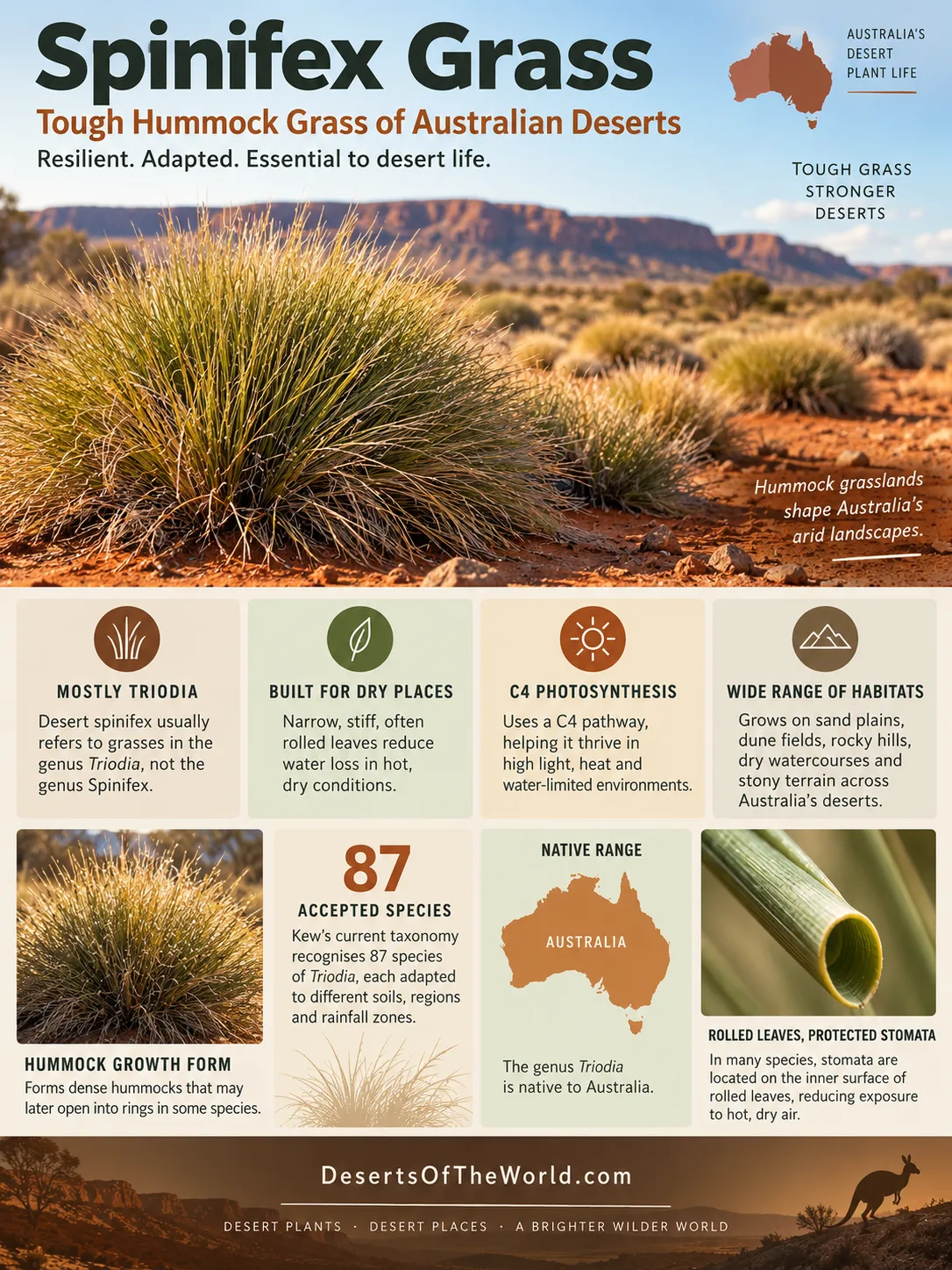
Spinifex is especially associated with Australia’s sandy deserts, yet it is not limited to dunes. Triodia hummocks also grow on sand plains, stony rises, rocky slopes, dry drainage systems, and other arid landforms. In many parts of the interior, spinifex hummock grassland is one of the main structures shaping the desert surface.
| Feature | Spinifex Grass in Australian Deserts |
|---|---|
| Main genus | Triodia |
| Plant family | Poaceae |
| Life form | Long-lived perennial grass |
| Growth form | Dense hummocks that may later open into rings in some species |
| Leaf form | Narrow, stiff, often tightly rolled or needle-like |
| Photosynthetic pathway | C4 |
| Typical environments | Sand plains, dune fields, rocky hills, dry watercourses, stony terrain, and some salt-lake systems |
| Accepted Triodia species | 87 in the current Kew Plants of the World Online taxonomy |
| Native range of the genus | Australia |
What “Spinifex” Means in Australian Deserts
The word spinifex can cause botanical confusion. In inland Australia, it is widely used as a common name for Triodia, the tough hummock grasses that dominate large areas of arid and semi-arid country. Yet Spinifex is also the scientific name of a separate grass genus.
Triodia Is Not the Botanical Genus Spinifex
The distinction is geographic as well as botanical. Desert spinifex is usually Triodia. Plants in the genus Spinifex, by contrast, are associated mainly with coastal dunes and beaches rather than the great hummock grasslands of the Australian interior.
Name note: A reference to “spinifex desert,” “spinifex country,” or “spinifex hummock grassland” in inland Australia will usually mean vegetation dominated by Triodia, not the botanical genus Spinifex.
| Feature | Desert “Spinifex” | Genus Spinifex |
|---|---|---|
| Usual meaning | Triodia grasses | A separate botanical genus |
| Typical Australian setting | Arid and semi-arid interior | Coastal dunes and beaches |
| Growth pattern | Dense hummocks, sometimes becoming rings | Spreading coastal grasses |
| Role in desert landscapes | Major vegetation component | Not the characteristic inland hummock grass |
Kew’s current taxonomic treatment accepts 87 species of Triodia. That number also shows why spinifex should not be described as a single desert grass species. Different Triodia species occupy different soils, regions, and rainfall zones across Australia.
Why Triodia Handles Arid Conditions
A spinifex hummock may look dry and coarse even when it is healthy. Its structure is very different from the broad, soft blades associated with lawns or wetter grasslands. The narrow leaves, dense growth, C4 photosynthesis, and specialised leaf anatomy all suit environments where heat, sunlight, and water shortage repeatedly shape plant growth.
Rolled Leaves Reduce Exposure
The needle-like appearance comes partly from the way many Triodia leaves roll tightly. A rolled leaf exposes less internal surface directly to hot, dry air. In some members of the group, stomata are concentrated on the protected inner surface of the rolled blade rather than the more exposed outer surface.
Stomata are the microscopic pores through which plants exchange gases and lose water vapour. Positioning them within grooves or protected portions of a rolled leaf can create a less exposed zone around the pore. The exact leaf anatomy varies among Triodia lineages, so no single stomatal pattern should be applied to all spinifex species.
The stiff leaf blades also contain substantial supporting tissue. That helps explain why many spinifex hummocks remain rigid when surrounding annual vegetation has dried away.
C4 Photosynthesis Fits Hot, Bright Country
Triodia belongs to a C4 grass lineage. C4 photosynthesis concentrates carbon dioxide around the cells where carbon fixation occurs. This pathway generally performs well under strong light and warm conditions and can use water more efficiently than the C3 pathway under many hot, dry conditions.
C4 photosynthesis does not make spinifex independent of rain. Growth still responds strongly to available water. It does, however, form part of a suite of traits that allow these grasses to remain established in Australian drylands through repeated cycles of rainfall and drought.
The Hummock Is Part of the Adaptation
Spinifex usually does not produce a continuous lawn. Individual plants form compact mounds called hummocks, with large gaps often remaining between them. Australian vegetation descriptions commonly record hummocks reaching around a metre in height, although the size varies by species and site and some local stands can grow taller.
Living shoots occupy the hummock while older leaves and stems accumulate within it. The result is a dense structure that persists above ground through long dry periods. Between the hummocks, the surface may remain largely exposed until rain triggers annual grasses and short-lived herbs.
Where Spinifex Country Occurs
Triodia is closely associated with Australia’s arid interior. Hummock grasslands form extensive vegetation across parts of Western Australia, the Northern Territory, South Australia, Queensland, and other dry mainland regions.
They are especially characteristic of the broad desert belt containing the Great Sandy Desert, Gibson Desert, Great Victoria Desert, Tanami Desert, and many central Australian sandplain and dunefield systems. Spinifex also occurs beyond formally named deserts, so a map of Australia’s deserts and a botanical distribution map of Triodia are not identical.
Spinifex Is Not Restricted to Sand Dunes
Red dunes are one of the best-known spinifex settings, but Queensland habitat records show just how broad the physical range can be. Hummock grasslands occur on:
- infertile sand plains
- dune fields and interdune areas
- rocky hills and range slopes
- stony and skeletal soils
- normally dry watercourses
- some salt-lake systems
Soil and landform help determine which species dominates. One Triodia species may favour sandy country while another is more strongly associated with rocky or lateritic surfaces. Even neighbouring dune crests, slopes, and swales can support different vegetation structures because water infiltration, soil depth, exposure, and nutrients change over short distances.
This is why Australian spinifex country often looks uniform from far away but becomes much more varied at ground level.
Soft, Hard, and Other Spinifex Species
Australian field names such as soft spinifex, hard spinifex, porcupine grass, and feathertop spinifex describe different Triodia species or groups. “Soft” is relative. A plant called soft spinifex can still have narrow, stiff leaves and should not be imagined as soft turf.
| Species | Common Association | Useful Distinction |
|---|---|---|
| Triodia pungens | Soft, gummy, or resinous spinifex | A widespread resin-producing species in northern and inland dry country |
| Triodia basedowii | Hard spinifex | A strongly hummock-forming species well known from central Australian desert country and for ring development |
| Triodia irritans | Porcupine grass | Named for its stiff, sharply pointed foliage |
| Triodia schinzii | Feathertop spinifex | A species of sandy inland environments, including central Australian spinifex country |
| Triodia longiceps | Giant grey spinifex | Recorded as a dominant hummock grass in parts of western Queensland |
Uluṟu-Kata Tjuṯa National Park alone records four spinifex species: T. pungens, T. basedowii, T. irritans, and T. schinzii. That local diversity is a useful reminder that a desert scene filled with similar-looking hummocks may contain more than one kind of spinifex.
Why Old Spinifex Hummocks Can Become Rings
Some of the most distinctive spinifex plants are not dome-shaped at all. Older hummocks of certain species develop an open centre and eventually appear as circles or broken rings.
The basic physical pattern is outward expansion. Living growth continues around the margin while older shoots and roots nearer the centre progressively die back. A mature plant can therefore change from a compact hummock into a ring of living grass surrounding a more open interior.
Triodia basedowii is one of the best-known ring-forming species. Yet ring formation should not be treated as a feature of every Triodia species.
Why the Centre Dies Back
The visible sequence of outward growth and central dieback is well documented, but the processes controlling ring development are more complicated than the shape alone suggests.
A 2021 study tested whether soil microorganisms could contribute to the pattern in T. basedowii. Seedling emergence was lower in untreated soil collected from inside existing rings than in soil from outside them, while sterilising inner-ring soil improved emergence. The results provide evidence that soil pathogens may contribute to conditions inside the ring.
They do not establish a single universal cause. Ring formation involves plant growth, ageing, local soil conditions, and possibly biological interactions below ground. Describing pathogenic microbes as one contributing process under investigation is more accurate than saying microbes alone create every spinifex ring.
How Spinifex Country Responds to Rain
Australian desert vegetation is strongly pulse-driven. Long dry intervals can leave spinifex hummocks dull yellow, straw-coloured, grey-green, or apparently inactive. Rain changes the system quickly enough to alter both the plants and the spaces between them.
Fresh spinifex growth becomes greener as water becomes available. Flowering stems may rise above the hummocks, and annual grasses and forbs can appear in ground that looked bare during the preceding dry period.
Soft spinifex, Triodia pungens, provides a clear example. Western Australian botanical material describes its hummocks turning bright green following rain and producing abundant flowers after favourable rainfall.
The open spacing between perennial hummocks is therefore important. Bare-looking soil is not necessarily unused space. It can hold seeds and short-lived plants that respond when enough moisture reaches the surface.
Fire Ecology of Spinifex Grasslands
Old spinifex accumulates dry leaves and stems. Once enough vegetation connects neighbouring hummocks, fire can travel across much larger areas than it could when plants were sparse and separated by wide bare gaps.
This creates an unusual desert relationship: a wet period can prepare the landscape for a later large fire. Rain produces new grass and other vegetation. That extra plant material eventually dries, increasing the amount and continuity of fuel.
Wet Years Can Build the Next Fuel Load
Australia’s State of the Environment reporting notes that central and western spinifex grasslands have experienced very large fires following seasons of above-average rainfall. The mechanism differs from the familiar idea that drought alone creates the greatest fire potential. In these desert grasslands, rain can first produce the biomass needed to connect the landscape.
The Great Sandy Desert provides a measured example. Strong vegetation growth followed high rainfall in early 2017. During the 2017–18 summer, major fires crossed the region, including an event in Ngurrara Country that burned about 3.8 million hectares.
The sequence can be simplified as:
- rain increases grass and herb growth;
- vegetation fills some of the gaps between established hummocks;
- the new biomass dries;
- fuel becomes more continuous across the ground;
- fire can move across a larger area;
- post-fire vegetation begins another period of recovery.
Different Triodia Species Recover Differently
There is no single spinifex response after fire. A survey of Triodia at 116 recently burned locations across mainland Australia found both major strategies: some populations regenerated by resprouting, while others returned from seed after adult plants had been killed.
Several species even showed different responses among populations. This variation matters because statements such as “spinifex always resprouts after fire” or “spinifex must regrow from seed” are both too broad for the genus.
The age of spinifex after fire also changes the physical habitat. Young regrowth is short and relatively open. Older hummocks become larger and structurally more complex, creating cover that some desert animals use for shelter.
A Spinifex Hummock Is Also Animal Habitat
The value of spinifex is not limited to plant cover. A mature hummock creates a three-dimensional structure close to the ground. Its stiff foliage, interior spaces, dead plant material, shade, and surrounding soil produce places where small desert animals can hide, forage, or shelter.
Queensland’s hummock grassland habitat records note use by numerous reptiles and small marsupials, including desert skinks, sand monitors, dunnarts, ningauis, and several grassland birds.
Not every animal uses a hummock in the same way. Some move through the spaces between plants. Others shelter beneath or within mature vegetation. For species that depend on dense cover, the difference between recently burned spinifex and decades-old hummocks can be substantial.
Mature Spinifex and the Sandhill Dunnart
The sandhill dunnart (Sminthopsis psammophila) shows how strongly the age and structure of hummock grassland can matter. Research in the Great Victoria Desert found daytime shelters within mature vegetation with a mean post-fire age of about 32 years. Burrows accounted for 77% of recorded shelter days and were commonly concealed beneath mature Triodia.
As ring-forming spinifex ages, its structure changes. Young hummocks can be too small or dense for the same shelter use, while older stages produce larger protected spaces and open centres. Eventually, ageing rings can fragment into separate living sections.
Australia’s National Recovery Plan for the Sandhill Dunnart came into effect on 10 April 2026. The continued attention given to mature desert habitat reflects how vegetation age, ground cover, and fire history are linked to the places this small desert mammal uses.
Why Spinifex Country Looks Patchy
A healthy hummock grassland is not necessarily a continuous carpet of vegetation. Sparse spacing is part of its normal structure. Australian vegetation descriptions often show individual Triodia mounds surrounded by exposed ground, with occasional shrubs or low trees rising above them.
That pattern changes across the landscape. A sandy plain may carry closely repeated hummocks, while a dune crest can have more open cover. A swale may support taller vegetation or different species. Rocky slopes can carry spinifex in shallow pockets between stone, and dry drainage lines may contain plants that benefit from occasional concentrated runoff.
Woody plants can also occur above the grass layer. Depending on location, spinifex country may include scattered Acacia, Grevillea, Senna, Eucalyptus, or Corymbia. The result is often better described as a mosaic than as an endless grassland.
| Landscape Position | Typical Spinifex Setting |
|---|---|
| Sand plain | Repeated hummocks with broad open spaces and scattered woody plants |
| Dune slope | Hummock cover arranged along sandy slopes, often changing toward crest and swale |
| Interdune swale | Deeper or differently textured soils can support a different mix of spinifex and shrubs |
| Rocky rise | Hummocks rooted among shallow soils, gravel, or exposed rock |
| Dry watercourse | Local runoff can support spinifex together with taller grasses, shrubs, or trees |
| After good rain | Green spinifex growth with temporary herbs and grasses filling previously bare spaces |
Spinifex in Aṉangu Knowledge at Uluṟu
Human relationships with spinifex vary among Aboriginal communities and regions, so uses should not be presented as a single practice shared everywhere across Australia.
At Uluṟu-Kata Tjuṯa, Parks Australia records that Aṉangu use spinifex resin to make kiti, an adhesive material used in tool making. The grass is threshed to obtain resin, which can then be heated and worked into a mouldable material.
Traditional relationships with spinifex also include knowledge of fire and vegetation age. Parks Australia notes that old, dense spinifex may be burned by Aṉangu to create more open areas and new foraging habitat. This local knowledge treats spinifex not as a static plant cover but as vegetation that changes through time.
Other communities have their own documented relationships with resinous Triodia. In north-west Queensland, the Indjalandji-Dhidhanu people’s use of Triodia pungens resin and plant material has been recorded in connection with adhesives, bedding, and other practical uses. The details belong to particular communities and places rather than to a single continent-wide tradition.
Sources
- Royal Botanic Gardens, Kew — Triodia R.Br. (accepted taxonomy, native range, and accepted species)
- Queensland Government — Hummock Grasslands (habitat, landforms, plant structure, species, and wildlife)
- Australian State of the Environment — Bushfires and Wildfires (rainfall, spinifex fuel growth, and large desert fire events)
- Parks Australia — Spinifex at Uluṟu-Kata Tjuṯa National Park (local species, hummock growth, habitat, resin, and Aṉangu knowledge)
- Australian Department of Climate Change, Energy, the Environment and Water — National Recovery Plan for the Sandhill Dunnart (2026 national recovery plan)
- Australian Journal of Botany — Ring Formation in Triodia basedowii (central dieback and evidence for a soil-microbe contribution)
- Macquarie University — Regeneration After Fire in Triodia (resprouting and seed-based recovery across burned sites)
- Scientific Reports — Leaf Traits in Australian Triodiinae (C4 grasses, rolled-leaf anatomy, stomatal position, and arid-zone evolution)
- Western Australian Government — Queensland Spinifex Grass Case Study (Traditional Knowledge and uses of Triodia pungens)