
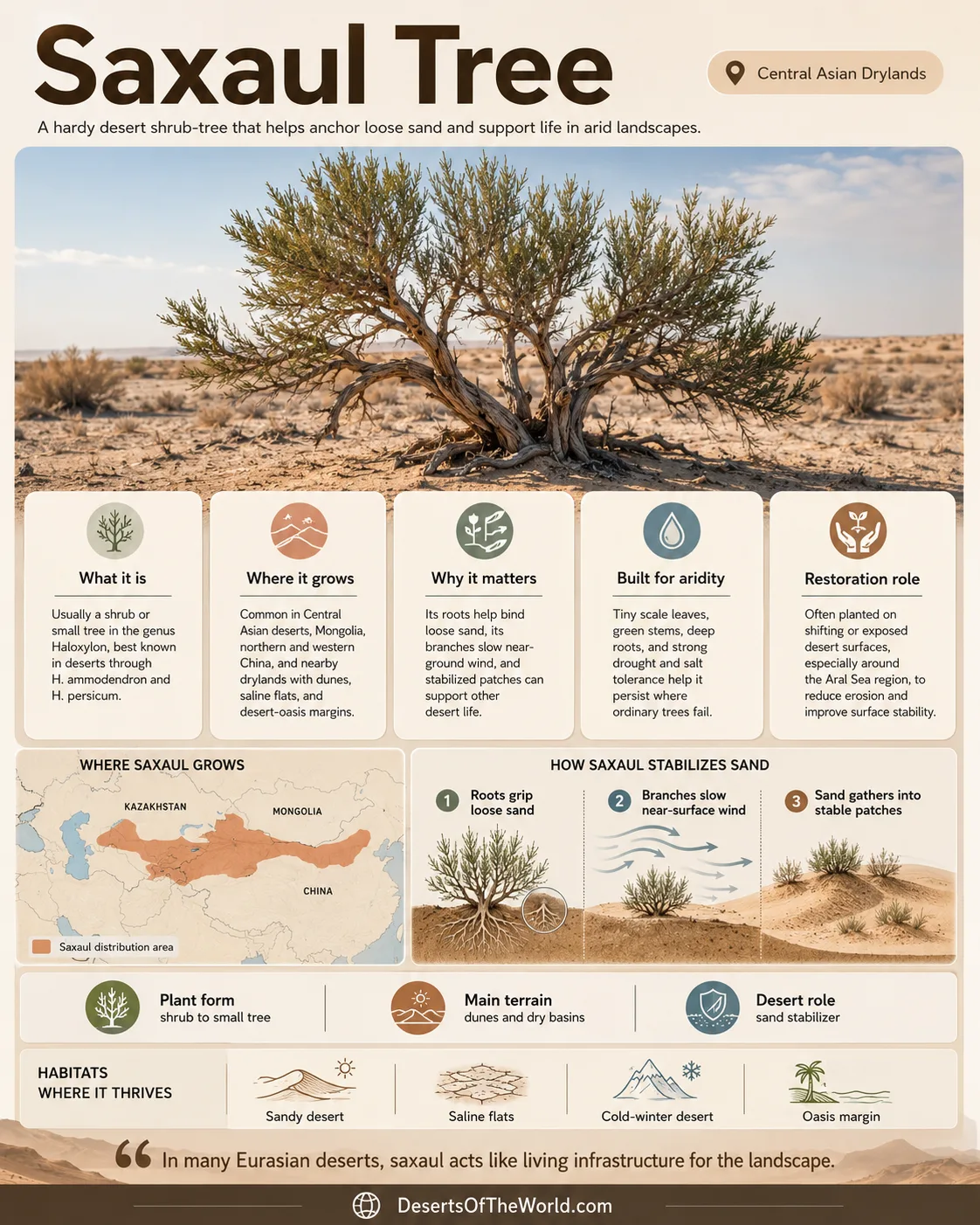
The saxaul tree is one of the clearest examples of how a desert plant can shape the land around it. Known scientifically through species such as Haloxylon ammodendron and Haloxylon persicum, saxaul grows where loose sand, dry wind, saline soil, and long rainless periods make ordinary trees fail. It is often more shrub than tree, often leafless to the eye, and often overlooked from a distance. Yet in Central Asian and Inner Asian deserts, it can hold sand in place, soften wind near the ground, and help other desert life settle around it.
Saxaul is not only a plant that survives in desert conditions. Its roots and woody structure can reduce sand movement, alter near-ground wind, and create more stable patches of habitat in otherwise mobile or exposed dryland surfaces.
Main Details of the Saxaul Tree
| Topic | Details |
|---|---|
| Common Name | Saxaul, black saxaul, white saxaul, saksaul |
| Main Scientific Names | Haloxylon ammodendron and Haloxylon persicum |
| Plant Family | Amaranthaceae; older sources may place related plants under Chenopodiaceae |
| Plant Type | Desert shrub or small tree, depending on species, age, and site conditions |
| Main Habitat | Sandy deserts, dune fields, desert-oasis edges, dry basins, saline flats, and arid shrublands |
| Best-Known Regions | Central Asia, Mongolia, northern and western China, parts of Iran, Afghanistan, and the broader drylands of Eurasia |
| Main Desert Role | Sand stabilization, wind erosion reduction, dune-edge vegetation, dryland restoration, and habitat support |
Names and Species
The word saxaul usually refers to woody desert plants in the genus Haloxylon. In everyday use, the name can cover more than one species. This matters because older field reports, Soviet-era botanical literature, modern taxonomic databases, and restoration documents do not always use the same names in the same way.
Black Saxaul
Black saxaul is commonly linked with Haloxylon ammodendron. In some older literature, the name Haloxylon aphyllum appears for closely related black saxaul forms. This is one reason saxaul can look confusing in older books and research papers.
Black saxaul is usually associated with heavier desert soils, depressions, old floodplain areas, saline ground, and sites where deeper moisture may be available. It can form open desert woodland rather than closed forest. The trees stand apart, but their roots and crowns still change the sand and air around them.
White Saxaul
White saxaul is usually linked with Haloxylon persicum. It is often found on sandy ground and mobile dunes. Compared with black saxaul, it is usually more tied to loose sand and rain-fed desert conditions.
The two names, black and white, do not mean the plants are visually simple to separate for every visitor. Bark color, branch color, soil type, height, and location all help, but local ecology matters. In desert plant communities, names often carry field meaning as much as textbook meaning.
Where Saxaul Grows
Saxaul is strongly tied to the drylands of Eurasia. Its range includes parts of Central Asia, Mongolia, northern and western China, Iran, Afghanistan, and nearby desert regions. Kew’s Plants of the World Online lists Haloxylon ammodendron as native from Iran to Mongolia and northern and western China, growing mainly in desert or dry shrubland. Haloxylon persicum has a wider dryland range, from Egypt to northern Xinjiang and western Pakistan, including the Arabian Peninsula.
On the ground, saxaul is most often linked with these desert settings:
- Sand dunes where roots can bind loose grains.
- Desert-oasis margins where moving sand can threaten fields and settlements.
- Cold winter deserts of Central Asia, including the Kyzylkum, Karakum, Muyunkum, and Gobi-related drylands.
- Saline and dry basins where ordinary shrubs struggle to survive.
- Former lakebed and exposed seabed areas, especially in restoration work around the Aral region.
The plant does not need lush soil. It is built for poor ground. Sand, salt, wind, and dryness are not side conditions for saxaul. They are part of its normal world.
Desert Adaptations That Make Saxaul Different
Saxaul looks spare because it has to be spare. In drylands, broad leaves can lose water too fast. Tall, soft growth can break in wind or fail during drought. Saxaul solves the problem by reducing what it exposes and strengthening what it hides.
Tiny Leaves and Green Stems
Many saxaul plants look nearly leafless. Their leaves are reduced to very small scales, while the young green branchlets carry much of the photosynthetic work. This gives the plant a thin, jointed, almost brush-like look.
That structure is not decorative. It reduces water loss. Less leaf surface means less evaporation under dry wind and strong sun. The plant keeps working, but quietly.
Roots That Grip Sand and Reach Moisture
The root system is the main reason saxaul matters so much in desert landscapes. Fine roots hold the upper sand layer. Deeper roots search for moisture where available. In some habitats, especially where groundwater or old alluvial moisture exists, saxaul can act as a phreatophyte, meaning it can use deeper water sources rather than relying only on surface rain.
This dual role is rare and useful: the plant can hold loose surface material while still drawing water from below. Above ground, it looks modest. Below ground, it is busy.
Salt, Drought, and Poor Soil Tolerance
Saxaul is both a desert plant and, in many settings, a salt-tolerant plant. That does not mean it grows anywhere without limits. Seedlings still need suitable timing, protection, and enough moisture to establish. Mature plants handle harsh conditions far better than young ones.
In dry restoration projects, this difference between seedling and adult plant is often the whole story. Planting saxaul is not the same as creating a saxaul woodland overnight. The first years matter most.
How Saxaul Stabilizes Sand
Saxaul stabilizes sand through several linked processes. None of them is magic. Together, they make a living barrier.
- Roots bind the sand. Fine roots and woody root systems reduce the chance that surface material will move with every wind event.
- Stems slow near-ground wind. Even an open shrub canopy changes wind speed close to the soil surface.
- Branches trap moving particles. Sand gathers around the plant base, helping form small mounds and more stable patches.
- Plant litter improves the soil surface. Fallen twigs and organic matter can help moisture stay longer near the root zone.
- Other plants may follow. Once the surface becomes less mobile, small herbs and shrubs have a better chance to settle.
A bare dune behaves like loose flour in a wind gust. Add saxaul, and the surface begins to catch, roughen, and hold. Not everywhere. Not instantly. But enough to change the behavior of the sand.
Saxaul Forests in Central Asian Deserts
The phrase saxaul forest can surprise readers because these woodlands rarely look like dense forests. They are usually open, dry, and widely spaced. In arid regions, though, even scattered woody cover can count as real desert woodland.
Research on the winter-cold deserts of Middle Asia describes Kazakhstan, Uzbekistan, and Turkmenistan as part of a vast dryland zone where white and black saxaul have been dominant woody species across large potential areas. One study in the Journal of Arid Environments estimated the potential distribution area of saxaul vegetation in these winter-cold deserts at about 500,000 km². The same research reported that above-ground biomass in many saxaul vegetation types often falls between 1.5 and 3 tonnes per hectare.
| Desert Region | Saxaul Connection |
|---|---|
| Kyzylkum Desert | Saxaul forms part of the native dryland vegetation mosaic across sandy and semi-fixed desert terrain. |
| Karakum Desert | Open saxaul stands occur with other drought-adapted shrubs in arid Central Asian landscapes. |
| Gobi Desert | Saxaul can be one of the main woody plants in some dry Gobi habitats, giving shelter and structure to sparse desert ground. |
| Taklamakan and Xinjiang Drylands | Haloxylon ammodendron is used in shelterbelt and sand-fixation work along desert-oasis edges. |
| Aralkum Desert | Saxaul is widely planted to stabilize exposed former seabed surfaces and reduce loose dust and sand movement. |
Saxaul and the Aralkum Desert
The Aralkum is a young desert formed on the exposed bed of the shrinking Aral Sea. It is one of the best-known modern examples of saxaul restoration work. Here, saxaul is planted not for scenery, but for surface stability.
Uzbekistan reported that a “green cover” of protective forest plantations had been created across about 1.6 million hectares of the dried Aral Sea bed in Muynak district between 2018 and 2022. That was an earlier stage of a larger programme. For the 2018–2025 period, official figures put the total area covered by protective forest plantations on the dried seabed at about 2 million hectares. The plantings include saxaul and other desert species selected for saline, drought-prone ground.
The work continued in 2026. In March, Uzbekistan’s forestry authorities reported that new saxaul and other desert-plant planting was underway on the dried seabed in Muynak district, with machinery, aircraft, forestry workers, and desert-plant seed involved in the season’s operations.
UNDP’s Green Aral Sea work has also reported planting 80,000 saxaul seedlings on 80 hectares in March 2025 in the Muynak district of Karakalpakstan.
Those numbers show the scale of the task. A saxaul seedling may be small enough to hold in one hand, yet restoration needs thousands, then millions, arranged across land that wind can cross without resistance.
Why Saxaul Is Used on Exposed Seabed
Former seabed surfaces can be saline, dry, open, and wind-prone. Saxaul is chosen because it can handle sand, salt, and water stress better than many woody plants. Once established, it creates roughness at the ground surface. That roughness matters because wind needs smooth, open ground to move sand freely.
Planting work still depends on timing, seedling survival, soil conditions, local moisture, and protection from disturbance. Saxaul helps, but the land decides how fast help becomes visible.
Seasonal Growth, Flowers, and Seeds
Saxaul does not rely on showy leaves or flowers. Its flowers are small, and its fruits often develop wing-like parts that help movement by wind. In many restoration settings, seed timing is handled carefully because saxaul seeds can lose viability if stored poorly or planted too late.
FAO’s technology record on saxaul planting in Tajikistan describes seed collection in November and immediate planting as part of the method used for sandy soil stabilization. The same record notes that non-irrigated saxaul in that setting depended on winter rain and dew after planting.
The Seedling Stage Is the Weak Point
A mature saxaul can look tough enough to ignore the desert. A seedling cannot. Early growth depends on small windows of moisture and protection. Too much grazing pressure, deep burial by moving sand, or long dry spells can reduce survival before the plant has built a useful root system.
This is why restoration projects often combine planting with site protection. The tree is desert-hardy later. Early on, it is still a seedling in a hard place.
Wildlife and Microhabitats Around Saxaul
In open desert, shade is not just comfort. It changes temperature, moisture, and shelter at ground level. Saxaul can create small microhabitats where insects, birds, reptiles, and other desert organisms find cover or nesting opportunities.
In Central Asian deserts, saxaul stands are linked with desert bird life, insect communities, and other shrubs that use the partly stabilized ground. The plant also supports a more varied soil surface than bare sand. Small differences matter in deserts. A twig, a root mound, a shaded patch — each one can become useful.
What Saxaul Can and Cannot Do
Saxaul is a valuable desert restoration plant, but it should not be treated as a cure-all. Drylands respond slowly. Soil texture, salinity, wind exposure, groundwater depth, planting season, and long-term care all shape results.
| What Saxaul Can Do | What Saxaul Cannot Do Alone |
|---|---|
| Reduce movement of loose sand once plants establish | Stop all dust and sand movement across a whole desert immediately |
| Add woody structure to sparse dryland surfaces | Create dense forest in places too dry or saline for stable growth |
| Help other desert plants return on more stable ground | Replace the need for site protection and careful planting |
| Survive drought and salt better than many trees | Guarantee seedling survival without suitable timing and local care |
The best way to understand saxaul is not as a miracle tree, but as a desert specialist. It works with harsh land, not against it.
Saxaul Compared with Other Sand-Binding Plants
Many desert plants help hold sand. Grasses, tamarisk, saltbush, wormwood, acacia, and other shrubs all have sand-binding roles in different drylands. Saxaul stands out because it can become woody cover in places where many trees cannot persist.
Compared with shallow-rooted herbs, saxaul adds longer-lived structure. Compared with taller moisture-demanding trees, it asks for less. Compared with temporary dune vegetation, it can form open woodland patches that last when conditions allow.
| Plant Type | Typical Desert Role | How Saxaul Differs |
|---|---|---|
| Ephemeral Desert Herbs | Grow after rain and briefly cover the soil | Saxaul gives longer-lasting woody structure. |
| Desert Grasses | Bind surface sand with dense roots | Saxaul adds shrub or tree height, slowing wind above the surface. |
| Saltbush and Low Shrubs | Tolerate dry and saline soil | Saxaul can form open woodland in suitable desert zones. |
| Tamarisk | Often grows near saline or water-influenced sites | Saxaul is more closely linked with sandy desert stabilization in Central Asia. |
Traditional Use and Conservation Notes
Saxaul wood has long been valued in dry regions because woody fuel is scarce in desert lands. Its dense wood made it useful to people living far from forests. That history also explains why natural saxaul stands need careful management today.
Modern interest in saxaul focuses less on fuel and more on land restoration, sand fixation, shelterbelt planting, and desert habitat support. In many places, living saxaul is more valuable on the land than cut from it.
Common Questions About the Saxaul Tree
Is Saxaul Really a Tree?
Yes, but not always in the way people imagine a tree. Saxaul can grow as a small tree or large shrub. In harsh desert sites, it may stay low and irregular. In better sites, some forms can become taller and more tree-like.
Why Does Saxaul Look Almost Leafless?
Its leaves are reduced to tiny scales, while young green branchlets do much of the photosynthesis. This helps reduce water loss in dry wind and strong sun.
Can Saxaul Stop Moving Dunes?
Saxaul can help stabilize dunes and sandy ground after it becomes established. It slows wind near the surface, traps sand, and binds soil with roots. It does not stop a moving dune system overnight.
Where Is Saxaul Most Famous?
It is especially linked with Central Asian deserts, the Gobi region, drylands of Xinjiang, and restoration projects in the Aralkum Desert around the former Aral Sea bed.
Is Saxaul a Cactus?
No. Saxaul is not a cactus. It belongs to the flowering plant family Amaranthaceae. Its desert survival strategy comes from reduced leaves, woody stems, salt tolerance, and an extensive root system rather than cactus-like water-storing pads.
Sources
- Plants of the World Online: Haloxylon ammodendron (taxonomy, accepted name, native range, and biome)
- Plants of the World Online: Haloxylon persicum (taxonomy, accepted name, native range, and biome)
- FAO STI Portal: Saxaul Plantation for Stabilisation of Sandy Soils (saxaul planting method, soil stabilization, seed timing, and dryland restoration context)
- UNDP Uzbekistan: Green Aral Sea Initiative (saxaul planting on the dried Aral Sea bed)
- UNCCD: Central Asia Land Degradation and Saxaul Planting Notes (Aral Sea restoration and saxaul planting area data)
- Uzbekistan Forestry Agency: Planting on the Dried Aral Sea Bed (2 million hectares of protective forest plantations in 2018–2025 and continued planting in Muynak in 2026)
- Journal of Arid Environments: Spatial Distribution and Carbon Stock of Saxaul Vegetation (Central Asian saxaul distribution, biomass, and dryland vegetation research)
- EPPO Global Database: Haloxylon ammodendron (overview, common names, and erosion-related notes)