
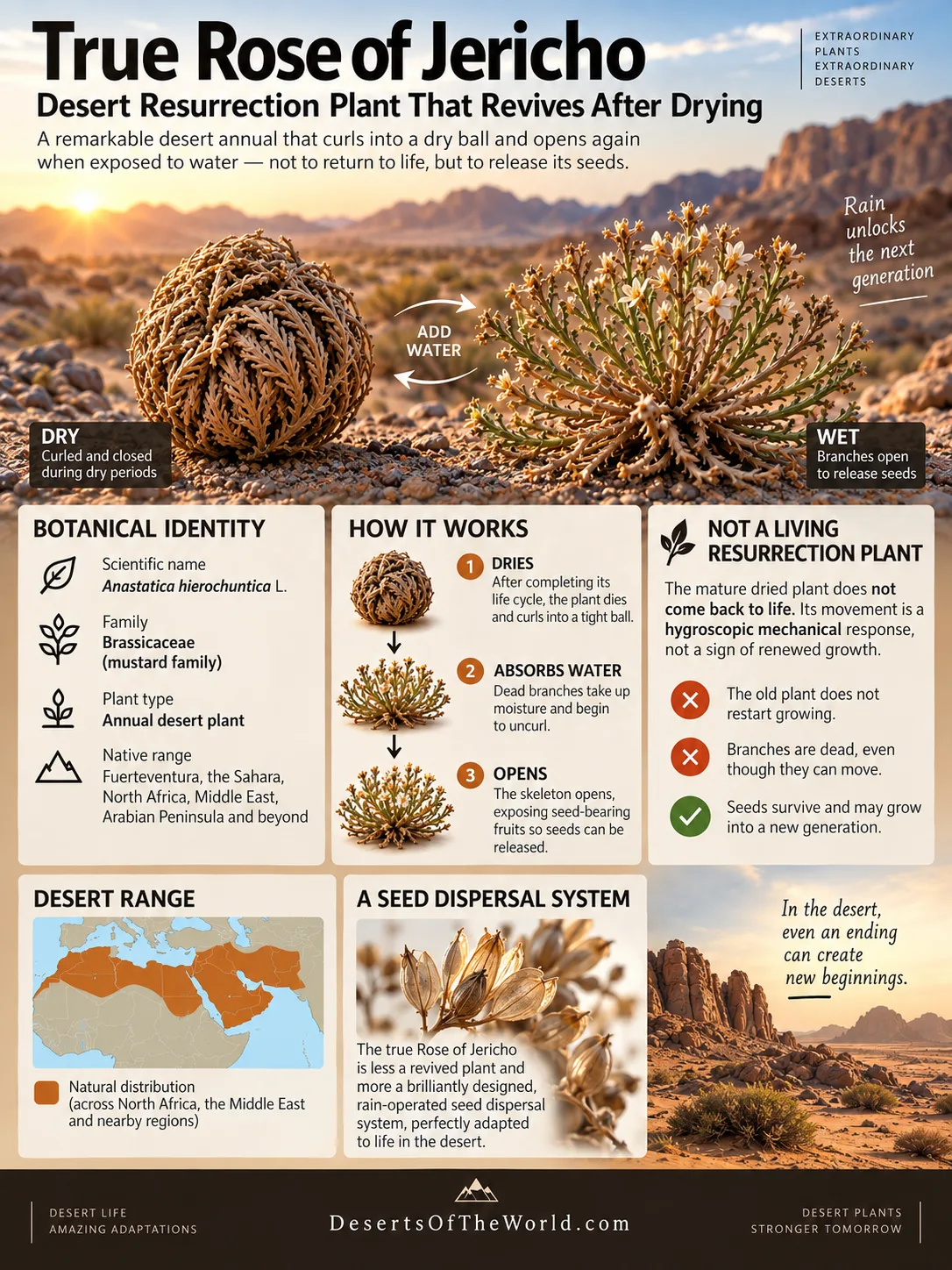
The true Rose of Jericho, Anastatica hierochuntica, is a small annual desert plant whose dry branches curl inward and open again when exposed to water. That movement has given it a reputation as a plant that dies, dries out, and later returns to life.
The real biology is more unusual. The mature dried plant does not become alive again. After completing its annual life cycle, the parent plant dies, but its lignified branches remain responsive to moisture. Rain causes this dead skeleton to open, exposing seed-bearing fruits and helping release seeds when the surrounding desert finally has water.
This makes Anastatica hierochuntica less a revived adult plant and more a rain-operated seed dispersal system. Its dead structure can continue serving the next generation long after the living plant has disappeared.
Botanical Identity and Desert Range
| Feature | True Rose of Jericho |
|---|---|
| Scientific name | Anastatica hierochuntica L. |
| Family | Brassicaceae |
| Plant type | Annual flowering desert plant |
| Primary biome | Desert and dry shrubland |
| Dry-season structure | Dead, curled, lignified skeleton |
| Response to water | Dead branches absorb water and uncurl |
| Main function of the movement | Exposes fruits so rain can release seeds |
| True vegetative resurrection? | No |
| Native range | Fuerteventura, the Sahara, parts of North Africa and the Middle East, the Arabian Peninsula, southern Iran and southwestern Pakistan |
Kew’s Plants of the World Online accepts Anastatica hierochuntica as an annual species associated mainly with desert and dry shrubland. Its natural distribution is much wider than the name “Jericho” suggests, extending across a broad belt of dry country from the Canary Islands and Sahara into western and southwestern Asia.
It belongs to the mustard family, Brassicaceae. Despite its common name, it is not a rose and has no close botanical relationship to true roses in the family Rosaceae.
Does the True Rose of Jericho Really Come Back to Life?
No. The curled brown structure usually sold or displayed as the true Rose of Jericho is the dead skeleton of an annual plant. Its branches can move after wetting, but movement alone does not mean that the tissue has returned to life.
A living resurrection plant survives extreme dehydration in its vegetative tissues and later restores physiological activity after rehydration. The mature dried skeleton of Anastatica hierochuntica does not restart photosynthesis, produce living leaves from its dead branches, or resume the growth of the old plant.
What survives is the next generation. Seeds remain held within fruits on the dead parent structure. The skeleton acts as a mechanical device that protects those seeds and controls when some of them are released.
| What Appears to Happen | What Actually Happens |
|---|---|
| The dead plant comes back to life | Dead woody branches respond physically to water |
| The plant wakes up | Moisture causes the curled skeleton to uncurl |
| The same plant starts growing again | The old adult remains dead; living seeds may produce a new generation |
| Opening proves the specimen is alive | Opening is a hygroscopic mechanical response |
What Makes the Dead Plant Open When Wet?
The movement is known as hygrochasy. In this type of plant movement, structures respond mechanically to changing moisture even though the tissues responsible for the movement may already be dead.
After Anastatica hierochuntica finishes growing and producing fruit, its stems dry and become lignified. As moisture is lost, the branches bend inward around the fruiting parts of the plant. The resulting dry structure can resemble a small woody ball or tightly closed basket.
When rain wets the skeleton, water enters the dead conducting tissues. The physical properties of those tissues change as they become hydrated. Because tissues on different sides of the stem do not respond identically, the curved branches begin to straighten.
The sequence is simple:
- The living annual plant completes reproduction.
- The parent plant dies and its stems dry.
- The dry branches curl inward around the fruits.
- Water enters the dead tissues during rain.
- The branches straighten and spread outward.
- Previously sheltered fruits become exposed to falling raindrops.
This response does not require active muscles, living leaves or renewed metabolism. The structure itself provides the movement.
Experiments have even shown opening when only the main root region of a dry skeleton contacted water. Water moved through the dead structure and triggered uncurling farther along the branches. That observation helps explain how a rooted skeleton can respond when desert soil becomes wet beneath it.
How Fast Does the Skeleton Open?
Opening begins gradually after water reaches the dry skeleton. In classic controlled experiments, fully saturated specimens reached their maximum opening in roughly two hours. Visible movement can begin earlier, so a specimen does not remain unchanged for the entire period.
The exact response outdoors depends on how much water reaches the plant, how dry the skeleton was beforehand, the condition of its tissues and whether rain continues long enough to saturate it.
Drying reverses the process. As water leaves the branches, they gradually curl inward again. This means the same dead skeleton can respond to more than one wetting and drying event.
The Dead Skeleton Becomes an Aerial Seed Bank
The curled plant is more than a dry remnant. It stores part of its seed crop above the soil surface. Ecologists call this an aerial seed bank.
Instead of dropping every mature seed immediately, Anastatica hierochuntica retains seeds within fruits attached to the dead parent. The inward-curled branches surround those fruits during dry weather. Rain later changes the shape of the skeleton and creates an opportunity for dispersal.
This delayed release matters in deserts where one brief shower may be followed by another long dry period. Keeping some seeds on the parent skeleton spreads dispersal across separate rainfall events rather than committing the entire seed reserve to the first available shower.
Research on desert aerial seed banks found that Anastatica hierochuntica seeds stored naturally on the parent skeleton for five months still germinated at high rates under laboratory conditions. Across the tested temperature and light treatments, germination exceeded 80%. Those laboratory results should not be treated as a guaranteed field germination rate, but they show that aerial storage can preserve highly viable seeds.
Other ecological work indicates that seed release from the dry skeleton may continue across multiple seasons. The old plant can therefore remain ecologically useful after its own life cycle has ended.
How Rain Controls Seed Release
Water performs two separate jobs. First, it changes the shape of the skeleton. Then falling raindrops help remove seeds from exposed fruits.
This distinction explains why simply becoming wet is not the whole dispersal mechanism.
Hygrochasy First, Ombrohydrochory Second
The first stage is hygrochasy: moisture uncurls the dead branches.
The second stage is ombrohydrochory, meaning seed dispersal caused by rain. Once the branches have opened, raindrops can strike the exposed fruit valves with enough force to help release seeds.
Experiments in which skeletons were immersed in water found that fruit opening often did not occur simply because the structure was wet. The results support a two-stage process in nature:
- Rain or wet soil hydrates the skeleton and opens the branches.
- Continued falling rain strikes exposed fruits and releases seeds.
The distinction is well suited to an arid environment. The presence of water can open the seed-bearing structure, while continued rain supplies the physical force that completes much of the dispersal.
Why One Rain Does Not Empty the Whole Seed Reserve
The fruits are not all equally easy to open. Their position on the skeleton and the strength with which fruit valves remain attached influence when seeds leave the plant.
Under lighter rainfall, some of the more exposed seeds may be released while others remain on the skeleton. Stronger or longer rain can expose and release more of the retained seed crop.
Field research has found that the amount of seed dispersed can rise with rainfall intensity. Light showers tend to produce more local dispersal, while heavier rain can release more seeds and provide enough runoff to move some of them into nearby low areas.
This creates a natural form of risk spreading. A small rain does not necessarily commit every seed to conditions that may soon become dry again.
Why Runoff Channels and Desert Depressions Matter
The true Rose of Jericho is associated with deserts, but its distribution within a desert is not random. Studies have linked populations with places where scarce rainwater becomes locally concentrated.
Typical microhabitats include:
- small desert runnels,
- shallow depressions,
- gravelly flats that receive runoff,
- sandy patches where water briefly collects,
- low points below nearby slopes.
This matters because rainfall totals alone do not determine how much water a desert plant can use. A short storm falling on hard or gravelly ground may send water downslope. A small depression can then receive more usable moisture than nearby higher ground.
Heavy rainfall can also move released seeds toward these runoff-collecting patches. The seed is then deposited in a place with a better chance of remaining moist long enough for germination and early growth.
The relationship between skeleton, rainfall, runoff and microsite explains why the species is such a useful example of desert ecology. Its reproductive strategy responds not only to drought, but also to where brief pulses of water move across the desert surface.
From Rain to Dry Skeleton: The Full Life Cycle
Anastatica hierochuntica survives desert uncertainty through generations rather than by keeping the same adult plant alive indefinitely.
- Rain wets suitable desert soil. Seeds that have been released during favorable conditions can begin germination.
- A new annual plant develops. Its growth depends heavily on available water and the local microhabitat.
- The plant flowers and produces fruits. Small seeds develop while moisture remains sufficient for reproduction.
- The annual plant senesces and dies. The adult life cycle ends.
- The branches dry and curl inward. Fruits and remaining seeds become enclosed within the dead skeleton.
- The skeleton persists through dry weather. Some seeds remain stored above ground.
- Rain returns. Water opens the hygrochastic branches.
- Raindrops strike exposed fruits. Part of the seed reserve is released onto wet ground or carried a short distance by runoff.
- The cycle can repeat. Seeds still retained on the skeleton remain available for later rainfall events.
The old adult does not restart this cycle. Its dead architecture helps determine when the next generation begins.
What the Living Plant Looks Like
The familiar dry ball is only the final stage of the plant’s life. A living true Rose of Jericho looks very different.
It grows as a low, branching annual herb with green stems and leaves. It produces small flowers and later develops fruits along its branching structure. As seasonal moisture disappears and reproduction finishes, the green tissues senesce and the plant gradually becomes the brown woody skeleton associated with the Rose of Jericho name.
The size of individual plants can vary strongly with water availability. Plants occupying better runoff positions can develop larger crowns and more branching than individuals growing under drier conditions. This plasticity is useful in a habitat where water availability may vary sharply over distances of only a few meters.
The dry form should therefore not be imagined as a dormant version of a mature green plant. It is the post-reproductive structure left after the annual has died.
True Rose of Jericho vs. False Rose of Jericho
Confusion between two unrelated plants explains many claims that the true Rose of Jericho becomes green and physiologically active again after extreme drying.
Anastatica hierochuntica is commonly called the true Rose of Jericho. Selaginella lepidophylla is often sold under names such as false Rose of Jericho or resurrection plant. Their responses to drying are biologically different.
| Feature | True Rose of Jericho | False Rose of Jericho |
|---|---|---|
| Scientific name | Anastatica hierochuntica | Selaginella lepidophylla |
| Plant group | Flowering plant | Lycophyte / spikemoss |
| Family | Brassicaceae | Selaginellaceae |
| Dry curled structure | Dead adult skeleton | Living desiccation-tolerant vegetative tissue |
| What water does | Physically uncurls dead branches | Rehydrates living tissues |
| Does the dry adult resume metabolism? | No | Yes, if the tissue remains viable |
| Does it become physiologically green again? | Dead skeleton does not | Viable tissue can recover greenness and metabolic activity |
| Main desert strategy | Rain-linked seed storage and dispersal | Vegetative desiccation tolerance |
| Native desert association | Sahara and Saharo-Arabian dry regions, extending eastward into western Asia | Chihuahuan Desert region |
Selaginella lepidophylla fits the physiological meaning of a resurrection plant much more closely because its vegetative tissues can survive extreme dehydration and recover after water returns.
The word “true” in “true Rose of Jericho” refers to the traditional common name attached to Anastatica hierochuntica. It does not mean that the species is the better example of physiological resurrection.
What Happens When a Dried Specimen Is Put in Water?
A dry Anastatica hierochuntica skeleton absorbs water and gradually spreads its branches outward. A tightly curled specimen can become much more open as its lignified tissues hydrate.
The change can look dramatic because the dry and wet structures have very different shapes. Yet the process remains physical.
Opening is not proof of life. Dead plant materials can retain structures that bend, twist or expand when their moisture content changes. The Rose of Jericho uses this property on the scale of almost the entire skeleton.
When water later evaporates, the branches lose moisture and curl inward again. Repeated opening and closing may therefore occur without the adult plant ever returning to a living state.
Does It Turn Green Again?
The dead mature skeleton of the true Rose of Jericho does not regenerate living green branches from its dried tissues. Wetting may darken its color or alter its appearance, but that should not be confused with restored photosynthesis.
Visible green growth associated with a dried specimen can have another explanation. Viable seeds may germinate under suitable conditions, creating new seedlings. Those seedlings are a new generation; they are not the dead branches coming back to life.
Commercial plants that visibly rehydrate as living green vegetative tissue may also be Selaginella lepidophylla, which is frequently sold under the Rose of Jericho name.
A Botanical Nuance: Young Seedlings Can Survive Some Drying
The statement that the adult skeleton is dead does not mean every life stage of Anastatica hierochuntica is equally sensitive to dehydration.
Controlled research on germinating seeds and very young seedlings found unusual drought tolerance. In one experiment, 60% of dried young seedlings with rootlets about 4–6 mm long resumed growth after a one-week dehydration treatment. Recovery became poorer when seedlings were farther along in development, remained dry for longer, or experienced harsher dehydration.
The researchers still concluded that the species should not be classified as a resurrection plant on this basis. The finding instead shows how early development can carry its own drought-survival traits in a desert annual.
This distinction matters: temporary dehydration tolerance in a seedling is different from resurrection of the dead adult skeleton.
Does It Roll Across the Desert Like a Tumbleweed?
The rounded dry shape has encouraged descriptions of the Rose of Jericho as a tumbleweed that rolls across the desert until it encounters water. That image does not describe the main seed-dispersal mechanism documented in ecological studies of Anastatica hierochuntica.
Research describes dry skeletons associated with their original desert microsites, where they respond to rainfall, open and release seeds. Seed movement is then linked to raindrop impact and runoff.
Wind may affect dry plant material in exposed terrain, but the species’ well-documented reproductive system does not require a skeleton to travel across the desert before it can disperse seeds. Its moisture-driven opening can work while the dead plant remains at the site where the parent successfully completed its life cycle.
Why This Strategy Works in Unpredictable Desert Rainfall
Many desert plants survive drought by keeping living tissues protected. Succulents store water. Some shrubs develop extensive roots. Other species reduce leaf area or remain dormant below ground.
Anastatica hierochuntica follows another route. It is an annual, so the mature plant does not need to keep its adult body alive through every dry season. Its reproductive system shifts survival toward seeds and the dead structure that holds them.
Several parts of that system work together:
- Seed retention: some mature seeds remain above ground on the dead parent.
- Physical protection: curled branches surround the fruiting structures during dry periods.
- Moisture-sensitive opening: rainfall uncurls the skeleton.
- Rain-triggered dispersal: falling drops help open exposed fruits.
- Partial release: weak rain does not necessarily remove every retained seed.
- Runoff placement: stronger rain can transport seeds toward shallow depressions and other wetter microsites.
- Delayed opportunity: retained seeds remain available for later rainfall events.
The result is a desert annual whose usefulness does not end when the adult dies. Its dried branches remain mechanically connected to rainfall, while its seed reserve waits for future opportunities.
The most accurate way to understand the true Rose of Jericho is therefore not as a dead plant returning to life. It is a plant whose dead skeleton continues performing a reproductive function, opening when water arrives and helping living seeds enter the desert at times when moisture is actually present.
Sources
- Royal Botanic Gardens, Kew — Plants of the World Online: Anastatica hierochuntica (accepted taxonomy, plant type, biome and native distribution)
- Annals of Botany / PubMed Central — Anatomical Significance of the Hygrochastic Movement in Anastatica hierochuntica (stem anatomy, dead-skeleton movement and rain-linked seed dispersal)
- PubMed — Water Response of the Hygrochastic Skeletons of the True Rose of Jericho (opening time, water movement through the skeleton and two-stage seed release)
- Acta Oecologica — Microhabitat Heterogeneity in Anastatica hierochuntica (runnels, shallow depressions, runoff and rainfall-dependent seed dispersal)
- Journal of Plant Ecology — Influence of Aerial Seed Banks on Germination Response in Desert Plants (aerial seed storage and germination experiments)
- PubMed — Drought Tolerance of Germinating Seeds and Young Seedlings of Anastatica hierochuntica (experimental dehydration and recovery of early life stages)
- PubMed — Desiccation Tolerance of Selaginella lepidophylla (physiological resurrection and comparison with the false Rose of Jericho)
- PubMed Central — Stress and Trait Variability in the Arid Annual Anastatica hierochuntica (modern research on variation within desert populations)