
Hoodia gordonii is a leafless, spiny succulent native to the dry landscapes of southern Africa. Its thick stems store water, its flowers can smell like decaying flesh, and young plants often begin life beneath the shelter of desert shrubs. These traits make it well suited to places where rain is irregular, exposed ground becomes intensely hot, and moisture can disappear quickly after a shower.
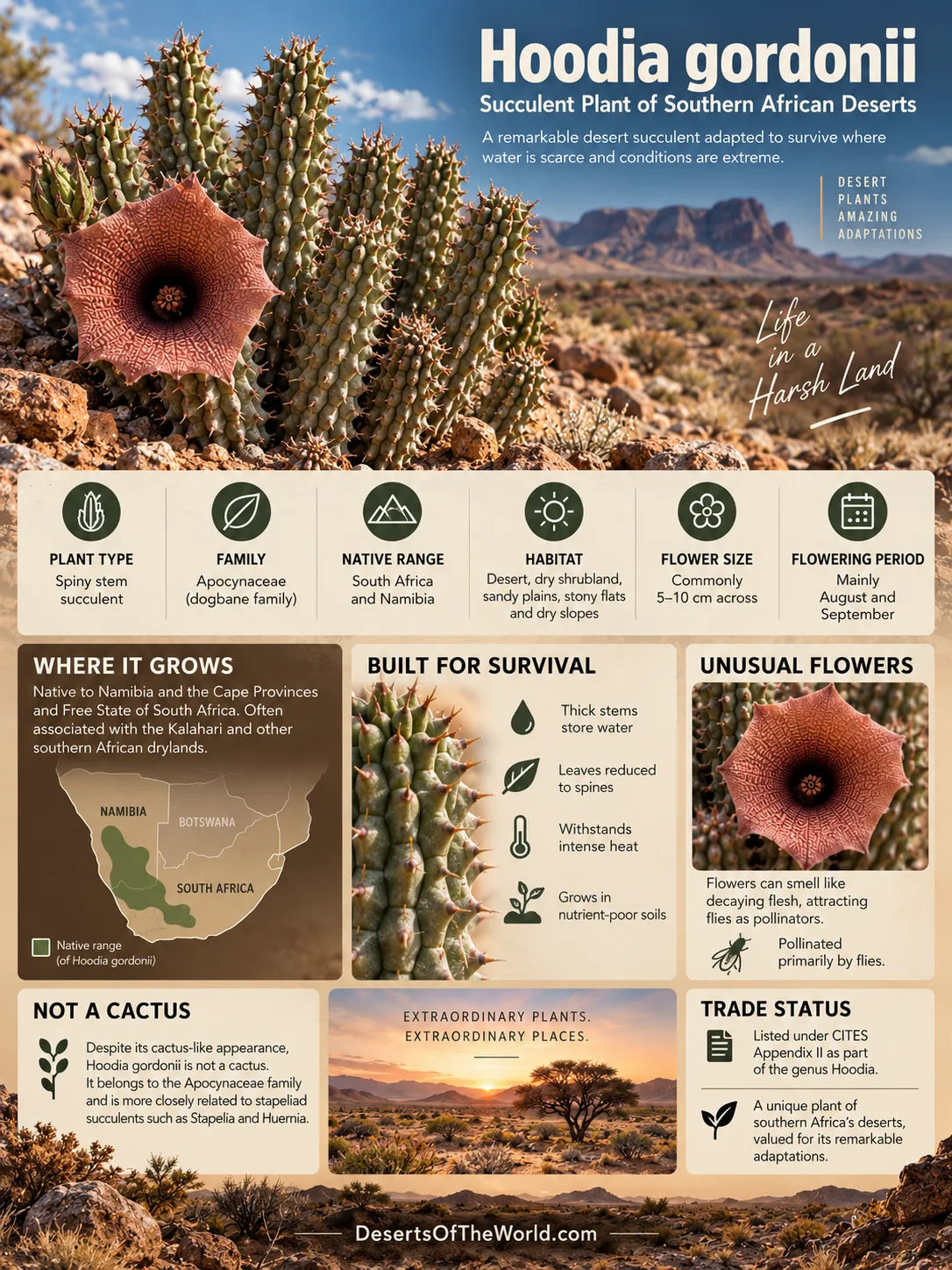
The plant is often called Kalahari cactus, but that name can be misleading. Hoodia gordonii is not a cactus. It belongs to the Apocynaceae family and is more closely related to stapeliad succulents than to members of the cactus family. Its cactus-like shape is an example of unrelated desert plants developing similar solutions to the same environmental pressures.
| Plant Feature | Hoodia gordonii |
|---|---|
| Plant type | Spiny stem succulent |
| Family | Apocynaceae |
| Native range | South Africa and Namibia |
| Main environment | Desert, dry shrubland, sandy plains, stony flats and dry slopes |
| Maximum height | About 1 m under favorable conditions |
| Flower size | Commonly about 5–10 cm across |
| Flowering period | Mainly August and September |
| Pollinators | Primarily flies |
| Seed development | Mainly October and November |
| International trade status | CITES Appendix II as part of the genus Hoodia |
Why Hoodia gordonii Is Not a Cactus
The upright, fleshy stems and rows of sharp projections make Hoodia gordonii look much like a cactus. Botanically, though, the resemblance stops there.
True cacti belong to the family Cactaceae. Hoodia gordonii belongs to Apocynaceae, the dogbane family, within a group of succulents known as stapeliads. Other members of this broader group include Stapelia, Huernia and several Ceropegia species.
The accepted botanical name is Hoodia gordonii (Masson) Sweet ex Decne. Kew’s Plants of the World Online also records older or alternative botanical names, including Stapelia gordonii and Ceropegia gordonii, as synonyms.
The cactus-like form is best understood as convergent adaptation. Desert plants from unrelated families can evolve thick water-storing stems, reduced leaves and compact growth because these features work well under strong heat and limited moisture.
What Hoodia gordonii Looks Like
A young Hoodia gordonii may begin with a single upright stem. Branching becomes much more pronounced as the plant matures, producing a dense cluster that can become almost as broad as it is tall.
SANBI records mature plants with as many as 50 individual branches. Under favorable conditions they may approach 1 m in height, while especially large specimens can become remarkably heavy because so much of the plant consists of fleshy, water-rich tissue.
The stems are usually grey-green to greenish brown. Conventional foliage is essentially absent, so the stems carry much of the plant’s photosynthetic work. Rows of raised tubercles end in sharp points, giving the plant the armored appearance that often causes it to be mistaken for a cactus.
Its flowers are very different from the stems. They emerge near the upper parts of the plant and can measure roughly 5–10 cm across. Flower color varies from pale cream or flesh tones to reddish purple and dark maroon.
Where Hoodia gordonii Grows Naturally
Hoodia gordonii is a southern African dryland species. Current Kew records place its native range in Namibia, the Cape Provinces and the Free State of South Africa. Field descriptions from SANBI place much of its known South African occurrence in the Northern Cape and parts of the Western Cape, with populations continuing northward into Namibia.
Its common name creates one recurring geographic misunderstanding. The plant is often marketed or described as the Kalahari cactus, which can suggest that it is simply a widespread plant of the entire Kalahari Basin.
That is too broad. The genus Hoodia extends across a wider part of southern Africa, including Botswana, but a SANBI review of herbarium records states that verified natural records of Hoodia gordonii itself are from South Africa and Namibia. Records attributed to the species outside that range need careful taxonomic verification.
Its Place in Southern African Drylands
The plant’s range overlaps landscapes associated with the Kalahari and the dry interior of southern Africa, but it is not restricted to a single classic desert surface. Parts of its distribution also connect with Karoo-type drylands and rocky shrubland environments.
This matters because Hoodia gordonii is not simply a dune plant. It occupies a mosaic of dry habitats where low rainfall, exposed soil, intense sunlight and long gaps between dependable water sources shape plant life.
From Kalahari Sand to Stony Slopes
Hoodia gordonii tolerates several kinds of arid terrain. Recorded habitats include:
- deep Kalahari sand
- dry sandy ground
- stony flats
- rocky or gravelly slopes
- open barren ground
- sandy dry riverbeds
- sites beside or beneath xerophytic shrubs
This range of surfaces reveals something useful about desert vegetation. A species does not always belong to one soil texture or one visual type of desert. Small differences in drainage, shade, rock cover and the way rainfall collects can create very different growing conditions within the same dry region.
Sandy ground drains rapidly but can allow roots to explore a deep volume of soil. Stones can reduce direct evaporation from patches of soil beneath them. Dry drainage lines may remain without flowing water for most of the year yet briefly collect moisture when rain does arrive.
Hoodia gordonii can take advantage of several of these dryland niches.
How Its Succulent Stems Manage Water Scarcity
The most obvious desert adaptation is the thick stem. Instead of investing heavily in broad leaves, Hoodia gordonii keeps much of its living tissue inside fleshy stems that can hold water between rain events.
Reduced leaf area also means less exposed surface through which water can be lost. The green stems remain photosynthetically active, allowing the plant to produce carbohydrates without maintaining a large canopy of conventional leaves.
Hoodia has also been described in botanical literature as a CAM succulent. CAM, or Crassulacean acid metabolism, allows a plant to shift much of its carbon dioxide uptake toward the cooler night period. Stomata can remain more restricted during the hotter part of the day, reducing the amount of water lost while gas exchange takes place.
That does not make the plant independent of rain. Succulence is a storage system, not a source of water. It helps the plant stretch brief periods of moisture across much longer dry intervals.
Tolerance of Hot Days and Cold Desert Nights
Southern African drylands are not permanently warm. Open desert and semi-desert terrain can experience strong temperature swings between day and night and between seasons.
SANBI reports that Hoodia gordonii occurs under heat exceeding 40°C and can survive temperatures around −3°C. These figures describe the plant’s broad tolerance rather than a precise physiological limit for every population or individual.
Frost can still damage the plant. Its ability to cope with occasional cold therefore should not be confused with the cold hardiness of plants from regularly freezing deserts.
Why the Flowers Smell Like Decaying Flesh
The flowers of Hoodia gordonii use a pollination system very different from the sweet-scented flowers associated with bees and butterflies.
They produce an odor often compared with decaying animal matter. To people the smell may be unpleasant, but to certain flies it acts as an attractant.
This type of fly pollination is known as myophily. Related stapeliad plants, including Stapelia and Huernia, use similar strategies.
How Fly Pollination Works
The flower combines scent with flesh-like colors that can range from pale tones to deep reddish purple. Flies investigating the odor visit the flower and can transfer pollen as they move between blooms.
The smell therefore is not an accidental by-product of living in the desert. It forms part of the plant’s reproductive biology.
Pollination also shows why a desert plant cannot be understood through drought adaptation alone. Hoodia gordonii must conserve water, survive heat, reproduce successfully and attract an available pollinator population. All of those processes operate in the same dry ecosystem.
Flowers, Horn-Shaped Fruits and Wind-Carried Seeds
In its southern African range, Hoodia gordonii commonly flowers during August and September, around the beginning of southern-hemisphere spring. Seed development follows, with mature fruits commonly recorded during October and November.
The fruit is especially distinctive. It develops as a pair of long follicles that spread apart in a V shape. Kew describes these fruits as reaching roughly 12 cm long.
The paired shape resembles small antelope or goat horns. This appearance is connected with the Afrikaans common name bokhorings.
When the follicles mature and split, they release numerous light, flat seeds. Each seed carries a tuft of silky hairs called a pappus. The hairs catch moving air and allow seeds to travel away from the parent plant.
Wind dispersal is useful in open dry country, but landing somewhere is only the beginning. A seed that reaches bare, sun-baked ground may still face conditions too harsh for successful establishment.
Young Hoodia Often Starts Beneath a Nurse Plant
A mature Hoodia gordonii can stand exposed to fierce sun, yet its earliest life stage may depend on shade.
SANBI describes young Hoodia plants becoming established beneath a nurse plant, usually a shrub that creates a more sheltered patch of ground. Its branches reduce direct solar exposure while the shaded soil below can remain cooler than nearby open ground.
The shelter may also slow moisture loss from the upper soil after rain. For a tiny seedling with a limited root system and little stored water, that small difference can determine whether it survives its first dry period.
As the Hoodia becomes larger and stores more water in its stems, it becomes better equipped for open conditions.
| Life Stage | Main Desert Challenge | Useful Trait or Condition |
|---|---|---|
| Seed | Finding a suitable establishment site | Silky hairs allow wind dispersal |
| Seedling | Hot ground and rapid drying | Shelter beneath a nurse shrub |
| Young plant | Building water reserves | Developing fleshy photosynthetic stems |
| Mature plant | Long dry periods and reproduction | Stem succulence, CAM metabolism and fly-pollinated flowers |
Hoodia and San Traditional Knowledge
Hoodia has a long history of use among San communities in southern Africa. Recorded traditional knowledge describes the fleshy material being used during long journeys and hunting trips when access to food and water was limited.
This history is often simplified into the statement that Hoodia is a traditional “weight-loss plant.” That modern phrase changes the original context. Traditional use was tied to coping with hunger and thirst while moving through dry landscapes, not to the commercial diet-product market that later developed around the plant.
The distinction matters because scientific interest in Hoodia eventually drew directly from this existing knowledge.
From Traditional Knowledge to P57 Research
South Africa’s Council for Scientific and Industrial Research, or CSIR, investigated Hoodia and later isolated compounds associated with appetite-related effects. One compound became widely known as P57.
The commercial interest that followed led to patents, licensing arrangements and plans to develop Hoodia-derived products. Recognition that this work had drawn on San traditional knowledge later resulted in negotiations between CSIR and San representatives.
A benefit-sharing agreement was reached in 2003. It provided for San communities to receive a share of certain milestone and royalty payments connected with commercial development of P57. The Hoodia case later became a widely cited example in discussions of traditional knowledge, biological resources and benefit sharing.
What Human Research Says About Hoodia and Weight Loss
The commercial reputation of Hoodia gordonii became much larger than the human evidence supporting it.
The U.S. National Center for Complementary and Integrative Health states that very little is known from human research. One controlled study involved 49 healthy overweight women who received either a purified Hoodia extract or a placebo for 15 days.
The Hoodia group did not lose more weight than the placebo group, and the extract did not produce the expected reduction in energy intake. The study also recorded tolerability concerns, including nausea and vomiting, along with changes in blood pressure, pulse and several laboratory measurements.
Traditional use, laboratory research into compounds such as P57 and proven weight-loss treatment are therefore three different subjects. Evidence for one should not be treated as proof of the others.
Evidence note: Hoodia gordonii is botanically well documented as a southern African succulent, but current human research does not establish it as an effective weight-loss treatment.
Why International Hoodia Trade Is Controlled
Commercial attention created demand not only for extracts but also for seeds, powder, dried material and live plants. CITES records show that trade expanded during the period when Hoodia attracted strong international interest as a possible dietary ingredient.
The genus Hoodia, including Hoodia gordonii, has been listed in CITES Appendix II since January 12, 2005.
Appendix II does not mean that every listed species is currently endangered. It means international trade is controlled so that commercial movement does not become incompatible with the survival of wild populations.
This distinction is especially useful for Hoodia gordonii. Its trade status and its conservation assessment are not the same thing.
Understanding the Conservation Status of Hoodia gordonii
Kew currently describes the species as not formally evaluated at the global level in the conservation information attached to its species profile. An older assessment from Namibia classified it as Lower Risk–Least Concern under the IUCN categories used at that time.
Kew also carries a 2024 model-based flowering-plant extinction-risk prediction that places Hoodia gordonii in the predicted not threatened category with confident model output.
A prediction model is not the same as a formal IUCN Red List assessment. It uses available botanical data to estimate risk and can help identify plants that may need closer assessment, but it should not be converted into an official Red List category.
| Conservation Measure | Current Interpretation |
|---|---|
| Formal global IUCN assessment | No global assessment reported by Kew |
| Older Namibian assessment | Lower Risk–Least Concern |
| 2024 Kew-linked extinction-risk model | Predicted not threatened |
| CITES | Appendix II international trade controls |
Wild populations still matter even where a plant is not classed as globally threatened. Collection pressure can be highly uneven, and a widespread species may occur in scattered local populations rather than forming continuous stands across its mapped range.
What Hoodia Reveals About Southern African Desert Ecology
Hoodia gordonii brings several desert processes together in one plant.
- Succulent stems store water between irregular rain events.
- Minimal conventional foliage limits exposed leaf area.
- CAM metabolism supports water-efficient gas exchange.
- Fly-pollinated carrion flowers connect the plant to desert insect communities.
- Wind-carried seeds spread across open terrain.
- Nurse shrubs can provide the protected microhabitat needed by young seedlings.
Those traits also explain why the plant cannot be reduced to the label “Kalahari cactus.” Its story reaches across the Kalahari and Karoo dryland context, succulent evolution, insect pollination, seed dispersal and the traditional ecological knowledge of people who have lived within southern Africa’s dry landscapes.
A mature Hoodia standing on exposed sand or stony ground may look completely self-contained. Its life cycle says otherwise. Rainfall, wind, flies, neighboring shrubs and the physical structure of the desert surface all help determine where the next generation can grow.
Sources
- Royal Botanic Gardens, Kew — Plants of the World Online: Hoodia gordonii (accepted taxonomy, native range, synonyms and botanical classification)
- Royal Botanic Gardens, Kew — Hoodia gordonii General Information (morphology, habitat, traditional use and conservation information)
- South African National Biodiversity Institute — Hoodia gordonii (plant description, habitat, flowering, pollination, seeds and nurse-plant ecology)
- South African National Biodiversity Institute — Trade in Hoodia gordonii and Other Hoodia Species (verified distribution, Hoodia trade and conservation background)
- CITES — Review of Trade and Management of Hoodia gordonii (Appendix II listing date and international trade history)
- U.S. National Center for Complementary and Integrative Health — Hoodia (human research, effectiveness and safety evidence)
- PubMed — Randomized Controlled Trial of Hoodia gordonii Purified Extract (15-day placebo-controlled human study)
- World Intellectual Property Organization — Hoodia Benefit Sharing (P57 development, San traditional knowledge and the 2003 benefit-sharing agreement)