
The best time to visit the Sahara Desert is usually from October to early April, with the most balanced months often being October, November, February, March, and early April. These months give most visitors warm daylight, cooler evenings, clearer walking conditions, and a better chance of enjoying dunes, oases, desert camps, rocky plateaus, and stargazing without the hardest summer heat.
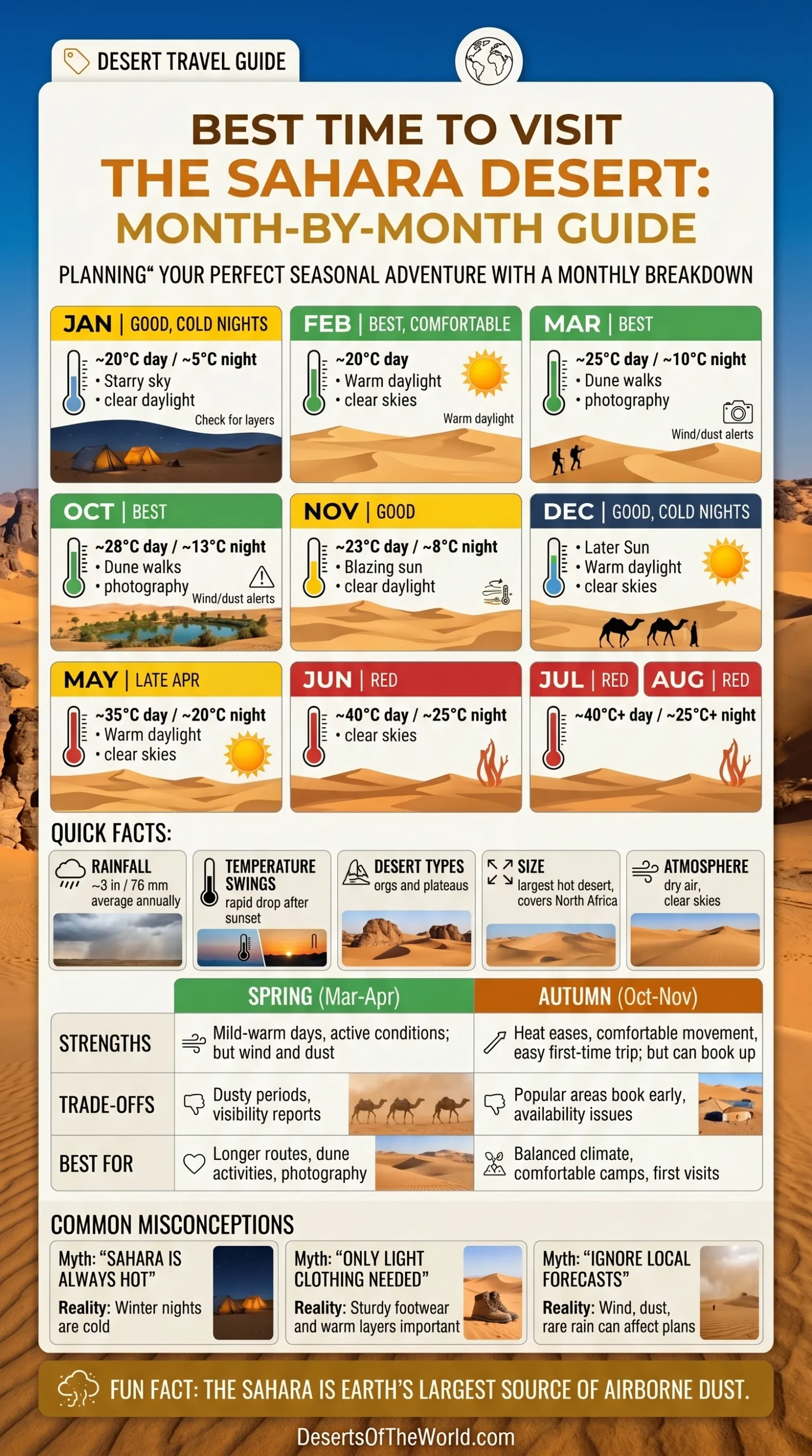
The Sahara is not one single weather zone. It stretches across North Africa, touching areas linked with Morocco, Algeria, Tunisia, Libya, Egypt, Mauritania, Mali, Niger, Chad, Sudan, and Western Sahara. A trip near Erg Chebbi in Morocco will not feel exactly like a visit near Siwa in Egypt, Djanet in Algeria, or the central Saharan interior. Still, the travel pattern is clear: winter is cool by day and cold at night, spring is pleasant but can be dusty, summer is very hot, and autumn is often the easiest season for first-time visitors.
Best Months to Visit the Sahara Desert
| Period | General Comfort | Typical Desert Feel | Best For | Main Thing to Check |
|---|---|---|---|---|
| October to November | Very good | Warm days, cooler evenings, easier desert movement | Dune camps, photography, stargazing, soft outdoor activity | Availability in popular gateway towns |
| December to February | Good, with cold nights | Clear daylight, sharp evening temperature drops | Stargazing, quiet desert stays, daytime exploration | Warm layers for nights and early mornings |
| March to Early April | Very good | Mild to warm days, active winds in some areas | First-time visits, longer routes, dune walks | Dust, wind, and local visibility reports |
| Late April to May | Mixed | Warmer days, cooler nights fading, stronger sun | Travelers comfortable with heat | Midday heat and route length |
| June to August | Difficult | Very hot days, limited comfort outside early and late hours | Only carefully planned short desert visits | Heat, camp closures, transport timing, shade |
| September | Improving | Still hot early in the month, better later | Flexible travelers aiming before peak season | Late-summer heat and storm risk in some southern edges |
For most readers, the simplest answer is this: choose autumn if you want the smoothest first Sahara trip. Choose late winter or early spring if you prefer cooler air and do not mind packing warm clothing. Summer asks for more caution. The desert gives little margin in July and August.
Why Timing Matters in the Sahara
The Sahara is the largest hot desert on Earth, and its climate is shaped by dry air, open skies, sparse rainfall, intense sun, and wide day-night temperature swings. Britannica notes that average rainfall across the Sahara is roughly 3 inches / 76 millimeters per year, though rainfall is uneven and some zones receive far less. That number matters for travel because dry air can make daytime heat feel sharp while nights cool quickly after sunset.
Between December and February, broad Saharan averages can sit around 20°C / 68°F by day and 5°C / 41°F at night. Between June and August, broad averages can rise near 40°C / 104°F by day and 25°C / 77°F at night. These are wide desert averages, not a promise for every camp or route. Inland basins, high plateaus, wind-exposed dunes, and oasis towns each behave a little differently.
One detail is easy to miss: the Sahara is not only sand. The famous dunes are called ergs, but much of the desert also includes rocky plateaus, gravel plains, dry valleys, salt flats, mountains, and oasis corridors. A month that feels fine for a short sunset visit near a dune camp may feel very different on a long overland route across open reg or hamada terrain.
Month-by-Month Guide to Visiting the Sahara Desert
| Month | Travel Comfort | Desert Conditions | Good Fit For |
|---|---|---|---|
| January | Cool by day, cold at night | Clear air is common, but nights can feel much colder than expected | Stargazing, quiet camps, short daytime walks |
| February | Cool to mild | Comfort improves during the day; evenings still need warm layers | First-time visitors who prefer cooler weather |
| March | Very good | Mild to warm days; wind and dust can appear in some areas | Dune walks, photography, desert camps, longer routes |
| April | Good early, warmer later | Bright days, stronger sun, occasional dusty spells | Travelers who want warmth without full summer heat |
| May | Mixed | Heat builds; midday activity becomes less pleasant | Short visits, sunrise and sunset outings |
| June | Hard | Hot days and limited shade; some camps reduce activity | Only well-planned trips with flexible timing |
| July | Very hard | One of the hottest periods; daytime comfort is low | Not ideal for most visitors |
| August | Very hard | Heat remains strong; some southern margins may see storm activity | Only careful, limited desert access |
| September | Improving late in the month | Early September can still feel like summer; late September is better | Flexible travelers who can choose cooler days |
| October | Excellent | Warm days, cooler nights, more comfortable movement | First-time visits, camps, photography, dune routes |
| November | Excellent | Comfortable daylight and cooler evenings | Balanced desert travel without summer heat |
| December | Good, with cold nights | Clear days are pleasant; nights can be sharply cold | Stargazing, calm desert stays, cooler weather travel |
January in the Sahara
January is a winter month in the Sahara. Daytime can be bright and comfortable, especially when the sun is high, but the cold arrives quickly after sunset. In open desert camps, the temperature drop can surprise visitors who packed for “a hot desert” and nothing else.
This is a good month for people who like quiet routes, clear skies, and crisp air. It is less suitable for anyone expecting warm evenings outdoors. A thick layer, a warm hat, and proper sleeping arrangements matter more than style here.
Best for: stargazing, calm desert camps, daytime dune viewing, and cooler overland travel.
February in the Sahara
February often feels more forgiving than January. Days start to soften, while nights can still be cold in open areas and higher desert regions. It is one of the better months for visitors who want mild daytime weather without the busier feel of spring.
Wind can still shape the day. On calm mornings, dunes look clean and sharply lined. On windy afternoons, fine sand and dust may reduce visibility. Normal desert rhythm, this is.
Best for: travelers who want cooler daylight, clear skies, and quieter desert routes.
March in the Sahara
March is one of the strongest months for a Sahara visit. The weather is often warm enough for outdoor time but not yet locked into summer heat. Dune walks, camp stays, photography, and longer drives usually feel more natural in March than in the hotter months.
The trade-off is wind. NASA Earth Observatory notes that Saharan dust storms can happen at any time of year, with winter and spring storms often carrying dust far beyond the desert. March can be excellent, but it is wise to check local conditions before committing to long exposed routes.
Best for: first-time visitors, photographers, longer desert loops, and travelers who want a strong balance of warmth and comfort.
April in the Sahara
April sits near the edge of the main comfortable season. Early April can be one of the best periods of the year, especially in Moroccan and northwestern Saharan gateway areas. Late April often feels hotter, with a stronger sun and less patience for midday activity.
Plan active time around morning and late afternoon. The desert looks different in those hours anyway: dunes show more shape, shadows deepen, and the light feels less flat.
Best for: warm-weather visitors, early-season desert camps, and shorter dune activities.
May in the Sahara
May is the turning point. The desert is still visitable in many gateway areas, but the easy comfort of March and April begins to fade. Midday heat can become tiring, especially on open sand, rocky ground, and long vehicle transfers with little shade.
May works better for short desert stays than for demanding routes. Sunrise and sunset carry the day. The hours between them need more care.
Best for: flexible visitors who can avoid midday exposure and keep plans simple.
June in the Sahara
June starts the hard summer pattern. The sun is high, shade is scarce, and many outdoor activities become less comfortable after the early morning. In some areas, desert camps may adjust operations, shorten excursions, or focus on late-day arrivals.
A June visit should be built around comfort rather than ambition. Long walks, casual midday wandering, and packed schedules do not fit the season well.
Best for: short, carefully timed visits with early morning or evening activity.
July in the Sahara
July is one of the most difficult months for Sahara travel. Broad summer averages can reach around 40°C / 104°F by day across the desert, and some inland sites may feel hotter. The ground radiates heat, vehicles warm quickly, and the body has to work harder even during simple movement.
Most visitors are better served by choosing another month. If July is the only option, keep desert exposure brief, choose established routes, confirm accommodation cooling arrangements, and avoid building the trip around daytime outdoor activity.
Best for: travelers with a specific reason to go and a very controlled plan.
August in the Sahara
August remains very hot. In the southern fringes of the Sahara, the seasonal movement of tropical weather systems can also bring localized storm activity, while other zones stay dry and intensely sunny. The result is not a simple “dry heat” story across the whole desert.
For comfort, August is not a natural first choice. Late August may start to feel slightly better in some places, but it is still far from the autumn sweet spot.
Best for: limited desert access, not broad exploration.
September in the Sahara
September is a transition month. Early September can feel close to summer. Late September often becomes more reasonable, especially in northern and northwestern Sahara gateway regions. The difference between the first and last week can be noticeable.
Travelers choosing September should stay flexible. A late-month plan is usually better than an early-month plan, and local forecasts matter more than fixed seasonal labels.
Best for: flexible travelers who want to arrive before the main autumn season.
October in the Sahara
October is one of the best months to visit the Sahara Desert. Days are often warm rather than punishing, evenings cool down without turning as cold as winter, and desert camps usually feel more comfortable. For many first-time visitors, October gives the cleanest balance.
This is also a strong month for photography. The sun is still bright, but the heat does not usually dominate the whole day. Dune ridges, palm groves, dry valleys, and old caravan-route towns are easier to appreciate when the weather gives you room to slow down.
Best for: first-time Sahara trips, desert camps, dune photography, and balanced outdoor time.
November in the Sahara
November is another excellent month. It often feels a little cooler than October, especially at night, but daytime conditions remain pleasant in many visitor regions. The air can feel clearer after the summer heat has eased, and long transfers are less tiring.
For travelers who want a calmer feel than October, November is a strong pick. Pack a warm layer for evenings, especially if staying in tents or simple desert lodges.
Best for: comfortable daytime exploration, stargazing, and quieter late-autumn travel.
December in the Sahara
December brings winter back into the Sahara. Days can still be bright and enjoyable, yet nights may feel cold enough to change the whole trip if clothing is too light. A desert camp in December can be beautiful. It can also be chilly. Both things are true.
This month suits visitors who prefer cool air and do not mind bundling up after sunset. It is not the month for warm evening lounging unless the accommodation is set up for winter comfort.
Best for: winter stargazing, cool daytime walks, and visitors who enjoy quiet desert nights.
Best Time by Sahara Travel Style
For First-Time Visitors
Choose October, November, March, or early April. These months usually give the easiest mix of warmth, comfort, route access, and camp availability. They also work well for the most common Sahara experiences: dune viewing, overnight stays, sunrise walks, and short camel or 4×4-supported routes.
For Stargazing
Choose November to February if cold nights do not bother you. Winter air can feel crisp, and long nights allow more time under dark skies. The main condition is warmth. A clear sky is only enjoyable when you can stay outside comfortably.
For Photography
Choose October, November, February, March, or early April. These months often give cleaner light than summer, easier movement, and more patience for waiting at dunes, palm oases, rock formations, and dry lake beds.
Wind matters as much as month. A calm morning can make a dune field look almost freshly drawn. A windy afternoon can blur the horizon in minutes.
For Families
Choose October, November, February, or March. These months reduce the strain of heat while avoiding the coldest midwinter nights in many areas. Keep desert stays short and simple, especially with children or older family members.
For Travelers Sensitive to Heat
Choose December, January, February, or November. Winter days can be gentle, but nights need proper clothing. For many heat-sensitive visitors, a cold evening is easier to manage than a very hot afternoon.
For Lower Crowds
Look at February, early March, late November, or early December. These periods can feel calmer than peak holiday windows and the busiest autumn-spring travel weeks. Availability changes by route, so it is still worth checking camps and transport early.
Spring vs Autumn in the Sahara
| Season | Strengths | Trade-Offs | Best Choice If You Want |
|---|---|---|---|
| Spring | Mild to warm days, good light, strong travel conditions before summer | Wind and dust can be more noticeable in some regions | Warmth, active days, and classic desert camp weather |
| Autumn | Heat eases, evenings are cooler, routes feel more comfortable | Popular gateway areas may book up earlier | The easiest first-time Sahara experience |
Autumn has a slight edge for many visitors because the desert is cooling down after summer. Spring is still excellent, especially from March into early April, but dusty wind can be a larger part of the experience. Not every spring day is dusty. Yet the chance is there, and it belongs in the plan.
How the Sahara Changes by Region
The phrase “Sahara Desert” covers a huge area. Month-by-month advice works best when it is tied to the kind of place being visited.
Moroccan Sahara Gateway Areas
Popular routes near Merzouga, Erg Chebbi, Zagora, M’Hamid, and Erg Chigaga often work best from October to April. March, early April, October, and November are usually the most comfortable months for dune camps and short desert excursions. Winter nights can be cold, especially in tented accommodation.
Algerian Sahara and Tassili n’Ajjer Region
Southern Algerian desert landscapes include dunes, rock formations, plateaus, and oasis towns. Cooler months are preferred for comfort. Winter can be excellent for daylight exploration, but nights may be cold in open or elevated terrain.
Egyptian Western Desert and Oasis Routes
Areas such as Siwa and other Western Desert routes are often more comfortable from autumn through spring. Summer heat can be hard on longer drives and outdoor stops. Winter nights may still require warm layers.
Sahel-Fringe and Southern Sahara Areas
The southern edge of the Sahara connects with the Sahel. Here, seasonal rainfall patterns can differ from the northern desert. Late summer can bring localized storms in some areas, while the central desert may remain very dry. For travel comfort, cooler dry-season months are usually easier than the hottest part of the year.
Weather Details That Affect a Sahara Trip
Day-Night Temperature Swings
The Sahara cools quickly after sunset because dry air and clear skies let heat escape fast. A day that feels warm in February can become cold after dark. This is why packing only light clothing is a common mistake in winter and early spring.
Think in layers:
- Light, breathable clothing for sunny daytime hours
- A warm fleece or insulated layer for evenings
- A wind-resistant outer layer for exposed camps or viewpoints
- A scarf or face covering for wind and dust
Wind and Dust
Dust is part of the Sahara’s natural system. NASA describes the Sahara as Earth’s largest source of airborne dust, and dust storms can happen in any season. Winter and spring events are especially relevant for travelers because strong winds can reduce visibility and change the feel of a route quickly.
This does not mean spring should be avoided. It means visitors should treat wind forecasts as real travel information, not background noise.
Rainfall and Rare Storms
The Sahara is dry, but “dry” does not mean rain never happens. Rain is limited, uneven, and sometimes sudden. Some desert areas may go long periods with little rain, while rare storms can reshape dry valleys and low-lying tracks for a short time.
For visitors, the practical point is simple: check local advice before entering remote routes, especially near wadis, dry lake beds, and unpaved desert tracks after unusual weather.
Altitude and Landform
High desert plateaus and mountain areas can feel much cooler than low dune basins. Rocky terrain also holds and reflects heat differently from sand. A route that crosses hammada, reg plains, dunes, and oasis valleys may feel like several deserts in one day.
Best Time for Desert Camps
The best months for Sahara desert camps are usually October, November, March, and early April. These months give a good balance between warm daylight and manageable nights. February and December can also be pleasant, but sleeping comfort depends more on blankets, heating arrangements, tent quality, and wind protection.
In summer, some camps may reduce operations or become uncomfortable during the day. Even when overnight temperatures are milder than midday heat, the long hot approach can drain energy before the camp experience begins.
Best Time for Dune Walks
For dune walks, choose October to April, with March, early April, October, and November being the most comfortable for many visitors. The best daily timing is usually near sunrise or late afternoon. Dune sand can become very hot under strong sun, and soft sand makes walking harder than it looks.
Short walks are better than long ones for most visitors. A dune field is not a flat trail; every step sinks a little. The desert makes small distances feel larger.
Best Time for Stargazing
The Sahara can offer dark, open skies, especially away from towns and bright camp lighting. The cooler months from November to February are often excellent for stargazing, but they also bring cold nights. March and October can be more comfortable for standing outside longer.
For the best experience, look beyond the month:
- Choose a site away from strong artificial lights
- Check the moon phase if dark skies matter
- Bring warm clothing even if the day was sunny
- Allow time for eyes to adjust to darkness
When to Avoid Visiting the Sahara
For most travelers, the hardest period is June through August. July and August are especially difficult because daytime heat can limit activity, reduce comfort, and make long transfers feel tiring. This does not make travel impossible on every route, but it does make the margin smaller.
Visitors who are sensitive to heat, traveling with young children, planning long outdoor activities, or expecting relaxed midday exploration should choose another season. The Sahara is better when the weather allows you to notice the landscape, not just endure the temperature.
What to Pack by Season
| Season | Clothing Focus | Useful Additions | Common Mistake |
|---|---|---|---|
| Winter | Warm layers, wind-resistant jacket, comfortable daytime clothing | Hat, gloves for cold nights, warm sleepwear | Packing only for daytime sun |
| Spring | Light layers, sun protection, evening layer | Scarf for dust, sunglasses, closed shoes | Ignoring wind and visibility |
| Summer | Loose breathable clothing, full sun coverage | Extra water plan, shade breaks, early timing | Planning midday outdoor activity |
| Autumn | Breathable daytime clothing, light evening layer | Sun hat, scarf, comfortable walking shoes | Assuming October nights are always warm |
How Many Days Are Enough for the Sahara?
The answer depends on distance from the gateway city. A short one-night camp can work near some access points, but longer routes often need two or more nights because desert roads, mountain crossings, and oasis stops take time. The Sahara rewards slower movement. Rushed routes often turn the desert into a backdrop seen through a window.
For a first visit, a balanced plan often includes:
- One arrival day with sunset near the dunes or desert edge
- One full or partial day for nearby landforms, oasis areas, or short walks
- One sunrise or early morning before departure
In hotter months, fewer activities and more rest time make the trip easier. In cooler months, longer daytime exploration becomes more realistic.
Common Weather Mistakes Visitors Make
- Thinking the Sahara is always hot: winter nights can be cold, especially in camps and open desert areas.
- Choosing summer for price alone: lower demand may come with harder heat and fewer comfortable activity hours.
- Skipping local forecasts: wind, dust, and rare rain can change plans faster than seasonal averages suggest.
- Packing open shoes only: sand, gravel, hot ground, and cold evenings all favor sturdy footwear.
- Planning too much at midday: even in good months, morning and late afternoon are often more pleasant.
Month Choice by Visitor Priority
| Priority | Best Months | Why These Months Work |
|---|---|---|
| Most Comfortable First Visit | October, November, March, Early April | Warm daylight, cooler evenings, better outdoor comfort |
| Cool Weather | December, January, February | Lower daytime heat, clear winter feel, cold nights |
| Stargazing | November to February, plus March | Longer nights and cooler air, with cold-weather packing needed |
| Photography | October, November, February, March | Good light, more patience outdoors, less summer haze from heat |
| Fewer People | February, Late November, Early December | Often calmer than the busiest spring and autumn windows |
| Heat Avoidance | November to March | Best chance of avoiding harsh daytime heat |
Helpful Notes Before Choosing a Sahara Month
Use Local Forecasts, Not Only Seasonal Advice
Seasonal advice helps with planning, but the final decision should include a local forecast for the nearest gateway town or desert camp. Look for temperature, wind speed, dust alerts, and any unusual rain reports.
Check the Exact Route
A paved-road viewpoint, a dune camp, a remote plateau route, and a multi-day crossing are not the same kind of trip. The harder the route, the more important the month becomes.
Match the Month to Your Body, Not Only the View
The Sahara is beautiful in many seasons. Comfort is the filter. If heat drains you quickly, do not choose May through September for a first visit. If cold nights bother you, avoid the deepest winter or choose accommodation with better insulation.
Give the Desert Enough Time
Many visitors remember the quiet parts most: the color change before sunset, the first cold minute after dark, the way wind redraws small ripples across sand. These moments need time. A better month gives you that time without fighting the weather.
Sources
- Britannica: Sahara Climate (general Sahara climate, rainfall, and day-night temperature patterns)
- World Meteorological Organization: State of the Climate in the Arab Region 2024 (regional climate context, hyper-arid inland areas, heat, and daily temperature range)
- NASA Earth Observatory: A Burst of Saharan Dust (Saharan dust behavior and seasonal transport patterns)
- NASA Earth Observatory: March of the Harmattan (Harmattan winds and Saharan dust movement in northwestern Africa)
- World Bank Climate Change Knowledge Portal: Morocco Historical Climate Data (regional climate data useful for Moroccan Sahara gateway planning)