
Desert travel safety starts before the first step onto sand, gravel, salt, rock, or dry wash. A desert may look open and simple from a road, yet its risks are often quiet: heat builds slowly, distance feels shorter than it is, shade may be rare, and phone service can fade just when a visitor needs it. Good planning keeps the visit calm. It also protects the landscape, because many desert surfaces take far longer to recover than they appear.
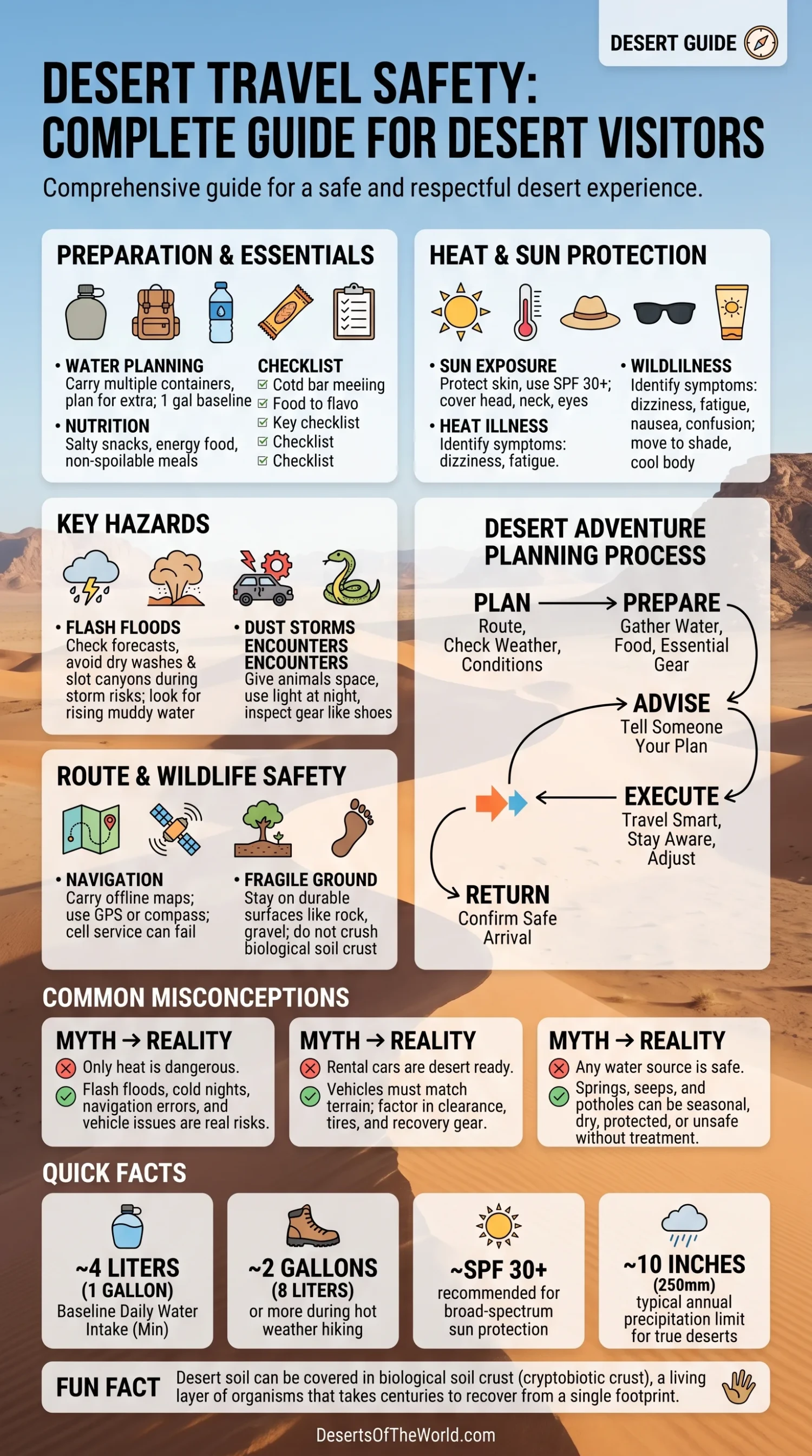
Desert Safety Basics By Situation
| Desert Situation | Main Concern | Safer Visitor Approach |
|---|---|---|
| Roadside Scenic Stop | Heat, glare, short walks becoming longer than planned | Carry water away from the vehicle, wear sun protection, and set a clear return point. |
| Day Hike | Dehydration, route confusion, foot injuries, exposure | Start early, use a map, carry more water than the route seems to need, and turn back before the plan feels strained. |
| Remote Desert Drive | Flat tires, soft sand, rough tracks, long gaps between help | Match the vehicle to the road, bring recovery gear, carry extra water, and share the route before leaving. |
| Dune Or Salt Flat Visit | Disorientation, reflected sunlight, soft ground after rain | Use visible landmarks, avoid low-visibility conditions, protect eyes and skin, and stay off wet or closed surfaces. |
| Canyon Or Dry Wash Route | Flash flood from storms nearby or upstream | Check forecasts, avoid narrow drainages during storm risk, and move to higher ground if water rises or changes color. |
| Overnight Camp | Cold nights, wind, wildlife contact, poor site choice | Camp away from washes, bring layers, use a headlamp, and inspect shoes or bedding before use. |
Why Desert Travel Needs A Different Plan
A desert is usually defined by low rainfall rather than heat alone. Many desert ecosystems receive less than 10 inches, or about 250 millimeters, of annual precipitation. Some are hot. Some are cold. Some sit near coasts where fog cools the air, while others lie on high plateaus where winter nights can feel sharp.
This matters because desert safety is not only about carrying water. Visitors also need to think about sun exposure, route finding, road surface, flash flooding, temperature swings, and fragile ground. The land is open, but help may not be close.
Desert distance can fool the eye. A ridge may seem near because there are few trees or buildings to give scale. A dry lake bed may look smooth, then turn sticky after rain. A canyon may feel sheltered, then become unsafe during storm conditions. Small decisions carry weight here.
Main Desert Hazards Visitors Should Know
Heat and Sun Exposure
Heat is the hazard most visitors expect, but it does not always feel alarming at first. Dry air helps sweat evaporate fast, so a person may not notice how much fluid is being lost. Wind can hide the strain too. The body keeps working, until it does not.
Direct sun adds another layer. Bare ground, pale sand, salt, and light-colored rock can reflect sunlight upward. That means exposed skin, eyes, lips, ears, and the back of the neck need protection even during short stops.
Dehydration and Salt Loss
Water loss and salt loss often happen together in hot desert travel. Drinking water matters, but so does eating enough. A visitor who sweats for hours and drinks plain water without food may still feel weak, dizzy, or foggy. Salty snacks, normal meals, and electrolyte products can help during longer outings.
Thirst is not a perfect warning system. In a dry desert, drink before thirst becomes strong. Better still, set a rhythm: small amounts often, with food during longer effort.
Navigation Problems
Desert navigation can fail in simple ways. A trail fades across slickrock. Tire tracks split into several routes. Dunes hide footprints. A wash bends until the original direction is hard to judge. A phone map works at the trailhead, then loses signal miles later.
Carry an offline map, a paper map where available, and a compass or GPS device that does not depend only on cell service. More important: know how to use them before the trip begins.
Vehicle Problems
In many desert areas, the vehicle is part of the safety plan. Tires, clearance, cooling system, fuel range, and road conditions matter. A paved viewpoint road is one thing. A sandy track, rocky wash road, or remote backcountry route is another.
A standard rental car may be fine for paved desert park roads, yet unsuitable for deep sand or rough tracks. A 4×4 badge does not make a vehicle ready for every desert road; tires, clearance, recovery points, driver skill, and current conditions all matter.
Flash Floods
Deserts can flood fast. Hard, dry soil and narrow drainage channels may send rainwater downhill with little warning. The storm may not be overhead. It may be upstream, beyond the visitor’s view.
Dry washes, slot canyons, low crossings, and canyon bottoms need respect. If water rises, turns muddy, carries debris, or makes a sudden rushing sound, move to higher ground. Do not try to cross moving floodwater on foot or by vehicle.
Dust, Wind, and Low Visibility
Dust storms can turn a clear road into a wall of brown air. Visibility may drop fast. Wind also strips moisture from skin and lips, chills the body at night, and can make a simple camp uncomfortable.
In open desert, blowing dust may arrive before rain or with strong outflow winds from storms. Watch the horizon. If a dust wall approaches, delay travel or stop safely before entering it.
Wildlife Encounters
Most desert animals avoid people when given space. Snakes, scorpions, spiders, bats, rodents, lizards, and insects are part of the ecosystem. Trouble usually starts when someone places a hand where they cannot see, walks barefoot at camp, leaves food loose, or tries to touch wildlife.
Use a light at night. Shake out shoes. Keep hands out of holes, rock cracks, and dense brush. Step where you can see. Simple habits work.
Water Planning That Matches Heat, Distance, and Effort
Many U.S. desert park safety pages use one gallon, or about 4 liters, per person per day as a baseline for desert visits. Hot hiking, long exposure, remote driving, or delayed return may require more. Mojave desert guidance, for example, advises at least one gallon per person per day and two gallons when hiking in hot weather.
Treat that number as a starting point, not a promise. A cool roadside visit and a summer hike on open ground are not the same trip.
How To Carry Water More Safely
- Carry water in more than one container. If one leaks, not all water is lost.
- Keep emergency water in the vehicle, but do not leave all water there when walking away.
- Use bottles or reservoirs with known capacity, not vague “large” containers.
- Drink steadily instead of waiting until the body feels drained.
- Pair water with food on longer outings, especially in hot weather.
- Set a turn-back amount before leaving. When that amount is reached, return.
Water Sources In Deserts
Do not assume a spring, seep, tank, pothole, or map-marked water point will be usable. Desert water may be seasonal, dry, hard to reach, protected for wildlife, or unsafe without treatment. In many parks and reserves, visitor water is only available at visitor centers, campgrounds, or developed points.
Carry what the trip needs. Then carry extra.
Food, Salt, and Energy
Desert visitors sometimes pack water and forget food. That creates a weak plan. The body needs energy to walk, think clearly, regulate temperature, and make good decisions.
Good desert travel food is simple:
- Salty snacks for sweat loss
- Meals that do not spoil fast in heat
- Food that can be eaten without cooking
- Extra portions for delays
- Food stored away from animals at camp
Avoid relying on one heavy meal after the outing. Small amounts during the day often work better, especially when the heat lowers appetite.
Clothing and Sun Protection
Desert clothing should protect skin while letting heat escape. Many first-time visitors choose the least clothing because the air feels hot. Exposed skin can burn, dehydrate faster, and make the body work harder.
Useful Desert Clothing Choices
- Lightweight long sleeves with breathable fabric
- Long pants for sun, brush, rock, and thorny plants
- A wide-brimmed hat or a cap with neck coverage
- UV-blocking sunglasses
- Closed-toe shoes with traction
- Extra layers for wind, shade, high elevation, or night temperatures
Use broad-spectrum sunscreen on exposed skin. Weather safety guidance often recommends SPF 30 or higher, applied before going outside and reapplied based on the product label, especially after sweating or wiping skin.
Do not forget the small burn zones: lips, ears, nose, hands, scalp line, and the back of the neck. They catch sun quietly.
Route Planning Before Leaving Pavement Or Trailheads
A safe desert route is not only a line on a map. It is a plan with limits. Visitors should know where the route starts, where it turns around, how long it should take, what terrain it crosses, and what changes would cancel the plan.
Before A Desert Walk Or Drive
- Check the official land manager page for closures, road status, permits, water availability, and seasonal warnings.
- Check local weather, not just a distant city forecast.
- Look for heat alerts, wind advisories, dust alerts, flood risk, and storm timing.
- Download offline maps and carry a backup that does not need signal.
- Tell a reliable person the route, destination, vehicle details, and return time.
- Know the local emergency number and ranger or visitor center contact options.
- Leave room in the schedule. A rushed desert plan invites mistakes.
Route sharing is not just a courtesy. In remote country, it gives search teams a starting area if someone does not return.
Hiking In Desert Terrain
Desert hiking rewards patience. Move early or late when heat allows it. Keep the pace steady. Rest in shade where possible. Watch the ground more than usual, because loose rock, cactus spines, cryptobiotic crust, animal burrows, and dry channels can all appear within a short distance.
Trail Choices
Marked trails are usually safer and easier to follow than cross-country shortcuts. They also reduce damage to fragile soil and plant life. In many deserts, the dark, bumpy, or crusted surface beside a path may be biological soil crust. One footprint can break it. Tires can damage even wider areas.
Stay on durable surfaces when a route allows it: marked trail, rock, gravel, established wash routes, or other already-used surfaces. Do not cut switchbacks or walk across closed restoration areas.
When To Turn Back
Turn back when conditions change, not when the situation becomes serious. The desert rarely rewards “just a little farther.”
- Turn back if water use is faster than planned.
- Turn back if the route is harder to follow than expected.
- Turn back if clouds build near canyons or washes.
- Turn back if anyone develops dizziness, nausea, unusual weakness, confusion, or a pounding headache.
- Turn back if heat, wind, or footing slows the group enough to threaten daylight.
A missed viewpoint is a small thing. A late return in heat or darkness is not.
Footwear and Hand Placement
Closed-toe footwear protects against hot ground, sharp stone, cactus spines, and uneven surfaces. Sandals may feel cooler but often leave feet exposed to cuts, burns, and thorns.
Hands need the same care. Do not place hands under ledges, inside cracks, under rocks, or into brush where visibility is poor. Use trekking poles where they help balance, but avoid poking wildlife, plants, or fragile crust.
Driving In Desert Terrain
Desert driving has two sides: ordinary road travel in hot, remote areas, and off-pavement travel on surfaces that may require special equipment. Both deserve planning.
Vehicle Readiness
- Start with a full fuel tank or charge plan, plus a reserve where the route requires it.
- Check tires, including the spare. Remote rocks can damage street tires fast.
- Carry a jack that can work on sand or uneven ground, along with a stable base.
- Bring a shovel and recovery boards or traction material for sandy areas.
- Carry extra coolant only if the vehicle system and safety instructions are understood.
- Keep extra water, food, layers, light, and medications inside the vehicle.
- Use roads that match both the vehicle and the driver’s skill.
Some unpaved desert roads are graded and mild. Others are rocky, sandy, narrow, or washed out. Rain can change them fast. A road that was easy last month may not be easy today.
If A Vehicle Gets Stuck Or Breaks Down
In remote desert areas, staying with the vehicle is often safer than walking for help. A vehicle is larger, easier to spot, and can offer shade. Walking during heat can use water quickly and make rescue harder.
- Move the vehicle only if it can be done safely and without making the situation worse.
- Use shade from the vehicle, but avoid lying under it where another vehicle might not see you.
- Signal for help with safe, visible markers.
- Conserve energy during the hottest hours.
- Use a satellite messenger or emergency beacon if the route is beyond phone coverage.
- If walking becomes the only reasonable option, leave a dated note with route, time, direction, and names. Walk during cooler hours and stay on main routes.
Weather Hazards: Heat, Dust, and Flash Floods
Heat Alerts
Heat advisories and extreme heat warnings should change travel plans. Delay long hikes, move activity to cooler hours, choose higher elevation where available, or use developed viewpoints instead of exposed trails. Shade is not always available in deserts, so do not build a plan around shade that may not exist.
Dust Storms On Roads
If dense dust approaches a road, avoid driving into it. When there is no safe exit and visibility drops, pull as far off the paved road as possible, stop, set the parking brake, turn off lights, and keep your foot off the brake so rear lights do not make another driver follow you off the road.
Wait it out. Dust storms are not a place to guess.
Flash Floods In Dry Country
A dry wash is a water route without water at the moment. That is the part visitors sometimes miss. Storms can send water through washes, canyons, and low crossings quickly, even when the sky above looks clear.
Use these warning signs seriously:
- Sudden rising water
- Water turning muddy
- Floating debris
- A new rushing sound in a canyon or wash
- Thunderclouds forming upstream or over nearby high ground
Move to higher ground if any of these appear. Never drive around flood barriers. Weather safety agencies warn that even shallow moving water can knock a person down, and deeper moving water can move vehicles.
Wildlife and Fragile Ground
Desert wildlife is usually easiest to protect by giving it room. Watch where feet and hands go. At night, use a light. Before putting on shoes, gloves, or clothing left outside, inspect them. In camp, keep food sealed and do not feed animals.
Snakes and other animals are not trail decorations, and they are not enemies either. They are residents. Back away, give space, and continue around only when the path is safe.
Protecting Biological Soil Crust
Some desert ground has a living surface made of organisms such as cyanobacteria, lichens, mosses, and fungi. It may look like dark rough crust, low bumps, or uneven soil. This surface helps hold soil in place and supports desert plant life.
It breaks easily under boots and tires. Once damaged, recovery can be slow. Staying on marked trails, rock, gravel, or durable wash surfaces helps protect it.
Camping Overnight In Desert Areas
Desert nights can surprise visitors. Heat can leave fast after sunset, especially at higher elevation or during windy weather. A camp that felt warm at 5 p.m. may require a jacket, hat, and warmer sleeping gear later.
Safer Camp Placement
- Do not camp in dry washes, low drainages, or canyon bottoms when storms are possible.
- Use established campsites where required or where the land manager recommends them.
- Keep tents away from fragile vegetation and biological soil crust.
- Anchor tents well in windy areas.
- Store food and scented items according to local rules.
- Keep a headlamp or flashlight within reach.
Camp should make the next morning easier, not create a new problem in the dark.
What To Do When Plans Change
Desert safety improves when visitors treat changing plans as normal. A closed road, rising wind, sudden heat, tired child, sore foot, or unclear route is enough reason to adjust. There is no need to force the original plan.
If Someone Shows Heat Illness Symptoms
Heat exhaustion may include headache, nausea, dizziness, weakness, thirst, heavy sweating, irritability, higher body temperature, or reduced urination. Stop activity early when these signs appear.
- Move the person to shade or a cooler place.
- Loosen or remove extra layers.
- Cool the body with wet cloth, fanning, or other safe cooling methods.
- Offer small sips of water if the person is awake and able to drink.
- Do not continue hiking or driving deeper into remote terrain.
Heat stroke is an emergency. Confusion, loss of consciousness, very high body temperature, or behavior that seems unusual needs immediate medical help through local emergency services, rangers, or rescue channels.
If The Group Gets Separated
Separation creates stress fast in open land. The safest action depends on the route and setting, but one rule helps: do not keep spreading the group farther apart. Before starting, agree on what to do if separated. Many parks advise staying in one place when lost or separated, because moving targets are harder to find.
- Use whistles, lights, or visible signals rather than shouting until exhausted.
- Return to the last known meeting point only if it is close and safe.
- Stay out of heat while waiting.
- Use emergency communication devices early, not after water is almost gone.
Desert Visitor Preparation List
| Category | Bring Or Check | Why It Matters |
|---|---|---|
| Water | Baseline water plus extra for heat, delays, and the vehicle | Dry air and sun can drain the body before thirst feels urgent. |
| Food | Salty snacks, easy meals, extra portions | Food supports energy, clear thinking, and salt balance. |
| Navigation | Offline map, paper map where available, compass or GPS | Cell service can be weak or absent in remote desert areas. |
| Sun Protection | Hat, sunglasses, sunscreen, protective clothing | Sun exposure comes from above and from reflected light off pale ground. |
| Footing | Closed-toe shoes, spare socks, blister care | Rock, heat, thorns, and long dry miles punish poor footwear. |
| Communication | Charged phone, backup battery, satellite messenger for remote routes | Emergency contact may not be possible with a phone alone. |
| Vehicle | Fuel, tires, spare, jack base, shovel, recovery gear where needed | Remote desert roads can damage vehicles and delay help. |
| Weather | Local forecast, heat alerts, flood risk, wind and dust warnings | Desert conditions can shift from clear to unsafe within a short time. |
| Overnight Gear | Warm layers, shelter, light, secure food storage | Night cold, wind, and wildlife contact are common camp issues. |
Desert Safety For Different Visitor Types
Families With Children
Children may not describe thirst, heat strain, or tiredness early. Keep routes short, plan shade stops, and watch behavior. Slowing down, stumbling, flushed skin, unusual quietness, or irritability can be warning signs. Give children their own water, but do not depend on them to manage intake alone.
Older Visitors and Visitors With Medical Needs
Heat, distance, and dry air can strain the body. Medication schedules, heart or breathing conditions, mobility limits, and the need for cooling should shape the plan before arrival. Choose developed viewpoints, shorter walks, or cooler hours when needed. Remote routes should not be the first choice when a person depends on timely medical care.
Visitors With Pets
Many desert parks and reserves restrict pets on trails, and hot ground can injure paws. Check local rules before bringing an animal. Carry water for the pet, avoid midday heat, and never leave an animal inside a parked vehicle in warm weather.
Respectful Desert Travel
Safe desert travel also means moving gently through the place. Stay on open routes. Pack out trash. Leave plants, rocks, bones, cultural objects, and wildlife where they are. Keep noise low. Let other visitors experience space and quiet.
The safest desert visitors do not try to overpower the landscape. They read it, adjust to it, and leave before conditions become strained. That is the desert lesson, plain and useful.
Sources
- U.S. Geological Survey – Deserts (desert precipitation, arid land, and desert ecosystem context)
- National Park Service – Mojave National Preserve Safety (water planning, route sharing, food, clothing, first aid, and emergency preparation)
- National Park Service – Desert Driving Safety (vehicle choice, desert road conditions, recovery gear, and remote driving preparation)
- National Park Service – 4WD Vehicles And Off-Pavement Travel Safety (staying with a vehicle during a remote desert emergency)
- CDC/NIOSH – Heat-Related Illnesses (heat exhaustion and heat stroke symptoms)
- National Weather Service – Dust Storms And Haboobs (road safety during dense blowing dust)
- National Weather Service – Turn Around Don’t Drown (floodwater depth and road-crossing safety)
- National Park Service – Canyonlands National Park Safety (flash flood warning signs, flooded washes, desert water, and heat precautions)
- National Park Service – Joshua Tree Visitor Safety (marked trails, footwear, rattlesnake awareness, and hand placement)
- National Park Service – Biological Soil Crusts (fragile desert soil crusts and visitor impact)