
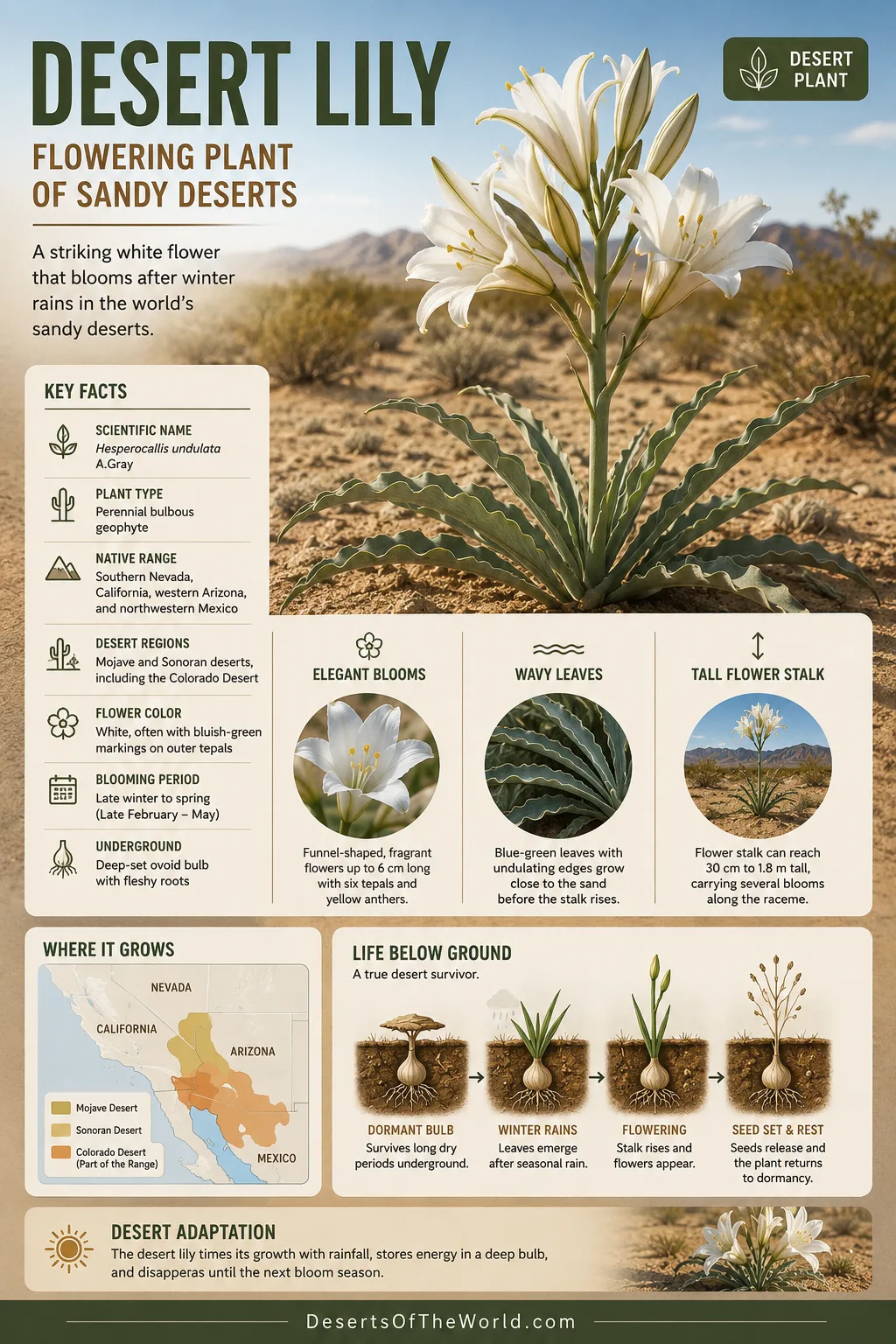
The desert lily (Hesperocallis undulata) is a bulb-forming perennial of the hot deserts of southwestern North America. For much of the year, there may be little above the ground to reveal its presence. After suitable winter rainfall, long blue-green leaves rise from sandy soil, followed by a flower stalk carrying large white, fragrant blooms.
The plant is closely tied to the Mojave and Sonoran desert regions, including the Colorado Desert of southeastern California. Loose sand, open desert scrub, seasonal rainfall, and long dry intervals shape its life cycle. The desert lily survives those intervals below ground as a geophyte rather than maintaining permanent above-ground foliage.
| Characteristic | Desert Lily |
|---|---|
| Scientific name | Hesperocallis undulata A.Gray |
| Plant type | Perennial bulbous geophyte |
| Current family | Asparagaceae |
| Native range | Southern Nevada, California, western Arizona, and northwestern Mexico |
| Main desert regions | Mojave and Sonoran deserts, including the Colorado Desert |
| Typical habitat | Dry sandy flats, desert scrub, loose slopes, and similar well-drained ground |
| Flower color | White, commonly with bluish-green or silvery-green markings on the outer tepals |
| Usual flowering period | Late winter through spring, commonly late February to May |
| Underground structure | Deep-set ovoid bulb with fleshy roots |
Botanical Identity and Classification
The accepted scientific name is Hesperocallis undulata. Hesperocallis is an unusual genus because it contains only this single accepted species. Royal Botanic Gardens, Kew places it in the Asparagaceae, the asparagus family, within the order Asparagales.
Older books and plant lists may place the desert lily in Liliaceae or Agavaceae. Those names reflect earlier systems of plant classification rather than different desert lily species. Modern botanical databases using newer relationships among flowering plants place Hesperocallis undulata in Asparagaceae.
The common name therefore needs a little care. The desert lily resembles a lily when in bloom, but it is not a species of Lilium, the genus containing the true lilies.
The scientific name also describes the plant well. The species name undulata refers to its wavy leaf margins, one of the easiest features to recognize when the plant is not yet flowering.
What the Desert Lily Looks Like
A flowering desert lily can appear surprisingly large beside the low shrubs and annual wildflowers of sandy desert ground. Its growth begins near the surface as a small cluster of long basal leaves. These leaves are narrow, blue-green to gray-green, and visibly wavy along their pale margins.
The flowering stalk rises from the center of the leaves. Botanical descriptions record plants from roughly 30 centimeters to 1.8 meters tall, although local rainfall and growing conditions can produce large differences between individuals.
White Funnel-Shaped Flowers
The flowers are among the plant’s clearest identification features. They are white to creamy white, funnel-shaped, fragrant, and arranged along the upper portion of the flowering stalk.
Each flower has six petal-like segments called tepals. On their outer surfaces, these may show bluish-green, gray-green, or silvery-green midstripes. The flowers are commonly around 5 to 6 centimeters long, large enough to make a flowering plant easy to notice against open sand.
Several flowers may open along the same raceme rather than forming one solitary bloom. Yellow to golden anthers stand out inside the white flowers.
Wavy Leaves Along the Desert Floor
The leaves provide an identification clue even before the flower stalk develops. They emerge from the base rather than being spaced along a leafy stem. Flora descriptions generally record blades around 20 to 50 centimeters long and less than 2 centimeters wide.
The combination of a blue-green surface, narrow blade, and strongly undulating pale edge separates them from many grass-like leaves growing nearby. The foliage may spread outward close to the sand while the flower stalk grows vertically above it.
The Underground Bulb
The visible plant represents only the seasonal part of the desert lily. Beneath the soil is an ovoid bulb, generally about 4 to 6 centimeters long, connected to fleshy roots.
This underground form is central to the plant’s desert life cycle. A perennial desert lily does not have to rebuild its entire organism from seed after every rainy season. Its persistent underground tissues remain in place while the above-ground growth disappears during dry periods.
Where Desert Lilies Grow
Hesperocallis undulata is native to the deserts of the southwestern United States and northwestern Mexico. Kew records its native distribution in Arizona, California, Nevada, and northwestern Mexico.
Within that broad range, the plant is especially associated with the Mojave and Sonoran desert systems. In southeastern California, it is also familiar from the Colorado Desert, the western portion of the Sonoran Desert that includes much of the low desert around Anza-Borrego.
| Region | Desert Lily Setting |
|---|---|
| Mojave Desert | Sandy flats, loose desert soils, slopes, and creosote-dominated scrub |
| Colorado Desert | Low, warm Sonoran Desert landscapes of southeastern California |
| Western Arizona | Dry sandy ground and creosote bush communities within Sonoran and Mojave-influenced landscapes |
| Northwestern Mexico | Arid landscapes extending the species’ range south of the United States |
The desert lily is therefore not simply a California wildflower. Its natural distribution crosses political boundaries and follows desert habitat and climate.
Why the Desert Lily Favors Sandy Ground
The desert lily is strongly associated with dry, loose, well-drained substrates. Flora of North America records it on dry sandy flats to rocky hills in creosote bush scrub, while observations across the California deserts also place it on sandy washes, gentle loose slopes, and similar open terrain.
Sand drains quickly. Water from a winter storm may penetrate into the soil rather than remaining at the surface for long periods. For a deeply rooted bulbous plant adapted to arid ground, this produces very different conditions from compact clay or permanently moist soil.
Sandy landscapes also change from place to place. Desert lilies can occur on nearly level flats, dune-like ground, sandy washes, and slopes composed of loose material. This explains why describing the species simply as a “dune flower” is too narrow.
Life Among Creosote Bush Scrub
Desert lilies commonly share low desert landscapes with creosote bush (Larrea tridentata) and other drought-adapted plants. Creosote scrub leaves broad areas of exposed ground between shrubs, producing the open habitat in which many seasonal desert wildflowers appear after rain.
During favorable spring conditions, desert lilies may occur alongside plants such as desert sand verbena, evening primroses, desert sunflowers, and other short-lived blooms. They do not all use the same survival strategy. Many neighboring spring wildflowers are annuals surviving the dry season as seeds, while the desert lily persists as a perennial underground bulb.
How a Perennial Lily Survives a Dry Desert
A desert lily spends much of its life where desert heat and dry air have less effect: below the soil surface. Botanists describe this growth form as a bulbous geophyte.
When conditions are dry, above-ground leaves and flowers are absent. The bulb and roots remain underground. After enough moisture reaches the root zone, new leaves can emerge and the plant may produce a flowering stalk.
This creates a very different pattern from a permanently visible desert shrub. A patch of seemingly empty sandy ground can contain established desert lily plants that are simply not producing conspicuous growth at that moment.
Rainfall Controls What Appears Above Ground
Desert lily flowering is closely associated with seasonal rain. Flora records describe flowering from late February through May following infrequent rains. In practice, the exact timing and abundance change with location, elevation, temperature, and rainfall history.
A calendar date alone cannot predict a large display. Rain must arrive in a useful pattern, and later temperatures also affect how quickly desert soils dry and how long flowers remain active.
This is why the same desert can show many flowering lilies in one spring and far fewer in another. The underground plants have not necessarily vanished. Their visible growth reflects the conditions of that season.
When Desert Lilies Bloom
The main flowering period occurs from late winter into spring. Botanical treatments generally place it between late February and May, with local desert reports often showing activity during February, March, and April.
Lower and warmer desert locations may develop earlier than cooler sites. Rainfall can also shift the timing. Because the species depends on seasonal moisture, bloom intensity is naturally irregular.
This relationship is well documented in Anza-Borrego Desert State Park. The park’s wildflower records have repeatedly reported desert lilies appearing with other spring flowers after productive winter rainfall. The species can occur as scattered plants in one season and become much more noticeable during a wetter spring.
Desert Lily Blooms and Desert Superbloom Years
A flowering desert lily does not indicate that the surrounding desert is experiencing a superbloom. Individual perennial plants may flower when conditions are adequate even when broad carpets of annual wildflowers never develop.
Likewise, a strong wildflower year can increase the chances of seeing desert lilies without guaranteeing dense populations everywhere. Different species respond to rainfall, soil moisture, temperature, and local habitat in different ways.
For the desert lily itself, the useful biological pattern is simple: winter moisture followed by suitable spring conditions can bring the underground perennial back above the sand.
What Happens After Flowering
After successful flowering, the desert lily forms a dry capsule rather than a fleshy fruit. Botanical descriptions give capsules roughly 12 to 16 millimeters long. They contain numerous dark, flattened seeds.
The seasonal sequence is therefore:
- underground perennial bulb during the dormant period;
- emergence of basal leaves after suitable moisture;
- development of a flower stalk;
- white spring flowers;
- capsule and seed production;
- loss of above-ground growth as dry conditions return.
Seed production allows new individuals to establish, while the underground bulb allows an existing plant to persist between favorable growing periods.
How to Recognize a Desert Lily
The easiest identification comes from considering several traits together rather than relying only on a white flower.
- Habitat: open arid ground, often sandy or loose desert soil.
- Leaves: narrow, blue-green basal leaves with strongly wavy pale edges.
- Flowers: large white or cream funnel-shaped blooms.
- Tepals: six petal-like segments, often marked by a greenish or silvery stripe on the back.
- Flower arrangement: several flowers can develop along an upright raceme.
- Growth form: perennial plant arising from a deep-set bulb.
- Season: most conspicuous from late winter through spring following useful rainfall.
The wavy leaves are especially helpful. Several desert plants produce pale or white flowers, but the combination of undulating basal foliage and large funnel-shaped blossoms is characteristic of Hesperocallis undulata.
Why the Name “Desert Lily” Can Cause Confusion
Common plant names are not governed as strictly as scientific names. “Desert lily,” “sand lily,” and similar names have been applied to unrelated plants in different parts of North America.
When the name desert lily refers to the showy white-flowered plant of the Mojave and Sonoran deserts, the scientific name Hesperocallis undulata removes the ambiguity.
It should also not be confused with true lilies in the genus Lilium. The flower shape may look familiar, but current botanical classification places Hesperocallis elsewhere in the order Asparagales.
The Desert Lily Preserve in California
The species is closely associated with a protected desert area near Desert Center in Riverside County, California. The Desert Lily Preserve protects habitat containing desert lily populations within the California Desert and is administered as part of the Bureau of Land Management’s conservation lands.
The preserve also illustrates an important feature of the species: protecting a desert wildflower does not mean protecting only the visible flowers. The sandy soil, underground bulbs, surrounding plant community, and natural rainfall-driven life cycle are all parts of the habitat.
A visitor outside the flowering season may see an open desert landscape with few or no lilies above ground. The perennial plants can still be present beneath that surface.
Its Place in Mojave and Sonoran Desert Vegetation
The desert lily shows that desert perennial plants do not all rely on woody stems, spines, or permanently exposed succulent tissues. Its strategy is seasonal: remain protected underground for much of the dry period, then place leaves and flowers above ground when moisture permits.
That strategy makes it part of a broader spring transformation in the Mojave and Sonoran deserts. Creosote bush and other perennial shrubs provide the persistent structure of many low-desert landscapes. Around them, annuals and geophytes respond to rainfall on much shorter schedules.
The result varies sharply from year to year. Desert lily populations may be present in the same sandy habitat even when their white flowers are absent from the surface.
Desert Lily Questions
Is the Desert Lily a True Lily?
No. Hesperocallis undulata is commonly called a lily because of its flower form, but it is not a member of the genus Lilium. Current Kew classification places it in the family Asparagaceae.
Which Deserts Have Desert Lilies?
The species occurs mainly in the Mojave and Sonoran desert regions of southwestern North America, including the Colorado Desert of southeastern California. Its native range extends through parts of California, Nevada, Arizona, and northwestern Mexico.
Why Do Desert Lilies Seem to Disappear?
The desert lily is a perennial geophyte. Its persistent bulb remains underground during dry periods while the seasonal leaves and flowering stem disappear. Lack of flowers in a particular year does not by itself mean the underground plant is absent.
What Time of Year Do Desert Lilies Flower?
Most flowering occurs from late winter through spring, commonly from late February to May. Local timing depends on rainfall, temperature, elevation, and desert location.
Why Are Desert Lilies Associated With Sand?
The species naturally occupies dry, well-drained desert ground and is frequently recorded on sandy flats, washes, loose slopes, and related soils. Its deep-set bulb and fleshy roots remain below the exposed surface while seasonal growth emerges after favorable moisture.
Is the Desert Lily an Annual Wildflower?
No. Although it often appears during the same spring flowering periods as desert annuals, Hesperocallis undulata is a perennial bulbous plant. That distinction explains why established plants can remain underground through dry seasons and emerge again when conditions improve.
Sources
- Royal Botanic Gardens, Kew — Plants of the World Online: Hesperocallis undulata (accepted name, family, native distribution, and growth form)
- Jepson eFlora — Hesperocallis undulata (botanical description, measurements, habitat, elevation, and flowering period)
- SEINet Arizona–New Mexico Chapter — Hesperocallis undulata (Flora of North America description, desert habitat, morphology, and flowering season)
- USDA Plants Database — Desert Lily (U.S. plant profile and native-status data)
- Lady Bird Johnson Wildflower Center — Hesperocallis undulata (native range, perennial growth, flowering color, and growing conditions)