
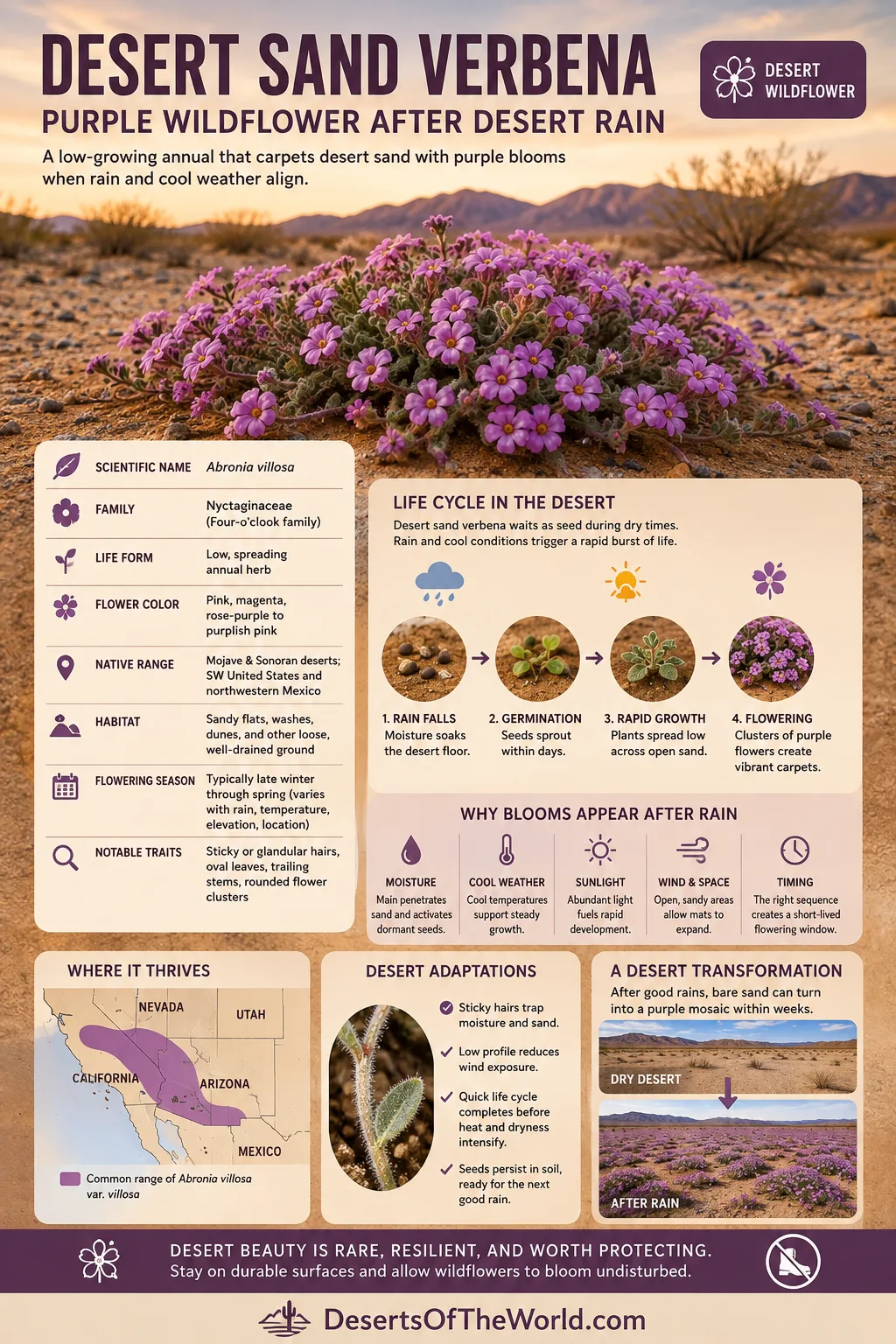
Desert sand verbena, Abronia villosa, is one of the low-growing wildflowers that can turn bare sandy ground pink, magenta, or purple after favorable desert rain. It is especially associated with the Mojave and Sonoran desert regions of the southwestern United States and northwestern Mexico. In dry periods the plant may be absent from view, while its next generation remains represented by seed in the soil. When cool-season moisture and temperature conditions line up, seedlings spread quickly across open sand and can form broad flowering mats.
The common name can be misleading. Desert sand verbena is not a true verbena in the family Verbenaceae. It belongs to the four-o’clock family, Nyctaginaceae, alongside other plants adapted to dry western landscapes. Its scientific name is the most reliable way to separate it from unrelated plants that also carry “verbena” in their common names.
| Feature | Desert Sand Verbena |
|---|---|
| Scientific name | Abronia villosa |
| Plant family | Nyctaginaceae (four-o’clock family) |
| Growth form | Low, spreading annual herb |
| Flower color | Pink, magenta, rose-purple to purplish pink |
| Typical setting | Sandy flats, washes, dunes, open desert scrub, and other loose, well-drained ground |
| Main desert association | Mojave and Sonoran desert regions |
| Usual flowering season | Most often late winter through spring in low desert settings, with timing shifting by rainfall, temperature, elevation, and location |
| Notable surface traits | Sticky or glandular hairs, oval to rounded leaves, trailing stems, rounded flower clusters |
What Desert Sand Verbena Is
Abronia villosa is an annual wildflower native to western North America. Calflora identifies it as a California native annual that also occurs elsewhere in western North America, while Kew’s Plants of the World Online places the native range of Abronia villosa var. villosa from southern Nevada toward northwestern Mexico, including Arizona, California, Nevada, Utah, and northwestern Mexico.
The plant usually stays close to the ground. Its stems creep outward rather than building a tall upright structure, allowing a single plant to occupy a surprisingly broad patch of open sand. In favorable seasons, many individuals can overlap visually and create the impression of a continuous purple-pink carpet.
Why It Is Called Sand Verbena
The “sand” part of the name fits its ecology: the plant is strongly associated with loose, fast-draining substrates. “Verbena” describes the common-name resemblance to other clustered flowering plants rather than botanical kinship. True verbenas belong to Verbenaceae; Abronia villosa belongs to Nyctaginaceae.
The species name villosa refers to its hairy character. That feature is easy to notice at close range because the leaves and stems can look softly hairy and may feel sticky from glandular surfaces. Fine sand often adheres to the plant.
Varieties Within Abronia villosa
The name Abronia villosa includes recognized botanical varieties. The widespread desert form is commonly treated as Abronia villosa var. villosa. California also has Abronia villosa var. aurita, known as chaparral sand verbena. Calflora treats var. aurita separately and identifies it as a California endemic. Keeping the varieties separate matters when interpreting range maps, habitat records, and conservation information.
Why Desert Rain Can Produce Purple Blooms
The phrase “after desert rain” describes the visible result, but the process starts before flowers appear. Desert annuals spend unfavorable periods as seed. Moisture can trigger germination when other environmental signals are suitable, allowing the plant to complete its above-ground life cycle during a temporary window when water is available.
For desert wildflower displays in Death Valley, the National Park Service explains that a soaking rain event is needed to start germination and that follow-up moisture through winter and spring helps seedlings continue growing. The park notes about half an inch of rain as an important germination-scale event for its wildflower community, but that figure should not be treated as a universal species-specific threshold for Abronia villosa. Soil, storm duration, temperature, seed condition, and local topography all influence the response.
Rain Alone Does Not Guarantee a Large Bloom
A single storm can wet the desert floor without producing a broad sand verbena display. Large flowering patches are more likely when several conditions occur in sequence:
- Rain penetrates deeply enough to wet the seed zone rather than only dampening the surface.
- Moisture returns often enough for young plants to keep developing.
- Cool-season temperatures allow seedlings to establish before strong heat arrives.
- Dry winds do not remove moisture too quickly from shallow soil and young leaves.
- The site already contains a viable seed reserve from earlier generations.
This explains why one wash can hold a dense pink-purple patch while another apparently similar site nearby remains mostly bare. Desert flower abundance is highly local.
Seed Germination Has More Than One Trigger
Research on sand verbenas has also shown that germination biology is more complex than simply adding water. A study published in the Journal of Arid Environments tested several Abronia species, including A. villosa, and examined germination responses to ethylene supplied experimentally. The work helps explain why sand-verbena seeds can be difficult to germinate under controlled conditions and why natural germination should not be reduced to a single rainfall number.
In the desert, that restraint is useful. If every seed germinated after the first brief shower, an entire local generation could be exposed to immediate drying. A soil seed reserve spreads that risk across seasons.
When Desert Sand Verbena Blooms
In the low deserts of the American Southwest, desert sand verbena is most strongly associated with late-winter and spring wildflower seasons. February through May is a commonly reported window, especially in the Mojave and western Sonoran desert areas. That range is useful, but it is not a fixed calendar.
Rainfall can shift emergence earlier or later, warm weather can accelerate flowering, and early heat can shorten the display. Elevation adds another layer: low desert floors often warm first, while higher terrain may support later flowering. National Park Service observations at Joshua Tree have documented Abronia villosa in spring and have also recorded flowering plants during a late-August visit, showing that suitable local conditions can produce blooms outside the familiar spring window.
Season is therefore better understood as a moisture-and-temperature response than as a date on the calendar.
How to Recognize the Purple Flowers
The flowers are usually described as bright pink, magenta, rose-purple, or purplish pink. From a distance, a flowering patch may look like scattered colored balls resting just above the sand. Up close, each rounded head consists of many narrow tubular flowers packed together.
Rounded Flower Clusters
Individual flowers are narrow and open into five lobes. Many flowers gather into a rounded cluster at the end of a stalk. The combined head is far more noticeable than any single blossom, which is why the plant can create intense patches of color even though it remains short.
Fragrance is another useful field character. Desert sand verbena is often reported as sweetly scented, especially when many flower heads are open at once.
Sticky Leaves and Trailing Stems
The foliage is usually dull to grayish green rather than glossy. Leaves are broadly oval to somewhat rounded or triangular in outline, and the plant’s glandular hairs can make the surface sticky. Trailing stems extend across the ground, sometimes forming mats that reach well beyond the central root area.
This combination—low trailing growth, sticky hairy foliage, and rounded magenta flower heads—is more useful for identification than flower color alone.
Where Desert Sand Verbena Grows
Desert sand verbena belongs to the dry landscapes of the southwestern United States and northwestern Mexico. The plant is strongly associated with the Mojave Desert and the western portions of the Sonoran Desert, including the Colorado Desert region of southern California.
Records and botanical references place Abronia villosa or its desert variety across California, Arizona, Nevada, Utah, and northwestern Mexico. It is well known from areas such as Death Valley, the Mojave Desert, Joshua Tree, the Coachella Valley, and the Anza-Borrego region when local conditions support germination and flowering.
Why Sandy Ground Suits the Plant
The species favors open sandy places where water drains quickly and competition from dense perennial vegetation is limited. Typical settings include sandy washes, flats, dune margins, loose roadside sand, and open patches within creosote-bush scrub.
Loose sand may appear barren during dry months, yet it can hold dormant seed and enough short-lived moisture after rain to support annual plants. Sand verbena takes advantage of that temporary window by spreading horizontally, producing flowers, setting seed, and completing its visible cycle before prolonged heat and dryness return.
A Life Cycle Built Around Short Wet Periods
Calling desert sand verbena an annual does not mean the species is present above ground every year at every site. It means an individual plant completes its life cycle rather than persisting as a long-lived shrub. The continuing population depends on seed that remains in or near the soil until conditions support another generation.
- Dormant stage: seed remains on or within sandy ground through dry conditions.
- Germination: suitable moisture and temperature cues allow part of the seed reserve to sprout.
- Rapid vegetative growth: stems spread across open ground while roots use available soil moisture.
- Flowering: rounded pink-purple heads develop as conditions remain favorable.
- Seed production: successful flowers produce the next seed supply before plants dry at the end of the favorable season.
The invisible seed stage is therefore as much a part of the desert sand verbena story as the purple bloom. A bare wash is not necessarily an empty one.
Desert Sand Verbena and Pollinators
The flowering period creates a short-lived food resource for desert insects. One of the best documented relationships involves the digger bee Anthophora abroniae. National Park Service research from Joshua Tree reports that the great majority of female specimens of this bee have been collected on Abronia villosa.
A Close Relationship With Anthophora abroniae
Female Anthophora abroniae have an elongated, hairy mouthpart suited to removing pollen from the narrow flowers of desert sand verbena. Joshua Tree observations found females moving rapidly among flowers within the rounded heads. Researchers repeatedly found the bee where Abronia villosa was in bloom, illustrating how a temporary desert wildflower display can support an insect whose activity is closely tied to the same seasonal window.
This relationship also shows why scattered flowering patches matter. Desert blooms are not only visual events; they briefly reorganize food availability across otherwise dry ground.
How to Separate It From Other Purple Desert Wildflowers
Purple is common in desert wildflower seasons, so color alone can lead to mistaken identification. Phacelias, purple mat, lupines, and several other desert plants can occupy the same general landscape.
| Field Trait | Desert Sand Verbena | Useful Contrast |
|---|---|---|
| Growth habit | Low and sprawling, often mat-like | Many phacelias and lupines rise more clearly above the ground |
| Flower arrangement | Dense rounded heads of many narrow flowers | Purple mat forms much smaller low flowers; lupines form vertical flower spikes |
| Leaves and stems | Hairy and often sticky | Other purple species may be hairy but lack the same rounded flower-head and trailing-stem combination |
| Substrate | Strongly associated with loose sandy ground | Neighboring wildflowers may also grow on gravel, rocky slopes, or finer soils |
| Overall silhouette | Broad, low patch with flower heads held just above the foliage | Look beyond color and compare plant shape first |
A close look at the whole plant usually resolves the identification: rounded magenta clusters sit above a sticky, hairy, prostrate plant rooted in sand.
Why Some Rainy Years Produce More Flowers Than Others
Desert wildflower seasons are uneven because rainfall totals tell only part of the story. The spacing of storms, soil depth, wind, daytime warmth, nighttime temperature, elevation, and the amount of viable seed already present can all change the result. A wet season can still produce modest flowers in one place and dense color several kilometers away.
Death Valley National Park describes well-spaced fall, winter, and spring rain, warming spring soil, and limited drying wind as favorable ingredients for broad displays. That pattern fits the ecology of annual desert flowers such as sand verbena, but each species and each site responds on its own schedule.
A 2026 Example From Death Valley
Death Valley National Park recorded a superbloom in 2026 after above-average rainfall during fall and winter 2025. The park reported low-elevation sprouts by December 2025, more flowering by early March 2026, and a short peak that ended by late March as temperatures rose early. Sand verbena is listed by the park among its common wildflowers, although the 2026 seasonal account describes the overall flower community rather than giving a species-by-species count.
The season is a useful example of the desert-rain pattern: moisture can build the conditions for a broad display, yet heat can close that window quickly. A bloom that appears sudden above ground may represent months of rainfall, root development, and temperature change.
Sources
- U.S. Fish & Wildlife Service — Desert Sand Verbena (official species identity and taxonomy)
- Royal Botanic Gardens, Kew — Abronia villosa var. villosa (accepted variety, classification, and native distribution)
- Calflora — Abronia villosa (California status, family, growth form, and occurrence records)
- National Park Service — Death Valley Wildflowers (rainfall, temperature, wind, bloom timing, and the 2026 season)
- National Park Service — Bees of Joshua Tree National Park (the relationship between Anthophora abroniae and Abronia villosa)
- Loyola Marymount University — Sand Verbenas Germinate in Response to Ethylene (research reference on Abronia germination biology)