
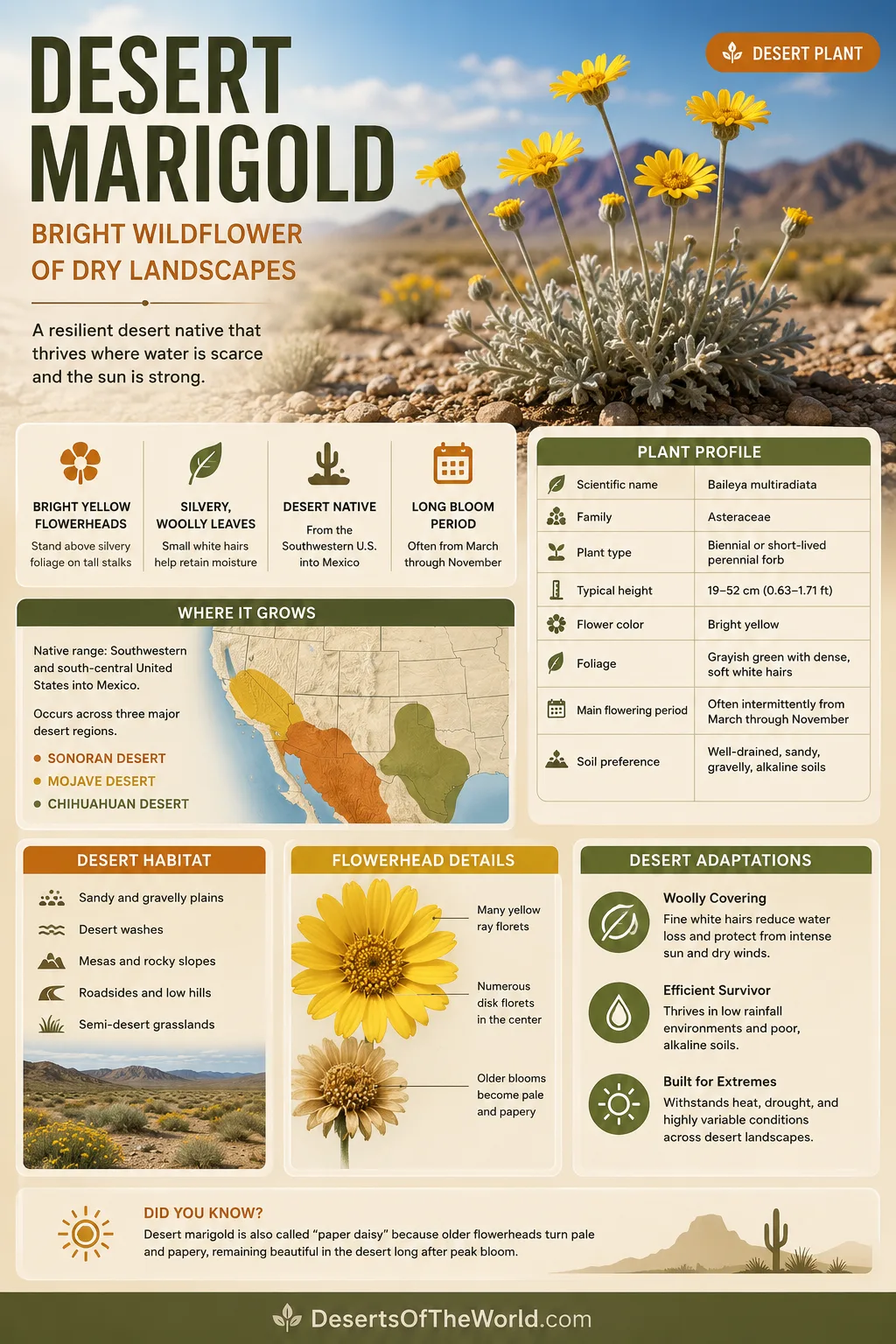
Desert marigold is one of the yellow wildflowers closely associated with the dry landscapes of the American Southwest. Its bright flowerheads rise above low, silvery foliage in desert washes, gravelly flats, rocky slopes, mesas, and other open ground where rainfall is limited and soils drain quickly.
The plant’s accepted scientific name is Baileya multiradiata. It belongs to the sunflower family, Asteraceae, and is native from the southwestern and south-central United States into Mexico. Its range includes parts of the Mojave, Sonoran, and Chihuahuan deserts. Despite the common name, it is not one of the familiar garden marigolds in the genus Tagetes.
Desert Marigold Plant Profile
| Characteristic | Description |
|---|---|
| Scientific name | Baileya multiradiata |
| Family | Asteraceae |
| Plant type | Biennial or short-lived perennial forb; growth habit can vary with local conditions |
| Typical height | About 19–52 cm (0.63–1.71 ft) |
| Flower color | Bright yellow |
| Foliage | Grayish green with dense, soft white hairs |
| Main flowering period | Often intermittently from March through November; flowering can extend beyond this where conditions remain favorable |
| Native range | Southwestern and south-central United States into Mexico |
| Desert regions | Mojave, Sonoran, and Chihuahuan deserts |
| Common habitat | Sandy and gravelly plains, washes, mesas, rocky slopes, low hills, roadsides, and semi-desert grasslands |
| Soil preference | Especially suited to well-drained sandy, gravelly, and alkaline soils |
How Desert Marigold Is Identified
A flowering desert marigold is easy to notice because the yellow heads stand well above most of the leaves. The plant usually develops a low cluster of gray-green foliage at its base, while long, relatively bare flower stalks lift the blooms into open sunlight.
Silvery, Woolly Leaves Near the Ground
The leaves range from deeply lobed to nearly entire and vary considerably in shape. What remains more consistent is their soft covering of small white hairs. This coating gives established plants a pale gray or silvery appearance that contrasts sharply with the yellow flowers.
The foliage is not simply an identification feature. USDA plant information notes that the fine hairs covering the leaves, stems, and flower stalks help the plant retain moisture, an useful trait in environments where exposed vegetation faces dry air, intense sunlight, and long intervals without rain.
Yellow Flowerheads on Long Stalks
What looks like a single desert marigold flower is actually a flowerhead made from many small florets, a feature typical of the Asteraceae family. Yellow ray florets form the conspicuous outer portion, while numerous disk florets occupy the center.
USDA descriptions record roughly 25–40 ray florets on a flowerhead, although the appearance varies as flowers develop. Older blooms gradually lose their strong yellow color and may become pale and papery. This explains another common name for the species: paper daisy.
Where Desert Marigold Grows Naturally
Baileya multiradiata is a plant of western North America’s arid and semi-arid country. Kew’s Plants of the World Online records its native range from the southwestern and south-central United States into Mexico, including Arizona, California, Nevada, New Mexico, Texas, Utah, and several regions of Mexico.
Within that broad range, desert marigold occurs across three major North American desert systems:
- Sonoran Desert — especially Arizona and adjoining areas of Mexico.
- Mojave Desert — including desert country in southeastern California, southern Nevada, and nearby areas.
- Chihuahuan Desert — extending through parts of New Mexico and western Texas into northern Mexico.
It is not restricted to bare sand. Natural populations occur on sandy plains, gravelly ground, mesas, rocky slopes, washes, roadsides, low hills, desert shrublands, and semi-desert grasslands. USDA records place the species from roughly 100 to 1,981 meters (328 to 6,500 feet) in elevation, although it is particularly common within the lower and middle parts of that range.
Why Desert Washes Suit the Plant
Desert washes can remain dry for long periods and then receive short pulses of water after rain. Desert marigold is well suited to these places. It also appears along disturbed ground and roadsides where runoff can briefly concentrate moisture without creating permanently wet soil.
This combination matters. The species tolerates dry ground very well, yet it responds to available moisture with new foliage and flowers. A desert wash therefore offers both the drainage the roots need and occasional access to water following storms.
How Desert Marigold Handles Dry Conditions
Desert marigold survives in places where moisture can disappear rapidly from exposed soil. Several characteristics work together rather than relying on one unusual adaptation.
Hair-Covered Foliage
The pale hairs covering much of the plant help it retain moisture. They also give the leaves their recognizable gray-green appearance. Silvery or pale foliage is common among unrelated plants of dry landscapes, although the exact structure and function of these surfaces differ among species.
Tolerance of Dry, Fast-Draining Soil
Desert marigold grows particularly well in sandy or gravelly alkaline soils. It can also occur in caliche, clay, loam, and other substrates when drainage is adequate. This flexibility helps explain why it appears across washes, slopes, plains, disturbed ground, and several desert vegetation communities rather than being confined to one soil type.
Its tolerance of drought should not be confused with a preference for constant dryness at every stage. Like other flowering plants, it responds to available water. During severe drought, foliage production and flowering may stop until conditions improve. At the opposite extreme, persistently wet soil can cause crown problems, so dependable drainage remains one of the species’ strongest habitat requirements.
A Short-Lived but Productive Growth Pattern
Desert marigold is commonly described as a biennial or short-lived perennial. Some field descriptions also treat it as annual under particular conditions. This apparent variation reflects a plant whose performance is closely tied to climate, moisture, elevation, and local growing conditions rather than a long-lived woody desert species.
Plants can produce abundant seed, and new individuals may appear around established populations when rainfall and temperatures favor germination. This allows a patch of desert marigolds to persist even though individual plants may not live for many years.
When Desert Marigold Blooms
There is no single flowering date that applies across the full geographic range. USDA plant records describe Baileya multiradiata as flowering intermittently from March through November and note that blooming can occur outside that period where conditions remain favorable.
Local climate makes a large difference. Elevation, winter temperatures, recent rain, and soil moisture can shift flowering by weeks or months. Big Bend National Park in Texas reports desert marigolds blooming in washes during much of the year, while National Park Service records from Death Valley describe flowering around Towne Pass beginning in April and sometimes continuing into July.
Farther north, Zion National Park identifies desert marigold among the wildflowers that can produce conspicuous displays in early to mid-April. These differences show why a fixed calendar is less useful than considering location and recent weather.
Rainfall and Flower Production
Rain does not guarantee an immediate carpet of flowers. Timing matters. Moisture must arrive when temperatures and other conditions allow plants to establish new growth and develop flower stalks.
Established desert marigolds can also continue flowering after the main spring wildflower period. This longer potential season separates the species from many desert annuals that emerge, flower, set seed, and disappear within a much narrower window.
Desert Marigold in the Desert Ecosystem
Desert marigold contributes more than seasonal color. Its flowerheads provide resources for insects, while its seeds and foliage interact with other animals of southwestern drylands.
USDA’s plant guide identifies the species as useful for pollinator habitat and notes that native bees visit its flowers, with strong activity reported during the monsoon season. Butterflies also use its nectar. Seeds may be taken by birds and other small animals, and black-throated sparrows have been recorded feeding on the pale seeds during fall.
The plant’s ability to establish in disturbed, dry ground has also led to its use in revegetation, erosion-control work, pollinator plantings, and rehabilitation of suitable arid land. It is particularly appropriate where native vegetation must cope with high temperatures, limited irrigation, and freely draining soil.
Desert Marigold and Similar Yellow Wildflowers
Several southwestern wildflowers produce yellow, daisy-like flowerheads, so flower color alone is not enough for identification. Foliage, stem structure, flowerhead form, and habitat provide better clues.
| Plant | Scientific Name | Useful Distinction |
|---|---|---|
| Desert marigold | Baileya multiradiata | Bright yellow heads on long stalks above low, gray-green, densely hairy foliage |
| Woolly desert marigold | Baileya pleniradiata | A related Baileya species that can look very similar and requires closer examination of plant structure |
| Colorado desert marigold | Baileya pauciradiata | Generally has noticeably fewer ray florets around each flowerhead |
| Desert gold | Geraea canescens | Another yellow desert member of Asteraceae, often associated with flats, slopes, and alluvial fans |
Why It Is Not a True Garden Marigold
The word “marigold” in the common name can cause confusion. Familiar garden marigolds belong to the genus Tagetes. Desert marigold belongs to Baileya. Both are members of Asteraceae, which explains some similarities in their composite flowerheads, but they belong to different genera.
The species name multiradiata refers to its many-rayed flowerheads. The genus Baileya was named in connection with American botanist and microscopist Jacob Whitman Bailey. Other recorded common names include desert baileya, wild marigold, showy desert marigold, and paper daisy.
Cultivation and Dry-Land Restoration
The same characteristics that allow desert marigold to occupy natural desert ground also make it useful in native dry-land landscapes. It grows from seed, accepts intense sun, tolerates heat and drought after establishment, and can reseed where conditions suit it.
Good drainage is more important than rich soil. Sandy, gravelly, caliche-rich, and other relatively lean soils are compatible with the plant, while prolonged saturation is poorly suited to it. USDA guidance notes that excessive watering can lead to crown rot and loss of plants.
For restoration or seed production, USDA guidance places seed only about 1/8 to 1/4 inch deep. Germination can be irregular, and the species may establish over time rather than appearing uniformly. Once mature plants begin setting seed, natural reseeding can help maintain a population in suitable dry ground.
Desert marigold should still be treated as a regional native rather than a universal drought-land plant. Native status and ecological suitability depend on location. Its strongest landscape connection remains the arid and semi-arid regions of the southwestern United States and Mexico where Baileya multiradiata occurs naturally.
Sources
- USDA Natural Resources Conservation Service — Desert Marigold Plant Guide (botanical description, habitat, flowering period, adaptations, ecology, and propagation).
- Royal Botanic Gardens, Kew — Plants of the World Online: Baileya multiradiata (accepted scientific name, classification, and native distribution).
- U.S. National Park Service — Death Valley Wildflowers (desert marigold identification, size, elevation, and local flowering period).
- U.S. National Park Service — Big Bend Yellow Wildflowers (desert marigold occurrence and extended flowering in desert washes).
- Arizona-Sonora Desert Museum — Desert Marigold Fact Sheet (identification, habitat, range, and growth form).