
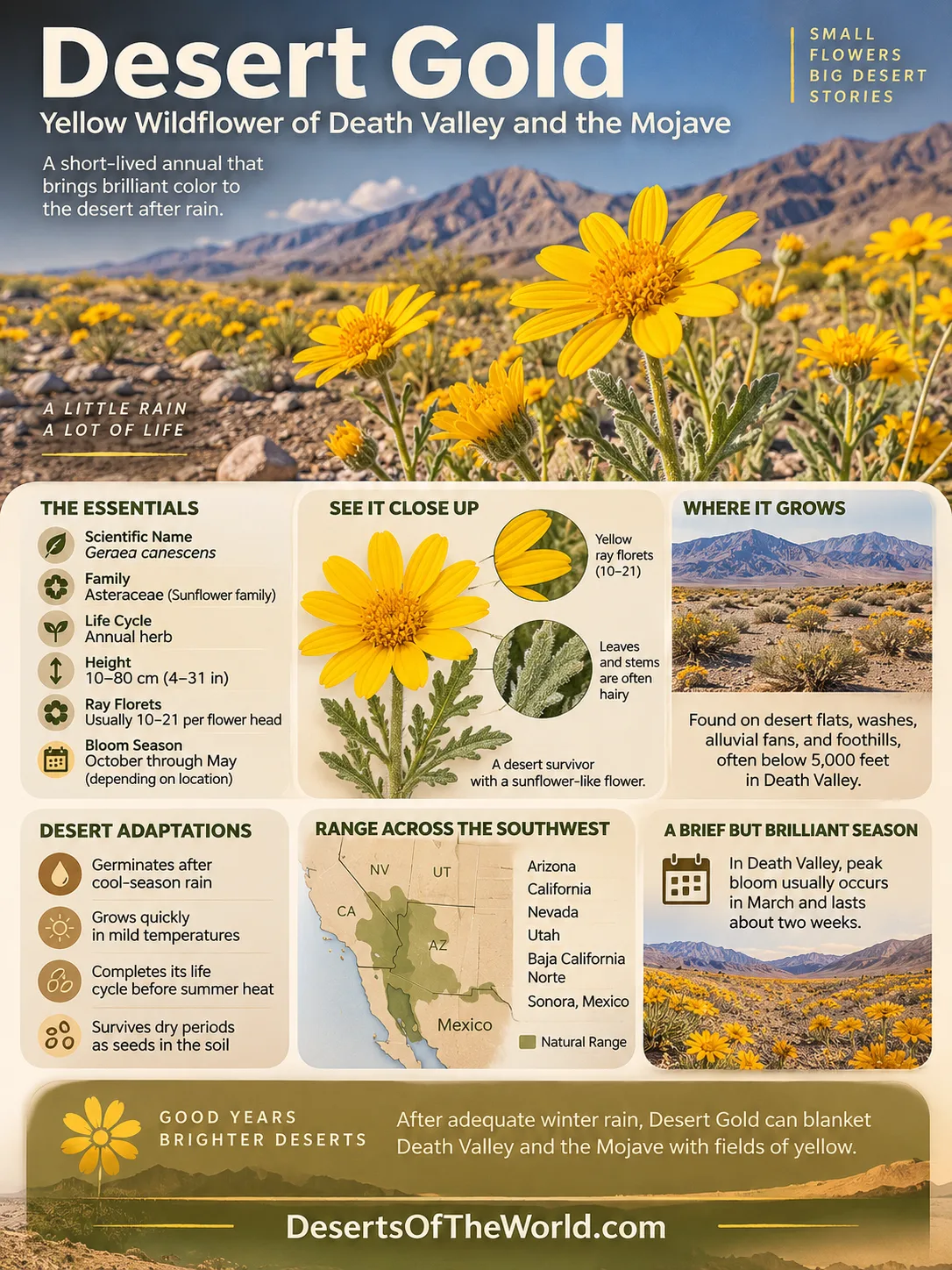
Desert Gold (Geraea canescens) is one of the yellow wildflowers most closely associated with Death Valley and the Mojave Desert. In ordinary years, individual plants may appear as scattered yellow blooms across gravelly flats and alluvial fans. After the right sequence of cool-season rain and mild temperatures, thousands can emerge together and turn broad stretches of desert yellow.
The plant is a short-lived annual in the sunflower family, Asteraceae. It survives the Mojave’s long dry periods mainly through its seeds, then completes its visible life cycle when moisture and temperature allow. This strategy explains why the same valley can look nearly bare one spring and support dense fields of Desert Gold in another.
Death Valley provided a clear example in 2026. Rain during fall and winter 2025 triggered low-elevation germination, and by early to mid-March 2026, fields of Desert Gold and Phacelia were flowering along Badwater Road. Early heat shortened the main display, which lasted only about two weeks before fading near the end of March.
Desert Gold Is a Short-Lived Desert Annual
Geraea canescens is an annual flowering plant native to the southwestern United States and northwestern Mexico. Despite its close association with Death Valley, Desert Gold is not endemic to Death Valley. Its natural range extends well beyond the national park.
| Feature | Desert Gold |
|---|---|
| Scientific name | Geraea canescens |
| Plant family | Asteraceae |
| Growth form | Annual herb |
| Other common names | Desert sunflower, hairy desert-sunflower |
| Recorded plant height | About 10–80 cm (4–31 in) across its botanical range |
| Ray florets | Usually 10–21 per flower head |
| Ray length | About 1–2 cm |
| Typical soil | Sandy and other loose desert soils |
| Native range | Arizona, California, Nevada, Utah, Baja California Norte, and Sonora |
| Range-wide flowering record | October through May, with local timing controlled strongly by climate and elevation |
Flora of North America records plants from about 10 to 80 cm tall and notes a flowering period extending from October through May across the species’ full range. Those broad botanical limits should not be confused with the much narrower spring display normally associated with Death Valley.
How Desert Gold Can Be Identified
Desert Gold has the familiar outline of a small sunflower or daisy, but each apparent flower is actually a composite flower head. The yellow structures that look like petals are ray florets surrounding many smaller disc florets in the center.
Botanical descriptions record about 10–21 ray florets on each head. The rays are usually 1–2 cm long. The leaves may be green to grayish and can be lance-shaped, oval, elliptic, or somewhat broader depending on their position on the plant. The foliage and stems are often noticeably hairy.
Death Valley National Park describes local Desert Gold as a slender, daisy-like wildflower with yellow rays and dissected lower leaves. Individual plants may carry one flower head or branch into several flowering stems.
Flower Head Structure
The combination of golden-yellow rays, a yellow-orange central disc, slender stems, and low desert habitat gives Desert Gold its characteristic appearance. A dense population is especially easy to recognize because hundreds or thousands of flower heads can form an almost continuous yellow layer above an otherwise sparse desert surface.
The plant should not be identified from color alone. Several unrelated or closely related Mojave wildflowers produce yellow flowers during the same season.
Where Desert Gold Grows in Death Valley
In Death Valley, Desert Gold is associated mainly with low desert flats, slopes, foothills, washes, and alluvial fans. The National Park Service lists it in creosote-bush scrub and Joshua tree woodland settings and describes it as occurring locally below about 5,000 feet.
Flora of North America gives a species-wide elevation record of 0–1,300 m (roughly 0–4,265 ft). The slightly broader 5,000-foot figure used by the National Park Service is a practical local habitat description for Death Valley rather than the same type of range-wide botanical record.
Why Alluvial Fans Support Desert Gold
Alluvial fans form where water leaves a canyon or mountain drainage and spreads sediment across the open valley margin. Repeated flows deposit sand, gravel, and finer material in a fan-shaped surface. These areas may look extremely dry for most of the year, yet short periods of runoff can wet the upper soil enough for annual wildflowers to germinate.
That combination suits Desert Gold: open ground, mineral-rich sediment, little shade, and short pulses of usable moisture. During a favorable spring, the normally muted surfaces of an alluvial fan can carry dense patches of yellow flowers.
Rain Timing Controls the Size of a Desert Gold Bloom
Desert Gold does not respond simply to a large annual rainfall total. When the rain falls matters. Death Valley’s most productive annual wildflower seasons generally depend on moisture arriving during the cool part of the year, when seeds can germinate and young plants can develop without immediately facing extreme heat.
Fall rain can begin the process. Continued winter moisture may then support seedlings long enough to build leaves, roots, and flower stems. Cool spring conditions can extend flowering. An early period of high temperatures can shorten it.
The contrast between recent Death Valley seasons shows how sharply the result can change. Extreme heat and low rainfall contributed to a below-average bloom in 2025. The following season developed differently after above-average fall and winter rainfall, eventually producing the 2026 superbloom.
The Seed Bank Waits Through Dry Years
Desert Gold follows an annual desert survival strategy. The adult plant does not remain alive through years of drought. It germinates, grows, flowers, produces seeds, and dies within one favorable growing period.
The long-term population survives below ground as a persistent seed bank. U.S. Geological Survey vegetation information notes that seeds of Geraea canescens and related desert annuals can remain in desert seed banks for decades while awaiting suitable fall and winter conditions.
This is why the absence of a large visible bloom does not mean Desert Gold has disappeared from an area. The living plants are only the brief above-ground phase of a much longer cycle.
From Germination to Seed Before Desert Heat Returns
- Dormant seeds remain in the soil through dry periods.
- Cool-season moisture permits germination when conditions are suitable.
- Seedlings develop rapidly while soil moisture remains available.
- Flowering follows, sometimes across very large areas in wet years.
- Seeds develop as the flowers age.
- The annual plants dry out as heat and aridity return, while their seeds remain for later seasons.
Death Valley’s wildflowers are therefore often described as desert “escapers.” They avoid the most severe part of the year by completing active growth before extreme summer conditions take over.
Desert Gold During the 2026 Death Valley Superbloom
The 2026 wildflower season provided an unusually clear view of this process. According to Death Valley National Park, above-average rainfall during fall and winter 2025 was followed by additional rain during the opening months of 2026.
| Period | What Happened in Death Valley |
|---|---|
| Fall–Winter 2025 | Above-average rainfall supplied moisture needed for annual wildflower development. |
| December 2025 | Wildflower sprouts began appearing at low elevations. |
| Early 2026 | Additional rainfall supported continued growth and green hillsides. |
| Late February 2026 | Scattered flowers began opening. |
| Early–Mid March 2026 | Fields of Desert Gold and Phacelia developed along Badwater Road. |
| Late March 2026 | The main low-elevation superbloom ended after early high temperatures accelerated drying. |
| April 2026 | Flowering continued at higher elevations, mainly as scattered plants and small groups rather than broad fields. |
The National Park Service reported that the main superbloom lasted only about two weeks. Flower density was lower than in some previous superbloom years, but a wide variety of species appeared. Desert Gold was among the plants producing the most visible low-elevation color.
The short duration matters. A strong germination year can create a large bloom, yet the length of that display still depends on what happens afterward. Heat can dry the soil and accelerate the end of flowering even after an excellent start.
What a Desert Gold Superbloom Actually Means
A superbloom is more than the presence of wildflowers. Death Valley National Park uses the term for seasons when flower abundance becomes large enough to form broad swaths of visible color across the landscape instead of isolated plants and small patches.
That distinction is useful for Desert Gold. The species can flower in Death Valley during ordinary years without creating a superbloom. A superbloom occurs only when enough annual plants germinate and flower together to alter the appearance of entire sections of the desert.
| Bloom Type | Typical Appearance |
|---|---|
| Sparse season | Individual plants or small groups separated by large areas of bare ground. |
| Normal favorable bloom | Numerous flowers and localized patches, but no broad continuous color across the landscape. |
| Superbloom | Enough flowering plants emerge together to create large fields or swaths of color visible across the desert. |
Death Valley National Park lists 1998, 2005, 2016, and 2026 as its four most recent superbloom years and notes that these events average roughly once a decade. That does not mean there is a ten-year biological cycle. Rainfall timing, temperature, soil moisture, seed availability, and local conditions differ from year to year.
Desert Gold Bloom Timing Changes With Elevation
There is no single calendar date when Desert Gold always blooms. Flora of North America records flowering from October through May across the plant’s full geographic range, while Death Valley’s low-elevation season is much more concentrated.
In Death Valley, the National Park Service places Desert Gold among the characteristic lower-elevation wildflowers of roughly mid-February through mid-April. These plants occur on alluvial fans and foothills before the main flowering season shifts toward cooler elevations.
| Death Valley Elevation Zone | General Wildflower Period | Desert Gold Context |
|---|---|---|
| Lower elevations and alluvial fans | Mid-February to mid-April | Main Death Valley setting for Desert Gold displays. |
| About 3,000–5,000 ft | Mid-April to early May | The general park wildflower season moves toward upper slopes, canyons, and higher valleys. |
| About 5,000–11,000 ft | Early May to mid-July | A later high-elevation wildflower community develops; this should not be interpreted as the normal Desert Gold season. |
This upward progression is one reason a park-wide statement such as “wildflowers bloom in March” can be misleading. Valley-floor plants may already be drying while mountain species are only beginning their growing season.
Desert Gold Extends Far Beyond Death Valley
Death Valley is one of the best-known places associated with Desert Gold, but the species occupies a much larger part of the desert Southwest. Kew’s Plants of the World Online records Geraea canescens as native to Arizona, California, Nevada, Utah, and northwestern Mexico, including Baja California Norte and Sonora.
Its distribution crosses more than one named desert region. Desert Gold occurs strongly in Mojave landscapes but also extends into neighboring warm-desert environments farther south.
Joshua Tree National Park offers another Mojave-area example. The National Park Service includes Desert Gold among the characteristic lower-elevation flowers of alluvial fans and foothills there, with the earliest broad lowland wildflower period generally falling between January and mid-April.
Why Desert Gold Is Not a Death Valley Endemic
The association between Desert Gold and Death Valley is so strong that the plant can easily be mistaken for a local endemic. Its documented distribution shows otherwise.
A true Death Valley endemic has a naturally restricted range centered on Death Valley or, in the narrowest cases, within the park itself. Geraea canescens occurs across several U.S. states and northwestern Mexico. Death Valley is an especially visible part of its range, not the boundary of it.
Desert Gold Compared With Other Yellow Desert Wildflowers
Yellow composite flowers are common enough in the Mojave that color by itself is a poor identification feature. Plant form, leaves, flower structure, and habitat provide better clues.
| Plant | Scientific Name | Growth Form | Useful Distinction |
|---|---|---|---|
| Desert Gold | Geraea canescens | Annual herb | Slender plant with golden daisy-like heads; can form extensive low-desert fields after favorable rain. |
| Desert Marigold | Baileya multiradiata | Perennial | Woolly, pale stems and flower heads with many more narrow yellow rays; the plant persists beyond one annual growing cycle. |
| Brittlebush | Encelia farinosa | Perennial shrub | Forms a woody, rounded shrub with pale gray or woolly leaves and flowers held above the foliage. |
| Desert Dandelion | Malacothrix glabrata | Annual herb | Usually has a softer, dandelion-like flower head made of numerous narrow rays rather than the sunflower-like Desert Gold form. |
| Golden Evening Primrose | Chylismia brevipes | Annual herb | Four broad petals create a very different flower structure from the many-rayed composite head of Desert Gold. |
Desert Marigold is especially useful for comparison because both species can place yellow daisy-like flowers above open desert ground. Death Valley National Park describes Desert Marigold as a perennial with woolly white stems, while Desert Gold is an annual that appears rapidly after suitable seasonal moisture.
Why Desert Gold Can Transform the Mojave Landscape So Quickly
A large Desert Gold bloom may appear sudden, but much of the ecological process has taken place out of sight. Seeds were already present in the soil. Rain supplied a short window for germination, and the annual plants used that window rapidly.
This strategy fits a desert where usable surface moisture may be brief. Mojave National Preserve describes many desert annuals as plants that complete their life cycle during the short winter and spring rainy season before the landscape becomes dry again.
The visible yellow field is therefore temporary by design. Desert Gold does not need to maintain leaves through the hottest months. Its successful season ends with seed production, returning the population to the soil before the next long dry interval.
That also explains one of the most striking features of Death Valley wildflowers: the landscape can hold the biological capacity for a major bloom while appearing almost empty above ground. When cool-season rainfall, temperature, soil moisture, and seed-bank conditions line up, Desert Gold makes that hidden capacity visible.
Sources
- U.S. National Park Service — Death Valley Wildflowers (2026 superbloom chronology, bloom seasons, elevation zones, and superbloom history)
- U.S. National Park Service — Explore Wildflowers in Death Valley (Desert Gold identification, habitat, elevation, and comparison with other Death Valley wildflowers)
- Royal Botanic Gardens, Kew — Plants of the World Online: Geraea canescens (accepted scientific name, classification, and native geographic range)
- Flora of North America — Geraea canescens (botanical description, plant height, ray florets, soils, elevation, and flowering record)
- U.S. Geological Survey — USNVC Hierarchy Explorer (desert annual seed banks and the response of Geraea canescens to precipitation and temperature)
- U.S. National Park Service — Joshua Tree Wildflower Viewing (Desert Gold in lower-elevation Mojave habitats and seasonal flowering progression)
- U.S. National Park Service — Plants of Mojave National Preserve (annual wildflower life strategy in the Mojave Desert)