
Desert oases are places where water reaches or stays close enough to the surface to support plants, soils, wildlife, and sometimes long-lived settlements. In a dry landscape, an oasis is not simply a “green spot.” It is a small water system shaped by groundwater, geology, evaporation, salts, wind, and human water use. Some oases begin as natural springs. Others form around shallow water tables, wells, artesian flow, wadis, or lakes between dunes. The green surface is only the visible part. The real story is usually underground.
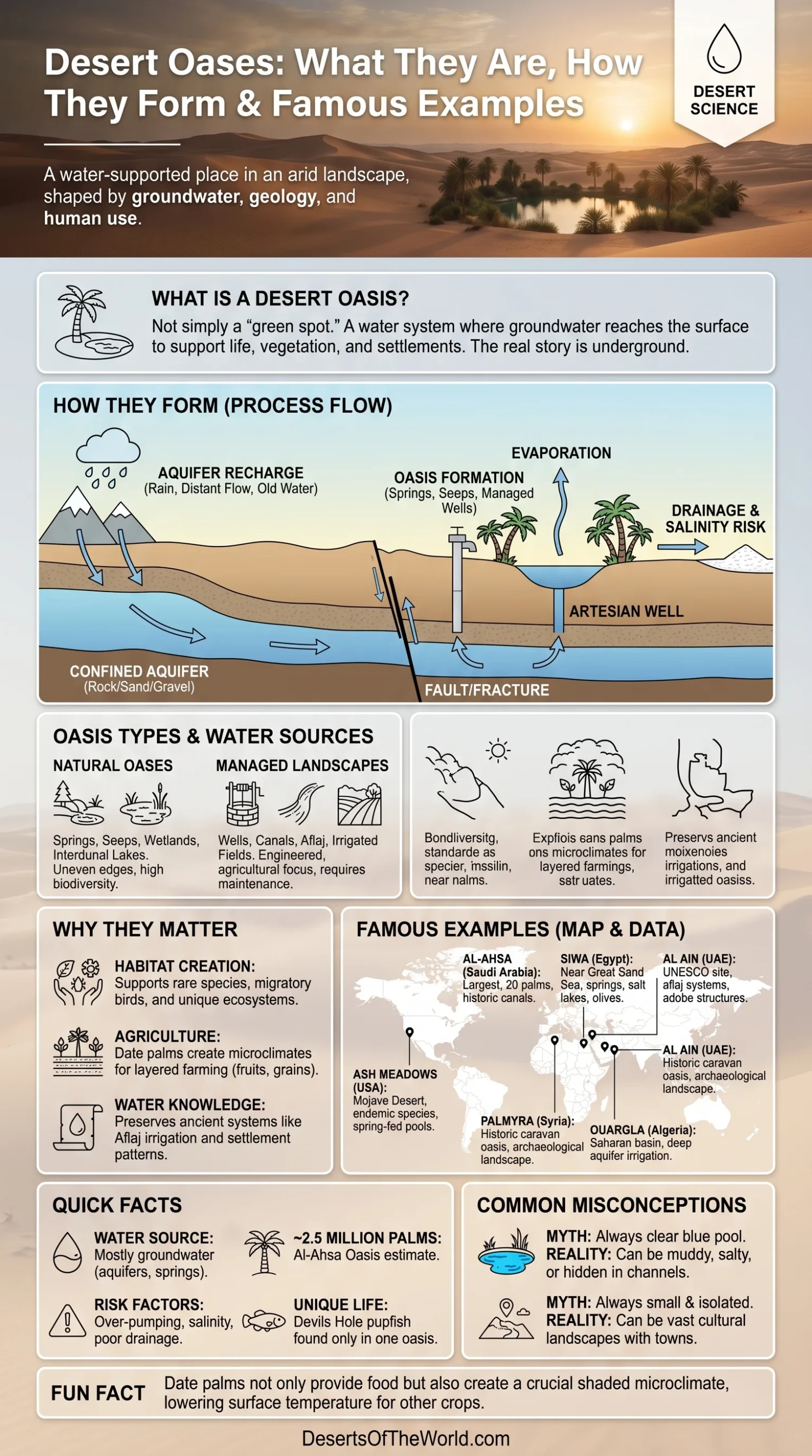
| Feature | What It Means |
|---|---|
| Basic Definition | A water-supported place in a desert or dryland where vegetation can grow. |
| Common Water Source | Groundwater rising through springs, shallow aquifers, wells, faults, or artesian pressure. |
| Main Desert Setting | Sand seas, gravel plains, rocky basins, wadis, depressions, and dune fields. |
| Typical Plants | Date palms, reeds, tamarisk, grasses, shrubs, salt-tolerant plants, and cultivated crops where irrigation exists. |
| Main Risks | Over-pumping, rising salinity, drainage problems, falling water tables, and land-use pressure. |
| Famous Examples | Al-Ahsa, Siwa, Al Ain, Ouargla, Ash Meadows, and Palmyra. |
What Is a Desert Oasis?
A desert oasis is a local area of dependable or semi-dependable water within an arid landscape. The water may appear as a spring, pool, wetland, shallow lake, irrigated palm grove, or green belt around wells. In many cases, an oasis is fed by an aquifer: a layer of rock, sand, gravel, or fractured limestone that stores and moves groundwater.
The word often brings to mind a ring of date palms beside a pool. That image is not wrong, but it is too simple. Some oases are small wet patches where reeds grow. Some are wide cultural landscapes with canals, gardens, settlements, old irrigation systems, and millions of palms. Others are fragile spring-fed habitats where rare fish, insects, or plants survive in one narrow water pocket.
The best way to understand an oasis is this: it is where desert dryness is interrupted by stored water. Sometimes the interruption is natural. Sometimes people have enlarged it through wells, channels, and farming.
How Desert Oases Form
Oases form when water becomes available at or near the desert surface. That sounds simple. The process behind it can be slow, hidden, and highly local. A dry plain may have no visible rivers, yet groundwater may move below it for many kilometers before rising at a low point, a fault, or a spring line.
Groundwater Reaches the Surface
Many oases begin where groundwater meets land surface. A spring can form when a slope, valley bottom, or depression cuts into the water table. If an aquifer fills high enough, water may overflow naturally. In a desert, even a small spring can change the land around it.
Once water appears, plants follow. Roots hold fine sediment. Organic matter builds in the soil. Shade lowers surface heat. Birds, insects, mammals, and reptiles use the wet patch. Over time, the oasis becomes a small living island inside a much drier setting.
Aquifers Store Water Beneath Dry Land
An aquifer is not an underground lake in the usual sense. It is more like a wet sponge made of rock, sand, gravel, or cracks. Water fills spaces inside the ground and moves through them. In deserts, this water may come from:
- Rain that fell in nearby mountains.
- Old recharge from wetter climate periods.
- Seasonal runoff that sinks into gravel beds.
- Long-distance groundwater flow from uplands.
- Deep artesian systems under pressure.
Some desert groundwater is young. Some is old. In parts of the Sahara and Arabian Peninsula, groundwater may have entered the ground during earlier wetter periods and now moves slowly through large regional aquifer systems. This is one reason some oases are productive but still vulnerable. Water may be available, yet not replaced quickly.
Faults and Rock Layers Guide the Water
Geology often decides where an oasis appears. Water does not move evenly underground. It follows easier paths: cracks, faults, porous sandstone, gravel channels, fractured limestone, or the boundary between rock layers.
In some basins, a buried hard rock ridge or less permeable layer blocks the downward movement of water. The water then rises. In other places, a fault acts like a vertical pathway, lifting groundwater toward the surface. This is why springs often appear in lines rather than randomly scattered points.
Not obvious from above, this part. A person may see only palms and a pool, while the oasis is actually controlled by a buried rock structure.
Depressions Catch and Hold Water
Many oases sit in depressions. A depression is a lower area where groundwater can stand close to the surface or where runoff can collect after rare rain. In dry climates, water at the surface evaporates fast, so these places often become salty unless drainage is good.
This is why some oasis landscapes contain both green groves and salt flats. The same water that feeds life can leave salts behind when it evaporates. If irrigation water has no safe way to drain, salinity can rise in soil and shallow groundwater.
Artesian Pressure Can Push Water Upward
In an artesian system, groundwater is trapped under pressure between less permeable layers. When people drill into it, or when a natural break reaches it, water may rise by itself. Some famous oasis regions developed around flowing wells and spring-fed irrigation, especially where deep aquifers underlie desert basins.
Artesian water can make farming possible in very dry places. Yet it can also create a false sense of abundance. If pumping exceeds recharge or pressure drops, wells may weaken, stop flowing, or become more saline.
Oasis Water Sources Compared
| Water Source | How It Works | Oasis Result |
|---|---|---|
| Spring | Groundwater naturally reaches the surface. | Creates pools, marshes, streams, or palm groves. |
| Shallow Water Table | Groundwater sits close enough for roots or wells to reach. | Supports vegetation and small-scale farming. |
| Artesian Aquifer | Pressurized groundwater rises through a natural opening or well. | Can feed flowing wells, canals, and irrigated fields. |
| Wadi Recharge | Rare floodwater sinks into sand and gravel after storms. | Feeds local groundwater pockets near dry riverbeds. |
| Interdunal Lake | Water collects between dunes where the water table is high or drainage is blocked. | Forms lakes or wetlands within sand seas. |
| Managed Wells and Canals | People draw and distribute groundwater for crops and settlements. | Expands the green area, but needs careful water control. |
Why Oases Matter in Deserts
In desert geography, oases matter because they show how water shapes life in drylands. A single spring can support plants, animals, farming, rest points, local culture, and settlement patterns. In wide deserts, oases often work like stepping stones. They connect routes across otherwise dry regions.
They Create Habitats in Dry Regions
Spring-fed desert habitats can support many species in a very small area. Reeds, sedges, palms, grasses, insects, birds, amphibians, fish, and mammals may depend on oasis water. In some places, species exist only in one spring system or one connected group of springs.
A desert spring is not only a water point. It is a protected pocket of temperature, moisture, shade, and food. For migrating birds, it can be a stopover. For desert mammals, it can be a dry-season lifeline. For aquatic species, it may be the entire range.
They Support Date Palms and Irrigated Crops
Date palms are strongly linked with many hot desert oases. They tolerate heat, create shade, and allow layered farming beneath their canopy. Under palms, people may grow grains, vegetables, fodder, citrus, olives, or other crops depending on soil, salinity, and irrigation water.
This layered system is practical. Tall palms reduce harsh sunlight and wind. Lower crops use the milder microclimate. In a desert, shade is not decoration; it changes what can grow.
They Preserve Water Knowledge
Many old oasis communities developed careful ways to move and share water: canals, wells, underground channels, basins, drainage lines, and timed irrigation. Al Ain in the United Arab Emirates is known for its oasis areas and early aflaj irrigation evidence. Al-Ahsa in Saudi Arabia is known for springs, wells, canals, gardens, and a large palm landscape.
These systems show a simple but demanding rule: an oasis survives when water use, drainage, soil, and shade stay in balance.
Famous Desert Oases Around the World
Oases differ widely. Some are natural wetlands. Some are historic palm landscapes. Some are settlement centers at the edge of large deserts. The examples below show several oasis types rather than one single model.
| Oasis | Region | Desert Setting | Noted For |
|---|---|---|---|
| Al-Ahsa Oasis | Eastern Saudi Arabia | Between desert margins of the Arabian Peninsula | Large palm landscape, springs, wells, canals, and more than 2.5 million date palms. |
| Siwa Oasis | Western Egypt | Near the Great Sand Sea and Western Desert | Springs, salt lakes, palms, olives, and groundwater management issues. |
| Al Ain Oases | United Arab Emirates | Desert and mountain-edge landscape | Oasis areas, wells, adobe structures, and early aflaj irrigation evidence. |
| Ouargla Oasis | Algerian Sahara | Northern Sahara basin | Groundwater from the North-West Sahara Aquifer System and irrigated fields. |
| Ash Meadows | Southern Nevada, United States | Mojave Desert region near Death Valley | Spring-fed oases, endemic species, and groundwater discharge from a large aquifer system. |
| Palmyra | Syrian Desert | Desert oasis north-east of Damascus | Historic caravan oasis and major archaeological landscape. |
Al-Ahsa Oasis, Saudi Arabia
Al-Ahsa is one of the clearest examples of a large oasis as both a natural and cultural landscape. It lies in the eastern Arabian Peninsula and includes gardens, canals, springs, wells, a drainage lake, historic buildings, and settlement areas. UNESCO describes it as the largest oasis in the world, with more than 2.5 million date palms.
The oasis sits near major desert contexts, including Ad-Dahna to the west and Rub’ Al-Khali to the south. Its scale makes it different from a small spring oasis. Al-Ahsa is a working landscape: water, palm agriculture, settlement, and old water systems all appear together.
Siwa Oasis, Egypt
Siwa sits in Egypt’s Western Desert, close to the Great Sand Sea. It is known for springs, salt lakes, palms, olives, and a distinct desert-edge setting. Its water story is not just about having springs. It also involves shallow and deeper aquifers, drainage, salinity, and careful management.
Modern water work in Siwa has focused on issues such as excess agricultural drainage, salinity in shallow aquifer water, and the need to balance groundwater extraction with land health. That makes Siwa a useful example of a living oasis problem: water can create fertility, but too much poorly drained water can harm soils.
Al Ain Oases, United Arab Emirates
Al Ain is a strong example of oasis life near mountains and desert. Its UNESCO-listed cultural sites include oasis areas, wells, adobe buildings, tombs, and evidence of the aflaj irrigation system. Aflaj channels move water through controlled routes, often using gravity. In oasis regions, that kind of water control can turn a limited source into a stable agricultural landscape.
Al Ain also shows how oases are more than biology. They are settlement records. Walls, wells, channels, and palm groves hold information about how people adapted to arid land without treating water as unlimited.
Ouargla Oasis, Algeria
Ouargla lies in the Algerian Sahara. Satellite imagery shows the contrast clearly: pale desert surfaces around irrigated fields and oasis growth. Its water is linked to the North-West Sahara Aquifer System, a vast groundwater system beneath Algeria, Tunisia, and Libya.
Ouargla is a good case for understanding both the strength and risk of groundwater-fed oases. Boreholes allow irrigation in the desert, but heavy drilling can raise concerns about salinity and long-term water balance. Green fields in a desert basin may look stable from the air. Underground, the balance may be delicate.
Ash Meadows and Devils Hole, United States
Ash Meadows, in southern Nevada, is a spring-fed oasis system near Death Valley. It is especially known for rare plants and animals. The area has dozens of seeps and springs, and its groundwater system extends far to the northeast. Devils Hole, a water-filled geothermal cave in this wider spring landscape, is famous as the only natural home of the Devils Hole pupfish.
This example is small compared with Al-Ahsa, but it teaches a large lesson. Some oases are not mainly agricultural. They are biological refuges. A change in water level, temperature, or chemistry can affect species with very limited habitat.
Palmyra, Syrian Desert
Palmyra is one of the best-known historic desert oases. Located north-east of Damascus, it developed as a caravan oasis in the Syrian Desert. Its value lies in the link between water, route geography, settlement, and architecture. For desert history, Palmyra shows how an oasis could become a stopping point, meeting place, and urban center in a dry region.
Not every oasis becomes a city. But where water, route position, and workable land meet, an oasis can shape movement across a desert for centuries.
Natural Oases and Human-Made Oasis Landscapes
Some oases are mostly natural. Others are partly engineered. The difference matters.
Natural Oases
A natural oasis forms where water appears without major human work. It may be a spring, seep, wetland, interdunal lake, or shallow groundwater area. Plants grow because roots can reach moisture or because surface water remains long enough to support them.
Natural oases often have uneven edges. Vegetation follows wet soil, not straight lines. Water may vary with season, recharge, and evaporation. Wildlife use may be high, especially where the surrounding desert has few other water points.
Managed Oasis Landscapes
A managed oasis uses wells, canals, basins, embankments, field divisions, or drainage systems. People may plant date palms, maintain irrigation channels, clean springs, or drill deeper wells. In these places, the oasis is a partnership between natural water and human labor.
Managed oases can be highly productive, but they need constant care. If drainage fails, salts collect. If wells draw too much water, the water table may fall or quality may decline. If old channels are abandoned, fields may dry or become waterlogged in the wrong places.
Why Oases Can Become Salty
Salt is one of the least understood parts of oasis geography. Desert water often contains dissolved minerals. When water evaporates, the minerals remain. Over time, salts can build up in soil, ponds, shallow groundwater, and irrigation basins.
Salinity can rise when:
- Irrigation water evaporates faster than it drains.
- Shallow groundwater rises into the root zone.
- Poor drainage leaves water standing in fields.
- More wells bring more mineral-rich water to the surface.
- Closed basins trap salts instead of flushing them away.
This is why oasis farming is not just a matter of “add water.” In a desert, water must also leave in the right way. Too little water dries the land. Too much trapped water can salt it. Balance is everything.
Plants Commonly Found in Oases
Oasis plants vary by region, temperature, soil, and water quality. A hot Arabian oasis will not look exactly like a spring-fed Mojave wetland or a North African salt-lake edge. Still, several plant groups appear often.
- Date palms: common in hot desert oases where irrigation and heat support palm agriculture.
- Reeds and rushes: grow near springs, marshes, pools, and drainage channels.
- Tamarisk: often found in salty or dryland water settings.
- Grasses and sedges: form wet patches around seepage zones.
- Olives and fruit trees: grown in some managed oases, depending on climate and water.
- Salt-tolerant shrubs: appear near saline flats, lake edges, and evaporating basins.
Palms are the symbol, yes. But reeds, shrubs, and salt-tolerant plants often tell the real water story at the edges.
Animals and Small Habitats Around Oases
Oases can support desert wildlife far beyond their size. Birds may use them as rest points. Insects and pollinators gather near flowering plants. Mammals may visit at night. Fish and aquatic invertebrates can live in spring-fed pools where water stays stable.
In places such as Ash Meadows and Death Valley spring systems, isolated waters have allowed rare species to adapt to very narrow habitats. These oasis habitats are sometimes described as ecological islands because they are separated from other wet places by dry land.
That isolation can protect unique life, but it also creates risk. A small water-level change may matter more in a spring pool than in a large river.
How Oases Differ From Lakes, Wetlands, and Rivers
An oasis can include a lake, wetland, or stream, but it is not exactly the same thing. The term describes a water-supported area within a dryland context. The desert setting is part of the meaning.
| Feature | Main Difference |
|---|---|
| Oasis | A water-supported area in a desert or dryland, often fed by groundwater. |
| Spring | A point where groundwater naturally flows to the surface; it may create an oasis. |
| Wetland | A water-saturated habitat; in deserts, some wetlands are part of oasis systems. |
| Lake | A body of standing water; oasis lakes may be fresh, brackish, or salty. |
| Wadi | A dry riverbed or seasonal channel; it may recharge groundwater after rare floods. |
What Makes an Oasis Last?
An oasis lasts when its water system stays balanced. That balance may depend on climate, aquifer recharge, pumping, evaporation, salinity, drainage, and land use. Large oases can seem permanent because settlements and palm groves remain for generations. Yet their water budgets still matter.
Recharge Must Match Use Over Time
Recharge is water added back to an aquifer. It may come from rain, mountain runoff, river seepage, or older regional flow. In arid regions, recharge can be slow and irregular. If water withdrawal is faster than replacement, the oasis may shrink or become harder to maintain.
Drainage Must Prevent Salt Build-Up
Good drainage allows excess water and dissolved salts to move away from root zones. Without it, soils may become less suitable for crops. Many oasis landscapes have channels not only to bring water in, but also to carry excess water out.
Vegetation Protects the Local Microclimate
Palms, reeds, shrubs, and fields reduce wind at ground level. They shade soil and slow evaporation in small ways. A healthy grove can create a cooler pocket inside a hot desert basin. Remove vegetation, and the surface may dry, heat, and erode more easily.
Common Misunderstandings About Oases
Every Oasis Has a Clear Blue Pool
Many do not. Some oases have muddy springs, reed beds, wells, canals, or salty ponds. Others are mostly palm gardens with water hidden in channels or underground.
Oasis Water Is Always Fresh
Not always. Oasis water can be fresh, brackish, warm, mineral-rich, or saline. Water quality depends on rock chemistry, evaporation, aquifer depth, and drainage.
Oases Are Always Small
Some are tiny spring patches. Others, such as Al-Ahsa, cover a broad cultural landscape with towns, fields, canals, and millions of palms.
More Wells Always Improve an Oasis
More wells can increase water supply for a time, but they can also lower pressure, raise salinity, or disturb the water table. In desert basins, pumping decisions need care.
Why Oases Are Important for Understanding Deserts
Oases reveal that deserts are not empty spaces. They are water-limited systems with hidden structure. A spring may show where an aquifer meets the surface. A palm grove may show centuries of water control. A salt lake may show evaporation at work. A rare fish pool may show long isolation.
For a desert landscape, an oasis is like a small window cut into the ground. Through it, the underground water system becomes visible.
That is why oases deserve careful reading. Their palms, reeds, canals, salts, springs, and wells all speak the same language: water is present, but never simple.
Frequently Asked Questions
What Is a Desert Oasis in Simple Terms?
A desert oasis is a place in a dry region where water is available at or near the surface, allowing plants and sometimes settlements to exist.
How Does an Oasis Get Water?
Most oases get water from groundwater. The water may rise through springs, reach plant roots from a shallow water table, flow from an artesian aquifer, or be drawn by wells.
Can an Oasis Dry Up?
Yes. An oasis can shrink or dry if groundwater levels fall, springs weaken, recharge declines, wells overuse the aquifer, or drainage and salinity problems damage the land.
Are Oases Natural or Human-Made?
They can be both. A natural water source may create the first oasis, while people may expand it with wells, canals, irrigation, and planted groves.
Why Are Date Palms Common in Oases?
Date palms tolerate hot desert climates, grow well with irrigation, and create shade that helps protect lower crops and soil.
Is Oasis Water Safe to Drink?
Not automatically. Oasis water can contain salts, minerals, microbes, or other natural and local contaminants. Drinking water safety depends on testing and treatment.
Sources
- U.S. Geological Survey – Springs and the Water Cycle (explains how springs form where groundwater reaches the surface)
- U.S. Geological Survey – Aquifers and Groundwater (background on aquifers, water tables, recharge, and pumping)
- U.S. National Park Service – Springs and Seeps in Death Valley (desert springs, seeps, oases, and wildlife habitat)
- U.S. National Park Service – Devils Hole (Ash Meadows, spring-fed oases, groundwater, and endemic species)
- UNESCO World Heritage Centre – Al-Ahsa Oasis (largest oasis, date palms, springs, wells, canals, and cultural landscape)
- UNESCO World Heritage Centre – Cultural Sites of Al Ain (oases, wells, adobe structures, and aflaj irrigation context)
- NASA Earth Observatory – Ouargla Oasis, Algeria (Saharan oasis imagery and North-West Sahara Aquifer context)
- Egypt Ministry of Water Resources and Irrigation – Siwa Oasis Development Project (Siwa groundwater, salinity, drainage, and water management)
- UNESCO World Heritage Centre – Site of Palmyra (historic oasis setting in the Syrian Desert)