
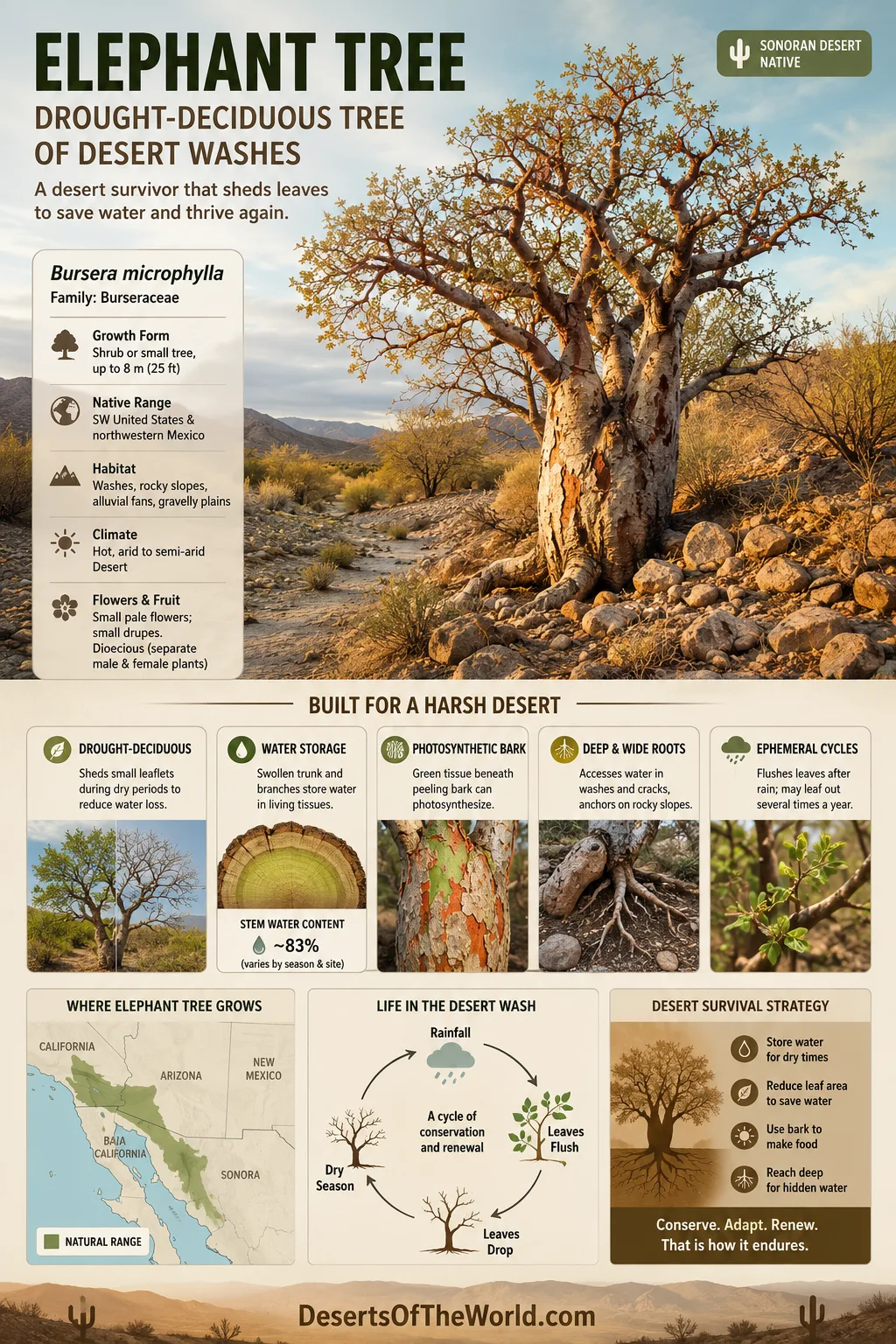
Elephant tree, Bursera microphylla, grows where water arrives in brief pulses rather than as a steady supply. A dry channel may remain dusty for months, then carry a fast sheet of runoff after rain falls on distant hills. Rocky slopes can appear almost bare, yet small cracks collect enough moisture for roots. The tree fits this uneven rhythm by changing its active surface: it grows leaves when water is available and sheds them when keeping them becomes too costly.
Its swollen trunk, peeling bark, red-tinged branches and finely divided leaves give it an unusual form among Sonoran Desert plants. The shape is not decorative excess. Each part reflects life in hot desert scrub, gravel fans, rocky hills and ephemeral washes across northwestern Mexico and the southwestern United States.
Elephant Tree in the Sonoran Desert
| Feature | Elephant Tree Detail |
|---|---|
| Accepted scientific name | Bursera microphylla A.Gray |
| Plant family | Burseraceae, the torchwood family |
| Growth form | Drought-deciduous shrub or small tree, sometimes reaching about 8 m (25 ft) |
| Native range | Southern California, Arizona and northwestern Mexico, especially Sonora and the Baja California peninsula |
| Main desert setting | Sonoran Desert and related dry shrublands |
| Common landforms | Washes, alluvial fans, gravelly plains, rocky slopes and warm south-facing exposures |
| Main drought response | Leaf loss during dry periods, water storage in stem tissues and limited photosynthesis through green stem tissue beneath thin bark |
| Flowers and fruit | Small pale flowers followed by small drupes; male and female flowers usually occur on separate plants |
The common name can cause confusion. Several unrelated or distantly related plants are called elephant trees because they develop thick trunks or contorted branches. Here, elephant tree means Bursera microphylla, also known in parts of Mexico as a torote. The scientific name matters because Baja elephant tree, Pachycormus discolor, may grow beside it while belonging to a different plant family.
A Tree That Can Look Dead Before Rain Returns
During a long dry spell, an elephant tree may stand almost bare. Its branches remain firm, its trunk stays swollen, and living tissue continues to function beneath the bark, but the leafy crown disappears. To an observer used to woodland trees, the plant can look damaged or dead. In its natural cycle, this leafless state is often a controlled response to water shortage.
Leaves create sugars through photosynthesis, yet they also release water through stomata. Hot air, low humidity and wind increase that loss. When roots cannot replace the water quickly enough, maintaining a full canopy becomes expensive. Elephant tree reduces the exposed leaf area rather than allowing its entire water balance to fail.
Drought-deciduous is therefore more precise than simply deciduous. A temperate tree often follows a predictable autumn schedule shaped by temperature and day length. Elephant tree responds more directly to available moisture, heat and local conditions. It may hold foliage longer after useful rain, shed it as soil dries, or produce a new flush outside a neat calendar pattern.
Why Keeping Leaves Can Become a Burden
The tiny leaflets already reduce the surface area exposed to dry air. That helps, but it does not remove the cost of transpiration. When drought continues, small leaves can still lose more water than the root system can replace.
- With leaves: the tree gains carbon, builds new tissue and can support flowering or fruit development.
- Without leaves: carbon gain drops, but water loss also falls sharply.
- After rain: buds can reopen and rebuild the canopy when the water budget improves.
Leaf shedding is not a failed growing season. It is a temporary reduction in activity that protects the woody body capable of growing again.
The Swollen Trunk as a Water Buffer
The lower trunk thickens with age and may divide into several twisted stems. Older branches can also become fleshy. Inside them, water is held in living parenchyma and woody tissues. This places elephant tree among the stem-succulent or semi-succulent trees of dry regions, even though it also forms true wood and a branched crown.
An Arizona-Sonora Desert Museum comparison found that sampled B. microphylla stem material was about 83% water. That measurement illustrates how watery the tissue can be; it should not be treated as a fixed value for every tree, season or part of the plant.
The trunk is better understood as a buffer than as a simple tank. It helps living tissues bridge dry intervals and may support the return of leaves when conditions improve. Studies of stem-succulent trees also show that stored water does not always replace daily root uptake in the way a household reservoir feeds a tap. Direct measurements differ among species. For elephant tree, stem storage functions as a seasonal water buffer rather than an unlimited reservoir.
Photosynthesis Without a Full Canopy
Thin, pale sheets of bark peel from older stems, often revealing copper, rust or reddish layers below. Beneath the thin outer surface lies chlorophyll-bearing tissue. Light can reach this tissue, allowing branches and trunks to continue a limited amount of photosynthesis while the tree is leafless.
This does not match the output of a full leafy crown. It does reduce the all-or-nothing divide between active and dormant appearance. The tree can shed its main water-losing organs while retaining some carbon recycling and stem activity.
Aromatic Sap and the Torchwood Family
Broken leaves or bark release strongly scented, oily sap. Bursera belongs to Burseraceae, the same family that includes the Old World genera associated with frankincense and myrrh. Elephant tree is not the commercial source of those products, but the family connection explains its resinous character.
The sap may help seal wounded tissue and discourage feeding animals. Its chemistry also gives the foliage and stems their noticeable scent.
Why Desert Washes Matter
A desert wash is an ephemeral drainage channel, not a permanently flowing stream. Most of the time it may look like a strip of sand, gravel and scattered shrubs. After intense rain, runoff from a much wider catchment can concentrate in the channel. The flow may be brief, yet its effects remain after the visible water disappears.
- Rain falls on hillslopes, rock faces or hard desert ground.
- Water moves downslope faster than the surface can absorb it.
- Runnels and side channels feed a larger wash.
- Flow deposits sand, silt, gravel and organic matter in new positions.
- Moisture remains below the surface longer than it does on exposed ground nearby.
For a woody desert plant, that short pulse can be more useful than light rain that wets only the uppermost soil. Water concentrated in a wash may infiltrate deeper, reaching roots protected from rapid surface evaporation.
Moisture Is Uneven Even Within One Wash
Not every point in a channel offers the same conditions. A bend may collect finer sediment. The downstream side of a boulder may slow water and trap debris. A low terrace beside the main channel may avoid the strongest current while still receiving subsurface moisture. These small differences help explain why elephant trees often appear as scattered individuals or loose stands rather than an even line.
The species does not behave like a riverbank tree dependent on permanent groundwater. Its advantage comes from using places where rare water becomes locally concentrated.
The Wash Is Only Part of Its Habitat
Calling elephant tree a wash plant is useful, but incomplete. Field vegetation records also place it on gravelly plains, alluvial fans, steep south-facing slopes, and rocky limestone or igneous ground. Soils may be sandy, stony or shallow.
Rocky slopes can provide hidden moisture. Water enters fractures, runs behind stones and gathers in pockets of finer material. Rocks may also shade the soil surface around roots. On the northern edge of the range, a south-facing wall or slope can create a warmer microclimate that reduces exposure to cold air.
| Landform | How It Can Favor Elephant Tree |
|---|---|
| Wash floor or margin | Receives concentrated runoff and buried moisture after short flow events |
| Alluvial fan | Spreads runoff across gravel and mixed sediment below mountain fronts |
| Rocky slope | Provides fractures, shaded root pockets and rapid drainage |
| South-facing exposure | Creates a warmer setting near the cold edge of the species’ range |
| Gravelly plain | Allows fast infiltration where roots can reach moisture below the hot surface |
From the Baja Peninsula to the Northern Sonoran Desert
Royal Botanic Gardens, Kew records the native range from southern California through Arizona and into northern Mexico. Within that broad outline, elephant tree is closely associated with the Sonoran Desert, western Sonora and much of the Baja California peninsula.
It is not equally common or equally large everywhere. In parts of Baja California and western Sonora it may form a conspicuous small-tree layer. Near the northern limit in Arizona and California, it is more scattered and often stays shrub-sized. Local water supply matters, but cold exposure also shapes this pattern.
A Tropical Plant Lineage at a Desert Edge
Bursera is especially diverse in warm Mexican dry forests and thornscrub. Elephant tree carries that warm-climate ancestry into one of North America’s driest regions. Its sensitivity to frost reveals the connection.
At the northern edge, trees often occupy warm rock faces, sheltered canyons and sun-facing slopes. A few degrees of local temperature difference can separate a viable site from one where repeated cold damage prevents the plant from becoming a larger tree.
A Desert with Two Main Rain Seasons
The Sonoran Desert differs from deserts dominated by one short wet season. Many areas receive some winter precipitation and another share during the summer monsoon. The balance changes across the region.
U.S. Forest Service summaries place mean annual precipitation in much of the Arizona Upland between roughly 200 and 425 mm. Drier parts of the Lower Colorado River Valley can receive far less, with broad regional values reported from about 30 to 285 mm. These are landscape ranges, not rainfall requirements for a single elephant tree.
The split rainfall pattern helps support a varied vegetation of small trees, large shrubs and succulents. Elephant tree still ties most stem extension to warm-season moisture, but leaf timing can respond flexibly to useful rain.
How to Recognize Bursera microphylla
No single feature identifies elephant tree in every season. The most reliable field impression comes from several traits appearing together: swollen woody stems, peeling pale bark, red or copper-toned younger branches, aromatic sap and very small leaflets.
Trunk, Bark and Branch Form
- The base becomes thick and may split into several contorted trunks.
- Older bark peels in thin, pale or whitish sheets.
- Newer branches often show red, cherry or copper tones.
- The crown is open rather than densely shaded.
- Branches may spread widely and develop a naturally sculpted form.
Wind-exposed coastal plants can remain compact, while protected inland plants may grow more upright. The species therefore ranges from natural bonsai-like shrubs to small trees.
Leaves Made of Many Tiny Leaflets
The leaves are alternate and pinnately compound. A single leaf may carry many pairs of tiny, dark green leaflets. University of Arizona descriptions report about 7 to 35 pairs, though field appearance varies with growth stage and population.
This finely divided canopy allows light and air to pass through. The small leaflets reduce the size of each exposed surface, while their complete loss during drought cuts water use much further.
Small Flowers, Separate Sexes and Bird-Carried Fruit
The cream or pale flowers are small and easy to miss. Most elephant trees are dioecious, meaning male and female flowers occur on separate individuals. A lone tree can flower without producing fruit if no compatible tree grows close enough for pollination.
Flowering occurs in summer, with California records centered around June and July. Farther south, exact timing follows local heat and moisture conditions. The fruit is a small drupe that becomes available to birds after ripening.
Gray Vireos have a particularly close winter feeding relationship with elephant tree fruit in coastal Sonora. Research has found broad overlap between the bird’s winter range there and dense stands of B. microphylla. Birds remove the pulp and transport seeds away from the parent plant, connecting scattered trees across dry terrain.
What Happens After Useful Rain
A rainfall event does not switch every elephant tree on at the same moment. Response depends on how much water entered the soil, where the roots sit, how long the previous dry period lasted, and whether temperatures support growth.
A typical sequence may include:
- Water moves into sandy deposits, rock fractures or buried wash sediments.
- Roots regain access to moisture and dormant buds begin to activate.
- New compound leaves unfold on branch tips.
- Photosynthesis rises as the canopy expands.
- Warm-season stem growth, flowering or fruit development may follow.
- Leaves yellow or drop when soil moisture again falls below a workable level.
The tree may leaf out after rain in more than one month, yet most stem growth occurs during the humid summer period. New leaves can be a short response to moisture, while lasting branch extension needs a longer window of favorable conditions.
Why One Storm May Not Be Enough
A brief shower can darken the ground without wetting the root zone deeply. A larger storm, repeated storms, or runoff concentrated by topography has a better chance of creating a useful pulse. The same rain amount may produce different results on a steep rock face, a sandy wash and a compacted plain.
A calendar alone cannot predict elephant tree foliage. The tree responds to effective moisture: water that reaches roots and remains available long enough to support growth.
How Its Drought Strategy Differs from Other Desert Plants
Sonoran Desert plants do not solve water shortage in one shared way. Elephant tree combines a woody crown with stem succulence and flexible leaf loss. Nearby species use other combinations.
| Plant | Main Water-Saving Pattern | Difference from Elephant Tree |
|---|---|---|
| Elephant tree | Stores water in swollen stems, drops leaves during drought and retains photosynthetic stem tissue | Combines true woody branching with a partly succulent trunk |
| Palo verde | Sheds small leaves while green bark continues much of the plant’s photosynthesis | Its slender green stems are less swollen than elephant tree trunks |
| Ocotillo | Produces leaves rapidly after rain and drops them when shallow soil dries | Uses repeated short leaf flushes on long cane-like stems |
| Columnar cactus | Stores water in ribbed stems and performs photosynthesis without ordinary leaves | Maintains a permanently leafless cactus body rather than a seasonal woody canopy |
| Creosote bush | Uses small resinous leaves, deep and spreading roots, and reduced activity under stress | Remains an evergreen shrub more often and lacks a swollen water-storing trunk |
Elephant tree sits between familiar categories. It is not a cactus, yet its stems are succulent. It is not a typical woodland tree, because its canopy can vanish whenever drought makes leaves too costly. Its form reflects a warm desert where rainfall is irregular but not absent.
Leafless Lookalikes in Baja California and Sonora
Thick, pale trunks have evolved in several dryland plants that are not close relatives. This is convergent evolution: similar environmental pressures produce similar outward forms.
Baja Elephant Tree
Pachycormus discolor can grow near Bursera microphylla in Baja California. When both are leafless, their swollen trunks and pale peeling bark can appear remarkably similar. Yet Pachycormus belongs to the cashew family, Anacardiaceae. It responds mainly to winter rain, while B. microphylla directs most growth toward the summer monsoon period.
Other Plants Called Elephant Tree
Bursera fagaroides and other species may also carry the elephant tree name. Leaf structure, bark texture, range and growth season help separate them. A common name alone should never be used to assign a desert plant to B. microphylla.
Where the Desert Adaptation Reaches Its Limits
Drought tolerance does not mean freedom from environmental limits. Elephant tree depends on a workable sequence of moisture, warmth and time.
- Cold: frost and prolonged freezing restrict the northern and upper-elevation edges of its distribution.
- Repeated weak rain seasons: short pulses may fail to recharge deeper soil or support new stem growth.
- Channel change: erosion or sediment movement can alter the root zone in washes.
- Strong flow: flash runoff can benefit established plants through infiltration while displacing seedlings from exposed channel positions.
- Fire: native Sonoran scrub historically carried fire infrequently because plant cover and fine fuels were patchy. Dense grass cover can connect fuels that were once separated.
The oldest plants persist because their strategy matches ordinary desert variability, not because they are unaffected by every extreme.
California Records and Regional Status
The California Native Plant Society inventory records elephant tree as G4 globally, while the species remains uncommon at the California edge of its range. The 2026 inventory lists 18 presumed extant occurrences, mainly in Imperial, Riverside and San Diego counties.
California records fall within rocky Sonoran desert scrub, often between about 200 and 700 m elevation. The state rank reflects rarity within California, not the abundance of the species throughout Mexico. Local rarity in California therefore does not describe abundance across the species’ full range.
The tree’s northern populations also show how tropical dryland lineages reach into warm desert pockets. Their location on sheltered slopes, rocky canyons and sun-facing terrain shows why regional range maps become more precise when topography is considered.
Sources
- Royal Botanic Gardens, Kew — Bursera microphylla (accepted name, plant family, native range and biome)
- California Native Plant Society — Bursera microphylla Alliance (habitat, height, drought-deciduous growth, water-storing tissues and vegetation associations)
- California Native Plant Society Rare Plant Inventory (California occurrences, elevation, flowering period and regional status)
- University of Arizona Campus Arboretum — Elephant Tree (branch form, leaflets, flowers, fruit and bark)
- Arizona-Sonora Desert Museum — Burseraceae (stem succulence, photosynthetic bark, rainfall response, range and lookalike plants)
- Arizona-Sonora Desert Museum — Succulent Bursera (illustrative stem water-content measurement)
- U.S. Forest Service — Sonoran Granite Outcrop Desert Scrub (washes, gravelly plains, rocky slopes, warm microhabitats and maximum reported height)
- U.S. Forest Service — Sonoran Desert Scrub Communities (regional rainfall, landforms, cold limits and fire setting)
- The Southwestern Naturalist — Gray Vireo Frugivory (bird feeding and seed-dispersal relationship in coastal Sonora)