
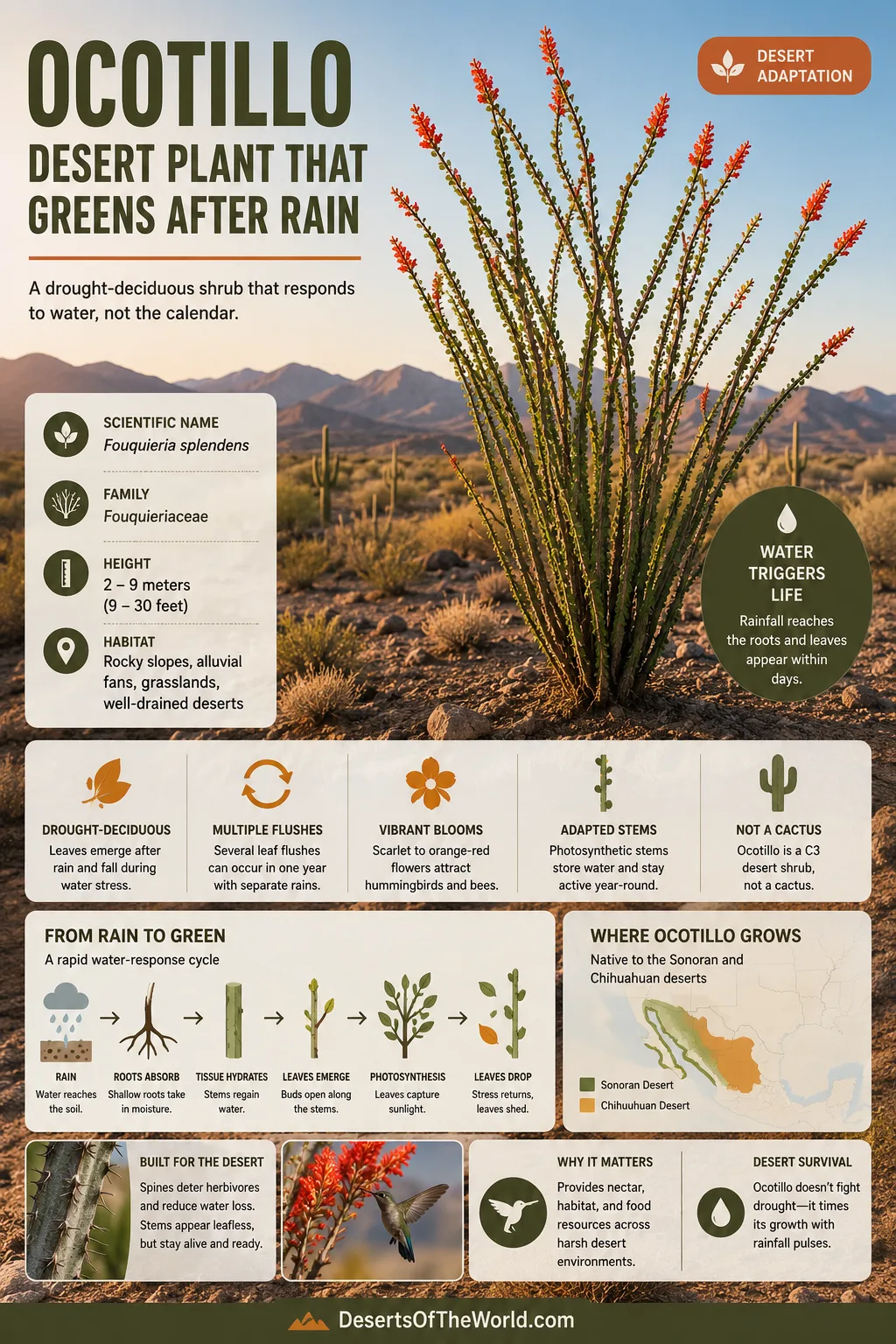
For much of the year, an ocotillo can look like a cluster of tall, thorn-covered canes rising from bare desert ground. Then rain reaches the root zone, and small green leaves spread along stems that seemed inactive only days earlier. The change is fast, but it is not a return from death. It is a repeated water-response cycle built for deserts where moisture arrives in short, uncertain pulses.
Fouquieria splendens does not try to remain green through every dry month. It opens a temporary photosynthetic surface when water is available, uses that surface while the soil stays moist, and sheds it when the cost of keeping leaves becomes too high. This pattern makes ocotillo one of the clearest examples of drought-deciduous growth in the Sonoran and Chihuahuan desert regions.
| Feature | Typical Expression | Desert Function |
|---|---|---|
| Scientific name | Fouquieria splendens | Identifies the species within the Fouquieriaceae family |
| Growth form | Large shrub with about 6 to 100 upright, wand-like stems | Raises leaves and flowers above low desert scrub |
| Height | About 2 to 9 meters (9 to 30 feet) | Creates a tall canopy without developing a conventional tree crown |
| Leaf behavior | Leaves appear after usable rainfall and fall during renewed water stress | Balances carbon gain against water loss |
| Leaf cycles | Several flushes may occur in one year; four or five have been recorded | Allows repeated use of separate rain events |
| Flowers | Scarlet to orange-red clusters at stem tips, often from March to June | Supplies nectar and supports pollination by hummingbirds and bees |
| Common habitat | Rocky slopes, bajadas, alluvial fans, desert grasslands, and well-drained plains | Places roots where brief rainfall can infiltrate without prolonged saturation |
Rain, Not the Calendar, Controls Ocotillo’s Green Phase
Many plants in temperate climates follow a familiar annual schedule. They leaf out in spring, remain active through summer, and lose foliage as winter approaches. Ocotillo works on a different clock. Its foliage responds mainly to available soil moisture, so a single plant may move between leafy and leafless states several times within the same year.
A winter storm, a spring rain, or a summer monsoon event can start a new leaf flush if enough water reaches active roots. The green period may last for weeks when moisture remains in the soil. Under hotter or drier conditions, it can end much sooner. A shower that only darkens the soil surface may produce little response if the water evaporates before reaching enough of the root zone.
This is why ocotillo should not be described as following one fixed growing season across its whole range. Rainfall timing differs between the Sonoran Desert, the Chihuahuan Desert, desert grasslands, and upland slopes. The plant’s visible cycle shifts with those local patterns.
Ocotillo Is Not a Cactus
The plant’s spines, leafless stems, and desert habitat often lead to a cactus label. Botanically, that label is wrong. Ocotillo belongs to the family Fouquieriaceae, not Cactaceae. Its scientific name is Fouquieria splendens.
The difference is more than taxonomy. Many cacti keep thick photosynthetic stems active throughout the year and use CAM photosynthesis to limit daytime water loss. Ocotillo is classed as a C3 desert shrub. Its most visible water-saving tactic is repeated leaf shedding, supported by semi-succulent stems and photosynthetic tissue beneath the bark.
One Plant, Two Very Different Appearances
A dry-season ocotillo may carry no leaves at all. Its stems look gray-green or brown, and the dense rows of spines become the dominant feature. After rain, clusters of small leaves cover those same stems. From a distance, the plant changes from an open bundle of canes into a narrow green fountain.
Neither appearance is abnormal. A leafless ocotillo in natural desert habitat may be conserving water exactly as expected, while a green ocotillo records a recent period of usable moisture. Its appearance is therefore a short-term reading of local water conditions, not a simple measure of age or health.
What Happens Between Rainfall and New Leaves
The transformation begins below ground, but the plant does not need to construct a new growth system from the beginning after every storm. Leaf-producing sites already exist along the stems. Water activates those prepared tissues.
- Rain infiltrates the upper soil around the plant.
- Shallow roots absorb water before the surface layers dry again.
- Water moves into stems and restores tissue hydration.
- Prepared leaf buds beside the spines begin to expand.
- Small leaves open along much of each cane.
- Leaf photosynthesis rises while soil moisture remains usable.
- Renewed water stress triggers leaf separation and drop.
Shallow Roots Catch Short Desert Rains
Ocotillo has a shallow root system with lateral roots extending near the soil surface. This arrangement suits a landscape where rainfall may wet the upper ground for only a short period. Roots positioned near that temporary moisture can respond before the water evaporates or drains deeper.
Root depth varies with soil, slope, bedrock, and plant age. At one caliche-underlain bajada site near Tucson, main roots were recorded only about 8 to 15 centimeters below the surface. Research on young plants in the northwestern Sonoran Desert found a greater mean root depth, around 19 centimeters. These measurements are local observations rather than a universal limit, but both show how much of the plant’s activity occurs near the upper soil layers.
Shallow rooting brings a trade-off. It helps the plant use brief rain pulses, yet it also exposes the root zone to fast drying. Ocotillo can use this strategy because it is able to withdraw from leaf-based growth when the upper soil loses moisture.
Prepared Leaf Sites Make the Response Fast
Leaf growth can begin without waiting for new long shoots. Buds positioned along existing stems expand when water becomes available. Under favorable summer conditions, fully formed leaves have been observed within about three days of rain.
Experiments with detached ocotillo stems show how much readiness is stored in the canes themselves. Dry stem sections began producing leaves within 24 hours after being placed in water, even though they were no longer connected to roots. After eight days, the largest leaves in the experiment were about 2.4 centimeters long. Water started the response, while stored materials within the stem supported the first stage of growth.
This does not mean every wild plant greens at the same speed. Rain depth, soil infiltration, air temperature, stem condition, and the length of the preceding drought all affect the visible result.
Why Ocotillo Treats Leaves as Temporary Equipment
Leaves are productive, but they are expensive in dry air. Their stomata admit carbon dioxide for photosynthesis, yet those openings also allow water vapor to escape. An evergreen leaf must resist heat, sunlight, and dehydration for a long period. Ocotillo follows another path: it produces leaves when the expected carbon gain is worth the water cost, then removes them when that balance changes.
The leaves can reach about 5 centimeters in length and are often described as thick or leathery, but they are not permanent desert foliage. Their main value is speed. They create a broad photosynthetic surface without requiring the plant to maintain that surface through months of drought.
Several Green Periods Can Occur in One Year
Ocotillo may produce four or five separate crops of leaves in a year when rainfall arrives in repeated pulses. A wet period starts one crop. Drying ends it. A later storm may start another.
This repeated refoliation separates ocotillo from plants that shed leaves only once each autumn. The cycle is opportunistic rather than tied to one date. On a hillside, neighboring plants can even show different amounts of foliage when runoff, rock cover, soil depth, or exposure causes small differences in available water.
Leaf Drop Is a Water-Saving Response
As the soil dries, roots can no longer replace water lost through the foliage at the same rate. Ocotillo responds by forming separation layers where leaves attach to the stem. The leaves then fall, cutting the plant’s evaporating surface.
Leaves do not always pass through a long yellow stage first. During rapid drought stress, they may dry and drop with little display. A bare plant after a recent green phase is therefore not necessarily declining. It may simply have completed one short photosynthetic window.
| Plant State | What Is Happening | Likely Environmental Context |
|---|---|---|
| Newly leafing | Buds along the stems are expanding | Recent rain has supplied usable root-zone moisture |
| Fully green | Leaves provide the main photosynthetic surface | Moisture remains available and temperatures permit activity |
| Dropping leaves | Water stress is rising and leaf maintenance is ending | Upper soil is drying after the rain pulse |
| Leafless | Water loss is reduced and growth is restrained | Dry conditions dominate, sometimes for many months |
How the Plant Functions While Leafless
Leaf loss greatly reduces water use, but it does not turn the canes into dead wood. Living tissues remain inside the stems. The bark limits further moisture loss, while green tissue beneath parts of the outer surface can use light.
Green Stem Tissue Keeps a Lower Level of Activity
Ocotillo stems contain chlorophyll and can carry out photosynthesis through areas where light passes into the outer tissues. This activity matters during the long leafless periods, though it should not be treated as an exact replacement for a full crop of leaves.
Leaves provide a much larger gas-exchange surface when water is available. Stem photosynthesis offers a smaller, persistent contribution and can also recapture some carbon dioxide released by living stem tissues. The plant shifts between these two modes rather than relying on either one alone.
Stored Stem Water Supports Reproduction
Ocotillo stems are semi-succulent. They hold water, though not in the swollen form seen in barrel cacti or many columnar cacti. Research in the Chihuahuan Desert found that stem water storage was closely tied to flower and fruit production, while stem growth followed a different pattern.
That distinction helps explain how an ocotillo can flower during a dry spring even when it carries few leaves. Water stored from earlier precipitation can support reproductive tissues at a time when fresh soil moisture is limited. Leaf production, stem extension, flowering, and fruiting do not always rise and fall together.
How Former Leaf Stalks Become Spines
The relationship between leaves and spines is visible along every ocotillo cane. A primary leaf develops with a stalk attached to the stem. The leaf blade is temporary, but part of the stalk remains and hardens into a spine. Later leaf clusters emerge near the base of that spine.
This creates an unusual pattern: a structure first connected with foliage becomes a lasting defense after the blade is gone. The spines can reach about 4 centimeters in length and discourage animals from feeding on the tender leaves or reproductive tissues. They also remain in place through repeated leafing cycles, giving bare stems their rough, armored appearance.
Flowering and Leafing Follow Different Timetables
Rain controls leaf production strongly, but it does not control flowering in exactly the same way. Ocotillo commonly produces dense clusters of red tubular flowers at the tips of mature stems from March to June, with timing shifting by latitude and elevation. In southern Arizona, the main flowering period often lasts about 50 to 60 days.
Flowers may appear before a new set of leaves. A plant can therefore be bare along most of its canes while carrying red flower clusters at the top. Summer rainfall may also be followed by scattered flowering, but the dependable spring display is not simply the floral version of rain-triggered leaf flush.
| Process | Strongest Control | Primary Function |
|---|---|---|
| Leaf emergence | Usable soil moisture after rainfall | Short-term carbon capture |
| Leaf drop | Renewed water stress | Reduced water loss |
| Spring flowering | Seasonal timing, plant size, stored resources, and water status | Pollination and seed production |
| Fruit development | Successful pollination and available stored resources | Production of capsules containing winged seeds |
Red Flowers Meet Migrating Hummingbirds
Ocotillo flowers are well placed for flying visitors. The clusters sit at the tops of tall stems, above much of the surrounding scrub. Their red color and tubular form suit hummingbird feeding, and each flower supplies nectar.
In southern Arizona, the spring flowering period overlaps the northward migration of hummingbirds. Field studies found that flowers open during the migration received better seed set than flowers opening after many hummingbirds had moved through. Solitary bees also pollinate the flowers, so ocotillo is not dependent on one visitor alone.
Nectar Also Appears Outside the Flowers
Ocotillo has extrafloral nectaries on its flower buds. These glands release nectar outside the flower itself and attract insects seeking water and sugars. In return, some visiting insects can reduce feeding damage around the buds.
This interaction adds another layer to the plant’s reproductive season. Floral nectar rewards pollinators inside open flowers, while nectar on unopened buds may attract small defenders before flowering is complete.
Where Ocotillo Fits in North American Deserts
Ocotillo is native to the drylands of the southwestern United States and Mexico. Its range extends from southeastern California across Arizona and New Mexico to western Texas, then south through broad parts of Mexico. It is most closely associated with the Sonoran Desert and Chihuahuan Desert, while also occurring in the Colorado Desert subdivision of the Sonoran system and on parts of the Mojave Desert’s southern margins.
The species is not restricted to the hottest valley floors. It grows from low desert plains to upland ridges. In the Trans-Pecos region of Texas, it has been recorded on limestone slopes and ridgetops at elevations reaching about 2,050 meters (6,700 feet).
Ocotillo on Sonoran Bajadas and Alluvial Fans
In the Sonoran Desert, ocotillo is common on bajadas, rocky slopes, alluvial fans, and open scrub with creosote bush, saguaro, brittlebush, jojoba, ironwood, palo verde, agaves, chollas, and prickly pears. Upper bajadas often suit it better than fine-textured valley soils because coarse rocky ground allows rain to infiltrate around the root zone.
The plant can become locally prominent where slopes collect runoff without remaining waterlogged. Its tall canes stand above lower shrubs, and its brief green phases often make recent rainfall patterns visible across an entire hillside.
Ocotillo on Chihuahuan Slopes and Desert Grasslands
Across the Chihuahuan Desert, ocotillo grows on rocky bajadas, ridges, limestone country, desert scrub, lechuguilla communities, yucca woodland, and open grassland margins. Summer rainfall plays a larger role in many eastern parts of this range, so leaf flush may track monsoon storms that arrive after a long hot spring.
Ocotillo also reaches some oak woodland edges and higher desert grasslands. These settings show that the species belongs to a range of dry, open plant communities rather than one narrow image of cactus-filled low desert.
Drainage Matters as Much as Rainfall
Ocotillo often favors rocky, well-drained ground. Rain must enter the soil, but the roots do not benefit from long periods of saturation. Coarse slopes and fans can provide a useful middle condition: fast infiltration followed by gradual drying.
Topography changes that balance. Rocks can guide runoff toward one plant, shade the soil, and slow evaporation. Slope direction changes sun exposure. A cooler east- or northeast-facing surface may preserve moisture longer than an exposed southwest-facing slope, especially for young plants with small root systems.
Why an Established Ocotillo and a Seedling Face Different Risks
A mature ocotillo can survive long leafless periods because it has established roots, many living stems, stored water, and stored carbohydrates. A seedling has almost none of that reserve. Germination after rain is only the first step.
Research in the northwestern Sonoran Desert found that successful seedling establishment depended on shade from a nurse plant or rock together with local water accumulation. The shaded microsite reduced heat load and slowed water loss, while runoff supplied moisture to the young roots. Recruitment appeared in a pulse rather than as a steady annual process.
This helps explain why a landscape can contain many old ocotillos but few small ones. Adult plants respond to separate storms by making temporary leaves. New plants need a longer chain of favorable events: viable seed, suitable temperature, rainfall, a protected site, enough follow-up moisture, and time to develop a root system.
Ocotillo’s Place Among Desert Plants and Animals
Ocotillo changes its ecological role with the season. During a wet phase, leaves add green surface area to open scrub and provide fresh tissue for small herbivores. During flowering, the upper stems become nectar stations for hummingbirds and bees. Developing capsules later release numerous winged seeds that can move away from the parent plant.
The canes also add vertical structure to habitats otherwise dominated by low shrubs, rosettes, grasses, and succulents. Birds may perch on the upper stems, while the spaces beneath established plants create patches of shade that differ from nearby open ground.
Its associated species vary across the range. Sonoran populations may grow beside saguaro and foothill palo verde. Chihuahuan populations may share slopes with lechuguilla, sotol, yucca, grama grasses, and creosote bush. Ocotillo links these communities through the same basic tactic: rapid activity when water arrives and restrained water use when it leaves.
What Ocotillo’s Appearance Says About Recent Conditions
An ocotillo can reveal recent moisture conditions, but the signal needs careful reading. One plant may receive runoff that its neighbor misses. A shaded slope can hold water longer than an exposed plain. Larger stems may also have more stored resources than younger ones.
A Leafy Plant Usually Marks Usable Recent Moisture
Fresh, expanding leaves show that water reached active tissues. A full green canopy suggests that moisture remained available long enough for many buds to develop. It does not prove that the rainy period will continue, and it does not indicate how much total rain fell across the wider desert.
A Bare Plant Is Often Conserving Water
Leaflessness is the normal dry condition for much of the year. Living stems may remain flexible and green beneath the outer surface even when the plant looks like a stand of dry poles. Long bare periods are expected in habitat where rain is irregular.
A single photograph cannot show the whole cycle. The same individual may carry dense foliage after one storm, lose it as the soil dries, and leaf out again after the next useful rain.
Flowers Do Not Guarantee a Matching Leaf Flush
Red flower clusters indicate that the plant has entered its reproductive period and has enough stored resources to support bloom. They do not always indicate recently wetted soil. Spring flowers can rise above nearly bare stems, while a summer rain may produce abundant leaves with only scattered flowers.
That separation between foliage and flowering is one of the most informative features of ocotillo biology. The green phase responds quickly to current water. The flowering phase draws on season, plant maturity, pollinator timing, and reserves accumulated earlier.
Sources
- U.S. Forest Service Fire Effects Information System: Fouquieria splendens (taxonomy, dimensions, roots, leaf cycles, flowering, pollination, habitat, and regeneration)
- U.S. Forest Service: Ocotillo Plant of the Week (rain-triggered foliage, desert range, flowering season, and hummingbird relationship)
- Arizona-Sonora Desert Museum: Fouquieriaceae (rapid leaf production, drought response, stem tissues, and family characteristics)
- National Park Service, White Sands: Ocotillo (cactus distinction, red flowers, hummingbirds, and stem photosynthesis)
- New Mexico State University: Ocotillo (growth form, spines, leaves, habitat, and Fouquieriaceae identity)
- American Journal of Botany Study on Stem Succulence (C3 physiology and the relationship between stored stem water, flowers, and fruit)
- Oecologia Study on Ocotillo Flowering Time (hummingbird migration, bee pollination, and seed set)
- Journal of Arid Environments Study on Seedling Establishment (root depth, shaded microsites, rock or nurse-plant protection, and local water accumulation)