
Namib Desert animals live in one of Africa’s most unusual dry landscapes: a coastal desert where sand dunes, gravel plains, dry riverbeds, rocky hills, fog banks, and Atlantic shorelines sit close together. The result is not a desert full of large herds at every turn. It is quieter than that. Much of the life here is small, pale, nocturnal, buried, or active only when the air brings moisture from the sea.
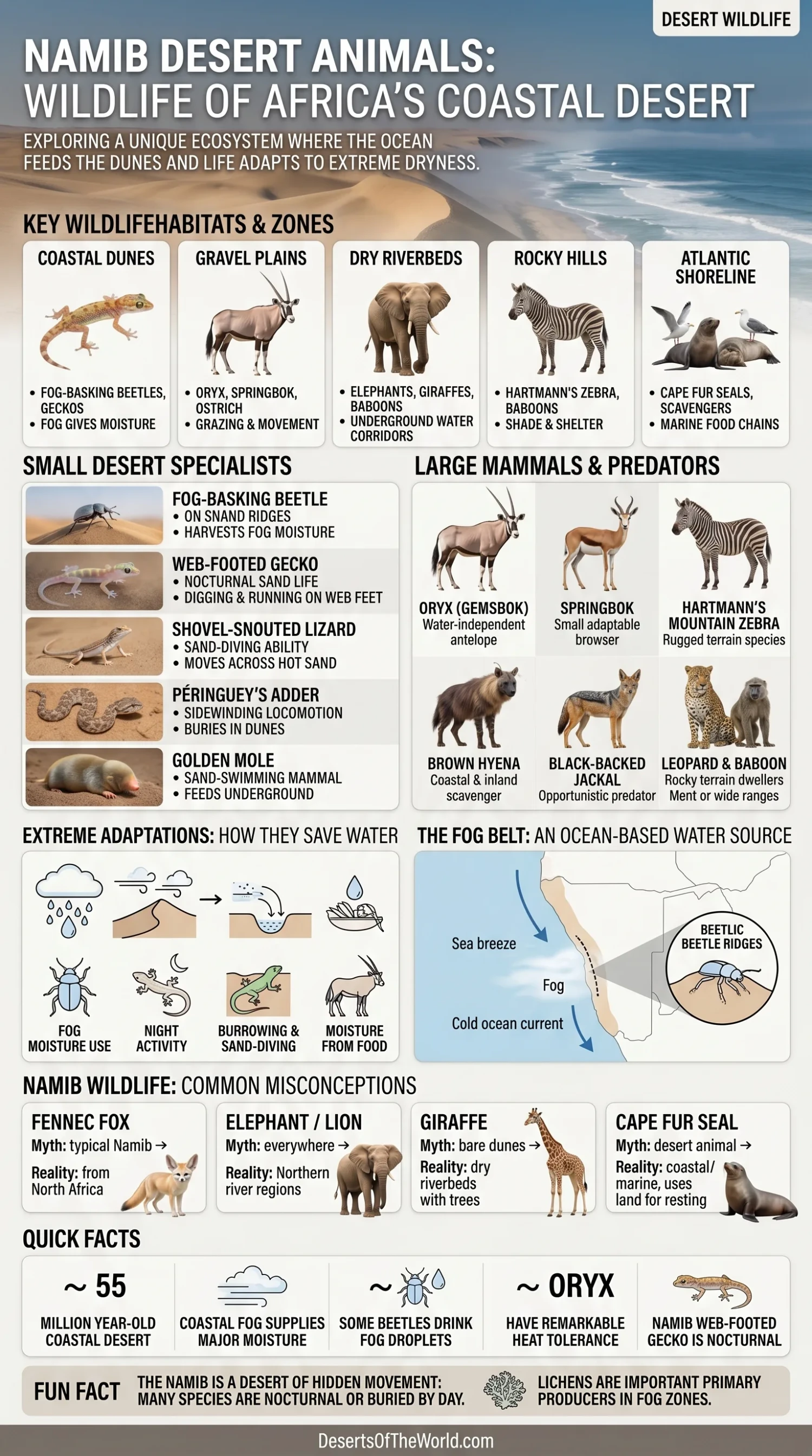
The Namib is often described as a desert of hidden movement. A beetle may collect water from fog on a dune ridge. A gecko may cross soft sand on webbed feet after dark. A brown hyena may move along the coast where the desert meets seal colonies. Farther inland and northward, dry river corridors support larger animals such as oryx, springbok, Hartmann’s mountain zebra, giraffe, elephant, rhino, and lion in places linked to the wider Namib landscape.
Namib Desert Animals and Their Main Habitats
The Namib is not one flat, empty stretch of sand. Wildlife changes sharply from the coast to the dunes, from gravel plains to dry riverbeds, and from the central sand sea to the northern desert margins. That matters because many animals people connect with the Namib do not all live in the same part of the desert.
| Habitat Type | Typical Animals | Why This Habitat Matters |
|---|---|---|
| Coastal Dunes | Fog-basking beetles, web-footed geckos, shovel-snouted lizards, Péringuey’s adders, dune larks | Fog gives moisture to animals that may rarely find open freshwater. |
| Gravel Plains | Oryx, springbok, ostrich, bustards, korhaans, small reptiles, insects | Open ground supports grazing, browsing, nesting, and long-distance movement. |
| Dry Riverbeds | Elephants, giraffes, baboons, leopards, jackals, brown hyenas, birds | Underground water and scattered trees make these corridors richer than nearby open desert. |
| Rocky Hills and Inselbergs | Hartmann’s mountain zebra, klipspringer, baboons, raptors, reptiles | Rocky slopes offer shade, lookout points, and shelter from wind. |
| Atlantic Shoreline | Cape fur seals, brown hyenas, jackals, shorebirds, seabirds | Marine life supports coastal food chains next to the desert edge. |
A Coastal Desert Where Fog Feeds Life
The Namib Sand Sea is recognized by UNESCO as the world’s only coastal desert with extensive dune fields influenced by fog. This is the detail that explains much of the wildlife story. In many deserts, animals wait for rain. In the Namib, many small animals also depend on fog, dew, and moisture held near the sand surface.
The fog does not make the desert wet in the usual sense. It arrives as a thin, cool layer from the Atlantic side, often strongest near the coast and weaker farther inland. On some mornings, it turns dune ridges, grass stems, beetle shells, and lichen-covered plains into small moisture traps. Not a stream. Not a pool. Still, enough for life.
This is why the Namib’s animal life feels different from the wildlife of greener African regions. The desert rewards small bodies, slow water loss, night activity, patient movement, and close ties to microhabitats.
Why The Namib Holds So Many Specialized Animals
The Namib is known for a high level of endemism, especially among reptiles, invertebrates, and other small desert animals. Many species are not simply “animals that can tolerate heat.” They are animals shaped around sand, fog, wind, bare ground, and scarce food.
Sand Works Like Shelter
Loose sand is not only a surface. For many animals, it is a roof, a cooling layer, a hiding place, and a hunting ground.
Several dune animals escape heat by burying themselves. Some move through sand almost as if it were water. Others leave only faint tracks at night, then disappear before the sun becomes harsh. This behavior helps them avoid heat, dry air, and predators.
Dry Riverbeds Act Like Green Lines
Ephemeral rivers are rivers that flow only after rain, yet their channels can support trees and shrubs through underground moisture. In the Namib, these dry river corridors are important for larger animals. They give shade, browse, travel routes, and occasional access to water.
This is where the desert begins to look less empty. Not lush, just more forgiving.
The Coast Adds a Marine Food Chain
Along the Atlantic edge, the desert meets one of southern Africa’s cold coastal systems. Cape fur seals breed and rest along parts of the coast, while scavengers such as brown hyenas and jackals use shoreline food sources. This creates a rare desert-coast link: animals of sand and stone living close to animals of surf and shore.
Small Animals of the Namib Dunes
The most specialized Namib Desert animals are often small. They may not be as famous as lions or elephants, but they show the desert’s character more clearly. Many are active at night, use fog, hide under sand, or blend into pale dune colors.
Fog-Basking Beetles
Fog-basking beetles are among the best-known animals of the Namib. Some darkling beetles climb dune ridges when fog is present, angle their bodies into the moist air, and allow droplets to form and run toward the mouth. Other beetles use different methods, including collecting moisture from small sand structures or damp surfaces.
This behavior is often described in simple terms as “drinking from fog,” but the real story is more varied. Not every Namib beetle does it the same way. Not every beetle that lives in the dunes is a fog-basker. The wider darkling beetle community includes many species with different body shapes, daily rhythms, and water strategies.
Namib Web-Footed Gecko
The Namib web-footed gecko is a pale, night-active gecko linked with sandy desert areas. Its broad, webbed feet help it move over loose sand and dig into it. Large eyes suit its nocturnal life, and its light body color helps it blend with dune surfaces.
This gecko is one of the animals that makes the Namib feel almost lunar at night. During the day, it is usually hidden. After dark, it becomes part of a quiet surface world of beetles, small spiders, moths, and other insects.
Shovel-Snouted Lizard
The shovel-snouted lizard, also called Anchieta’s dune lizard, is strongly associated with wind-shaped sand. Its body and head are suited to moving over and into loose dunes. When the sand surface becomes hot, it can lift its feet in quick alternation, using behavior as much as body shape to cope with heat.
Its sand-diving ability is one of the Namib’s classic desert adaptations. A moment on the surface, then gone.
Péringuey’s Adder
Péringuey’s adder is a small desert viper of the Namib’s soft dunes. It is known for sidewinding movement, which helps reduce contact with hot sand. It often lies partly buried, with only parts of the head visible, waiting for small prey such as lizards.
It is a natural part of the dune food web. It should be viewed from a safe distance and never handled. Ecologically, it is one of the dune predators that helps form a layered hunting system even across apparently open sand.
Namib Desert Golden Mole
The Namib Desert golden mole is a small, sand-swimming mammal of coastal dunes. It is blind, lives mostly beneath the surface, and feeds on small invertebrates. Unlike burrowing animals that make firm tunnels, it moves through loose sand that collapses behind it.
This animal is rarely seen because its life is mostly under the surface. Its presence is easier to imagine through tracks, feeding signs, and the behavior of the dune system itself. The Namib has many animals like this: present, but not obvious.
Spiders, Scorpions, Ants, and Other Invertebrates
Invertebrates form much of the Namib’s living fabric. Beetles, ants, termites, spiders, solifuges, moths, and scorpions help move energy through the desert. They feed on seeds, dry plant material, detritus, smaller animals, and one another.
Some spiders and scorpions use burrows. Some insects track fog and plant moisture. Termites and ants can become food for reptiles, birds, and small mammals. In a desert where large animals may be spread far apart, these small creatures keep the food web working day by day.
Large Mammals of the Namib Desert
Large mammals do live in the Namib region, but they are not evenly spread across the desert. The central dune sea is mostly a place for small specialists. Larger animals are more often tied to gravel plains, dry riverbeds, rocky areas, desert margins, and protected landscapes such as Namib-Naukluft Park and the northern Namib.
Oryx
The oryx, also called gemsbok, is one of the most recognizable large animals of Namibia’s dry country. Its long horns, pale coat, and black-and-white face markings make it visually striking, but its real desert value lies in its water-saving biology.
Oryx can live in arid and semi-arid areas without depending on permanent drinking water. They gain moisture from food, reduce water loss, use shade and cooler hours, and tolerate heat in ways that suit open desert plains. In the Namib, they are often linked with gravel plains, dry valleys, and dune-edge areas rather than the steepest open dunes.
Springbok
Springbok are smaller antelope that also suit dry open country. They feed on grasses, shrubs, and seasonal growth when conditions allow. Their movements often follow food availability, and they can use sparse vegetation that would not support heavier grazers for long.
In the Namib setting, springbok show how desert herbivores live by flexibility. They do not need the landscape to be rich everywhere. They need enough patches at the right times.
Hartmann’s Mountain Zebra
Hartmann’s mountain zebra is tied to rugged, dry terrain in Namibia and nearby regions. In the Namib-Naukluft area, rocky hills, escarpment slopes, and mountain zones give it better footing, shade, and refuge than open dune fields.
This zebra is a reminder that the Namib is not only sand. Rock matters. So do slopes, canyons, and high dry ground.
Brown Hyena
The brown hyena is one of the Namib’s most interesting carnivores. It can use coastal zones, dry inland areas, and desert margins. Along parts of the Namib coast, brown hyenas may feed from marine-linked food sources, including seal colonies and natural carrion.
Its role is not only that of a predator. Brown hyenas also work as scavengers, moving nutrients across the desert landscape. In a dry place where food appears unevenly, that ability matters.
Black-Backed Jackal
Black-backed jackals are adaptable canids found across many southern African habitats, including arid zones. In the Namib, they may use coastal areas, plains, and dry river environments. They feed on small animals, insects, eggs, fruit, and carrion when available.
Their success comes from being flexible without being careless. They read the desert well.
Leopard and Baboon
Leopards and baboons are recorded in the broader Namib-Naukluft landscape, especially where rocky terrain, canyons, and riverine vegetation provide cover and food. They are not animals of bare central dunes in the same way as beetles, geckos, and dune lizards.
This distinction is useful: the Namib has wildlife zones. A species can belong to the Namib region without being a true open-dune specialist.
Desert-Adapted Elephants, Rhinos, and Lions
Desert-adapted elephants, black rhinos, and lions are often associated with Namibia’s dry northwest, including regions connected to the wider Namib and its river systems. They are not a separate species. They are populations of familiar African animals living in unusually dry terrain.
Their survival depends heavily on movement, dry river corridors, scattered water, shade, and large home ranges. Elephants may travel through riverbeds and browse on trees and shrubs. Rhinos use arid landscapes with enough browse and protection. Lions in the northwest may range across dry valleys, gravel plains, and coastal-influenced areas where prey is available.
These animals add drama to the idea of the Namib, but they should not be used to describe every part of the desert. The central sand sea and the northern dry-river country are different wildlife settings.
Coastal Animals Where The Desert Meets The Atlantic
The Namib’s coastline creates one of the clearest contrasts in African deserts: dry sand beside cold ocean water. Marine life supports seals and seabirds, while the shore provides food for scavengers and predators that move between land and coast.
Cape Fur Seals
Cape fur seals are strongly linked with parts of the Namibian coast. They rest, breed, and feed from the marine system, not the inland desert. Still, they are part of the Namib story because the desert reaches the shoreline.
Their colonies can attract brown hyenas, jackals, gulls, and other scavengers. In this way, the ocean sends energy into the desert edge.
Shorebirds and Seabirds
Coastal lagoons, flats, and shoreline areas can support birds very different from those of the dunes. African black oystercatchers, gulls, cormorants, flamingos, pelicans, and other water-associated birds may be found in suitable coastal habitats around the Namibian shore.
This birdlife belongs to the same desert margin, but it follows tides, mudflats, fish, and marine food rather than dune seeds or insects.
Birdlife of The Dunes, Plains, and Dry Country
Birds are easier to notice than many small reptiles or nocturnal mammals, yet desert birds also rely on careful energy use. Some feed early or late. Some nest on open ground. Some follow seeds, insects, or small animals across wide dry areas.
Dune Lark
The dune lark is closely associated with Namib dune habitats and is often treated as one of the desert’s special birds. It uses sparse vegetation and sandy terrain, feeding on seeds and small invertebrates.
A bird like this tells a larger story: the dunes are not empty piles of sand. They hold grasses, insects, tracks, nests, and food chains that can be missed at first glance.
Ostrich
Ostriches occur in open dry landscapes where they can move widely and feed on plant material, seeds, and small items found while foraging. Their size makes them easier to spot than most Namib animals, but they still depend on open space and patchy food.
Bustards, Korhaans, Vultures, and Raptors
Namib-Naukluft Park records include birds such as Ludwig’s bustard, Rüppell’s korhaan, lappet-faced vulture, Herero chat, and African black oystercatcher. These names show the range of habitats inside the broader park: dry plains, rocky areas, coast, and open desert.
Raptors and vultures play a visible role in arid ecosystems. They cover long distances, use rising air, and find food across landscapes where carcasses or prey may be far apart.
How Namib Desert Animals Save Water
Water saving in the Namib is not one trick. Different animals use different answers: fog collection, nocturnal movement, burrowing, moisture-rich food, low activity during heat, reflective colors, and long-distance travel.
| Adaptation | Animals That Show It | How It Helps |
|---|---|---|
| Fog Moisture Use | Darkling beetles, some dune insects, animals using dew-coated surfaces | Allows moisture intake when rainfall is rare. |
| Night Activity | Web-footed geckos, many beetles, small mammals, some predators | Reduces heat stress and water loss. |
| Burrowing or Sand-Diving | Golden moles, shovel-snouted lizards, geckos, some spiders and scorpions | Uses cooler sand layers as shelter. |
| Moisture From Food | Oryx, springbok, geckos, insect-eating birds, small mammals | Reduces need for open drinking water. |
| Long-Distance Movement | Oryx, elephants, brown hyenas, jackals, some birds | Helps animals reach scattered food and water sources. |
| Pale Color and Camouflage | Geckos, lizards, insects, dune birds | Blends with sand and may reduce heat load. |
Predators and Scavengers in The Namib Food Web
Predators in the Namib range from tiny ambush hunters to large carnivores. The food web is layered, even when the land looks bare.
- Small predators include spiders, scorpions, predatory beetles, lizards, and snakes.
- Medium predators and scavengers include jackals, foxes, raptors, owls, and brown hyenas.
- Large predators such as leopards and lions occur in suitable parts of the wider Namib region, especially where prey and cover exist.
Scavenging is especially useful in a desert. It keeps nutrients moving when food is unpredictable. A seal carcass on the coast, a natural death on a gravel plain, or a small animal taken by a raptor can all become part of a longer chain.
Animals Often Mistaken as Typical Namib Dune Wildlife
Some animals are often mentioned in broad articles about Namibia, but they should be placed carefully when discussing the Namib Desert itself.
| Animal | Better Context | Why The Distinction Matters |
|---|---|---|
| Fennec Fox | North African deserts, not a typical Namib Desert animal | It is often used in generic desert content, but it does not represent Namib wildlife. |
| Elephant | Northwestern desert river systems and arid savanna-desert margins | Desert-adapted elephants are real, but they are not central dune specialists. |
| Lion | Northern Namib and dry river landscapes where prey is present | Desert-adapted lions belong to a specific regional setting, not every Namib habitat. |
| Giraffe | Dry riverbeds, savanna edges, and browse-rich corridors | They need woody vegetation and are not animals of bare shifting dunes. |
| Cape Fur Seal | Atlantic shoreline and marine food webs | It is part of the Namib coast, but its food source is the sea. |
Seasonal Patterns in Namib Desert Wildlife
The Namib’s seasons do not create the same lush-and-green rhythm seen in wetter regions. Rain is irregular in many areas, and fog can be more dependable near the coast than rainfall. Still, animals respond to small changes.
- After rain, grasses, seeds, and insects may increase in some areas.
- Cooler periods can make daytime movement easier for some animals.
- Foggy mornings can support moisture collection by dune insects and other small animals.
- Dry riverbeds may become more active when vegetation, shade, or water is available.
For many species, the pattern is not “wet season abundance” in a simple sense. It is more patchy. A small rain event, a fog belt, a flowering shrub, or a dry river with deeper moisture can shape where animals feed and move.
Tracks, Signs, and The Hidden Side of Namib Wildlife
Many Namib animals are easier to read through signs than through direct sightings. Tracks on soft sand can show beetle trails, gecko steps, lizard marks, snake sidewinding, jackal paths, or the delicate surface traces of small mammals.
These marks matter because they reveal nighttime life. By midday, wind may erase them. The desert resets its page.
Other signs include:
- Small burrow entrances near vegetation clumps
- Beetle tracks crossing dune slopes
- Bird footprints near dry channels or coastal flats
- Scat from jackals or brown hyenas in travel corridors
- Feeding marks around grasses, seeds, or dry plant material
Why Small Animals Carry Much of The Namib’s Identity
Large mammals often get more attention, but the Namib’s most distinctive wildlife story belongs to small animals. The dune beetles, geckos, lizards, golden moles, spiders, scorpions, ants, and other invertebrates show how life fits into narrow margins.
They live close to the sand temperature. They respond to fog. They use the underside of grass clumps, the lee side of dunes, and the cooler layers below the surface. They do not make the desert look crowded. They make it work.
This is the main reason Namib Desert animals should not be described only as a safari list. The Namib is also a study in fine-scale survival: small bodies, short activity windows, careful moisture use, and exact habitat choices.
Responsible Wildlife Observation in The Namib
The Namib’s animals are adapted to dry conditions, but many are still sensitive to disturbance. Slow-growing lichens, burrows, nesting sites, and dune microhabitats can be damaged easily. Wildlife observation should keep the desert intact.
- Stay on marked tracks where access rules require it.
- Do not collect animals, shells, bones, plants, or insects.
- Never handle snakes, scorpions, spiders, geckos, or beetles.
- Keep distance from seals, hyenas, jackals, antelope, and nesting birds.
- Avoid feeding wildlife; it changes natural behavior.
- Use quiet observation around dry riverbeds and water points.
In the Namib, respect is not complicated. Give animals space, leave tracks lightly, and let the desert keep its own rhythm.
Notable Namib Desert Animals
| Common Name | Scientific Name | Main Namib Connection |
|---|---|---|
| Oryx / Gemsbok | Oryx gazella | Arid plains, gravel flats, dune margins, and dry-country grazing areas |
| Springbok | Antidorcas marsupialis | Open dry plains and sparse grass-shrub habitats |
| Hartmann’s Mountain Zebra | Equus zebra hartmannae | Rocky slopes, mountains, and dry rugged terrain |
| Brown Hyena | Parahyaena brunnea | Coastal desert, gravel plains, and desert-edge scavenging routes |
| Black-Backed Jackal | Lupulella mesomelas | Coast, plains, and adaptable desert-edge habitats |
| Namib Web-Footed Gecko | Pachydactylus rangei | Nocturnal sandy habitats and dune systems |
| Péringuey’s Adder | Bitis peringueyi | Soft wind-blown dunes of the Namib |
| Shovel-Snouted Lizard | Meroles anchietae | Loose dunes and sand-diving behavior |
| Namib Desert Golden Mole | Eremitalpa granti namibensis | Coastal dune sands and underground foraging |
| Fog-Basking Beetle | Onymacris species and other tenebrionids | Fog moisture use on dune ridges and sand surfaces |
| Dune Lark | Calendulauda erythrochlamys | Sandy dune habitats and sparse desert vegetation |
| Cape Fur Seal | Arctocephalus pusillus pusillus | Atlantic coast where the desert reaches the sea |
Sources
- UNESCO World Heritage Centre: Namib Sand Sea (coastal fog desert status, area, dune systems, fog ecology, and endemic desert life)
- Namibia Ministry of Environment, Forestry and Tourism: Namib-Naukluft Park (park size, habitats, listed mammals, vegetation, and recorded birdlife)
- Atlas of Namibia: Terrestrial Wildlife Endemism (endemism patterns in Namibian reptiles, mammals, birds, scorpions, and amphibians)
- NASA Jet Propulsion Laboratory: Namib Desert, Namibia (Namib as a coastal desert, dune setting, and broad note on arthropods and small desert wildlife)
- Ecosphere: Fog and Fauna of the Namib Desert (fog as a water source for Namib Desert animals and moisture-use adaptations)
- Nature: Fog-Basking by the Namib Desert Beetle (classic research on fog-basking behavior in Namib dune beetles)
- Animal Diversity Web: Namib Sand Gecko / Web-Footed Gecko (range, habitat, behavior, and sand adaptation details)
- Animal Diversity Web: Grant’s Golden Mole (habitat and dune-life details for the Namib Desert golden mole)
- SANBI Red List of South African Species: Gemsbok (oryx arid-land range, water independence, and desert-related adaptations)
- BirdLife DataZone: Dune Lark (species factsheet for a bird strongly associated with Namib dune habitats)
- African Snakebite Institute: Péringuey’s Adder (species profile, dune habitat, and identification context)