
The Atacama Desert is often described through dryness, salt flats, volcanoes, and clear skies. Its animals tell a quieter story. Wildlife here does not cover the land evenly. It gathers where life has a foothold: high Andean lagoons, coastal fog zones, salt-flat wetlands, rocky slopes, dry scrub, and rare flowering-desert plains. In the open hyperarid core, animals may be scarce. Around water, shade, insects, and desert plants, the Atacama becomes far more alive than it first appears.
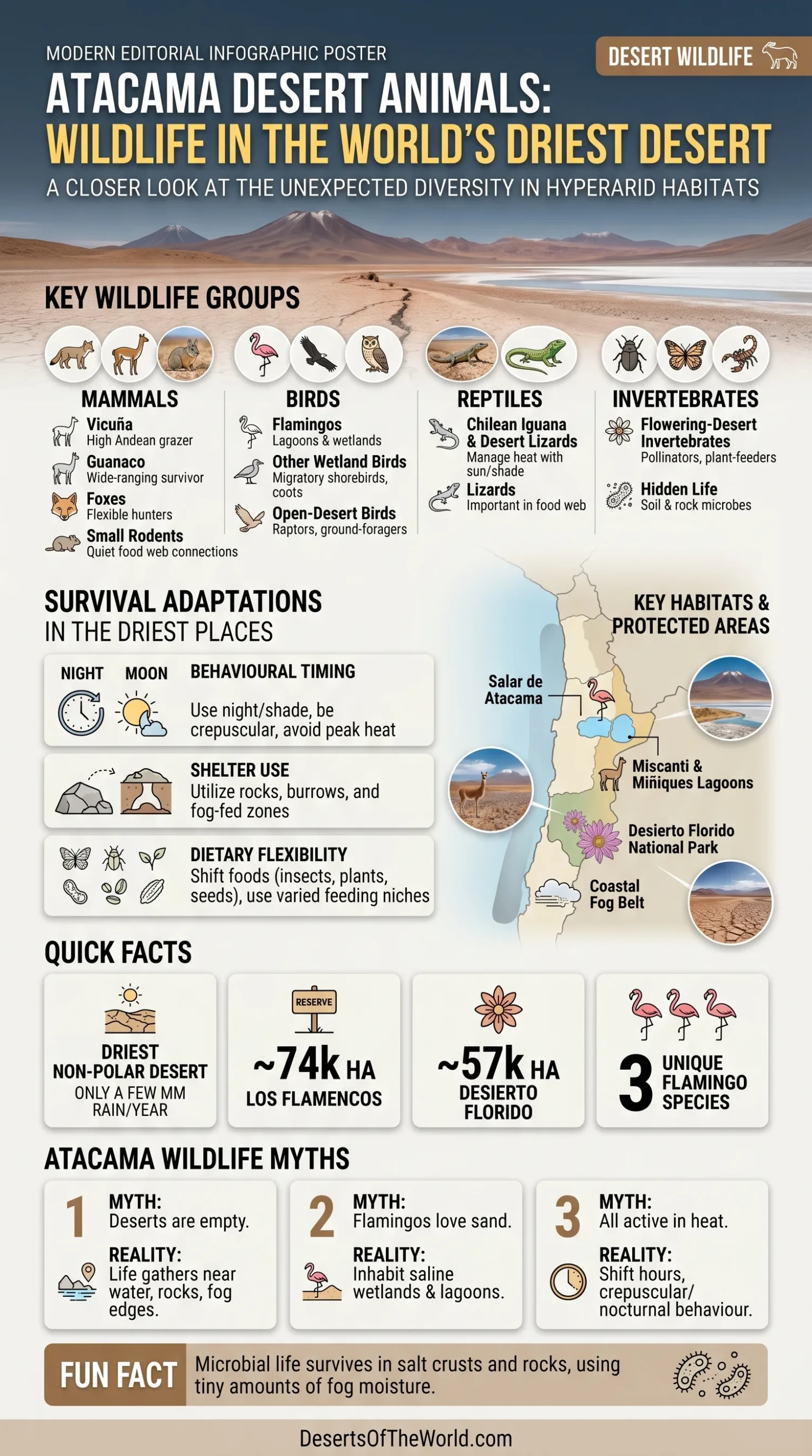
Atacama Desert Animals And Their Harsh Home
The Atacama Desert stretches along northern Chile between the Pacific coast and the Andes. It is widely known as the driest non-polar desert on Earth. Some parts receive only a few millimeters of rain in a normal year, while other places may go long periods with almost no measurable rain.
That does not mean the whole desert is one flat, lifeless surface. The Atacama includes:
- Coastal cliffs and fog-fed slopes near the Pacific Ocean
- Salt flats such as the Salar de Atacama
- High-altitude lagoons near the Andes
- Dry valleys, volcanic plains, and rocky basins
- Flowering-desert areas that awaken after rare rains
- Oases and wetlands where animals can feed, nest, or pass through
For wildlife, this patchwork matters more than the word “desert” alone. A flamingo standing in a saline lagoon, a guanaco moving across dry scrub, and a lizard warming itself on a stone are all Atacama animals, but they use very different parts of the desert.
| Habitat Type | Why It Matters | Animals Often Linked To It |
|---|---|---|
| Salt-Flat Lagoons | Saline water supports algae, tiny crustaceans, and feeding grounds for birds. | Andean flamingo, Chilean flamingo, James’s flamingo, Andean avocet, ducks |
| High Andean Wetlands | Cold, thin-air wetlands provide grazing and water in an otherwise dry plateau. | Vicuña, Andean goose, horned coot, Andean gull, lesser rhea |
| Rocky Slopes And Outcrops | Rocks create shade, den sites, lookout points, and warmer surfaces for reptiles. | Viscacha, culpeo fox, lizards, small rodents, owls |
| Dry Scrub And Desert Plains | Sparse shrubs and seasonal plants feed herbivores and insects. | Guanaco, South American gray fox, burrowing owl, grassland birds |
| Coastal Fog Belt | Fog adds moisture where rain is rare, supporting lichens, plants, insects, and birds. | Insects, spiders, lizards, coastal birds, small mammals |
| Flowering-Desert Areas | After rare rain, dormant plants bloom and attract pollinators and seed-eating animals. | Beetles, butterflies, lizards, guanacos, birds, foxes |
Why Animals Can Survive In The World’s Driest Non-Polar Desert
Atacama animals survive by avoiding the hardest conditions instead of fighting them head-on. Many species depend on timing, shelter, and small pockets of moisture. Life here is not loud. It is precise.
They Stay Close To Reliable Water Or Food
In the Atacama, water shapes movement. Flamingos gather at lagoons. Vicuñas and guanacos use grazing areas tied to wetlands, slopes, or seasonal vegetation. Foxes follow prey. Lizards gather where insects are present. Even tiny invertebrates may appear in greater numbers after fog, dew, or rain-fed plant growth.
Open desert may look like the center of the story, but for many animals it is more like a crossing zone. The real living edges are often around salt pans, springs, oases, and highland wetlands.
They Use Night, Shade, And Burrows
Many desert animals avoid full heat and strong sun. Small mammals may use burrows. Reptiles shift between sun and shade to manage body temperature. Foxes and rodents are often more active in cooler hours. Birds may feed early or late, then rest when the light is harsh.
Simple strategy. Real survival.
They Handle Salt, Thin Air, And Sparse Food
The Atacama is not only dry. In many places it is salty, windy, cold at night, and high above sea level. Animals in the Andean part of the desert must cope with thin air and strong ultraviolet light. Lagoon birds also deal with saline water and highly specialized food sources.
Flamingos show this clearly. Their bills filter tiny food from briny water. Different flamingo species can feed in related habitats without using exactly the same feeding niche. On the high plains, vicuñas graze tough vegetation and live at elevations where many lowland mammals would struggle.
Main Mammals Of The Atacama Desert
Mammals are not as easy to see as birds in the Atacama, but they are part of the desert’s food web. Some are large and visible in open country. Others are small, nocturnal, or hidden among rocks and burrows.
| Animal | Scientific Name | Typical Habitat | What Makes It Suited To The Desert |
|---|---|---|---|
| Vicuña | Vicugna vicugna | High Andean plains, wetlands, and puna grasslands | Lives at high elevation and grazes sparse, tough vegetation. |
| Guanaco | Lama guanicoe | Dry scrub, open plains, slopes, and flowering-desert zones | Moves widely and feeds on hardy desert plants. |
| Culpeo Fox | Lycalopex culpaeus | Rocky slopes, open desert margins, highlands | Flexible diet; can feed on rodents, birds, reptiles, insects, and plant matter. |
| South American Gray Fox | Lycalopex griseus | Dry plains, scrub, coastal desert, park margins | Uses varied food sources and can travel through dry terrain. |
| Southern Viscacha | Lagidium viscacia | Rocky slopes and highland outcrops | Uses rocks for shelter and feeds on sparse mountain vegetation. |
| Darwin’s Leaf-Eared Mouse | Phyllotis darwini | Dry valleys, shrubland, rocky ground | Small size, shelter use, and flexible feeding help it persist in dry zones. |
| Cururo | Spalacopus cyanus | Sandy or loose soils in desert scrub | Burrowing behavior protects it from heat and dry surface conditions. |
| Dune Mouse | Eligmodontia dunaris | Desert dunes and sandy ground | Small, discreet, and linked to dry sandy habitats. |
Vicuñas: High-Altitude Desert Grazers
The vicuña is one of the most graceful animals of the Andean Atacama. It lives in high, open landscapes where grasses and cushion plants may grow near wetlands or seasonal moisture. Its slim body, alert posture, and fine coat suit cold nights and bright days.
Vicuñas are often linked with the altiplano rather than the driest desert floor. That distinction matters. They are Atacama animals, but mostly in the high Andean edge of the desert system, not in the barest salt-and-stone core.
Guanacos: Wide-Ranging Survivors
Guanacos are larger camelids that can use dry scrub and open plains. In the southern Atacama and flowering-desert areas, guanacos may feed on desert plants that appear after rare rain or persist as hardy shrubs.
They also help show how the Atacama works as a living landscape. A place can look empty from the road, then a guanaco appears on a slope, feeding calmly where the vegetation seems almost invisible.
Foxes: Flexible Hunters And Scavengers
Foxes in the Atacama, especially the culpeo fox and South American gray fox, rely on flexibility. They may eat rodents, lizards, insects, eggs, small birds, fruits, or plant material depending on what the desert offers.
This matters because Atacama food supply is uneven. A fox that depends on only one prey type would face hard limits. A fox that can shift its diet has a better chance in a place where rain, insects, and plant growth come in pulses.
Viscachas And Small Rodents
Viscachas are rabbit-like rodents of rocky places. They often blend into stone so well that they seem to appear only when they move. Small rodents are less visible, but they feed predators and help connect plants, seeds, insects, and soil life.
In deserts, small animals often carry more ecological weight than visitors expect. Quiet, mostly unseen, they keep the food web moving.
Birds Of The Atacama Desert
Birdlife is often the easiest part of Atacama wildlife to notice, especially near lagoons and salt flats. The desert’s wetlands act like islands. They attract resident birds, seasonal visitors, and high-altitude specialists.
Flamingos Of The Atacama
The Atacama is famous for flamingos because several saline lagoons provide the food and shallow water they need. In northern Chile, three flamingo species are especially linked with desert lagoons:
- Andean flamingo (Phoenicoparrus andinus)
- James’s flamingo or Puna flamingo (Phoenicoparrus jamesi)
- Chilean flamingo (Phoenicopterus chilensis)
These birds feed by filtering tiny organisms from saline water and soft sediment. Their presence depends on lagoon depth, water chemistry, food supply, nesting conditions, and disturbance levels. For that reason, flamingos are not simply “desert birds.” They are wetland birds living inside a desert.
Other Lagoon And Wetland Birds
Salt flats and high lagoons support more than flamingos. Depending on the site and season, Atacama wetlands may host:
- Andean avocet
- Yellow-billed teal
- Crested duck
- Andean gull
- Horned coot
- Andean goose
- Puna plover
- Baird’s sandpiper and other migratory shorebirds
Some of these birds use the Atacama as part of a wider movement route. Others are tied more closely to high Andean wetlands. Either way, water is the magnet.
Open-Desert And Highland Birds
Away from lagoons, the bird community changes. Dry plains, scrub, and rocky ground may support ground-foraging birds and raptors. In protected areas and desert-plain habitats, records include species such as the burrowing owl, variable hawk, rufous-chested dotterel, miners, tinamous, Andean condor, and lesser rhea.
Not all are easy to find. Some keep distance, some blend with the ground, and some move across wide areas. In the Atacama, a bird’s absence from view does not mean absence from the landscape.
Reptiles In The Atacama Desert
Reptiles fit the Atacama well because they can use sun, shade, rocks, and body posture to manage heat. Lizards are especially tied to rocky ground, sandy flats, coastal desert, and places where insects gather.
Several Liolaemus lizards occur in northern Chile’s desert habitats. The genus is well known across South America for its variety of species and its ability to occupy cold, dry, high, and rocky settings. In the Atacama, lizards may feed on insects, plant matter, or mixed diets depending on species and site.
Chilean Iguana And Desert Lizards
The Chilean iguana (Callopistes maculatus) is one of the more noticeable reptiles in parts of the Atacama region. Other lizards, including spotted and desert-adapted species, may use stones, shrubs, and open ground. Some are active when the ground is warm but not dangerously hot.
Heat helps them move. Too much heat pushes them back into shade. That balance is the reptile rhythm of the desert.
Why Lizards Matter In The Atacama Food Web
Lizards are not just background animals. They eat insects and may become prey for foxes, raptors, and snakes. In flowering-desert years, more plants can mean more insects; more insects can support more lizard activity. The chain is plain once seen, but easy to miss from a car window.
Insects, Spiders, And Other Small Desert Animals
Small animals carry much of the Atacama’s hidden life. Beetles, butterflies, flies, spiders, scorpions, wasps, grasshoppers, and land snails may appear in the right habitat or season. They are especially noticeable after rain events, in fog-fed areas, near vegetation, or around wetlands.
In Desierto Florido National Park, official park information lists pollinating and seasonal invertebrates associated with flowering years, including moths, beetles, jewel insects, and sand snails. These animals matter because many desert plants need pollinators during short windows of bloom.
Flowering-Desert Invertebrates
The flowering desert is not only about plants. When dormant seeds sprout after rain, insects respond. Beetles feed, pollinators move between flowers, birds and reptiles find more food, and mammals may use the temporary flush of vegetation.
Brief, yes. Empty, no.
Soil And Rock Micro-Life
The Atacama also has microbial life in soils, salt crusts, rocks, and wetland edges. This is not “wildlife” in the usual visitor sense, but it is part of the living desert. Some microbes survive with tiny amounts of moisture from fog, salts, or rare water pulses. Scientists study these organisms because they show how life can persist near the edge of dryness.
Where Atacama Wildlife Is Most Often Found
Wildlife watching in the Atacama is usually tied to habitat. A person looking only at bare plains may think the desert has few animals. A person who understands the habitats will know where life is more likely to gather.
Salar De Atacama And Laguna Chaxa
The Salar de Atacama is one of the best-known wildlife areas in the desert because its lagoons support flamingos and other waterbirds. Laguna Chaxa, part of the Los Flamencos National Reserve system, is strongly linked with flamingo viewing and salt-flat ecology.
The setting is harsh: saline water, crusted salt, intense sun, and limited freshwater. Yet the food web works there because microscopic life, algae, brine organisms, and wetland margins support birds adapted to those conditions.
Los Flamencos National Reserve
Los Flamencos National Reserve protects several sectors around San Pedro de Atacama, including salt flats, lagoons, highland areas, and desert valleys. Its animal list includes flamingos, vicuñas, foxes, viscachas, Andean birds, and other high-desert species.
The reserve’s protected area is about 73,986.5 hectares, according to CONAF. The number is useful because it shows the reserve is not a single small lagoon. It is a set of habitats spread across a desert-altiplano landscape.
Miscanti And Miñiques Lagoons
These high-altitude lagoons sit in a colder Andean setting. Birds such as flamingos, gulls, coots, and ducks may be seen around the water, while vicuñas can appear on surrounding plains. The air is thinner here, and the habitat feels different from the lower salt flats.
Desierto Florido National Park
Desierto Florido National Park, created in 2023, protects part of the southern Atacama’s flowering-desert ecosystem. CONAF lists its area as about 57,107.4 hectares. In normal dry periods, much of the life remains low, hidden, or dormant. After enough rain, plants bloom and animal activity becomes easier to notice.
Official information for the park names year-round wildlife such as the spotted lizard, Chilean iguana, burrowing owl, variable hawk, cururo, dune mouse, northern guanaco, and South American gray fox. During flowering years, invertebrates become more visible as pollinators and plant-feeders.
Coastal Atacama
The coastal edge of the Atacama receives moisture from fog, often called camanchaca. This moisture can support lichens, desert plants, insects, spiders, reptiles, and birds. The coast also connects the desert with marine life, including seabirds and shore species.
It is a different Atacama: still dry, but touched by fog.
How Atacama Animals Adapt To Extreme Dryness
Desert adaptations are often described as if every animal has one dramatic trick. The Atacama is more subtle. Most animals survive through a blend of behavior, body structure, diet, and habitat choice.
| Challenge | Animal Response | Examples |
|---|---|---|
| Little Rain | Use wetlands, fog zones, food moisture, or wide movement routes. | Flamingos, guanacos, foxes, insects |
| Strong Sun | Rest in shade, burrows, rocks, or become active during cooler hours. | Rodents, foxes, lizards, spiders |
| Cold Nights | Use fur, shelter, group behavior, or protected sleeping sites. | Vicuñas, viscachas, small mammals |
| Saline Water | Feed in specialized ways or use wetland edges without relying on freshwater pools. | Flamingos, shorebirds, brine-associated invertebrates |
| Sparse Food | Shift diet, move across larger areas, or wait for seasonal pulses. | Foxes, guanacos, beetles, birds |
| High Elevation | Live in thin-air environments and graze or feed near Andean wetlands. | Vicuñas, Andean geese, flamingos, lesser rheas |
Behavior Matters More Than Bravery
Atacama animals are not “tough” in a simple sense. They are careful. They choose hours, places, and foods that reduce stress. A lizard does not stay on burning ground to prove it can. It moves. A fox does not hunt only one prey. It adjusts.
Many Species Depend On Small Moisture Sources
Fog, dew, seepage, underground water, rare rain, and saline lagoons all play a role. Some animals drink directly when water is available. Others get moisture from food. Some insects and plants respond to fog or short wet periods, creating food for larger animals.
The Hyperarid Core Has Fewer Visible Animals
A common mistake is to imagine the Atacama’s wildlife spread evenly across the desert. The driest interior can have very low visible animal activity. More animals appear along the ecological edges: wetlands, highlands, oases, coastal fog zones, and rare bloom areas.
This is one reason short animal lists can be misleading. A species may live in the Atacama region, but only in certain habitats.
Are There Dangerous Animals In The Atacama Desert?
The Atacama is not known mainly for large dangerous wildlife. Most animals avoid people. Foxes, camelids, birds, reptiles, and small mammals should be watched from a respectful distance. Scorpions, spiders, and insects may occur, as in many dry regions, but they are not the main story of Atacama wildlife.
The safer and more useful rule is simple: do not touch, feed, chase, corner, or handle wild animals. This protects both the visitor and the animal.
How Rare Rain Changes Wildlife Activity
Rain is rare in much of the Atacama, but when the right amount falls in the right area, the change can be striking. Dormant seeds germinate. Flowers appear. Insects follow. Birds and reptiles become easier to notice. Guanacos and foxes may use the richer feeding conditions.
Desierto Florido National Park information notes that flowering can be triggered when rainfall passes a local threshold. It also notes that life may remain latent in the shallow subsurface during dry periods, waiting for enough moisture.
That is one of the Atacama’s most useful lessons: some desert life is not absent. It is waiting.
Common Myths About Atacama Desert Wildlife
Myth: The Atacama Has Almost No Animals
The driest areas may have very few visible animals, but the broader Atacama Desert system contains mammals, birds, reptiles, invertebrates, and microbes. The trick is knowing the habitat. Look near water, rocks, fog-fed zones, and seasonal vegetation.
Myth: Flamingos Live In Dry Sand
Flamingos live in desert wetlands, not dry dunes. Their Atacama habitat is shallow saline water, mudflats, and lagoon margins where they can filter food.
Myth: All Atacama Animals Are Active In The Heat
Many animals avoid peak heat. Some are crepuscular, nocturnal, or tied to cooler highland conditions. Reptiles may use warmth, but even they need shade and timing.
Myth: The Best Wildlife Is Only Around San Pedro De Atacama
San Pedro is a well-known base for seeing salt-flat and highland wildlife, but the Atacama’s animal life also includes coastal fog habitats, southern flowering-desert zones, protected parks near Copiapó, and high Andean wetlands beyond the most visited circuit.
Respecting Wildlife In The Atacama
The Atacama’s animals often live close to the edge of what their habitat can support. Small disturbances can matter, especially near nesting birds, salt-flat lagoons, and flowering-desert areas where plants and invertebrates may be underfoot.
- Stay on marked paths in protected areas.
- Watch animals from a distance.
- Do not feed foxes, birds, camelids, or any wild animal.
- Keep noise low near lagoons and nesting areas.
- Do not walk or drive across fragile bloom areas.
- Keep pets out of protected desert habitats where rules prohibit them.
- Carry out all trash, even small food scraps.
Wildlife in the Atacama is often sparse because the land allows only careful living. A footprint through a bloom zone, a vehicle track across soft desert soil, or food given to a fox can last longer than it seems.
Best Known Atacama Desert Animals By Group
Mammals
- Vicuña
- Guanaco
- Culpeo fox
- South American gray fox
- Southern viscacha
- Darwin’s leaf-eared mouse
- Cururo
- Dune mouse
Birds
- Andean flamingo
- James’s flamingo
- Chilean flamingo
- Andean goose
- Horned coot
- Andean gull
- Andean avocet
- Yellow-billed teal
- Burrowing owl
- Variable hawk
- Andean condor
- Lesser rhea
Reptiles
- Chilean iguana
- Spotted lizard
- Several Liolaemus lizards
- Desert and coastal lizard species tied to rocks, scrub, or sandy ground
Invertebrates
- Desert beetles
- Pollinating moths and butterflies
- Flies and wasps
- Spiders
- Scorpions
- Sand snails in suitable desert habitats
Why The Atacama Desert’s Wildlife Feels Different From Other Deserts
Many famous deserts are known for dunes, camels, snakes, or broad mammal herds. The Atacama is different. Its wildlife is tied to edges and exceptions: the lagoon inside the salt flat, the fog on a coastal hill, the wetland below a volcano, the bloom after rare rain, the rock pile that shelters a viscacha.
So the best way to understand Atacama Desert animals is not to ask, “What lives in the dry desert?” A better question is, “Where does this desert allow life to gather?”
The answer changes from coast to plateau, from salt flat to slope, from dry year to flowering year. That is the Atacama: spare in the open, detailed at the edges, and far more alive than it first lets on.
Sources
- Nature Communications: Evidence For Eocene Aridification Of The Atacama Desert’s Hyperarid Core (Atacama described as the most arid non-polar region on Earth)
- NASA Earth Observatory: Rare Snow In Atacama Desert, Chile (Atacama dryness, rare precipitation, and regional climate context)
- CONAF: Reserva Nacional Los Flamencos (protected-area data, habitat notes, and listed wildlife including flamingos, vicuñas, foxes, and Andean birds)
- CONAF: Parque Nacional Desierto Florido (official park area, flowering-desert ecology, listed year-round wildlife, and invertebrates seen during bloom years)
- Chile Ministry Of The Environment SIMBIO: Parque Nacional Desierto Florido (protected-area biodiversity data, threatened species notes, and official ecosystem information)
- Frontiers In Microbiology: The Atacama Desert, A Biodiversity Hotspot And Not Just A Mineral-Rich Region (peer-reviewed overview of Atacama microbial life, hyperaridity, and biological research)
- University Of California Museum Of Paleontology: The Desert Biome (general desert animal behavior, burrowing, nocturnal activity, and heat avoidance)
- Ramsar Sites Information Service: Sistema Hidrológico De Soncor Del Salar De Atacama (wetland context and flamingo species associated with the Salar de Atacama system)