
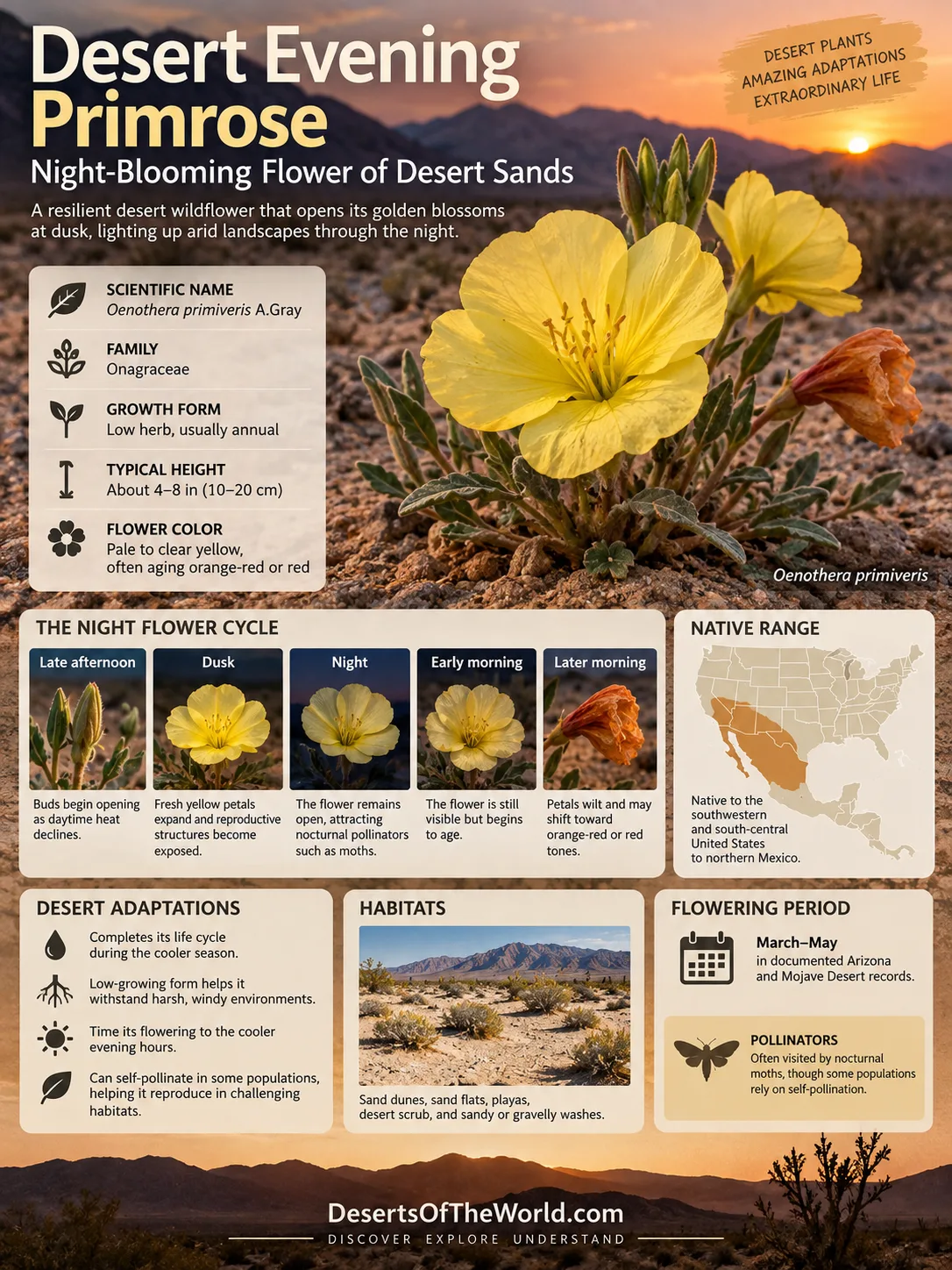
Desert evening primrose, Oenothera primiveris, is a low-growing wildflower of North American desert country. For much of the day it can blend into pale sand, gravel, and open scrub. By late afternoon, its large yellow flowers begin to open. They remain open through the night and fade the following morning.
The timing fits a plant whose reproductive life is closely tied to cooler evening hours and nocturnal pollinators. Yet desert evening primrose is more complex than a simple moth-pollinated flower. Across its range, populations differ in flower size, scent, nectar production, and reliance on self-pollination. Those differences make Oenothera primiveris an unusually informative example of how a desert annual can adjust its reproductive strategy across changing habitats.
| Feature | Desert Evening Primrose |
|---|---|
| Scientific name | Oenothera primiveris A.Gray |
| Family | Onagraceae |
| Growth form | Low herb, usually annual |
| Typical height | About 4–8 in (10–20 cm) |
| Flower color | Pale to clear yellow, often aging orange-red or red |
| Petal number | Four |
| Flower opening | Late afternoon to dusk |
| Flower lifespan | Usually remains open overnight and senesces the next morning |
| Typical flowering period | March–May in documented Arizona and Mojave Desert records |
| Main habitats | Sand dunes, sand flats, playas, desert scrub, and sandy or gravelly washes |
| Native range | Southwestern and south-central United States to northern Mexico |
Botanical Identity of Desert Evening Primrose
Oenothera primiveris belongs to the evening primrose family, Onagraceae. Royal Botanic Gardens, Kew currently accepts the species name and records its native distribution in Arizona, California, Nevada, New Mexico, Texas, Utah, and northern Mexico.
The U.S. Fish and Wildlife Service also uses Oenothera primiveris for the common name desert evening primrose. Other names include yellow-flower desert evening-primrose and large yellow desert primrose.
Common names require some care. Several Oenothera species grow in dry western landscapes, and names containing “desert,” “dune,” or “evening primrose” are sometimes applied inconsistently. For this species profile, desert evening primrose means Oenothera primiveris.
A Flower Timed to Open at Dusk
The defining behavior of desert evening primrose is its flowering schedule. Its yellow petals usually begin opening in the late afternoon and are fully displayed around dusk. The flower remains open through the night, then ages during the following morning.
This opening process is called anthesis, the period when a flower is open and functioning reproductively. In O. primiveris, evening anthesis places the freshest flower into the cooler part of the desert day.
The Overnight Flower Cycle
| Time | Typical Flower Condition |
|---|---|
| Late afternoon | Buds begin opening as daytime heat declines. |
| Dusk | Fresh yellow petals expand and the reproductive structures become exposed. |
| Night | The flower remains open; fragrant and nectar-producing populations can receive nocturnal pollinators. |
| Early morning | The flower is still visible but begins to age. |
| Later morning | Petals wilt and may shift toward orange-red or red tones. |
A plant seen at midday may therefore look quite different from the same plant near sunset. Fresh evening flowers show the clearest yellow color and the most intact petal shape.
Why Yellow Flowers Can Turn Red
Fresh flowers are yellow, but their petals often change color as they age. University of Arizona records describe petals that fade toward red, while botanical descriptions also note orange or reddish tones during senescence.
This can produce several flower colors on one plant at the same time. Newly opened blooms may appear pale yellow while older flowers nearby show orange-red coloration. The change is an aging effect rather than evidence that the plant produces separate yellow and red flower forms.
Pollination Changes Across the Species Range
The evening schedule suggests moth pollination, and that is an important part of the species’ biology. Yet Oenothera primiveris does not use exactly the same reproductive pattern everywhere it grows.
A range-wide study published in the American Journal of Botany examined populations across the southwestern United States. Researchers found a geographic transition in floral traits and mating systems.
Western Populations Retain Strong Hawkmoth Traits
Populations in western and central parts of the range tend to have traits associated with long-distance pollination by hawkmoths. These include:
- larger flowers,
- pale yellow petals visible in low light,
- evening opening,
- floral fragrance,
- nectar production, and
- greater separation between anthers and stigma in some populations.
Hawkmoths are strong nocturnal fliers and can move pollen between flowers that are separated across open desert terrain. Their association with evening primroses is well established within the genus, and researchers have documented hawkmoth visitation to O. primiveris.
Eastern Populations Rely More on Self-Pollination
Farther east, the same species can look reproductively different. Studied eastern populations tended to have smaller flowers, weaker scent emission, reduced floral separation, and much higher capacity for automatic self-pollination.
In botanical terms, this is a shift toward autogamy: pollen from a flower fertilizes that same flower without depending on pollen carried from another individual.
Self-pollination can provide reproductive assurance where visits from suitable pollinators are inconsistent. The transition is not an absolute boundary. Small-flowered populations can still receive hawkmoth visits, but genetic data from the study indicate that self-fertilization becomes much more frequent toward the eastern end of the sampled range.
| Trait | Western and Central Tendency | Eastern Tendency |
|---|---|---|
| Flower size | Larger | Smaller |
| Floral scent | Stronger | Reduced |
| Nectar | More associated with nectar-producing flowers | Reduced floral investment |
| Pollination pattern | Greater opportunity for hawkmoth-mediated outcrossing | Higher frequency of self-fertilization |
| Reproductive assurance | More dependent on pollen movement between flowers | Greater ability to produce seed without another plant |
This geographic variation is one of the most distinctive biological features of desert evening primrose. A flower population on western desert dunes is not necessarily functioning in exactly the same way as a population growing in eastern desert washes.
Leaves, Rosette, Flowers, and Seed Capsules
Desert evening primrose grows close to the ground. Before flowering, much of the plant may appear as a flattened cluster of gray-green or green leaves against open desert soil.
The Low Basal Rosette
Leaves arise mainly from a basal rosette. University of Arizona descriptions place typical plant height around 4–8 inches (10–20 cm), although the leaves themselves can extend much farther horizontally.
Botanical descriptions record leaf blades roughly 2–11 inches (5–27 cm) long. Larger leaves may reach about 1–2.75 inches (3.5–7 cm) wide. Their shape is usually narrow and deeply divided into toothed or rounded lobes.
The leaves and flower stalks carry a dense covering of short hairs. The low profile and gray-green foliage can make a non-flowering plant easy to overlook on sandy or gravelly ground.
Four Broad Yellow Petals
A fresh flower normally has four broad yellow petals, each with a shallow notch near the outer edge. Detailed botanical descriptions place petal length around 1.4–2.2 inches (3.5–5.5 cm).
The stigma is divided into four narrow lobes, a recognizable feature of many evening primroses. Stamens surround the central reproductive structures, while the ovary develops below the flower and later becomes the seed capsule.
Woody Capsules Follow the Flowers
After flowering, the ovary matures into an upright capsule. Published descriptions give mature capsules a length of roughly 1.2–1.8 inches (3–4.5 cm). They are thick, woody, hairy, four-angled, and narrower toward the tip.
The dry fruit is less showy than the flower, but it completes the plant’s short reproductive cycle. Research on populations growing along desert washes suggests that fruits and seeds can also be moved through wash systems during rain events.
Where Desert Evening Primrose Grows
Oenothera primiveris belongs to the dry landscapes of the American Southwest and northern Mexico. Its distribution crosses portions of the Mojave, Sonoran, and Chihuahuan Desert regions.
It is not restricted to one type of sand environment. Researchers and botanical surveys record it from both dune landscapes and more stable desert surfaces.
Dunes, Sand Flats, Playas, and Washes
Recorded habitats include:
- sand dune systems,
- sand flats,
- playas,
- sandy and gravelly washes,
- creosote bush scrub,
- open desert scrub,
- Joshua tree woodland, and
- some pinyon-juniper transition areas.
This habitat range matters because “desert sands” are not a single environment. Loose dune sand behaves differently from a broad sand flat, while an ephemeral wash periodically carries water, sediment, and seeds through otherwise dry terrain.
Range-wide research found especially large populations in some dune systems where broad areas of suitable sandy habitat are available. Populations in central and eastern parts of the distribution can occur as smaller patches along sandy or gravelly washes.
Low Desert Sites Dominate the Records
Arizona and National Park Service botanical records place the species from low desert elevations to about 4,500 feet (1,370 m) in documented regional floras. Elevation limits vary across the full range, so that figure is best treated as a regional field reference rather than a universal biological boundary.
Native Range From California to Texas and Northern Mexico
Kew’s accepted distribution records place Oenothera primiveris in:
- Arizona,
- California,
- Nevada,
- New Mexico,
- Texas,
- Utah,
- northwestern Mexico, and
- northeastern Mexico.
The range forms a broad desert arc rather than one continuous carpet of plants. Suitable habitat occurs in patches, and annual abundance can vary sharply from one locality to another.
That patchiness also helps explain why floral biology changes geographically. Dune populations can occupy broad sandy systems, while plants farther east may be confined to narrower wash habitats where population size and pollinator movement differ.
A Short Life Cycle Timed to Desert Moisture
Most botanical authorities describe desert evening primrose as an annual, although research literature has also described the species as annual or occasionally short-lived perennial. In the desert settings where it is commonly observed, its visible growth and flowering are strongly seasonal.
Growth Begins During Favorable Desert Conditions
Annual desert wildflowers avoid remaining as active leafy plants through every month of heat and dryness. Their growing season is concentrated into periods when moisture and temperature allow rapid development.
For O. primiveris, the sequence is broadly:
- seed germination during favorable moisture conditions,
- development of a low basal rosette,
- rapid vegetative growth,
- production of flower buds,
- evening flowering and pollination,
- capsule development, and
- seed maturation as the plant dries.
This strategy differs from the water-storage approach of desert succulents. Desert evening primrose does not need to maintain a large fleshy body through prolonged dry periods. Its reproductive season is concentrated into a shorter window.
Spring Is the Main Flowering Season
Regional botanical records commonly place flowering from March through May. Exact timing is not fixed from year to year. Desert annuals respond to the sequence of rainfall, soil moisture, temperature, elevation, and local exposure.
A favorable winter and early spring can support more visible flowering, while a dry season may leave the same ground with far fewer plants. One year’s flower display should therefore not be treated as a complete map of where the species can occur.
How to Recognize Desert Evening Primrose
Identification is easiest when several features are considered together. Flower color alone is not enough because the genus Oenothera contains many western species with large evening-opening flowers.
A typical Oenothera primiveris combines:
- low growth, often close to the soil surface;
- a basal rosette of long, lobed leaves;
- dense short hairs on leaves and flower stalks;
- four large yellow petals with notched tips;
- flowers opening around dusk;
- petals aging toward orange-red or red;
- an upright, woody four-angled capsule after flowering; and
- a setting of open desert sand, gravel, scrub, dunes, or washes.
The combination of yellow evening flowers and deeply divided basal leaves is especially useful. Fresh flowers are easiest to assess in late afternoon, around sunset, or early in the morning.
Desert Evening Primrose and Similar Desert Species
One common source of confusion is the number of pale-flowered evening primroses occupying overlapping western desert landscapes.
| Species | Typical Flower | Growth Pattern | Useful Distinction |
|---|---|---|---|
| Oenothera primiveris | Yellow, aging orange-red or red | Low annual, basal rosette | Yellow dusk-opening flowers with hairy, deeply lobed leaves |
| Oenothera deltoides | White to pale, often aging pinkish | Spreading desert annual | Known as birdcage evening primrose, desert lantern, or dune primrose |
| Oenothera caespitosa | Large white flowers aging pink or reddish-purple | Low perennial with basal leaves | White rather than yellow flowers; often called tufted or fragrant evening primrose |
It Is Not the Birdcage Evening Primrose
Oenothera deltoides deserves special separation because it also grows in desert sand and dunes. The National Park Service lists it as birdcage evening primrose, while Calflora also records the names desert lantern and dune primrose.
Its flowers are typically white rather than yellow. After flowering and fruiting, its dried branching structure can form the cage-like shape behind the birdcage name.
That dry birdcage form should not be used as a defining feature of Oenothera primiveris. The two plants belong to the same genus and can share desert habitat, but they are different species.
White Tufted Evening Primrose Is Also Different
Oenothera caespitosa can also grow as a low rosette and open fragrant flowers late in the day. Its fresh petals, however, are white and may fade pink or reddish-purple. It is generally perennial, unlike the mainly annual O. primiveris.
The color distinction is useful in the field: a low desert evening primrose with fresh, broad yellow flowers points much more strongly toward O. primiveris.
When the Flowers Are Most Distinctive
The best time to observe the flower in its fresh state is around late afternoon, dusk, and the early hours of night. Early morning can also preserve much of the flower shape before senescence advances.
Midday observations can be misleading. Older blooms may already be partly closed, wilted, or reddish, making the plant look very different from a newly opened evening flower.
Spring offers the strongest chance of encountering flowering plants in much of the documented range, especially after a season with favorable moisture. The plant may still be present outside a conspicuous bloom as leaves, drying stems, capsules, or seed-bearing remains.
Its Role in Desert Night Ecology
Desert evening primrose connects several parts of desert ecology within a short flowering window. Its fresh flowers become available as daylight fades, placing floral scent, nectar, pollen, and receptive stigmas into the period when nocturnal insects are active.
In larger-flowered populations, hawkmoth-associated traits can promote pollen movement between separate plants. In populations where those visits are less dependable, self-pollination offers another route to seed production.
The species therefore does not rely on one reproductive method across its entire range. It retains variation. Some populations invest more strongly in attracting mobile nocturnal pollinators; others can reproduce with far less outside pollen transfer.
Once flowering ends, woody capsules carry the next stage of the cycle. In wash habitats, rainfall can reshape the surface, move sediment, and transport reproductive material along drainage channels. On dune systems, populations can occupy much broader stretches of suitable sandy ground.
A plant only a few inches tall can therefore reflect several features that define desert life: seasonal moisture, patchy habitat, nocturnal activity, rapid reproduction, and strong differences between populations separated across a wide arid range.
Sources
- University of Arizona Cooperative Extension — Oenothera primiveris (plant size, leaves, flowers, habitat, bloom period, and fruit characteristics)
- U.S. Fish and Wildlife Service — Desert Evening Primrose (accepted common and scientific name)
- Royal Botanic Gardens, Kew — Plants of the World Online (accepted taxonomy, native range, and biome)
- American Journal of Botany — Range-Wide Study of Oenothera primiveris (hawkmoth-associated floral traits, self-pollination, genetic variation, dunes, and wash habitats)
- National Park Service — Oenothera deltoides (birdcage evening primrose comparison)
- University of Arizona Cooperative Extension — Oenothera caespitosa (comparison with tufted evening primrose)