
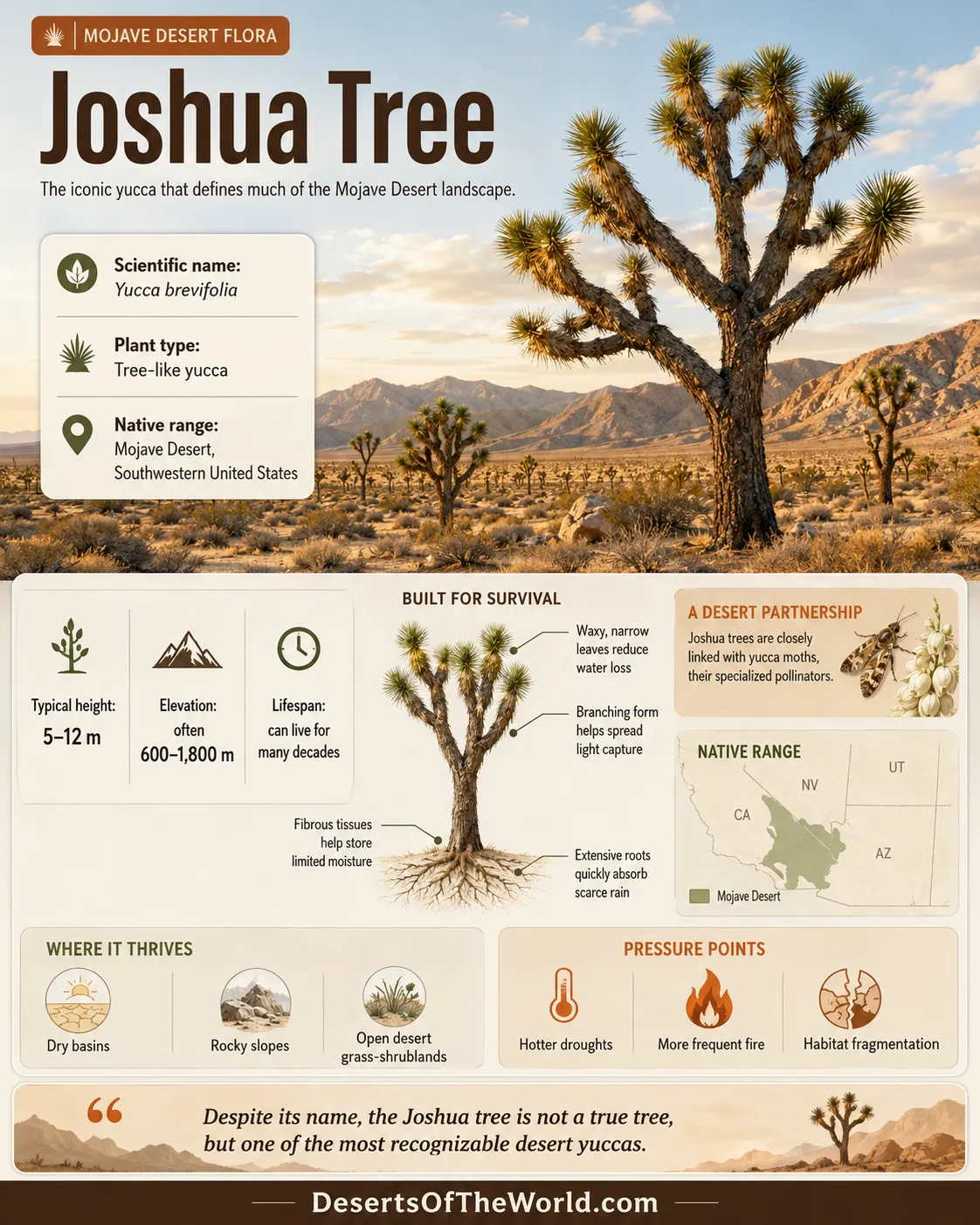
The Joshua tree, Yucca brevifolia, is one of the clearest living markers of the Mojave Desert. It is not a tree in the usual forest sense, yet it shapes the high desert skyline like one: a shaggy trunk, forked arms, dense crowns of sword-like leaves, and pale spring flowers that depend on a very specific desert partnership. Where Joshua trees appear naturally, the land is usually cold enough in winter, dry enough through much of the year, and high enough to belong to the Mojave’s cooler desert belt.
This plant is often treated as a symbol, but it is also a working part of the desert. Birds nest in it. Small animals shelter around it. Its flowers feed a pollinating moth, and its fallen trunks slowly become cover for reptiles and insects. A Joshua tree looks still from a distance. Up close, it is busy.
Main Details of the Joshua Tree
| Common Name | Joshua tree, western Joshua tree |
|---|---|
| Scientific Name | Yucca brevifolia |
| Plant Group | A long-lived yucca; a monocot related to the agave branch of flowering plants |
| Best-Known Desert Link | Mojave Desert, especially high desert landscapes in California, Nevada, Arizona, and southwestern Utah |
| Typical Habitat | Open high desert slopes, valleys, alluvial fans, bajadas, and well-drained desert soils |
| Height | Many mature plants reach tree-like size; rare individuals can exceed 40 feet |
| Growth Pattern | Slow growth after early establishment; age is hard to measure because Joshua trees do not form normal annual rings |
| Pollination | Depends on yucca moths of the genus Tegeticula |
| Desert Role | Provides nesting sites, shade pockets, shelter, seed food, and structure in open Mojave habitat |
What the Joshua Tree Is
The Joshua tree belongs to the yucca group, not to pines, oaks, palms, or the broadleaf trees most people picture first. Its scientific name, Yucca brevifolia, means “short-leaved yucca.” That name fits. Compared with the nearby Mojave yucca, Joshua tree leaves are shorter, stiff, pointed, and packed into rounded clusters at the ends of branches.
Botanically, it is a monocot, the same broad flowering-plant category that includes grasses, orchids, lilies, and palms. That explains one odd detail: a Joshua tree can look woody and tree-like, but it does not make growth rings like a pine or oak. Counting rings will not reveal its age. Researchers use size, branching, growth rate, and site conditions instead.
Is It Really a Tree?
Yes and no. It is a tree by shape, not by family. A mature Joshua tree can have a trunk, branches, a crown, and enough height to stand above surrounding shrubs. In that everyday sense, “tree” works. In plant classification, it remains a yucca.
This distinction matters because it explains its desert behavior. Joshua trees do not grow like forest trees, heal like forest trees, or age like forest trees. Their trunks are fibrous. Their leaves are armed. Their growth is slow, uneven, and closely tied to desert weather.
How It Differs From the Mojave Yucca
The Mojave yucca, Yucca schidigera, often grows in the same region and can confuse visitors at first. A simple field clue helps: Mojave yucca leaves are usually longer and often show curly fibers along the edges. Joshua trees tend to develop a taller trunk and a branched, tree-like outline, especially after flowering.
| Feature | Joshua Tree | Mojave Yucca |
|---|---|---|
| Scientific Name | Yucca brevifolia | Yucca schidigera |
| Growth Form | Often trunked and branched, with a tree-like profile | Usually more compact, with a strong rosette form |
| Leaves | Shorter, stiff, clustered at branch tips | Longer, broader, often with fibrous leaf edges |
| Landscape Signal | Strong indicator of Mojave high desert conditions | Common in several southwestern desert settings |
Where Joshua Trees Grow in the Mojave Desert
Joshua trees are tied most closely to the Mojave Desert, a high desert region of the southwestern United States. They are not spread evenly across the desert. Instead, they form patches, open woodlands, scattered stands, and broad belts where elevation, winter cold, summer heat, soil drainage, and rainfall patterns line up.
The best-known stands grow in and around Joshua Tree National Park, Mojave National Preserve, the Antelope Valley, the western Mojave, parts of southern Nevada, northwestern Arizona, and southwestern Utah. The plant is not limited to one park. It is a desert-region species.
High Desert Setting
The Mojave is often cooler than lower desert regions nearby. That matters. Joshua trees need hot summers, dry air, and bright sun, but they also respond to winter cold. In Joshua Tree National Park, they are often found between roughly 2,800 and 5,800 feet. Broader official range figures for Joshua tree species extend beyond that, because conditions vary from one part of the Mojave region to another.
They often grow on:
- open desert valleys with room between shrubs;
- rocky slopes and alluvial fans;
- well-drained sandy, gravelly, or loamy soils;
- transition zones between creosote bush scrub, blackbrush, and higher pinyon-juniper country;
- cooler high desert basins where winter temperatures can drop low enough to shape flowering cycles.
Too low, and the desert may be too hot or too dry for steady recruitment. Too high, and the plant gives way to other vegetation. In between, where the Mojave breathes cold at night and heat by day, Joshua trees find their line.
Why It Is a Mojave Desert Indicator
A natural Joshua tree stand often tells a careful observer three things at once: the land is dry, the elevation is usually moderate to high for a desert, and winter cold plays a role in the local ecology. That is why the plant works almost like a living signpost for the Mojave.
Not every Mojave landscape has Joshua trees. Some areas are too low, too salty, too disturbed, too rocky in the wrong way, or outside the plant’s suitable climate band. This patchy pattern is normal. Deserts are not empty blankets; they are mosaics.
Shape and Adaptations in Dry Country
The Joshua tree has a strange shape because the Mojave asks for strange solutions. Its leaves are narrow, tough, and pointed, reducing water loss while discouraging browsing. Its trunk stores structure rather than soft shade. Its roots search widely for moisture in desert soils where rain may arrive in pulses and disappear fast.
Leaves, Trunk, and Branches
The leaf clusters sit like spiky crowns at the ends of branches. Each leaf is firm and sharp-tipped. These leaves help the plant handle sun, wind, and dry air. They also make a natural barrier around nesting birds and small animals.
The trunk is often covered with old leaf bases, giving it a rough, shaggy look. That texture is part of the plant’s character. It can also create small surfaces and gaps used by desert animals. Not smooth, not soft, not lush. Built for exposure.
Slow Growth and Long Life
Joshua trees grow slowly after their early years. Reported growth can vary by site, age, rainfall, and temperature, but official park sources describe a general pace that may range from about half an inch to a few inches per year after establishment. Some trees are estimated at about 150 years old, and older individuals may live far longer.
Age remains an estimate. Since the plant lacks normal annual rings, a tall Joshua tree is not a simple calendar. Branching, height, trunk form, and site history all offer clues, but none gives a perfect number.
Seedlings and Nurse Plants
Young Joshua trees face the desert at its hardest scale: ground level. Heat reflects from soil, hungry animals browse low vegetation, and moisture can vanish in days. Seedlings often survive better near or beneath nurse plants, such as desert shrubs that create small pockets of shade and protection.
This is one of the quiet details behind Joshua tree woodlands. Mature plants may stand apart in open space, but many begin life tucked close to another plant. Shelter first, skyline later.
Flowers, Yucca Moths, and a Rare Desert Partnership
Joshua tree flowers appear in dense clusters, usually near branch tips. They are creamy white to greenish white, waxy, and shaped for a pollination system that is far more specialized than wind or casual insect visits.
The plant depends on yucca moths. These moths do not merely bump into flowers by accident. They gather pollen, move it to another flower, and lay eggs in the flower structure. Their larvae later feed on some of the developing seeds, while enough seeds remain for the plant to reproduce. Both sides gain something.
When Joshua Trees Bloom
Blooming often takes place from late winter into spring, with many observations falling between February and April. It does not happen equally every year. Rainfall timing, winter cold, plant age, and local conditions all affect flowering.
A Joshua tree usually branches after it flowers. That is why some plants stand as single columns for years, while others grow into forked forms with many arms. Their architecture is partly a bloom record written in wood-like fiber.
The Yucca Moth Connection
The Joshua tree and its moth belong to one of the desert’s most exact relationships. The moth needs Joshua tree flowers for its life cycle. The tree needs the moth for fertile seed production. In the western and eastern Joshua tree groups, different yucca moth species are tied to different plant forms.
This is not a loose partnership. It is a narrow fit. If the timing of flowers and moth activity falls out of step, seed production can suffer. That is one reason researchers pay close attention to flowering dates, moth emergence, and seed set across the Mojave.
Western and Eastern Joshua Trees
Many older references treat Joshua trees as one species with varieties. Current research often separates them into two closely related species: the western Joshua tree, Yucca brevifolia, and the eastern Joshua tree, Yucca jaegeriana. Both are Mojave icons, and both share the familiar spiky, branching look. They are not identical.
| Trait | Western Joshua Tree | Eastern Joshua Tree |
|---|---|---|
| Scientific Name | Yucca brevifolia | Yucca jaegeriana |
| General Range | More associated with western Mojave areas, especially California and Nevada | More associated with eastern Mojave areas, including parts of Nevada, Arizona, Utah, and California |
| Growth Form | Often taller and more tree-like | Often shorter, with more compact or multi-stemmed forms in some areas |
| Pollination | Linked with a western yucca moth relationship | Linked with an eastern yucca moth relationship |
| Why It Matters | Helps explain range maps, conservation planning, and field identification | Shows that “Joshua tree” can refer to more than one closely related desert plant |
For a general reader, both are Joshua trees. For botanists and land managers, the difference matters because each form may respond differently to habitat, rainfall, elevation, pollinators, and local conditions.
Wildlife That Uses Joshua Trees
A Joshua tree is habitat in vertical form. In an open desert, height changes everything. A branch can become a nest site. A leaf cluster can become cover. A fallen trunk can become a sheltering log in a place where logs are rare.
| Desert Animal or Group | How the Joshua Tree Helps |
|---|---|
| Scott’s Oriole | Often nests among the spiny leaf clusters, where the plant offers protection and structure |
| Northern Flicker | May use tree cavities or older trunks in suitable areas |
| Wood Rats | Use fallen leaves and the base of the plant as part of protective shelter sites |
| Desert Night Lizards | Can use fallen Joshua tree material as cover while feeding on small insects |
| Yucca Moths | Use the flowers for pollination and reproduction, linking insect life directly to the tree’s seed cycle |
| Insects and Other Small Invertebrates | Use flowers, dead wood, leaf litter, and sheltered cracks as microhabitat |
The plant also changes the feel of the land for smaller organisms. Its shade may be narrow, but narrow shade still matters in desert heat. Around roots and fallen leaves, moisture and organic material can gather in small amounts. Tiny changes, large effects.
Plants That Share Joshua Tree Habitat
Joshua trees rarely stand alone as the only plant life. They grow among desert shrubs, grasses, annual wildflowers in wet years, cacti, yuccas, and higher-elevation woodland edges. The exact neighbors depend on elevation, soil, and rainfall.
Common Plant Neighbors
- Creosote bush often appears in warmer, lower desert scrub near Joshua tree range edges.
- Blackbrush can form broad dark-green shrublands in cooler Mojave zones.
- Mojave yucca may share slopes and fans with Joshua trees.
- Cholla and prickly pear cacti add spiny structure in many desert plant communities.
- Pinyon pine and juniper can appear above or near upper Joshua tree zones.
- Desert annuals may bloom after favorable winter rain, briefly changing the ground layer.
This mix helps explain why Joshua tree landscapes can look sparse and full at the same time. The spacing is wide, but the relationships are close.
Weather, Soil, and Elevation Needs
The Joshua tree’s habitat is shaped by a simple desert tension: it needs dryness, but not just any dryness. It does best where the land receives enough moisture in the right seasons for seedlings, flowering, and seed production, while still remaining open, sunny, and well drained.
Rainfall Timing
Winter precipitation can help prepare the plant for spring growth and flowering. Summer thunderstorms may support parts of the desert community, but Joshua trees are not lush-season plants that respond like garden shrubs. Their life cycle moves slowly, and one wet spell does not rewrite years of dry conditions.
Good bloom years often reflect a combination of rain, plant condition, and cold-season cues. Poor bloom years may pass quietly. The plant waits.
Winter Cold and Flowering
Cold winters help shape Joshua tree flowering. Freezing temperatures may damage growing tips in a way that helps trigger branching and bloom formation. This is one reason the plant is linked to high desert belts rather than only the hottest low desert floors.
Soil Drainage and Rooting Ground
Joshua trees favor dry, open soils that drain well. Sandy, gravelly, rocky, or loamy desert soils can all support them when the broader habitat is right. Heavy, waterlogged soil is not their style. In the Mojave, water matters most when it moves through the ground without lingering too long around roots.
Name, Traditional Uses, and Desert Identity
Long before the name “Joshua tree” became widely used in English, Indigenous communities knew the plant as part of the high desert. Some groups used tough leaves for woven items and used flower buds or seeds as food. These uses belong to local knowledge systems tied to place, season, and careful handling.
The common English name is often linked to 19th-century Mormon travelers who saw the raised branches as resembling the biblical Joshua. The story is widely repeated, though historical details are not always easy to pin down. Either way, the name stuck, and the plant became one of the most recognizable silhouettes of the American desert Southwest.
Joshua Tree National Park and the Plant’s Public Image
Joshua Tree National Park made the plant famous far beyond botany. The park sits where the higher Mojave Desert meets lower Colorado Desert influences, which makes the vegetation shift visible across the landscape. In the park’s Mojave sections, Joshua tree stands can appear across valleys, slopes, and boulder country.
The park is not the plant’s only home, but it is the place many people first learn to recognize it. That public visibility has shaped how the Joshua tree is understood: not merely as a plant, but as a marker of desert space, night skies, granite boulders, cold winter mornings, and wide high-desert basins.
Seeing Joshua Trees Without Harming Them
Joshua trees are tough plants in a tough climate, but their bark, roots, flowers, and seedlings can be damaged by careless contact. The best way to appreciate them is simple: stay on durable surfaces and marked routes, do not climb them, and do not break leaves, flowers, or branches.
They grow slowly. A damaged branch may represent many years of growth. A seedling hidden under a shrub may be easy to miss. In desert country, small traces last.
Natural Pressures on Joshua Tree Landscapes
Joshua trees live with heat, drought, browsing, insects, wind, and long gaps between ideal seedling years. These pressures are normal parts of desert ecology. Some years favor flowering. Some years favor survival rather than growth. Some seedlings fail. A few find the right pocket of shade, soil, moisture, and protection.
Why New Seedlings Matter
A stand of mature Joshua trees can look healthy even when few young plants are establishing beneath it. That is why researchers study recruitment, not just adult trees. The future of a woodland depends on young plants reaching maturity, flowering, and entering the pollination cycle.
Seedling success can be limited by dry spells, browsing, poor seed years, unsuitable ground conditions, and the loss of nurse plant cover. The adult trees are the visible story. The seedlings tell the next chapter.
Fire, Grasses, and Desert Recovery
Many Mojave plant communities did not evolve with frequent large fires. When fine grasses fill open spaces, they can carry fire across areas that once had more bare ground between shrubs. Joshua trees do not recover from fire like some sprouting shrubs or grasses. A burned mature plant may not return from the base.
Recovery in Joshua tree habitat is slow because the plant itself is slow. A young stand cannot replace an old one in a few seasons.
Current Conservation Notes
Yucca brevifolia remains listed as Least Concern in the IUCN category shown by Kew’s Plants of the World Online. At the federal level, western and eastern Joshua trees are still shown by the U.S. Fish and Wildlife Service as not listed under the Endangered Species Act, but the 2023 finding that ESA listing was not warranted is no longer the current endpoint. A federal court set that finding aside in July 2025 and remanded the matter to the Service for reconsideration.
In February 2026, the Service published a peer-review plan for a new Joshua Tree Species Status Assessment and marked the assessment as in progress. The new SSA is intended to inform the Service’s next determination on whether Joshua trees warrant listing as threatened or endangered under the ESA. California continues to manage western Joshua tree conservation through its own state planning and permitting rules, so the federal review and California protections remain separate.
At the state level, the California Fish and Game Commission reviewed the status of the western Joshua tree on August 13, 2026 as required by the Western Joshua Tree Conservation Act. The Commission determined that no changes to the Western Joshua Tree Conservation Plan were necessary to ensure conservation of the species. The next Commission review must occur at a public meeting before August 31, 2028. CDFW also published its Western Joshua Tree Conservation Fund webpage on September 10, 2026, showing how mitigation fees are allocated to land acquisition and conservation easements, restoration, monitoring, long-term land management, and related conservation costs.
Field Identification Notes
A mature Joshua tree is usually easy to recognize once the eye learns its shape. The trunk looks fibrous and rough. Branches fork upward or outward. Leaf clusters sit at the tips like tight green stars. Old leaves may hang along the trunk, and flower clusters may appear at branch ends in season.
Features To Look For
- A tall, trunked yucca form rather than a low rosette.
- Short, sharp leaves grouped at branch tips.
- Forked branches on plants that have flowered.
- Dense white-green flower clusters in late winter or spring.
- Open Mojave high desert surroundings rather than lush riparian ground.
Common Sources of Confusion
Young Joshua trees can look more like ordinary yucca rosettes before they develop height and branching. Eastern Joshua trees may also appear shorter or more compact than the classic western form. In mixed yucca country, leaf length, trunk shape, branching, and habitat all help with identification.
A single trait may mislead. The whole plant tells the truth better.
Why the Joshua Tree Matters to Desert Knowledge
The Joshua tree is useful because it connects many desert topics in one plant: high desert climate, plant adaptation, pollination, wildlife shelter, slow growth, seedling survival, and land management. It shows that deserts are not empty spaces waiting to be filled. They are living systems with timing, limits, and relationships that can be easy to miss from a car window.
It also gives the Mojave a shape people remember. Creosote flats, basalt slopes, granite boulder fields, blackbrush benches, and Joshua tree woodlands each tell a different desert story. The Joshua tree’s story is the one with raised arms, moth-timed flowers, hidden seedlings, and a long wait between rain and maturity.
Sources
- National Park Service — Joshua Trees (plant identity, growth, flowering, range notes, wildlife use, and Joshua Tree National Park details)
- National Park Service — Mojave National Preserve Plants (Mojave habitat notes, elevation range, lifespan, nurse plant information, and desert plant community context)
- U.S. Geological Survey — Eastern Joshua Trees and Their Sole Pollinators (yucca moth pollination, eastern Joshua tree research, and Mojave range information)
- U.S. Fish & Wildlife Service — Joshua Tree Species Profile (scientific name, taxonomy, and federal species profile information)
- U.S. Fish & Wildlife Service — 2023 Joshua Tree Federal Review (historical 2023 finding, range acreage, elevation range, and species distinction)
- U.S. Fish & Wildlife Service — 2026 Joshua Tree Species Status Assessment Peer Review Plan (current in-progress SSA and its role in the next ESA listing determination)
- California Department of Fish and Wildlife — Western Joshua Tree Conservation Plan (August 13, 2026 Commission review, no Conservation Plan changes required, and next review before August 31, 2028)
- California Department of Fish and Wildlife — Western Joshua Tree Conservation Fund (fund categories for acquisition, conservation easements, restoration, monitoring, land management, and related conservation costs)
- U.S. District Court — 2025 Joshua Tree ESA Judgment (2023 finding set aside and remanded to the U.S. Fish and Wildlife Service)
- Kew Science — Plants of the World Online: Yucca brevifolia (accepted scientific name, common names, and IUCN category listing)