
Desert paintbrush brings intense red and orange color to some of the driest landscapes of western North America. It appears on sagebrush slopes, rocky desert margins, open shrublands and pinyon-juniper country, where its colored upper stems can stand out sharply against pale soil and gray-green vegetation.
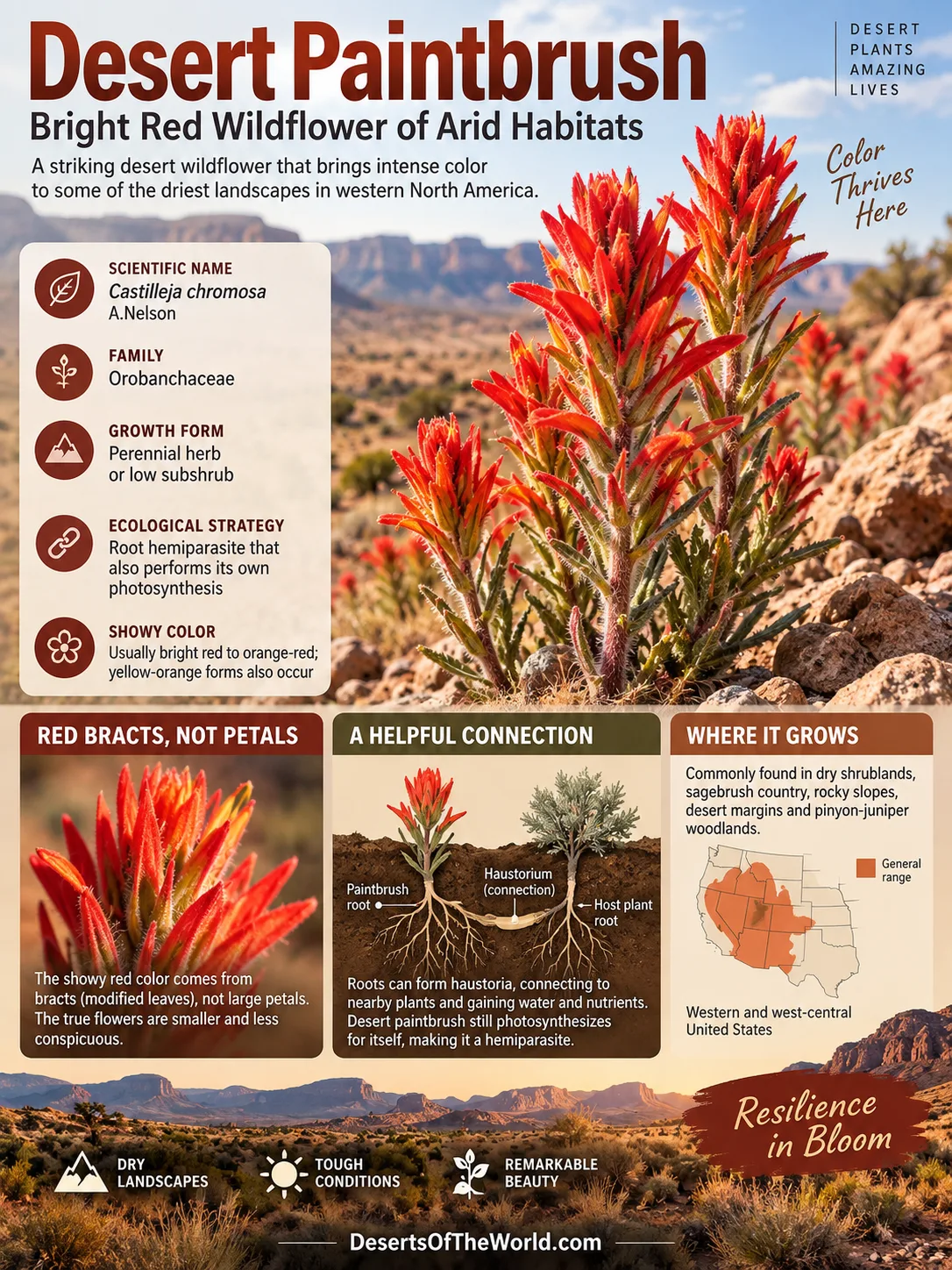
The plant is more unusual than its appearance suggests. In Castilleja chromosa, much of the bright red display comes from bracts rather than petals. Below ground, the plant can connect its roots to neighboring plants through structures called haustoria. It still photosynthesizes for itself, but this root connection allows it to obtain resources from a host. Botanists therefore describe desert paintbrush as a root hemiparasite.
The common name needs a small botanical distinction. “Desert paintbrush” is sometimes applied to more than one western Castilleja. The species covered here is Castilleja chromosa, the accepted name used by current Kew taxonomy.
| Species Detail | Desert Paintbrush |
|---|---|
| Scientific name | Castilleja chromosa A.Nelson |
| Family | Orobanchaceae |
| Growth form | Perennial herb or low subshrub |
| Ecological strategy | Root hemiparasite that also performs its own photosynthesis |
| Showy color | Usually bright red to orange-red; yellow-orange forms also occur |
| Typical setting | Dry shrubland, sagebrush country, rocky slopes, desert margins and pinyon-juniper woodland |
| Native range | Western and west-central United States |
| Life cycle | Perennial rather than a short-lived desert annual |
Why Desert Paintbrush Looks Bright Red
The most visible part of desert paintbrush is not a conventional cluster of large red petals. Its small true flowers sit among brightly colored bracts, which are modified leaves associated with the flower cluster.
These bracts can be vivid red, orange-red or yellow-orange. Their color extends across the upper part of the plant and creates the dense “paintbrush” appearance behind the common name. The calyx around the flower can also carry similar coloration, adding even more color to the inflorescence.
The True Flowers Are Much Less Obvious
Inside the colored display are narrower tubular flowers. They are far less conspicuous than the surrounding bracts and include green to yellow-green portions that can be partly hidden when the plant is viewed from a distance.
This distinction matters when identifying the species. A red paintbrush-like cluster does not mean the plant has large red petals. The visible structure is a combination of bracts, calyx tissue and smaller tubular flowers.
USDA descriptions also note that both the bracts and calyx are hairy. The colored bracts commonly have three to five rounded lobes, while the actual corolla extends beyond the calyx and has a narrow upper portion.
A Wildflower Connected to Other Plants Below Ground
Desert paintbrush has green tissues containing chlorophyll, so it can manufacture carbohydrates through photosynthesis. It is not completely dependent on another plant for its carbon supply.
Its roots, however, can form specialized connections with the roots of nearby vegetation. This makes Castilleja chromosa a hemiparasite rather than a fully independent wildflower.
How Haustoria Connect Desert Paintbrush to a Host
The connecting structures are called haustoria. A haustorium forms where the paintbrush root establishes contact with a suitable host root. Through that connection, hemiparasitic Castilleja can gain access to water and dissolved resources moving through the host.
The relationship is easy to miss because the visible paintbrush may look like an ordinary standalone perennial. Much of the interaction occurs underground.
| Above Ground | Below Ground |
|---|---|
| Green leaves carry out photosynthesis | Roots can encounter neighboring plant roots |
| Red-orange bracts surround the flowers | Haustoria can form at host-root contact points |
| The plant grows as a perennial | The host connection can provide access to water and other resources |
Sagebrush Is More Than Nearby Vegetation
Sagebrush communities are among the characteristic settings for desert paintbrush, and sagebrush can also serve as a host for paintbrush roots. This creates a more direct relationship than two plants simply occupying the same dry slope.
Other plants can serve as hosts as well. Hemiparasitic paintbrushes are not tied to a single host species, and the surrounding plant community can affect which roots are available for connection.
This underground strategy separates desert paintbrush from familiar succulent desert plants. It does not depend on a thick water-storing stem like a cactus. Instead, its ecology combines its own photosynthesis with the ability to tap into another root system.
Where Desert Paintbrush Grows
Current Plants of the World Online records Castilleja chromosa as native to Arizona, California, Colorado, Idaho, Montana, Nevada, New Mexico, Oregon, Utah and Wyoming. Its range therefore crosses several very different dryland regions rather than belonging to a single desert.
Populations occur within and around landscapes associated with the Mojave Desert, Great Basin, Colorado Plateau and the dry interior West. The species continues into upland shrub-steppe and open woodland, which explains why it may be encountered well beyond low desert basins.
| Landscape Type | Typical Desert Paintbrush Setting |
|---|---|
| Mojave Desert | Open dry terrain, rocky slopes and higher desert areas |
| Great Basin | Sagebrush-steppe and other dry interior shrub communities |
| Colorado Plateau | Sandy or rocky terrain, canyon country, sagebrush and open woodland |
| Pinyon-juniper zone | Open, well-drained ground between woodland vegetation |
| Dry shrubland | Sagebrush, shadscale and related arid or semi-arid plant communities |
A Desert Plant That Does Not Require Sand Dunes
The word “desert” can create the wrong habitat picture. Desert paintbrush is not a sand-dune specialist.
It can grow in sandy ground, but it also occurs on rocky slopes, foothills, sagebrush flats, desert scrub and open woodland. California records place the species in vegetation communities that include sagebrush scrub, shadscale scrub, pinyon-juniper woodland and Joshua tree woodland.
National Park Service records add another useful example. At Joshua Tree National Park, desert paintbrush occurs within the Mojave Desert landscape, while Capitol Reef National Park in Utah records it in sandy soils associated with sagebrush and pinyon-juniper woodland.
Its distribution shows why an arid-land plant should not automatically be pictured on bare sand. Many western deserts contain mosaics of gravel, rock, biological soil crust, shrubland, grassland and open woodland.
How Desert Paintbrush Fits Dry Habitats
Castilleja chromosa does not resemble a cactus or other succulent, yet several parts of its form suit exposed dry country.
- Narrow lower leaves: The basal and lower stem leaves are slender rather than broad.
- Divided upper leaves: Upper leaves can split deeply into several narrow lobes.
- Hairy surfaces: Stems, leaves, calyxes and bracts can carry short, bristly hairs.
- Perennial growth: The plant persists beyond a single brief flowering season rather than relying on the one-season life cycle used by many desert annuals.
- Host-root connections: Hemiparasitism gives the root system another route to resources available within the surrounding plant community.
- Dry, open habitat: Field records repeatedly place the species in exposed shrublands, slopes and well-drained soils.
No single trait explains its survival. Desert paintbrush combines perennial growth, a relatively small-leaved form and an unusual below-ground relationship with neighboring plants.
When Desert Paintbrush Blooms
There is no single flowering calendar that applies across the full range of Castilleja chromosa. Latitude, elevation, local temperature, soil moisture and seasonal precipitation all shift the timing.
At Capitol Reef National Park, desert paintbrush is listed as flowering from April through June. Petrified Forest National Park also records an April-to-June period. In the Mojave Desert at Joshua Tree, National Park Service material gives a broader May through September window for the species.
Those differences are not contradictory. A species spread across deserts, plateaus, foothills and higher interior terrain can flower at different times as spring conditions move across the landscape.
Flowering Is Not the Same as an Annual Desert Superbloom
Desert paintbrush should not be treated exactly like the annual wildflowers that appear in immense numbers after favorable desert rains. It is a perennial.
Rainfall and temperature can still affect growth and flowering, but an established plant can persist between flowering seasons. Annual desert species often depend on seeds waiting in the soil for suitable germination conditions; desert paintbrush follows a different life history.
This is why red paintbrush stems may appear as scattered patches among established shrubs rather than forming the broad, nearly continuous carpets associated with some annual wildflower events.
How to Recognize Castilleja chromosa
Color is the first feature most people notice, but several characters should be considered together. USDA botanical descriptions portray desert paintbrush as an erect perennial with short, bristly hairs and stems that may branch.
The lower leaves are narrow and entire. Higher on the stem, the leaves can be deeply divided into three to seven thin lobes. The showy bracts near the top are usually red, orange-red or yellow-orange and are themselves hairy.
| Feature | What to Look For |
|---|---|
| Growth form | Erect perennial with several visible flowering stems possible |
| Stem surface | Short, bristly hairs |
| Lower leaves | Narrow and usually undivided |
| Upper leaves | Often deeply divided into 3–7 narrow lobes |
| Bracts | Bright red, orange-red or sometimes yellow-orange |
| Flowers | Narrow tubular structures partly concealed by the colored bracts |
| Habitat clue | Dry shrubland, sagebrush terrain, rocky slopes or open pinyon-juniper country |
Not Every Desert Paintbrush Is Scarlet Red
Bright red is characteristic, but it is not the only possible color. Botanical descriptions also include orange and yellow-orange bracts. A plant should therefore not be rejected as C. chromosa simply because its upper bracts are less scarlet than expected.
Likewise, red color alone cannot confirm the species. The genus Castilleja contains many species with brightly colored bracts, and several western paintbrushes occupy overlapping habitats.
Why Similar Paintbrush Species Can Be Confusing
One identification problem begins with the common name itself. “Desert paintbrush” has been used for both Castilleja chromosa and, in some references or regions, Castilleja angustifolia. Northwestern paintbrush or narrowleaf paintbrush are other names associated with C. angustifolia.
The two species can also look similar in the field. Both may occur in dry western landscapes and carry red-orange color near the ends of their stems.
Reliable identification therefore depends on a combination of characters such as leaf division, bract shape, calyx form, corolla proportions, overall growth form and geographic context. Matching only the color of a photograph is not enough.
This matters especially in parts of the Intermountain West where several Castilleja species can occur within the same broad region.
Plant Height and Structure
Size varies with site conditions and with the regional population being described. A USDA Forest Service profile gives mature desert paintbrush stems as roughly 30–75 cm (12–30 in) tall. A Capitol Reef National Park profile describes local plants as approximately 10–56 cm (4–22 in).
The overlap between these records is more useful than treating one number as a universal limit. Desert paintbrush is generally a small to medium perennial wildflower rather than a tall shrub.
Its stems are erect and can appear clustered. Short hairs give the gray-green vegetative parts a slightly rough or muted surface, while the saturated upper bracts create a strong color contrast.
Why a Desert Wildflower Can Grow Above the Desert Floor
The species name does not restrict desert paintbrush to low, hot basins. Western drylands change rapidly with elevation. A slope can remain arid or semi-arid while temperatures become cooler and vegetation shifts from low desert scrub toward sagebrush or pinyon-juniper woodland.
Castilleja chromosa follows this broader dryland pattern. Records occur from desert environments into foothills and upland shrub communities. This helps explain the long flowering season reported across its range: plants in warmer locations can reach flowering condition earlier than populations growing in colder uplands.
For desert geography, moisture regime and plant community can be as informative as elevation alone. A high, dry sagebrush slope may support plants associated with arid landscapes even though it looks very different from a low desert basin.
Desert Paintbrush Inside a Larger Plant Community
A desert paintbrush plant rarely functions as an isolated spot of color on otherwise empty ground. It grows within established vegetation communities where shrubs, grasses, perennial herbs and open woodland plants compete for the same limited soil moisture.
That community matters especially for a hemiparasite. Nearby plants are not merely background vegetation; their roots may become part of the paintbrush’s below-ground environment.
Several communities repeatedly appear in records for C. chromosa:
- sagebrush scrub and sagebrush-steppe;
- shadscale and other dry shrub communities;
- Mojave Desert vegetation;
- Joshua tree woodland;
- pinyon-juniper woodland;
- dry foothills, canyon slopes and rocky open terrain.
The pattern also shows why desert plant life can be dense and interconnected even where annual rainfall is low. Roots may overlap beneath apparently open ground, and a plant such as desert paintbrush can interact directly with that hidden network.
What Happens After the Red Display Fades
Flowering is followed by fruit development. Desert paintbrush produces dry capsules rather than fleshy fruit. USDA descriptions place these capsules at about 10–15 mm long and note that they contain numerous tiny seeds.
As the flowering period ends, the intense color of the upper plant no longer dominates the landscape, but the perennial does not complete its entire life cycle with seed production. Established underground structures remain part of the living plant and can support later seasonal growth.
This separates desert paintbrush from the many arid-land annuals whose adult plants disappear after seed production. Its visible red phase is seasonal; the plant’s ecological presence lasts longer.
Current Botanical Classification
The accepted scientific name is Castilleja chromosa A.Nelson. Plants of the World Online places the species in the family Orobanchaceae, commonly called the broomrape family.
Older field guides may place paintbrushes in Scrophulariaceae, the figwort family. That older classification still appears in historical publications and some regional resources, so the two family names can appear when researching the same plant. Current classification recognizes Castilleja within Orobanchaceae, a family notable for many plants with parasitic or hemiparasitic root relationships.
Kew recognizes C. chromosa as an accepted species and records its native distribution across ten U.S. states. Using the scientific name is particularly helpful here because the common name “desert paintbrush” is not exclusive to a single taxon.
Sources
- Plants of the World Online — Castilleja chromosa (accepted taxonomy, family and native distribution)
- U.S. National Park Service — Joshua Tree National Park, Split Rock Trail (Mojave occurrence, hemiparasitism, haustoria and colored bracts)
- U.S. National Park Service — Capitol Reef National Park Wildflowers (local habitat, plant size, flowering season and host relationship)
- U.S. National Park Service — Petrified Forest Orange to Red Wildflower Guide (flower structure, root parasitism and regional bloom period)
- USDA Forest Service — Forbs of the Great Basin (stem, leaf, bract, corolla, capsule and seed morphology)
- Calflora — Castilleja chromosa (California status and associated vegetation communities)